Prologue
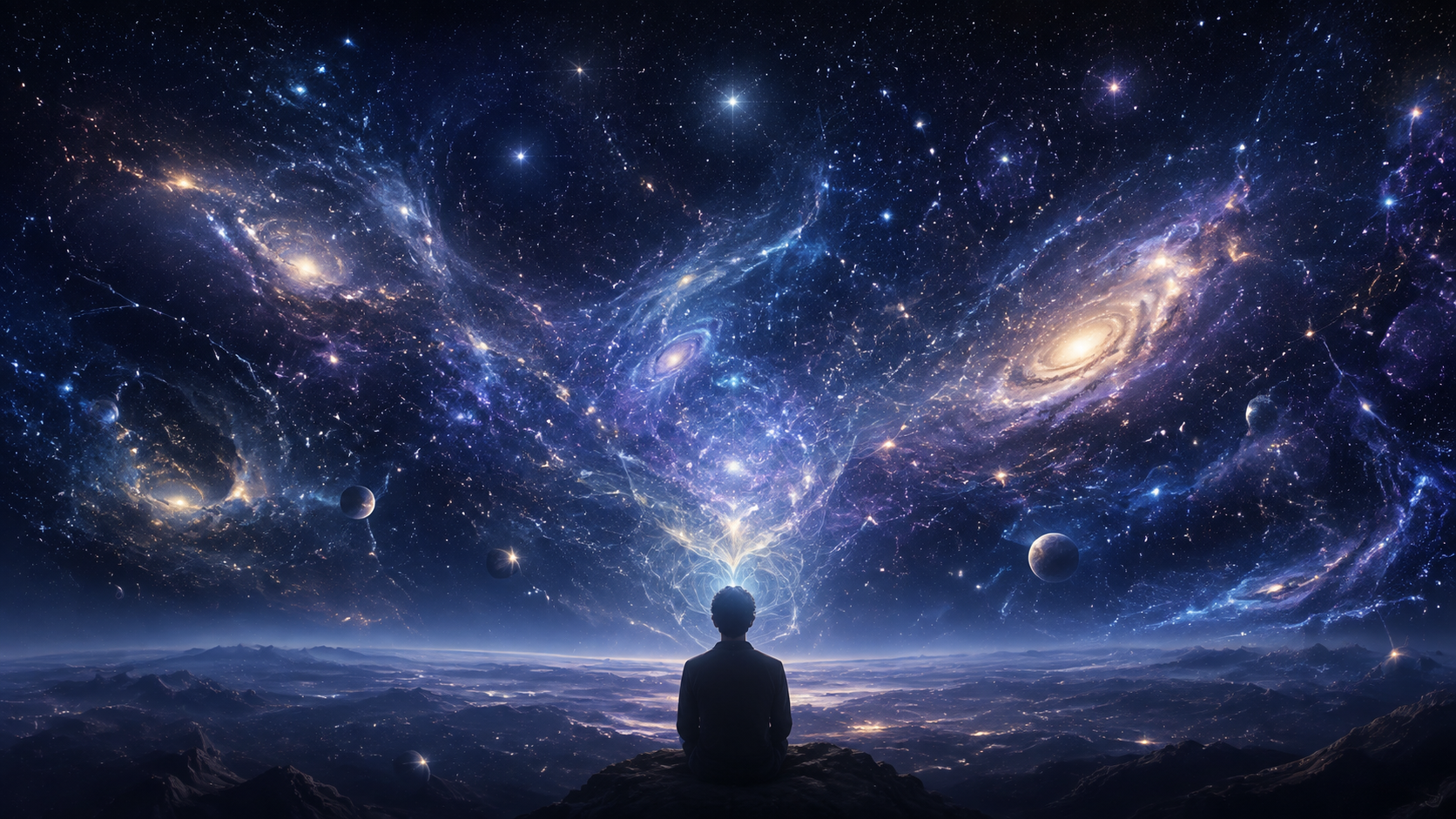
What is the relationship between Consciousness and the Universe?
We ordinarily assume that the answer is obvious.
First there was the universe. Stars and galaxies formed. The Sun and Earth appeared. After an immense span of time, life emerged, and eventually human beings came into existence. Human consciousness arrived much later.
Viewed through the history of the cosmos described by contemporary science, this sequence seems entirely natural.
The Cheonbong Archive does not ask us to reject that history. It does not deny the Big Bang, atoms, stars, galaxies, or black holes. Its question lies one level deeper.
When we look at a house, we see walls, windows, and a roof. We do not usually see the foundation beneath it. Yet the invisible foundation may determine the stability of the entire visible structure.
Humanity has studied atoms and light, observed stars and galaxies, and traced the universe back toward black holes and the Big Bang. In doing so, it has drawn an extraordinarily precise picture of the cosmos.
But one question remains:
On what is that entire picture being drawn?
However carefully we investigate the picture, might we still overlook a fundamental layer of reality if we never ask about the ground on which the picture appears?
This is where the Consciousness Field Theory begins.
It does not erase matter or the universe. It asks us to look again at consciousness as a more fundamental ground through which matter and the universe appear, are observed, become intelligible, and acquire meaning.
Table of Contents
- Prologue
-
- When Did the Universe Say That It Exists?
-
- Would the Universe Remain If the Last Observer Disappeared?
-
- The Apple Never Entered Us—So Why Do We See It?
-
- Do We See Things Themselves, or the World as It Appears in Consciousness?
-
- Which Came First: Consciousness or the Universe?
-
- Why Do Philosophy, Science, and Religion Meet Again in Consciousness?
-
- Why Does Consciousness Hide Itself and Show Us Only the World?
-
- What Must Change First If We Want to Change the World?
-
- Does Consciousness End When the Body Ends?
- Epilogue
1. When Did the Universe Say That It Exists?
We believe that the universe exists.
We see stars in the night sky, observe remote galaxies through telescopes, analyze light, and calculate the history of the cosmos. NASA’s overview of cosmic history traces that history back approximately 13.8 billion years. Contemporary cosmology explains the birth of stars and the formation of galaxies, and it uses observation and mathematics to disclose even black holes that cannot be seen directly.
The Consciousness Field Theory does not deny any of these scientific achievements. It accepts them and then asks one additional question:
What is it that knows all of this as “the universe”?
Let us ask an unusual question. When did the universe say to humanity, “I exist”? Did a star ever announce, “I am a star”? Did a black hole ever tell us, “I am here, so record me as a black hole”?
Nothing of the kind occurred.
Human beings gave names to stars, galaxies, black holes, and the universe. More importantly, we did not merely name them. We analyzed light entering a telescope, compared data, discovered mathematical relations, interpreted the results, and finally declared, “There is a galaxy.”
This does not mean that human thought manufactured the galaxy. It means that the galaxy we know is always the galaxy as it has appeared to us through consciousness. The same is true of the black holes we know, the Big Bang we describe, and the history of the universe we reconstruct.
No present human being existed 13.8 billion years ago. Yet where does the statement “The universe began approximately 13.8 billion years ago” exist now? It exists as something calculated, understood, and affirmed within present consciousness.
Through consciousness, we infer an era in which human consciousness did not exist. Within consciousness, we conceive a universe independent of human consciousness, and we judge that this universe existed whether or not human beings were present.
That judgment may be correct. The point is not to dismiss it. The point is simply this:
We have never stepped completely outside consciousness in order to verify the universe from a position untouched by consciousness.
We always encounter the world through the window of consciousness. Yet the window is so transparent that we forget it is there. We look at atoms, stars, life, humanity, and the universe on the canvas, while scarcely noticing the condition that allows any of them to appear to us at all.
This leads to a more difficult question. If the last human consciousness disappeared, in what sense could what we call “the universe” still be said to exist?
That is where our first thought experiment begins.
For related background, see Part 6, Chapter 4 | Consciousness Field Theory.
2. Would the Universe Remain If the Last Observer Disappeared?
Rather than begin with an argument, let us conduct a thought experiment.
Billions of people live on Earth. Someone in Seoul looks at the sky. Someone in Tokyo watches the Moon. An astronomer observes a distant galaxy. One person sees a flower, another the sea, and another a cell through a microscope.
Our shared world contains billions of points of observation.
Now reduce that number, one stage at a time:
billions, one billion, one hundred million, one million, ten thousand, one hundred, ten, two—and finally one.
Only the last human being remains on Earth. This person looks into the night sky. Stars are visible. The Moon is visible. Through a telescope, distant galaxies are still visible. The final observer says, “The universe still exists.”
So far, nothing is puzzling. There is someone who sees, and there is a world that is seen.
But what happens when the last observer also disappears?
One becomes zero.
No humans remain. There are no human eyes or brains, no one who looks at the stars, and no one who uses the word “universe.” Has the universe vanished?
The ordinary scientific answer is no. The Sun would continue nuclear fusion, planets would continue moving, galaxies would continue evolving, and physical regularities would continue to operate without human observers.
The Consciousness Field Theory does not immediately deny this answer. It asks a more fundamental question:
If the final consciousness capable of confirming the universe had disappeared, for whom or within what field would the statement “the universe still exists” hold?
We readily answer, “It would obviously still be there.” We imagine an Earth without people: abandoned cities, an unseen ocean, stars at which no one looks, and a cosmos expanding long after humanity has vanished.
But who is now witnessing that imagined scene?
Our own consciousness is.
We removed every human observer from the thought experiment, yet one observer remained concealed within it: the consciousness imagining the observerless world.
This is the point. We can imagine a universe without human consciousness, but we cannot imagine that universe without consciousness being involved in the act of imagining it. However thoroughly we try to remove the observer, consciousness remains at the final step.
This does not prove that the physical universe disappears when an individual closes their eyes or dies. Nor does it prove that an external universe cannot exist independently of any particular person. The conclusion must be more careful.
When we say that something “exists,” our judgment of existence is already related to consciousness. If an individual consciousness disappears, the universe as experienced, understood, named, and judged by that individual disappears with it. Whether the external universe itself continues independently is a further ontological question; this thought experiment alone does not settle it.
The Seer and the Seen
Every experience appears to contain two poles: the seer and the seen.
There is a person who sees an apple and an apple that is seen. There is someone who sees a rose and a rose that is seen. There is someone who sees a star and a star that is seen.
Yet something is strange. The object is visible, but the consciousness that sees it is not. The apple can be touched and weighed. Consciousness cannot be grasped by the hand or placed on a scale.
How, then, does visible matter meet invisible consciousness? How does something believed to be outside us become a reality experienced within us?
The crucial intermediary is light.
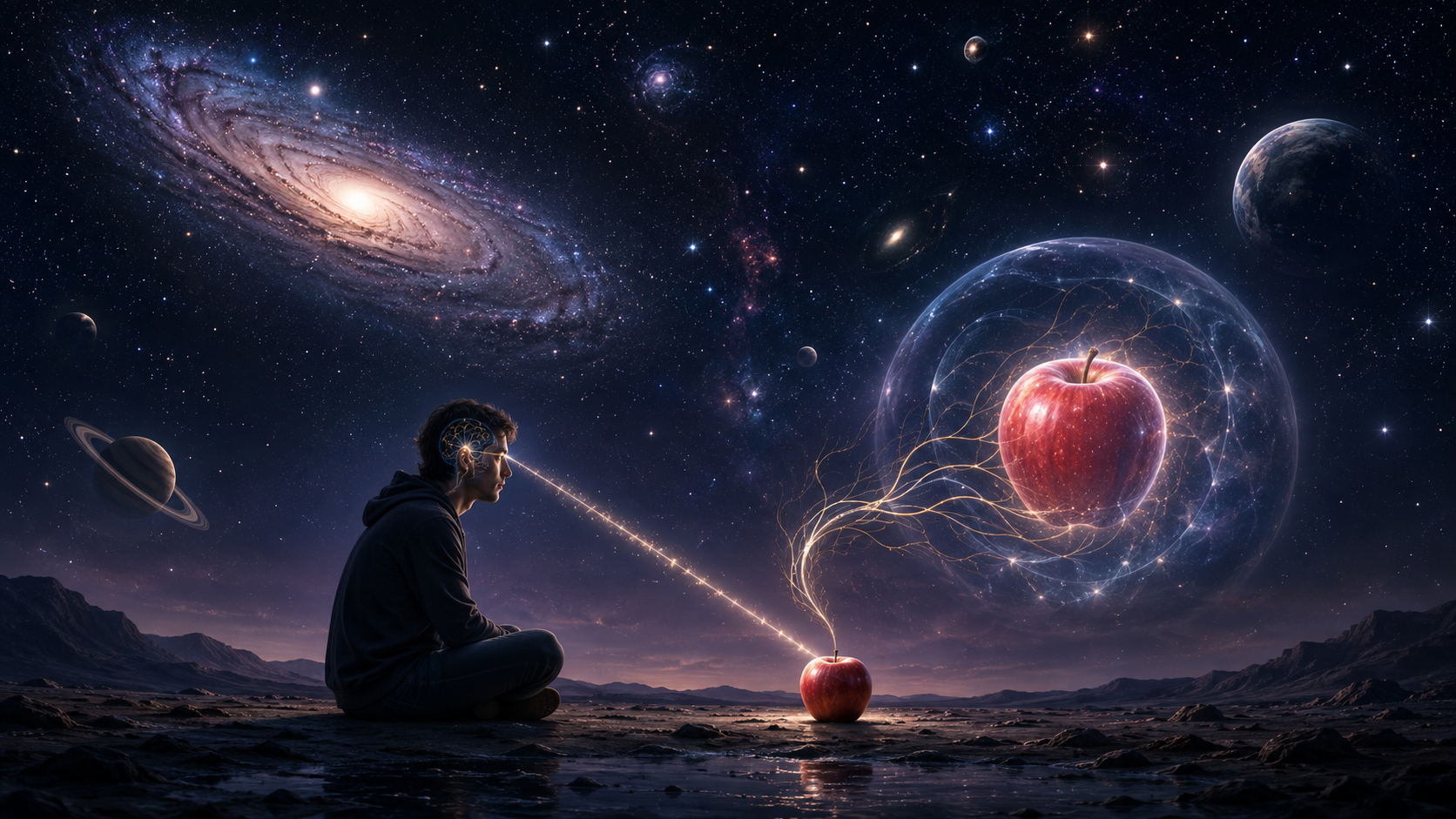
When we look at an apple, the apple itself does not enter consciousness. The apple remains where it is. Light reflected from it enters the eye, and through that process the apple appears in experience.
This simple fact changes the entire question of the relation between an external material world and an internally experienced world.
3. The Apple Never Entered Us—So Why Do We See It?
Let us temporarily descend from the universe and place a single apple before us.
It is red. We say without hesitation, “There is an apple over there.” The experience is so ordinary that it seems to require no explanation. But if we follow the process from the beginning, something remarkable appears.
There is the apple that is seen, and there is the one who sees it. We might say that the eye is the seer, but the eye is a sensory organ that receives light. We might say that the brain is the seer, but after neural processing there remains the subject for whom “I am seeing a red apple” is an experience.
The Consciousness Field Theory calls that subject consciousness.
Now trace the physical sequence carefully.
The apple itself does not enter the eye. Light falls upon the apple and is reflected toward the observer. That reflected light reaches the retina, where photoreceptors convert light into electrical signals, as explained by the U.S. National Eye Institute. Those signals travel from the retina through the optic nerve and undergo complex processing in the brain.
At that point, what is being transmitted is not the apple itself. It is not the apple’s weight, flesh, sweetness, or solidity. It is a pattern of signals produced in response to light.
Yet what appears at the end of the process?
We do not ordinarily experience wavelengths or electrical activity. A completed apple appears: red, round, glossy, and seemingly located at a distance in front of us.
The apple never entered us, but an apple appears.
Light entered and was transformed into neural signals. Nevertheless, conscious experience contains a coherent object with color, shape, distance, texture, and meaning.
At least one point is clear: the apple as experienced is not the external apple transported intact into consciousness. It is an experience of the apple that appears in consciousness.
To say this is not to say that nothing exists or that the apple is a meaningless illusion. The experience is vivid and consequential. We can grasp the apple, feel its solidity, bite it, hear its crunch, and taste sweetness and acidity. The question is not whether the experience is real. The question is where and how that experience is constituted.
Why Does an Inner Experience Feel External?
An even more surprising question follows.
If the experienced apple appears in consciousness, why do we not feel that it is “inside” us? Why does it appear to be “over there,” outside the body, occupying an objective world shared with others?
Conscious experience does not merely present color and shape. It presents distance, direction, space, and the compelling sense that the object is separate from the observer. The world is experienced not as a private image floating inside the head but as an external reality in which the body itself is located.
This suggests a hypothesis: consciousness may not be a passive screen on which data are displayed. It may participate in constituting the experiential structure in which subject and object, here and there, inner and outer, are differentiated.
The External World in a Dream
Dreams provide a familiar comparison.
In a dream, I am here and a mountain is over there. I am inside a room while another person stands beyond the door. The sky is overhead, and the stars seem unimaginably distant. Subject and object appear clearly divided.
When I awaken, however, I recognize that the dream-self, the mountain, the room, the other person, and the distant stars all appeared within a single dream experience. What was “outside me” in the dream was not therefore outside the consciousness in which the dream arose.
This does not prove that waking reality is merely a dream. The two must not be carelessly equated. The dream comparison demonstrates a narrower but important possibility: consciousness can present a structured world in which objects are experienced as external to the subject even though the entire experienced scene arises within consciousness.
The waking question therefore remains open. An apple may be outside the body, but how can we establish—without again relying on conscious experience—that it is also outside consciousness in an absolute sense?
Here the apple returns us to the universe. If the apple itself did not enter us, how do we see the apple? If the universe itself does not enter us, how do we see and understand the universe? Might even “outside” be part of the structure in which a world is realized in consciousness?
4. Do We See Things Themselves, or the World as It Appears in Consciousness?
In the previous section, we followed the path from apple to reflected light, from light to retina, and from retinal transduction to neural signals. The external apple itself did not enter consciousness. Yet a complete apple appeared in experience.
The question must therefore be reformulated. Do we see the apple as it is in itself, or do we see the apple as it appears under the conditions of human perception and consciousness?
This is not a question invented by modern neuroscience. Immanuel Kant’s transcendental idealism distinguishes between the world as it appears to human beings—the world of phenomena—and the thing in itself, considered independently of the conditions under which we experience it.
We encounter things, but we do so through sensation, cognition, spatial and temporal organization, and the other conditions of human experience. We cannot simply leave those conditions behind and compare our experience with the thing in itself from a standpoint entirely outside experience.
This distinction matters whenever we see an apple, observe a star, or investigate the universe. The world we know has always passed through conditions of sensing, measuring, interpreting, and understanding. We therefore cannot casually assume that the experienced world and reality completely independent of all experience are identical in every respect.
The Consciousness Field Theory takes one further step. If everything we directly experience appears within consciousness, can the very space we call “external” be treated as wholly unrelated to consciousness?
We normally say: I am here. The apple is there. The house is farther away. The Moon is much farther away, and a star lies light-years beyond it. I am inside the universe, and the universe surrounds me.
But the location of the apple, its distance, and the space in which it appears are also experienced. The same applies to the Moon and the star.
The theory therefore proposes a possibility: consciousness may not be merely one observer located inside an already completed world. It may be a more fundamental ground of the experiential structure in which “self” and “world” appear as separate.
The dream analogy again clarifies the possibility without proving the theory. In a dream, the dream-self, other people, roads, mountains, sky, and all the distances among them appear within one experiential field. Waking from the dream reveals that the apparent separation within the scene was not necessarily a separation from the consciousness in which the scene appeared.
The point is not that waking reality is a dream. The point is that one field of consciousness can present an ordered world in which subject and object seem fully separate.
The Canvas of Consciousness
Imagine a painted canvas. On it stands a person. Before that person lies an apple; behind them are a house and mountains; above them shine the stars. Within the picture, all these things appear separated by distance. From the standpoint of the canvas, however, person, apple, mountain, and star all appear on one ground.
Consciousness, the theory suggests, may be such a ground—not a physical sheet somewhere inside the universe, but the condition in which the experienced distinction between observer and world becomes possible.
This does not deny matter. The apple remains. Atoms remain. Stars, the Big Bang, and scientific laws remain. The proposal simply adds another question: What is the more fundamental ground on which all these can appear, become known, be experienced, and acquire meaning?
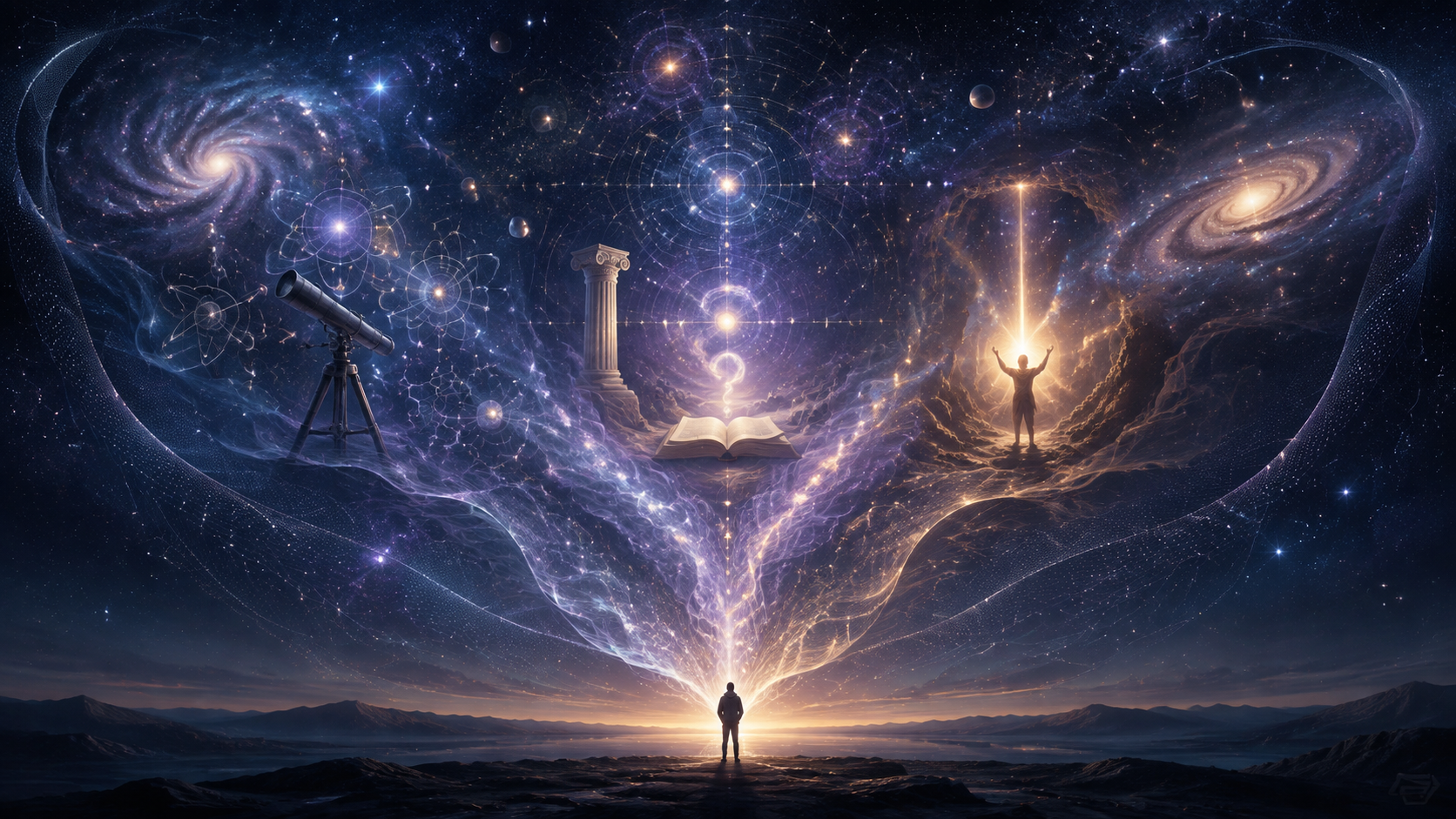
Science investigates the structures and laws of the world. Philosophy asks how that world is experienced and known. Religion asks about the source and meaning of creation. The Consciousness Field Theory explores whether these different inquiries may share a deeper ground in consciousness.
This brings us to the unavoidable question: Which came first, consciousness or the universe?
5. Which Came First: Consciousness or the Universe?
The question of Consciousness and the Universe now becomes unavoidable.
We have reached the central question of this chapter.
Which came first: consciousness or the universe?
On the ordinary scientific timeline, the answer seems simple. The universe came first. It has a history of roughly 13.8 billion years, while humanity appeared much later. If consciousness arose from the activity of the brain, then the sequence is:
universe → life → human beings → consciousness
But the word “first” can mean two different things.
Something may be earlier in time. Or it may be more fundamental as the condition that makes something else possible. Temporal priority and foundational priority are not necessarily the same.
Human beings undoubtedly appeared late in the cosmic timeline. Yet what now understands the concepts “13.8 billion years,” “earlier,” “later,” and “the beginning of the universe”? Once again, consciousness does.
This does not mean that human consciousness created the universe. The scientific claim that the universe existed before humanity and the philosophical question of how that universe becomes known and experienced are distinct questions.
Human beings did not create stars. Yet the distance, temperature, birth, and death of stars became human knowledge through observation, interpretation, and consciousness. Black holes did not name themselves. We observed evidence, formed concepts, assigned names, and studied their properties.
Thus it is not easy to separate “the universe as we know it” completely from consciousness.
Temporal Priority and Foundational Priority
Consider an apple tree. The beginning of a great tree does not look like a tree. It is a small seed. The seed has no visible trunk, branch, or leaf, yet under the appropriate conditions roots emerge, a stem grows, and an entire tree appears.
Human life also begins in a form unlike the completed body. Through cell division and development, a human organism takes shape.
The relevant principle is not a particular biological answer. It is that the appearance of a result need not resemble the condition from which the result becomes possible.
Now return to the universe. Stars, galaxies, planets, rocks, water, and our bodies all belong to the material world. We therefore assume that their deepest origin must also be material.
Humanity has traced matter toward molecules, atoms, particles, fields, and the earliest physical states of the cosmos. This work is indispensable, and the Consciousness Field Theory does not reject it.
It asks one additional question: Why must the deepest ground of matter itself possess exactly the properties we currently call material?
Just as a seed does not resemble a mature tree, could the most fundamental condition of the material world possess properties unlike the visible matter that emerges within it?
Here the theory proposes the possibility of nonmaterial consciousness. It does not eliminate matter. It accepts material reality while asking what deeper ground makes such a reality possible.
The foundation of a house is often unseen, yet it supports the visible walls, windows, and roof. In the same way, humanity has investigated the vast visible structure of atoms, life, stars, galaxies, and the Big Bang. We may now ask what that structure stands upon.
The hypothesis is that its deepest ground may be consciousness.
Therefore, to say “consciousness is prior to the universe” does not mean that individual human minds existed 13.8 billion years ago. It is not a claim about the cosmic timetable. It asks what more fundamental condition allows time, space, matter, and universe to arise, be experienced, and become intelligible at all.
If that condition is a primordial field of consciousness, then consciousness may not be the latest accidental by-product inside the universe. It may be the deeper ground in which the universe becomes possible.
This raises another question. If a nonmaterial ground underlies the material universe, how can the visible arise from the invisible?
Human traditions have asked versions of this question for centuries. Buddhism has reflected on emptiness and form. Biblical thought relates creation to the Word. Philosophy has investigated subject and object, appearance and reality. These are not identical doctrines, but they may approach a common problem in different languages.
How far, then, can philosophy, science, and religion meet on the canvas of consciousness?
6. Why Do Philosophy, Science, and Religion Meet Again in Consciousness?
The relationship between Consciousness and the Universe is therefore not only a scientific question but also a philosophical and religious one.
Throughout this chapter, we have pursued two related questions: What is the universe made of, and what is it that knows the universe?
Science has long investigated the first question. It has divided matter, discovered atoms and particles, described gravity and electromagnetism, explored spacetime and quantum phenomena, and traced the development of stars, galaxies, and the cosmos itself.
These achievements are extraordinary. The Consciousness Field Theory does not deny them. It adds one question: Where should we place the consciousness that discovers, interprets, and understands all of this?
Here science encounters philosophy.
Is the world we see the world exactly as it is in itself, or is it the world as it appears under human conditions of experience? Kant distinguished phenomena from things in themselves. We experience objects, but we cannot step entirely outside our cognitive conditions and view those objects from nowhere.
The apple makes this problem concrete. Reflected light enters the eye, the retina transduces it, and the nervous system processes signals. Science can explain much of this pathway. Yet a question remains: Why does a physical process appear to a subject as an experience? Why do transmitted signals become the felt qualities “red,” “round,” and “beautiful”?
At this point, a science of matter confronts the problem of consciousness.
Philosophy arrives at the same threshold by another route. When it asks what it means for something to exist, it eventually meets the subject who experiences and knows existence.
Religion begins elsewhere. It asks why the world exists, where humanity came from, what creation means, and how life and death should be understood. Many religious traditions have not explained the source of the visible world solely in terms of visible matter.
Biblical thought connects creation with the Word—a concept bearing information and meaning as well as expression. The Consciousness Field Theory does not identify the Word with a particular scientific mechanism. It notices a shared direction: the source of the visible is not exhausted by visible matter alone.
Buddhist thought explores the relation of emptiness and form. Emptiness cannot simply be reduced to “nothing,” while form refers to the world of experienced phenomena. The theory does not claim that its concept of consciousness is identical to Buddhist emptiness. It observes a possible point of contact in the refusal to treat visible phenomena as the final and self-explanatory layer of reality.
Thus the three paths remain different, yet each arrives at a related boundary.
- Science follows matter and encounters observation and consciousness.
- Philosophy follows existence and encounters subject, object, appearance, and knowledge.
- Religion follows the source of the world and encounters creation, meaning, and an invisible ground.
The Consciousness Field Theory places beneath these inquiries a proposed common ground: consciousness.
This does not turn science into religion or religion into science. Each retains its proper role. Science studies the structures and laws of the world. Philosophy examines how a world is known and experienced. Religion explores source and meaning.
Integration means neither erasing their differences nor forcing them into a single explanatory vocabulary. It means recognizing distinct levels of inquiry while asking whether they rest upon a deeper shared condition.
Return once more to the canvas. Atoms and galaxies appear on it, as do life and humanity. Scientific formulas, philosophical questions, and stories of creation also appear. We have often treated these pictures as entirely separate while overlooking the ground that permits all of them to appear.
The Consciousness Field Theory does not erase the pictures. It leaves atoms, the Big Bang, evolution, bodies, and the universe in place. It asks what allows all of them to appear, become known, be experienced, and possess meaning.
If that ground is consciousness, philosophy, science, and religion may enter one larger structure without abolishing one another.
This also returns us to the earlier mystery. Why does an apple appearing in consciousness seem to exist outside us? Why does dream-space feel like genuine external space? Why can consciousness distinguish subject from object and allow the distinction to be experienced as reality?
Perhaps creation is not only the production of things. It may also involve realizing the invisible as time and space, form and color, subject and object, and a coherent world of experience.
A decisive question follows. If consciousness is the deepest ground, why do we live without noticing it?
7. Why Does Consciousness Hide Itself and Show Us Only the World?
Our way of experiencing the world contains a peculiar structure. We open our eyes and see a room, windows, people, cars, and sky. But the consciousness seeing all of them is itself unseen.
It is the closest reality and yet the hardest to find.
Consider a film. While watching it, we attend to the people, ocean, mountains, and events on the screen. We do not continually focus on the screen itself. If we repeated, “This is only an image projected on a surface,” throughout the film, deep immersion would become difficult.
The screen has not vanished. It supports every scene. It has simply receded from attention.
Could consciousness possess a similar structure? Rather than displaying itself in the foreground, consciousness presents the world that appears to it. We do not ordinarily say, “I am experiencing a tree in consciousness.” We simply say, “There is a tree.”
In that short sentence, consciousness recedes and the world advances. We call the result reality.
The Consciousness Field Theory proposes the hypothesis of the self-concealment of consciousness. This does not mean that consciousness intentionally deceives us. It means that for an experiential world to possess complete reality, the ground enabling that experience may not itself appear as another object within the scene.
Dreams again exhibit an analogous structure. In a dream, the self and world seem fully separate. Mountains are distant, other people stand apart, and the sky is overhead. On waking, we recognize that self, mountain, person, and distance all appeared within one dream experience.
This does not demonstrate that waking reality is a dream. It shows that consciousness can allow what appears within it to be experienced as an external world separate from the subject.
Why, then, does waking reality feel not like a mere image but like a solid material world? Stones are hard, fire burns, falling is dangerous, other people possess their own agency, and actions have consequences.
Because of this compelling reality, we naturally treat the world as an existence wholly independent of consciousness. The theory, however, invites us to see this realism not as a failure of creation but as evidence of its precision.
Consciousness may not merely generate images. It may differentiate self and world, subject and object, inner and outer, and time and space, allowing the resulting order to be lived as reality.
If so, we must reconsider how humanity tries to solve its problems. We have sought to end wars, reform institutions, advance technology, and protect the environment. All of these are necessary. But if consciousness lies beneath the way a world is experienced and acted upon, perhaps change must also begin at that deeper level.
To change the world, must we first transform the consciousness through which the world appears, is interpreted, and becomes the object of choice?
8. What Must Change First If We Want to Change the World?
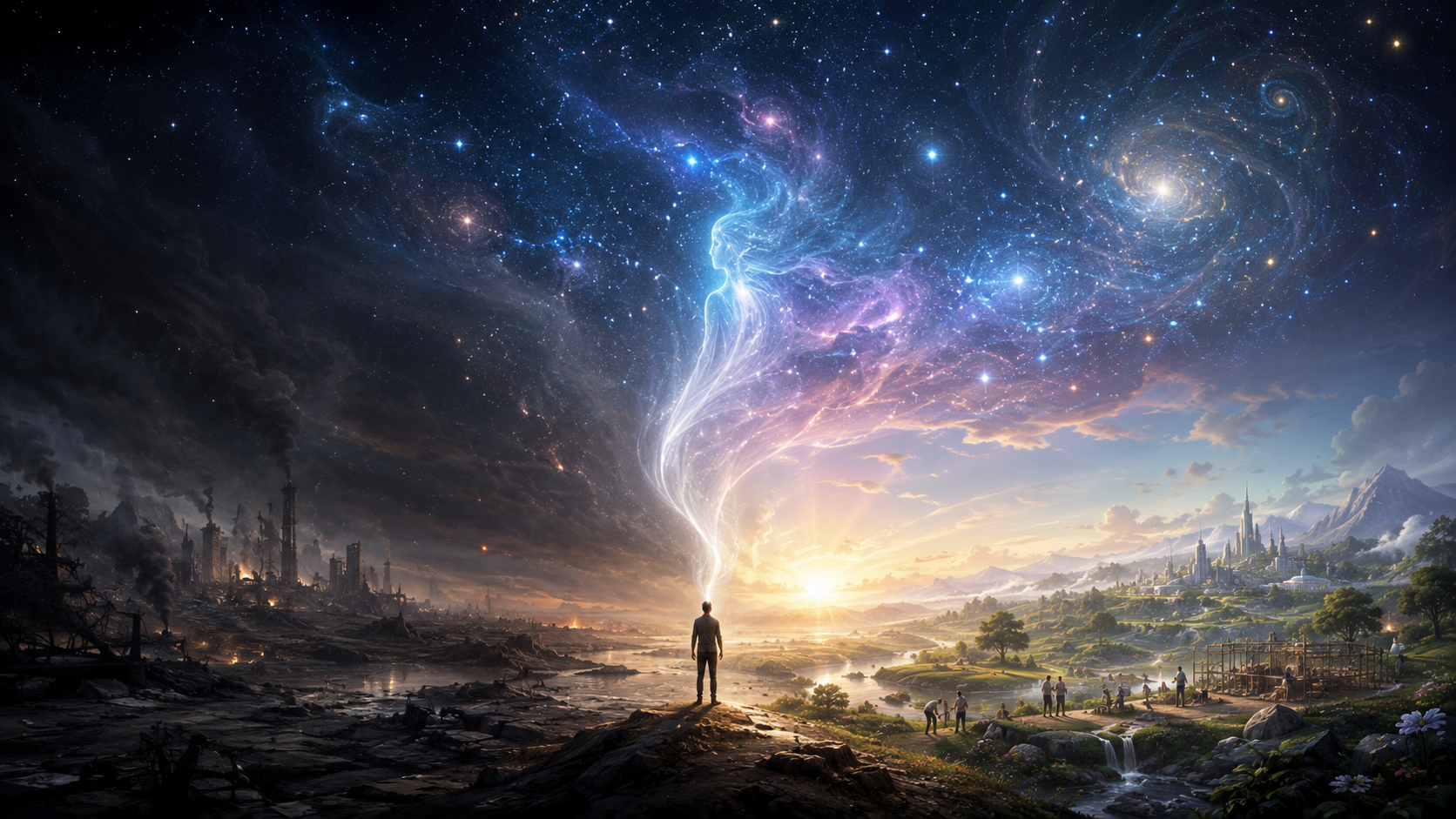
Humanity has transformed its surroundings by building better homes, improving transport, treating disease, constructing laws and institutions, and advancing science and technology. Human life has changed dramatically.
Yet war, conflict, greed, fear, violence, and death remain. Why has our power to change the world grown so greatly while our fundamental problems continue to recur?
Perhaps we have repeatedly repaired only the place where the problem becomes visible.
Imagine a wall that keeps cracking. We repair it, use stronger material, and repair it again. If the crack continues to return, eventually we must inspect not only the wall but the foundation beneath it.
War, violence, and environmental destruction appear externally. Yet human beings initiate and choose the actions through which they occur. Desire, fear, anger, possessiveness, and superiority become behavior; behavior reshapes society and the world.
At a deeper level, we meet consciousness again.
This does not mean ignoring external problems. Wars must be prevented, the environment protected, and poverty and disease addressed. The theory asks us to look one layer deeper as well: If the structure of consciousness producing the problem remains unchanged, might similar outcomes recur even after their visible forms are repaired?
Technology illustrates the point. The same technology may save lives or destroy them. Technology alone does not decide the difference. The consciousness using it does.
Individuality Without Absolute Separation
We distinguish self and other: my body and your body, my property and your property, my nation and your nation, my interest and yours. Such distinctions are not inherently wrong. Individuality makes encounter, dialogue, and love possible.
The problem may arise when difference is treated as absolute disconnection.
I am different from you, but am I wholly unrelated to you?
The Consciousness Field Theory returns here to the relation between primordial consciousness and individual consciousness. If many individual centers of experience arise within one more fundamental field of consciousness, individuality need not be an error to eliminate. It may be a structure through which one ground produces diverse experiences.
Waves have different shapes, yet they are not wholly separate from the sea.
If this perspective is possible, our relation to others changes. Can another person’s suffering remain entirely irrelevant to me? Religious teachings that emphasize love, compassion, forgiveness, neighborliness, and unity may then be interpreted anew.
This does not mean the Consciousness Field Theory has scientifically proven those religious teachings. It means that the recurring movement beyond absolute separation can be reconsidered through the hypothesis of a shared ground in consciousness.
Humanity has often assumed that better surroundings will produce better human beings. The opposite direction also deserves attention:
Might a more mature consciousness produce a better world?
This is not merely an appeal to positive thinking. It involves a transformation in our basic understanding of what we are.
Am I only a body that is born, lives, and disappears? Or am I consciousness experiencing this world through a body? Am I an isolated individual, or do I possess individuality while remaining related to a more fundamental field of consciousness?
Our answers may alter how we understand life and death, other people, and the world.
For this reason, consciousness is not a philosophical ornament attached to the end of cosmology. It is a starting point. If we want to change the world, we must ask what experiences, interprets, and chooses within that world.
This brings us to the final and most human question of the chapter. If we understand our source as consciousness, what becomes of death?
9. Does Consciousness End When the Body Ends?
What have human beings feared for the longest time?
Poverty, illness, and war all inspire fear. Yet beneath them lies death.
Why do we fear death? Not simply because the body stops moving, but because we interpret bodily death as the disappearance of the self.
The heart stops. Brain activity ceases. The body no longer moves. Biologically, we say that the person has died.
Then, often without noticing it, we add another claim: because the body has ended, “I” have ended.
Are those two claims necessarily identical?
Throughout this chapter we have questioned the relation between body and consciousness. The eye receives light, nerves transmit signals, and the brain processes them. But what experiences red, recognizes an apple, remembers a loved one, and knows that it exists?
We have called that consciousness.
The same distinction must be examined in relation to death. Is the cessation of bodily function identical to the nonexistence of consciousness itself?
Contemporary science demonstrates an intimate relation between brain and consciousness. Brain injury can alter memory, cognition, and personality. Under anesthesia, ordinary conscious experience disappears or changes profoundly. We cannot therefore claim that brain and body are unimportant to human experience.
The Consciousness Field Theory does not deny these facts. It leaves one question open:
Does the brain produce consciousness, or does the brain serve as the interface through which consciousness experiences this world?
Consider a radio. If the receiver breaks, sound can no longer be heard through it. That fact alone does not prove that the receiver created the broadcast.
This analogy does not prove the relation between brain and consciousness. It merely prevents one logical possibility from being closed prematurely. Do we yet know with certainty that bodily death and the extinction of consciousness are the same event?
If consciousness is more fundamental than the body, is death truly the end? Or is it the end of one mode of experience?
The Consciousness Field Theory presents this as a question, not as an established scientific conclusion. It does not claim to have proven survival after death. It asks whether identifying the end of bodily function with the absolute end of consciousness may contain an assumption that has not yet been fully demonstrated.
That question must be pursued more deeply in the chapters ahead.
Epilogue
Our inquiry into Consciousness and the Universe has brought us back from the outer cosmos to consciousness itself.
We began by looking outward toward the universe. In the end, we returned to ourselves.
Did the universe exist before consciousness? Is the apple truly outside consciousness? Do we see things themselves, or the world as it appears to us? Why does consciousness conceal itself? And when the body ends, does consciousness also end?
The Consciousness Field Theory does not declare that it possesses final answers to these questions. It proposes a possibility:
At the deepest ground of what we call reality, there may be consciousness rather than matter alone.
If so, the world we have observed throughout our lives acquires a different meaning. Perhaps we are not merely conscious beings that appeared inside a preexisting universe. Perhaps we experience both the universe and ourselves within a deeper field of consciousness.
The key distinction must remain clear. The fact that every known and experienced world appears in consciousness does not by itself prove that an external cosmos vanishes when an individual observer disappears. It establishes a limit on what we have directly experienced and opens a further ontological question. The Consciousness Field Theory then advances its own hypothesis: the material world as a whole may arise within a more fundamental field of consciousness.
This returns Consciousness and the Universe to the question with which we began. Perhaps consciousness is not the final accidental product of cosmic history. Perhaps it is the first condition under which a cosmos can appear, be experienced, and possess meaning.
And this question leads directly to the next chapter:
What, then, is the Grand Consciousness Field?
Continue the Series
Previous Chapter
Part 6, Chapter 4 | Can Consciousness Field Theory Unite Science, Philosophy, and Religion?
The previous chapter explored how philosophy, science, and religion might be brought into one larger conversation through the Consciousness Field Theory. It examined whether their different questions—about physical law, human knowledge, creation, and meaning—may meet at a deeper level without erasing their differences.
Next Chapter Preview
Part 6, Chapter 6 | What Exactly Is Consciousness? Rethinking Time, Space, Matter, and the Universe.
Link to be added after the English chapter is published.
This chapter has asked whether consciousness is merely a late product inside an already completed material universe or a more fundamental condition under which a universe can appear and be experienced. The next chapter will turn directly to consciousness itself: What exactly is it, what does it do, and how might time, space, matter, the body, and the universe be reconsidered when consciousness becomes the starting point rather than the final afterthought?
Explore Through Video
If this article has raised further questions, continue through the Cheonbong Archive video series. Each format approaches the same subject at a different depth.
2 Minutes | The Core Question and a Consciousness Thought Experiment
Watch the 2-minute English video
Video link to be added after publication.
Begin with the chapter’s sharpest question and take part in a brief thought experiment: If every observer disappeared, in what sense would the universe still be known to exist—and can we ever imagine an observerless universe without consciousness performing the imagining?
10 Minutes | How Do Consciousness and Matter Meet?
Watch the 10-minute English explanation
Video link to be added after publication.
Follow the red apple from reflected light to the retina, neural signals, and conscious experience. The video asks why an apple that never enters the observer nevertheless appears as a complete object located in an external world.
20 Minutes | Deep Audio: Consciousness, Matter, and the Universe
Listen to the 20-minute English deep audio
Video link to be added after publication.
Enter the full inquiry into cosmology, perception, Kant, dreams, creation, philosophy, science, religion, the self-concealment of consciousness, and the question of whether consciousness must end when the body ends.
Start with the short question, continue through the ten-minute inquiry, and then enter the twenty-minute deep exploration for a more complete understanding of this chapter.
Link Audit (Editorial Reference)
Internal Cheonbong Link
- Part 6, Chapter 4:
https://cheonbong.kr/consciousness-field-unified-theory/— used once in Section 1 for background and once in the end-of-article previous-chapter navigation. - Next English chapter:
[NEXT CHAPTER URL]— deliberately left as a placeholder because no confirmed English URL was provided. - English video links:
[2-MIN VIDEO URL],[10-MIN VIDEO URL], and[20-MIN VIDEO URL]— deliberately left as placeholders until the videos are published or their URLs are confirmed.
External Authoritative Links
- NASA, Cosmic History:
https://science.nasa.gov/universe/overview/— supports the approximately 13.8-billion-year cosmic history referenced in Section 1. - National Eye Institute, How the Eyes Work:
https://www.nei.nih.gov/eye-health-information/healthy-vision/how-eyes-work— supports the retina-to-electrical-signal pathway described in Section 3. - Stanford Encyclopedia of Philosophy, Kant’s Transcendental Idealism:
https://plato.stanford.edu/entries/kant-transcendental-idealism/— provides scholarly background for the appearance/thing-in-itself distinction in Section 4.
These external sources support the specific scientific or philosophical background claims linked to them. They are not presented as endorsements of the Consciousness Field Theory.