Rethinking time, space, matter, and the universe through the transparent lens of consciousness
Part 6, Chapter 6 | What Is the Consciousness Field?
Table of Contents
- Prologue | We Have Never Stepped Outside Consciousness
- Consciousness Is Hardest to See Because It Is Closest
- As We Forget the Air, We Forget the Field of Consciousness
- Close Your Eyes | Where Does That Vast World Appear?
- Open Your Eyes | Where Is Reality Experienced?
- Bring a Rock | Who Says, “This Is Matter”?
- From Eight Billion Observers to Zero | What Remains?
- Where Was the Universe Said to Exist Before Consciousness?
- From Waking Until Sleep | What Is Always With Me?
- What Is the Consciousness Field? A Philosophical Definition
- Epilogue | Has the Universe Ever Been Outside Consciousness?
Prologue | We Have Never Stepped Outside Consciousness
You open your eyes in the morning. A room appears. You see the sky beyond the window and hear another person’s voice. You think about what must be done and move your body. During the day, you meet people, see objects, listen, touch, compare, and judge. At night, you lie down and sleep. The next morning, the world appears again. Days become months, months become years, and the years become a lifetime.
Through every moment, one thing has never been absent: consciousness.
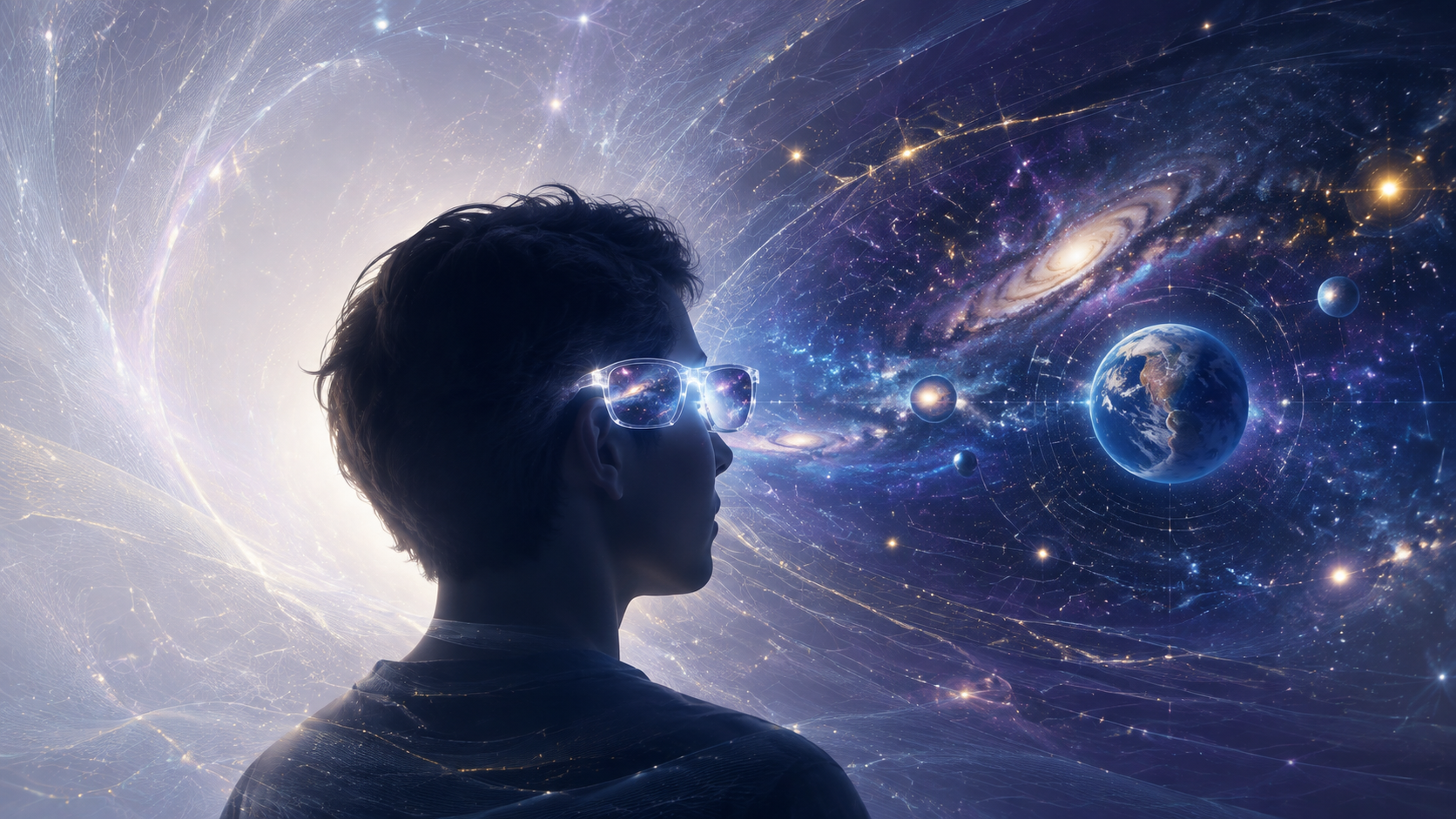
We are like people born wearing perfectly transparent glasses. Because the lenses are always present and entirely clear, we do not notice them. We notice mountains, oceans, faces, and stars, but not the medium through which they become present to us. We learn that Earth orbits the Sun, that the solar system belongs to a galaxy, and that the observable universe contains innumerable galaxies. Yet where is all this observation, learning, and knowing taking place? It is taking place in consciousness.
A claim about the universe begins in the awareness of a person, is expressed through language, and enters the awareness of others. This does not make astronomy unreal. It raises a prior philosophical question: can we confidently place the universe outside the only condition through which it is ever observed, inferred, named, or understood?
What is the consciousness field? The Grand Consciousness Field Theory proposed by the Cheonbong Archive begins with that question. It does not reject cosmology, evolution, or neuroscience. It asks whether the world described by those sciences may rest upon a more fundamental field in which time, space, matter, observers, and knowledge can appear at all.
1. Consciousness Is Hardest to See Because It Is Closest
Every human being lives with consciousness. A child is conscious, and so is an elderly person. A scientist investigates through consciousness, a philosopher reasons through it, and a religious person asks about God and existence through it. Yet we seldom attend to consciousness itself.
Think of a contact lens. A person wearing it does not stare at the lens all day; the person looks through it. The lens of the eye works in a similar way. We see through it without constantly thinking about it. Consciousness may be an even more fundamental transparent lens. Color is consciously seen. Sound is consciously heard. Pain, love, memory, and anticipation are consciously experienced. The past returns as memory, while the future appears as imagination, anxiety, or hope.
We awaken through consciousness, encounter a world, make decisions, and fall asleep. Then we meet the world again the next day. Have we mistaken what appears within experience for something more primary than the condition that makes every experience possible?
This question does not require us to deny the external world. It asks us to separate two issues that are often blended together. One is epistemological: how does anything become known or experienced? The other is ontological: what exists independently of our knowing? The first can be examined directly. The second demands further argument. The distinction will guide every thought experiment in this chapter.
2. As We Forget the Air, We Forget the Field of Consciousness
We live inside the atmosphere. We cannot survive without air, but ordinarily we give it little thought precisely because it is always present. The consciousness field can be approached through this analogy, but the analogy must not be mistaken for a literal claim. The field is not another physical atmosphere floating somewhere in the cosmos.
In the Grand Consciousness Field framework, it names the possible foundational condition in which everything we experience as a world—including time, space, matter, and individual consciousness—can arise. We normally place consciousness inside the material world, often inside the brain. This theory reverses the direction of the question. Is consciousness contained by matter, or is the experienced material world contained within a more comprehensive field of consciousness?
Imagine an immense canvas on which mountains, cities, bodies, distances, and histories are displayed. The canvas is not itself one more object inside the picture. It is the condition that allows a picture to appear. Likewise, the consciousness field is not proposed as an invisible substance sitting beside visible substances. It is a conceptual framework for asking what allows both objects and subjects, regularity and meaning, to become manifest.
Nor is this merely a communication network linking eight billion private minds. It is a more radical hypothesis: individual minds and the shared, ordered world they experience may both arise within a deeper ground. In that sense, asking what is the consciousness field is asking whether the observer and the observed might share one root.
3. Close Your Eyes | Where Does That Vast World Appear?
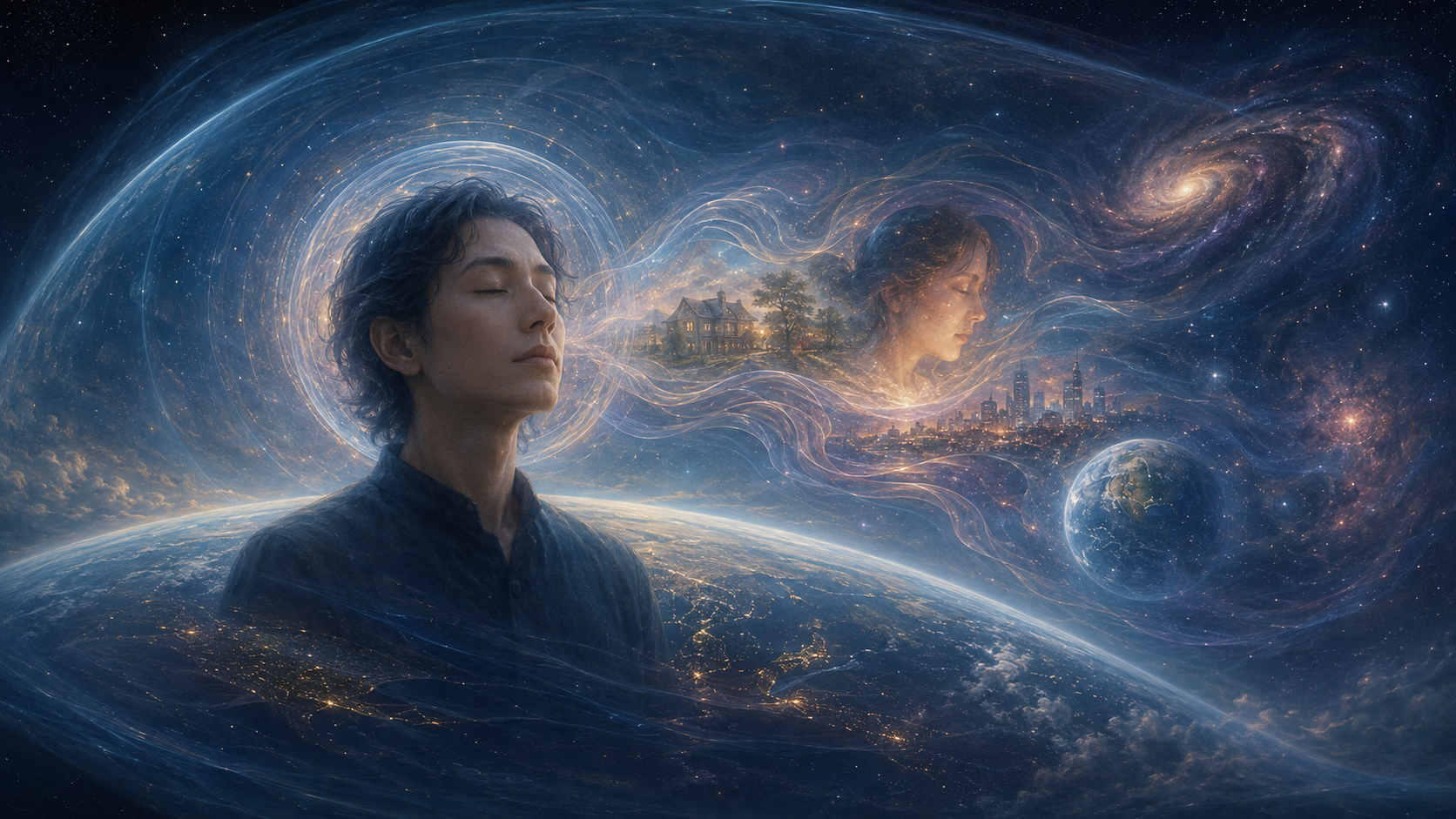
Close your eyes for a moment. The room in front of you disappears from sight. Yet you can remember the house where you lived as a child. You may see the face of someone you love, or the face of a parent who has died. You can think of Seoul, Japan, or the United States. Then you can leave Earth in imagination, move through the solar system, cross the galaxy, and contemplate the universe.
Your eyes remain closed. Light from those imagined galaxies is not now entering your retinas. The physical childhood home has not shrunk and entered your skull. Nevertheless, an expansive world appears as experience. It contains near and far, faces and voices, places and distances, past events and future possibilities.
Now proceed slowly. Recall the gate of the old house, the location of a window, the family table, and the sound of a familiar voice. Widen the scene to the neighborhood, the city, the country, Earth seen from space, the solar system, and the Milky Way. Consciousness opens an experienced world that cannot be measured by the physical size of the skull in which brain activity occurs.
This does not mean imagination proves the physical universe to be imaginary. The universe remembered or visualized is not identical to the universe measured by telescopes. The thought experiment establishes a narrower but important point: the event of a world appearing to me does not occur without consciousness. It gives us an experiential doorway into the question, what is the consciousness field?
4. Open Your Eyes | Where Is Reality Experienced?
Open your eyes. A table, window, building, or mountain appears. We rightly say, “The earlier scene was imagination; this is reality.” Waking reality resists private wishes. It is shared with others, displays continuity, and follows stable regularities. The Cheonbong Archive does not erase these differences.
Still, what is experiencing this reality now? Light enters the eye and sensory information is transformed into neural signals. Yet what you experience is not a list of wavelengths or electrical impulses. You see a blue sky, hear music, recognize a loved one, and taste an apple. The imagined world and the waking world differ profoundly, but both become worlds for you only through conscious experience. This relation remains a central problem in the philosophy of consciousness.
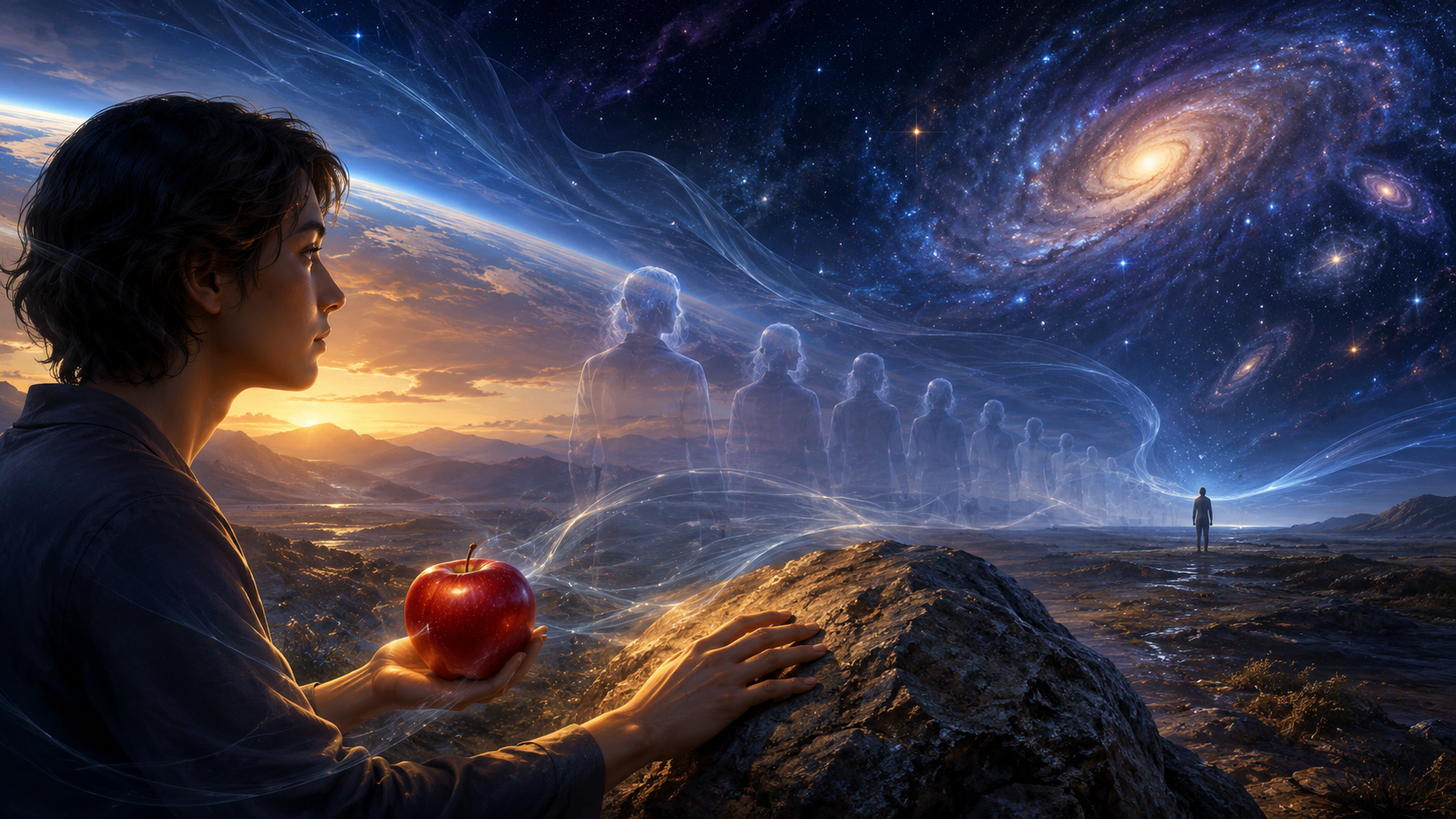
Place a red apple on the table. The apple itself does not travel into your eyes. Only light reflected from its surface reaches the retina and is transformed through the visual system. Yet consciousness presents one complete, round, red apple. When you bite it, physical fruit enters your mouth and receptors respond, but sweetness, sourness, aroma, juiciness, and crispness are experienced in consciousness. The apple does not know that it is red, sweet, or delicious.
Dreams sharpen the puzzle. In a dream, you may see an apple, hold it, and taste it. A dream-self appears “here,” the apple appears “there,” and space seems to separate them. After waking, you understand that the self, apple, and distance all arose within one dream experience. Could waking reality also involve a deeper field in which subject and object appear separated, even though they share one ground?
This is a philosophical possibility, not a neuroscientific conclusion. Dreams are private and unstable; waking reality is public, lawful, and resistant. Showing that both are consciously experienced does not give them the same ontological status. Nor does the apple experiment solve the hard problem of consciousness. It identifies the point where causal accounts of receptors and neurons meet the unanswered question of why physical processing is accompanied by redness, sweetness, and meaning.
The Grand Consciousness Field Theory explores the separation of subject and object as a possible “staging structure of creation.” The phrase does not claim that a personal mind invents the shared world. It proposes that a deeper consciousness field could sustain both individual observers and an ordered world that confronts them as external reality.
5. Bring a Rock | Who Says, “This Is Matter”?
Touch a large rock. It is hard, heavy, and resistant. You may want to say, “If this is not matter, what is?” The theory does not deny the rock’s resistance. Instead, ask who says, “This is a rock,” “This is hard,” and “This is matter.” The rock does not speak those concepts. A conscious observer feels, identifies, and judges.
If my consciousness disappears, the color, texture, weight, and hardness of the rock as experienced by me disappear with it. The concepts “rock” and “matter,” as used and understood by me, also disappear. This directly supports an epistemological conclusion: the rock’s appearance to a person, and that person’s judgment that it is matter, are inseparable from conscious experience.
It does not prove that the external rock itself ceases to exist when that person is unconscious or dies. Whether the rock persists without any observer is a distinct ontological question. The rock experiment must not be asked to prove more than it can. It shows the dependence of experienced properties, concepts, and judgments on consciousness; it does not, by itself, demonstrate the dependence of all reality on an individual mind.
The Grand Consciousness Field Theory takes a further step by proposing that the entire material world may be constituted within a more fundamental field of consciousness. But that stronger proposal is not logically established by touching one rock. It is a philosophical hypothesis developed by bringing together problems of perception, subjectivity, shared reality, cosmic origin, and meaning.
6. From Eight Billion Observers to Zero | What Remains?
Expand the thought experiment to Earth. Begin with roughly eight billion people. Remove observers in imagination: one person, a million, a billion, until only one remains. That last person can still look at the night sky and say, “The universe remains.” Now imagine that the final observer also disappears.
Who calls a star a star? Who classifies a rock as matter, measures time, calculates distance, or knows that a universe exists? We can answer, “The universe exists even if no human observes it.” Modern science has achieved extraordinary explanatory and predictive success by treating physical processes as independent of human observation. This chapter does not discard that working realism.
Yet a philosophical limit remains. The proposition “the universe exists without consciousness” is being formed, examined, and asserted by consciousness now. We cannot travel into a condition in which no consciousness exists, verify it consciously, and return with an observation. Every statement about an observerless universe reaches us through present observation, evidence, inference, theory, and awareness.
Again, the correct conclusion is modest. The experiment does not prove that the universe vanishes when observers reach zero. It reveals the limit of what can be known independently of the very capacity for knowing. It therefore carries the question what is the consciousness field from psychology into epistemology and ontology.
7. Where Was the Universe Said to Exist Before Consciousness?
We learn a powerful scientific history: the universe expanded from an early hot, dense state; stars and galaxies formed; Earth emerged; life evolved; brains developed; and human consciousness appeared much later. The Cheonbong Archive does not deny the Big Bang model, stellar evolution, biological evolution, or neuroscience. It asks a different-order question beneath that history.
Before any conscious organism appeared, in what sense was the early universe a known universe? Who called a galaxy a galaxy, matter matter, or a billion years a billion years? Today, scientists reconstruct cosmic history through radiation, fossils, mathematical models, instruments, and shared reasoning. The past does not physically enter the present. Evidence appears now, and consciousness interprets it through concepts.
That observation does not make cosmology arbitrary. Independent researchers can test claims, compare measurements, reject errors, and refine models. Scientific objectivity is a disciplined achievement of shared inquiry. The question is whether even this magnificent account is ultimately presented within a field of awareness—and whether the capacity for appearance, intelligibility, and lawfulness requires a foundation more basic than matter alone.
We must distinguish temporal order from ontological ground. In physical time, brains may arise late in cosmic history. Ontologically, however, consciousness might still be the condition in which that entire history is disclosed, known, and meaningful. Saying that a movie begins before a character appears does not mean the screen begins after the character. The screen is not another event inside the movie’s timeline.
This screen analogy is not proof. It clarifies the hypothesis. Matter may be temporally prior to human consciousness within the universe while a more fundamental consciousness field is ontologically prior to both. Asking what is the consciousness field therefore does not force a choice between science and philosophy. It asks whether science’s temporal account rests within a broader condition of manifestation.
8. From Waking Until Sleep | What Is Always With Me?
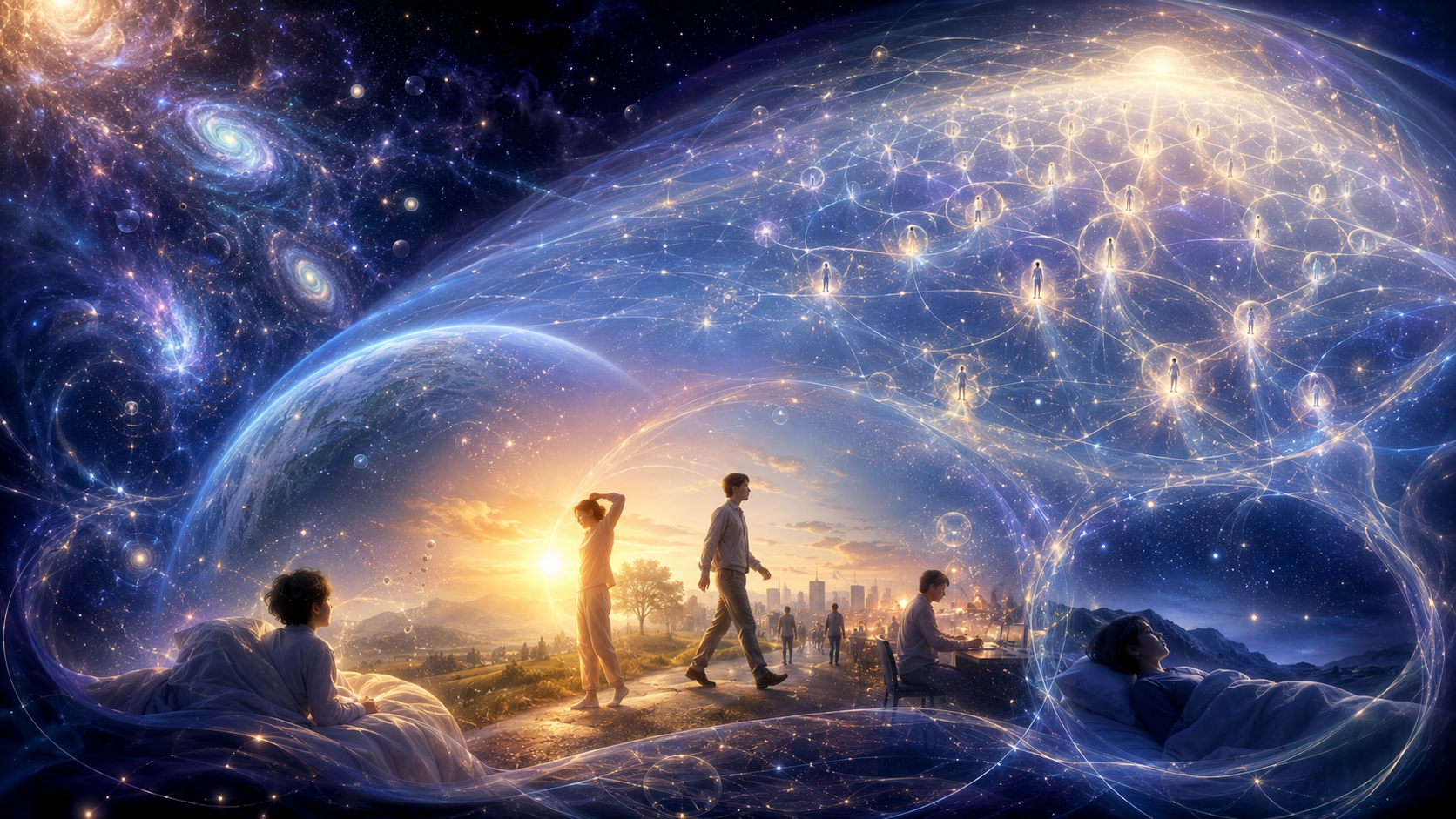
Return from cosmic time to one ordinary day. You awaken. The room appears, your body feels heavy or refreshed, and the day’s concerns return. You eat breakfast, travel, work, speak, remember, plan, and worry. Objects and people change from moment to moment. Your emotions rise and fall. Yet every item appears within the continuing horizon of consciousness.
When you read about Rome, ancient Korea, dinosaurs, or the early universe, those remote ages become present as knowledge now. When you plan tomorrow, a future that does not yet exist becomes present as possibility. Consciousness gathers what is absent in space and time into one lived field.
At night, you fall asleep. Ordinary waking experience recedes. In dreams, another world may arise with people, objects, landscapes, love, fear, taste, and distance. The body lies in bed, while experience stages a world that can feel completely real until awakening. The dream demonstrates that consciousness can generate a world-like experience without the corresponding external objects being present in the ordinary way.
But it does not prove that waking reality is merely a personal dream. Waking reality has continuity, resistance, shared confirmation, and stable law. The philosophical proposal is different: just as a private dream depends on an individual consciousness, perhaps shared reality depends on a vastly deeper, nonpersonal field that supports both observers and the common world.
If personal consciousness is absent, the world experienced by that person is absent. Whether the external universe independently disappears is not thereby established. The Grand Consciousness Field hypothesis asks whether the shared universe is grounded not in your private awareness, but in an original consciousness from which individual centers of experience and their lawful world emerge together.
9. What Is the Consciousness Field? A Philosophical Definition
We can now offer a working definition. What is the consciousness field? It is the proposed foundational field in which time, space, matter, individual consciousness, and the relations among them become capable of appearing as an experienced and intelligible world.
It is not simply my awareness or yours. It is not a physical substance detected by an instrument, and it is not a substitute term for the brain. Nor is it a proven field in the sense used by established physics. It is a philosophical hypothesis and conceptual framework for exploring whether consciousness is derivative from matter or whether matter and mind arise within a deeper common ground.
The theory can be described in three layers. First is original consciousness: the foundational capacity for manifestation and awareness. Second is the Grand Consciousness Field: the structured ground in which time, space, natural law, material forms, and relations unfold. Third are individual consciousnesses: localized perspectives through which the common world is experienced, interpreted, and creatively answered.
A computer analogy may help. Applications, windows, images, and user accounts appear distinct, yet all depend upon an underlying operating environment. The analogy has limits; consciousness is not literally software. Its purpose is to show how many distinct perspectives and objects might share one hidden foundation without losing their practical differences.
This idea also echoes the philosophical insight that we never encounter things wholly apart from the conditions under which they appear to us. Kant’s account of experience, introduced in the Stanford Encyclopedia of Philosophy’s overview of Kant, does not itself establish the Grand Consciousness Field Theory. It does, however, remind us that the structure of knowing cannot simply be removed from the world as known.
So what is the consciousness field in the most concise form? It is the invisible canvas proposed beneath both observer and observed—the condition through which a universe can be experienced, known, and interpreted, and possibly the deeper ontological ground through which a universe can manifest at all. The first half of that statement concerns experience; the second remains the theory’s stronger metaphysical proposal.
Epilogue | Has the Universe Ever Ben Outside Consciousness?
We began with an ordinary morning and traveled through memory, imagination, an apple, a rock, eight billion observers, cosmic history, and a full human day. Each experiment led back to the same boundary: we have never stepped outside consciousness to compare the world as experienced with a world entirely unrelated to experience.
This does not prove that an individual mind creates the universe. It does not prove that a rock disappears when no person sees it. It does not overturn the Big Bang, evolution, or neuroscience. It shows that every claim, measurement, concept, and doubt about reality becomes available to us through consciousness.
The Grand Consciousness Field Theory then advances a larger philosophical proposal: consciousness may not be a late and accidental by-product inside a fundamentally unconscious universe. A primordial field of consciousness may instead be the transparent ground on which cosmic history, material order, living bodies, and individual awareness unfold.
What is the consciousness field? It is not offered here as a completed scientific answer. It is a disciplined question and a conceptual lens: perhaps the universe has never stood outside consciousness, because the distinction between “universe” and “observer” itself arises within a more comprehensive field.
The final question is therefore not only whether consciousness exists inside the universe. It is whether the universe we know—and perhaps the universe that is—has ever existed outside the transparent field in which existence can appear.
Previous Chapter | Part 6, Chapter 5
Before defining the field itself, the previous chapter asked whether the universe truly came before consciousness. It preserved modern cosmology while examining the deeper distinction between temporal sequence and ontological foundation.
📖 Part 6, Chapter 5 | Consciousness and the Universe: Which Came First?
Next Chapter | Part 6, Chapter 7 Preview
If time, space, matter, and observers may arise within a more fundamental consciousness field, the next question follows naturally: how should we distinguish the material world from the world of consciousness? The next chapter examines where these two worlds differ, where they meet, and whether they are ultimately two aspects of one reality.
📖 Part 6, Chapter 7 | The Material World and the World of Consciousness
Explore in Video | 2, 10, and 20 Minutes
2-Minute Thought Experiment
This concise entry point asks you to close your eyes, imagine a universe, and reconsider where the experienced world appears.
▶ 2-Minute Core Thought Experiment: [2-Minute Video URL]
10-Minute Exploration
Follow the apple, rock, and final-observer experiments, with the key objections and philosophical boundaries kept in view.
▶ 10-Minute Detailed Explanation: [10-Minute Video URL]
20-Minute Deep Exploration
Examine the complete relationship among consciousness, matter, cosmic history, individual experience, and the Grand Consciousness Field Theory.
▶ 20-Minute Deep Exploration: [20-Minute Video URL]
If this question opened a new way of seeing reality, subscribe to the Cheonbong Archive and turn on notifications so you do not miss the next thought experiment.
[2-Minute Video URL][10-Minute Video URL][20-Minute Video URL]