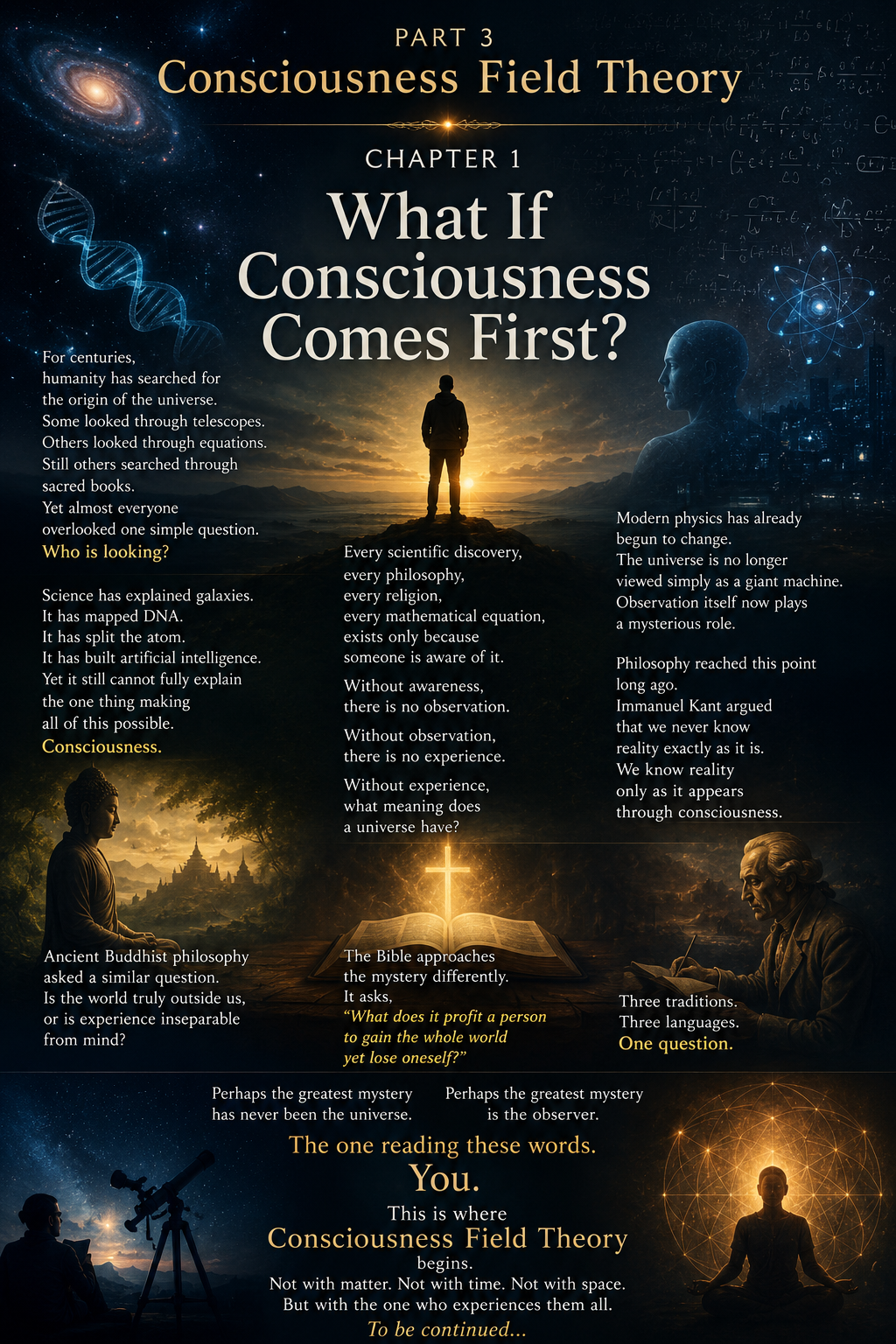
Consciousness Field Theory
Chapter 1
What If Consciousness Comes First?

For centuries,
humanity has searched for the origin of the universe.
Some looked through telescopes.
Others looked through equations.
Still others searched through sacred books.
Yet almost everyone overlooked one simple question.
Who is looking?
Science has explained galaxies.
It has mapped DNA.
It has split the atom.
It has built artificial intelligence.
Yet it still cannot fully explain
the one thing making all of this possible.
Consciousness.
Every scientific discovery,
every philosophy,
every religion,
every mathematical equation,
exists only because
someone is aware of it.
Without awareness,
there is no observation.
Without observation,
there is no experience.
Without experience,
what meaning does a universe have?
Modern physics has already begun to change.
The universe is no longer viewed simply as a giant machine.
Observation itself now plays a mysterious role.
Philosophy reached this point long ago.
Immanuel Kant argued
that we never know reality exactly as it is.
We know reality
only as it appears through consciousness.
Ancient Buddhist philosophy
asked a similar question.
Is the world truly outside us,
or is experience inseparable from mind?
The Bible approaches the mystery differently.
It asks,
“What does it profit a person
to gain the whole world
yet lose oneself?”
Three traditions.
Three languages.
One question.
Perhaps
the greatest mystery
has never been the universe.
Perhaps
the greatest mystery
is the observer.
The one reading these words.
You.
This is where
Consciousness Field Theory
begins.
Not with matter.
Not with time.
Not with space.
But with
the one who experiences them all.
To be continued…
PART 3
Chapter 2
The Observer Changes Everything

For more than three hundred years,
modern science has viewed the universe
as a gigantic machine.
Matter came first.
Life emerged later.
Consciousness was considered
nothing more than
a product of the brain.
It seemed obvious.
Until physics began asking
a different question.
In the world of quantum mechanics,
something unexpected appeared.
The smallest building blocks of nature
did not always behave
like tiny solid objects.
Instead,
they behaved like possibilities.
Only when they were measured
did a definite result emerge.
Suddenly,
the observer
was no longer standing
outside the experiment.
This discovery
did not prove
that consciousness creates reality.
But it did something
equally important.
It challenged
the old picture
of a completely independent universe.
Observation
could no longer be ignored.
Long before quantum physics,
the philosopher Immanuel Kant
had already reached
a similar conclusion.
He argued
that we never know
the world exactly as it is.
Everything we experience
passes through
the structures
of our own consciousness.
Space.
Time.
Cause and effect.
These may not simply belong
to the universe.
They may also belong
to the observer.
Modern neuroscience
adds another layer.
Your eyes
do not directly see reality.
They receive light.
Your ears
do not directly hear reality.
They receive vibrations.
Your brain
transforms electrical signals
into colors,
sounds,
memories,
and meaning.
The world you experience
is already
an interpretation.
If that is true,
then a profound question emerges.
Perhaps
we are not merely
living inside the universe.
Perhaps
the universe we experience
is inseparable
from consciousness itself.
This is where
philosophy,
science,
and even ancient spiritual traditions
begin to converge.
Not because
they use the same language.
But because
they are all approaching
the same mystery.
The mystery
of the observer.
The next question is unavoidable.
If consciousness
is more fundamental
than we once believed,
where does consciousness
come from?
That question
will lead us
to an entirely new way
of understanding reality.
To be continued…
PART 3
Chapter 3
Beyond Space and Time
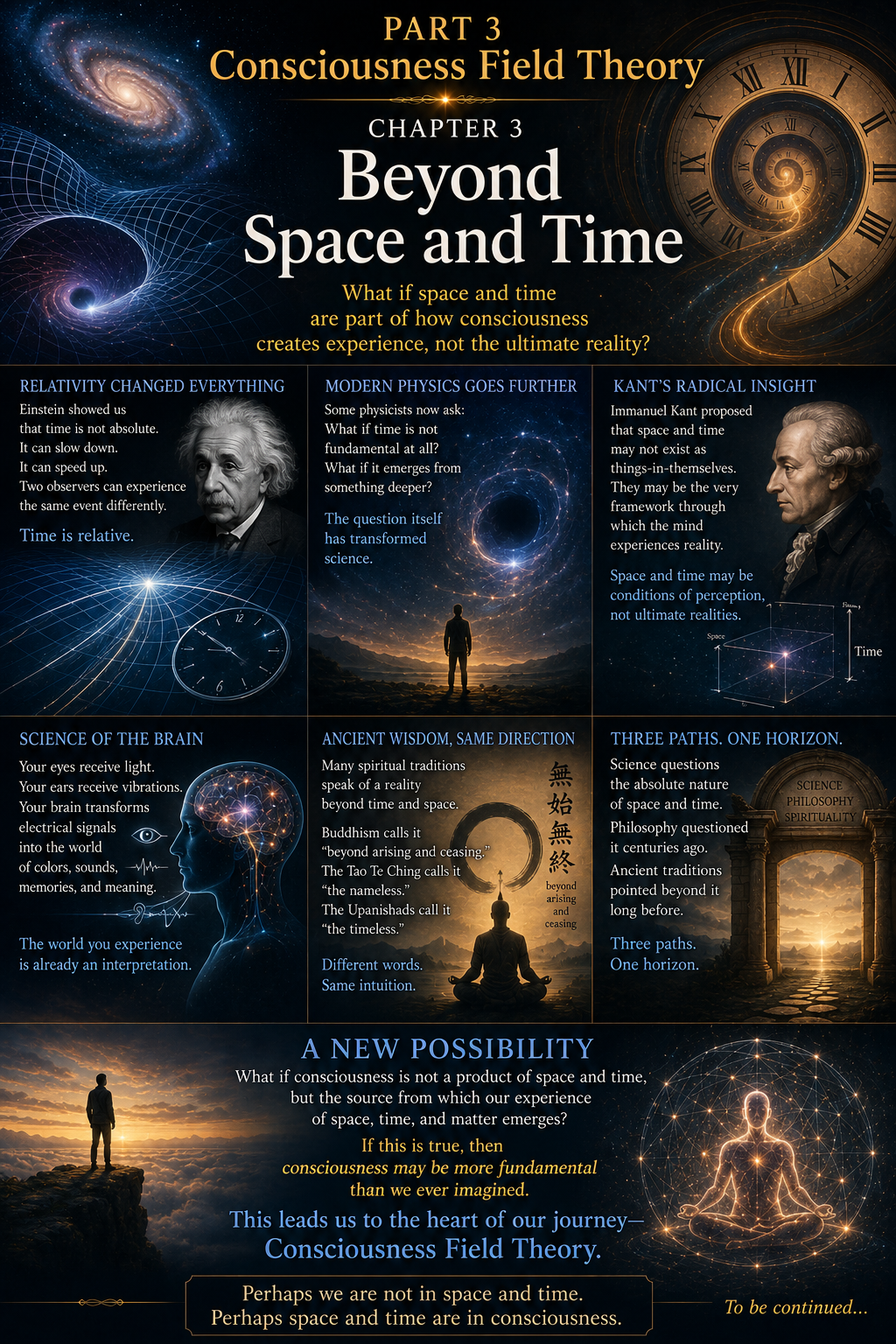
For thousands of years,
people believed
that space and time
were the stage
upon which the universe existed.
Everything happened
inside them.
Nothing could exist
without them.
It seemed undeniable.
Then came Albert Einstein.
His theory of relativity
changed everything.
Time was no longer absolute.
It could slow down.
It could speed up.
Two observers
could experience
the same event
differently.
Time,
once thought to be universal,
became relative.
A century later,
physicists began asking
an even deeper question.
What if time
is not a fundamental ingredient
of reality at all?
Some modern theories suggest
that time
may emerge
from something
more fundamental.
Not everything agrees,
but the question itself
has changed
the direction of science.
Long before this,
Immanuel Kant
had proposed
a remarkable possibility.
Space and time,
he argued,
may not exist
as independent things.
They may be
the very framework
through which
the human mind
experiences reality.
In other words,
space and time
could be
conditions of perception,
not the ultimate structure
of existence itself.
If that is true,
then an extraordinary possibility appears.
Perhaps
we are not
inside space and time.
Perhaps
space and time
are part of the way
consciousness
organizes experience.
The universe
may be far stranger
than we ever imagined.
Ancient wisdom
echoes a similar idea.
Many spiritual traditions
have described
ultimate reality
as something
beyond time,
beyond space,
and beyond death.
Though their languages differ,
their direction
is surprisingly similar.
Science has begun
to question
the absolute nature
of space and time.
Philosophy
questioned it centuries ago.
Ancient traditions
pointed beyond it
long before modern science existed.
Three paths.
One horizon.
If consciousness
is not merely
a product
of space and time,
then perhaps
it is something
more fundamental.
Something
from which
our experience
of space,
time,
and even matter
emerges.
That possibility
leads us
to the central idea
of this series.
Consciousness Field Theory.
To be continued…
PART 3
Chapter 4
Consciousness Field Theory
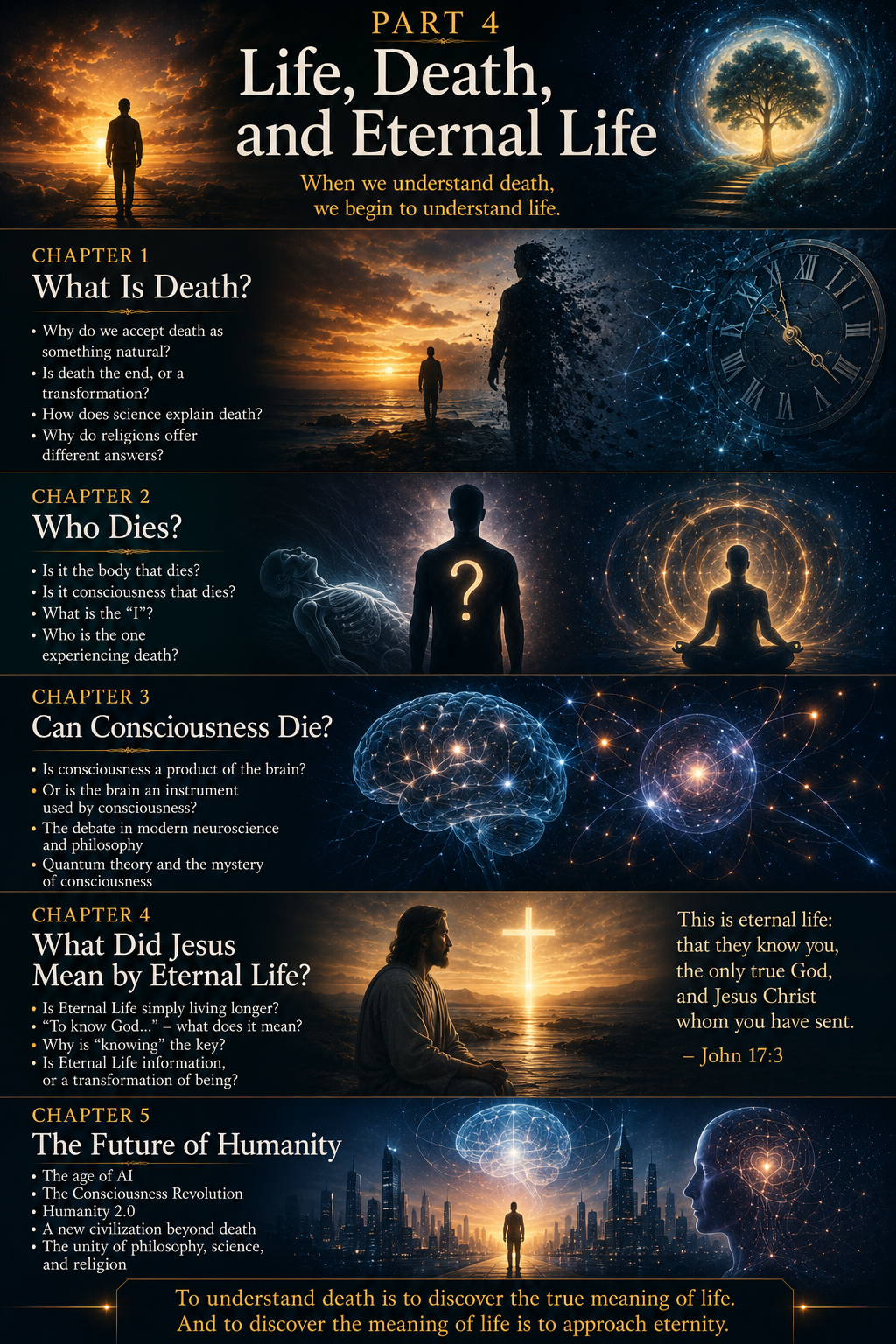
For centuries,
humanity has searched
for the foundation
of reality.
Some believed
everything began
with matter.
Others believed
everything began
with energy.
Still others
looked beyond
the physical universe.
But what if
they were all
looking at
different expressions
of the same reality?
Consciousness Field Theory
begins
with a simple question.
What if consciousness
is not produced
by the universe,
but is one of the conditions
that makes
the universe
experienceable?
Think about it.
Every discovery,
every equation,
every work of art,
every scientific theory,
every act of love,
every fear,
every memory,
exists only
because
it is experienced
by consciousness.
Without consciousness,
there is no observer.
Without an observer,
there is no experience.
Without experience,
what does the word
“reality”
actually mean?
This theory
does not reject science.
It does not reject philosophy.
It does not reject religion.
Instead,
it asks
whether they have each
been describing
different layers
of the same truth.
Science
explores
how the universe works.
Philosophy
asks
how reality
is known.
Religion
asks
why existence
has meaning.
Perhaps
these are not
competing questions.
Perhaps
they complete
one another.
If consciousness
is fundamental,
then matter
may not be
the whole story.
Space,
time,
information,
and even life itself
could be understood
as different expressions
within a deeper field
of consciousness.
Not magic.
Not superstition.
But a new way
of asking
an ancient question.
Every revolution
begins
by changing
one assumption.
The Earth
was not
the center
of the universe.
Time
was not
absolute.
Matter
was not
solid
in the way
we once imagined.
Now,
another question
stands before us.
Could consciousness
be more fundamental
than matter itself?
If the answer
is even partly yes,
then our understanding
of life,
death,
identity,
and reality
must change.
Not gradually.
Completely.
Perhaps
the greatest discovery
of the future
will not be
a new planet,
a new particle,
or a new machine.
It will be
a deeper understanding
of consciousness.
And with it,
a new understanding
of ourselves.
To be continued…
PART 3
Chapter 5
A New Beginning

Every civilization
leaves behind
its own picture
of reality.
Some saw
the universe
as a machine.
Others saw
it as a living organism.
Some believed
that consciousness
was only
a byproduct
of the brain.
But history reminds us
that every age
eventually
revises
its deepest assumptions.
Today,
humanity stands
at another turning point.
Artificial intelligence
is changing
how we work.
Biotechnology
is changing
how we live.
Quantum physics
continues
to challenge
our understanding
of reality.
Yet one question
still remains.
Who are we?
Perhaps
the future
will not belong
only to those
who build
more powerful machines.
It will also belong
to those
who better understand
the nature
of consciousness.
Because every invention,
every scientific breakthrough,
every work of art,
and every act of compassion
begins
within awareness.
If Consciousness Field Theory
is even partially correct,
then humanity
may be entering
a new chapter.
A chapter
where philosophy,
science,
and spirituality
are no longer rivals,
but partners
searching
for the same truth.
The greatest frontier
may not lie
among the stars.
It may exist
within
the one
who is looking
at the stars.
The observer.
The self.
The mystery
we have carried
since the beginning
of history.
The journey
has never been
only about
understanding
the universe.
It has always been
about
understanding
ourselves.
Because the question,
“Who am I?”
is also
the question,
“What is reality?”
Perhaps
the future
will remember
this century
not only
as the age
of artificial intelligence,
but as the moment
humanity
began
to rediscover
consciousness.
The search
is not over.
In many ways,
it has only
just begun.
Thank you
for joining
this journey.
And perhaps,
the next great discovery
is not waiting
somewhere
out there.
Perhaps
it is waiting
within you.
World Re-interpretation
A journey where philosophy, science, and spirituality meet.
See you in the next chapter.