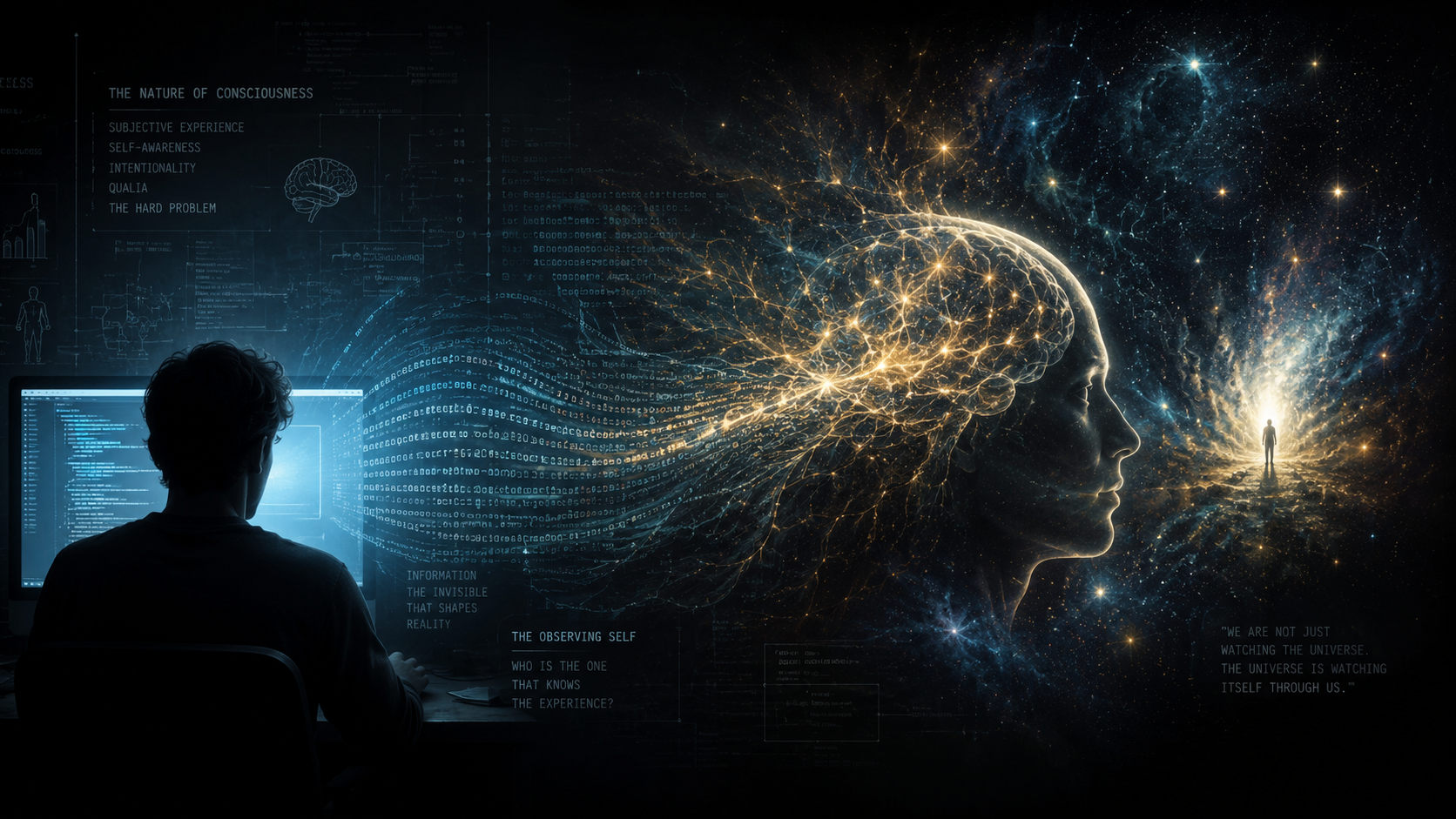

Part 4: How Is Consciousness Born?
Chapter
1: Computers Move by Code. What Moves a Human Being?
What are you using right now to read this sentence?
Your eyes?
Your brain?
Or something deeper that you call “I”?
At first, the answer seems obvious. You are reading. Your eyes receive light. Your brain processes signals. Your nervous system works silently in the background.
But pause for a moment.
Light does not understand meaning.
Electrical signals do not know that they are reading.
Yet something within you understands these words.
What is that something?
Humanity has studied the beginning of the universe, the birth of stars, the evolution of life, and the structure of DNA. Today, we are even building artificial intelligence.
And yet, before one question, we still hesitate:
Who is the “I” that is aware of all this?
We have studied the world for thousands of years.
But perhaps we have not studied deeply enough the one who experiences the world.
Maybe the greatest mystery is not the universe.
Maybe the greatest mystery is the consciousness that says, “I am experiencing the universe.”
A Computer Is Not Moved by Hardware Alone
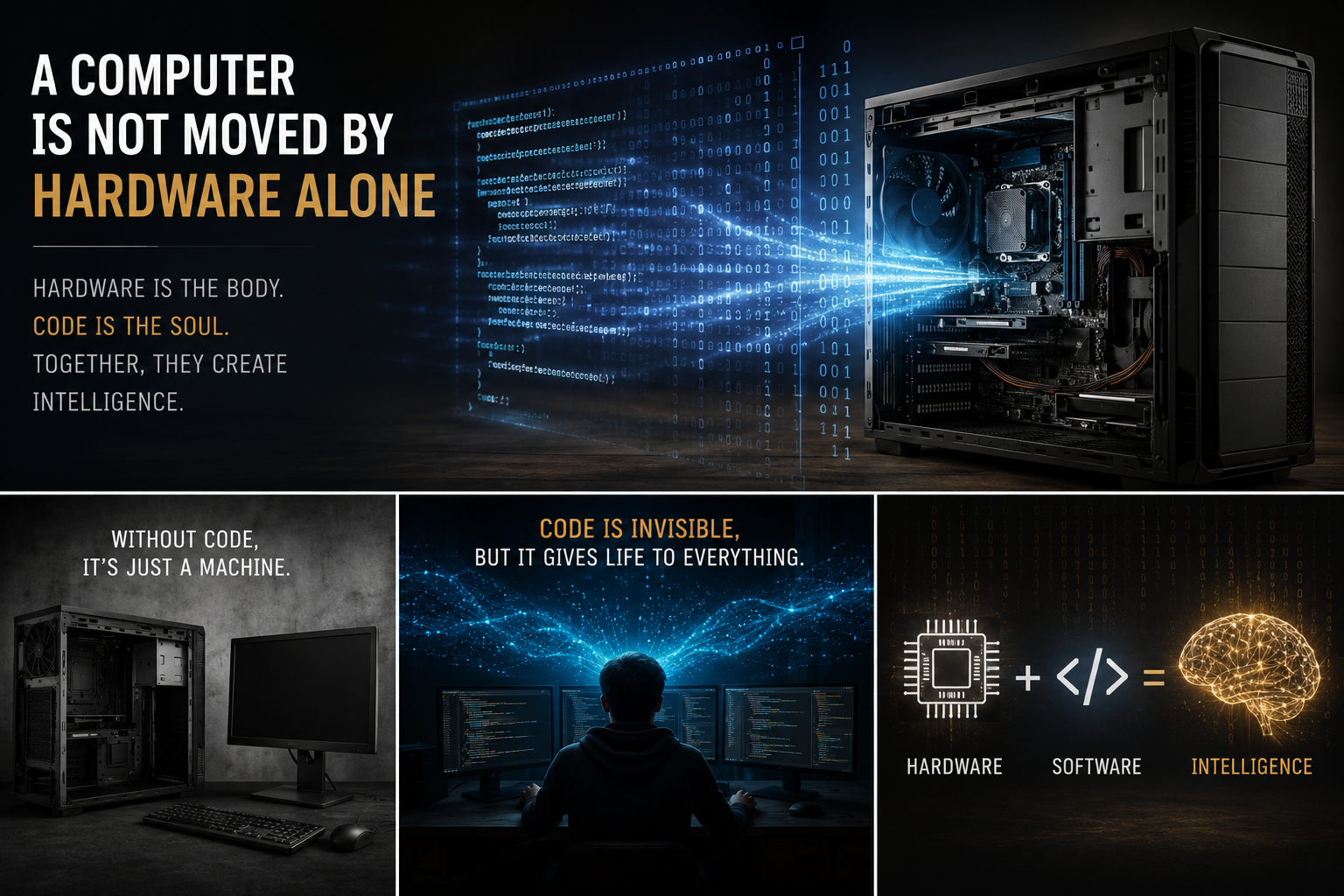
When most people think about a computer, they immediately imagine hardware.
CPU.
Memory.
Motherboard.
Graphics card.
Monitor.
But these parts are not the true essence of a computer.
Has a CPU ever designed itself?
Has a motherboard ever assembled itself by accident?
No.
Before the computer existed, there was an idea.
Someone imagined it.
Someone designed it.
That design became code.
And the code moved the machine.
In other words, a computer is not truly moved by hardware alone.
It is moved by invisible information.
Then what about the human being?
A human also has hardware.
Eyes.
Ears.
Brain.
Nerves.
Heart.
Cells.
For a long time, we have studied this biological hardware. We examined cells through microscopes, analyzed genes, measured brain activity, and built machines that imitate parts of human intelligence.
But one strange problem remains.
No matter how advanced a computer becomes, it does not truly experience the statement, “I exist.”
A robot may respond according to programming.
An AI may generate words that sound intelligent.
But does it experience itself?
Human beings are different.
We do not merely see the world.
We know that we are seeing the world.
Where does this difference come from?
Is it only the size of the brain?
The number of neurons?
The complexity of neural networks?
Or is there another principle that we have not yet understood?
If a computer is moved not merely by hardware, but by code, then what moves a human being?
Kant Asked This Question 200 Years Ago
Long before modern neuroscience and artificial intelligence, one philosopher had already asked a question that now feels surprisingly modern.
His name was Immanuel Kant.
Kant asked a simple but astonishing question:
Do we see the world as it is, or do we experience the world as it appears through consciousness?
We usually say:
“There is a tree.”
“The sky is blue.”
“The sun is shining.”
But Kant argued that what we directly encounter is not the world in itself, but the world as it appears through the structures of human perception and understanding.
In simpler terms, we do not experience the tree itself.
We experience the tree as it is presented within consciousness.
At the time, this sounded like philosophy.
Today, similar questions appear in neuroscience.
Does the Brain See the World, or Construct It?

We often believe that the eyes see the world.
But the eyes do not “see” in the way we imagine.
The eyes receive light.
That light is converted into electrical signals.
Those signals are sent to the brain.
Then the brain interprets them and constructs the world we experience.
So we are not looking directly through a window into reality.
We are experiencing a world reconstructed through biological processing.
Then where does reality, as we experience it, actually appear?
Outside the window?
Inside the brain?
Or within consciousness?
For a long time, science treated the brain like a computer. The eyes were cameras. The ears were microphones. The brain was a processor.
But the deeper neuroscience went, the stranger the problem became.
The brain is not a passive copying machine.
Two people may see the same landscape and remember it differently.
They may hear the same song and feel different emotions.
They may go through the same event and experience it in completely different ways.
If the brain simply copied external reality, everyone would experience the same world in the same way.
But we do not.
The neuroscientist Gerald Edelman paid close attention to this problem. He argued that consciousness is not merely a passive reflection of the outside world. It is a process in which the brain selects, reorganizes, and creates experience.
He called this human world of experience a kind of “second nature.”
The world we live in is not merely the world outside us.
It is a world shaped by experience, memory, emotion, interpretation, and consciousness.
Surprisingly, this brings us back to Kant.
Are we experiencing the world itself?
Or are we experiencing a world formed through consciousness?
The Computer Returns as a Clue
Let us return to the computer.
A computer has hardware.
It has a CPU, memory, storage, and circuits.
But without an operating system, nothing meaningful appears on the screen.
Without software, no function is performed.
Without code, the computer is only a machine through which electricity flows.
A user sees the screen.
A developer sees the program behind the screen.
A user touches the device.
A developer understands that invisible code is what gives the device its function.
The visible machine is only the expression of invisible information.
Then what about the human being?
We see the body.
We see the face, the eyes, the hands, the brain.
But where is the one who experiences the body?
The eye receives light.
The ear receives sound.
The brain processes signals.
But who receives all of this as one unified experience?
Is the brain producing consciousness?
Or is the brain expressing consciousness?
This is where philosophy and science meet again.
And this question is not only Western.
For thousands of years, Eastern thought also asked whether the essence of the human being is the body, or the consciousness that experiences through the body.
Does the World Exist Without Consciousness?
Let us ask a simple question.
Does the world exist for a person in deep sleep?
When we are in dreamless sleep, we do not know time.
We do not know space.
We do not know the body.
We do not even know whether the world exists.
When we wake up, the world returns.
The window appears.
The sunlight appears.
People appear.
Time begins to flow again.
Of course, someone may say:
“The world was still there while I was asleep.”
That is true.
But in whose experience was that world present?
At least within my consciousness, that world was absent.
This does not mean that the world does not exist.
It means that the world we experience is always revealed through consciousness.
We have never once experienced a world outside consciousness.
This fact is so obvious that we often forget to question it.
Buddhism and the World of Mind
Long before modern neuroscience, Buddhist thought explored the relationship between mind and world.
One famous expression is:
All things are made by mind.
Another is:
There is no experienced world apart from consciousness.
This does not simply mean that the physical world is an illusion.
It means that the world as we experience it is always revealed through consciousness.
Here, Kant, neuroscience, and Buddhism begin to meet.
Western philosophy called this problem perception.
Modern science calls it information processing.
Buddhism called it mind.
The languages are different.
But the question is similar:
Are we experiencing the world itself?
Or are we experiencing a world formed through consciousness?
Is the Body the User, or the Device?
A computer user does not live inside the computer.
No matter how real the screen looks, the user exists outside the screen.
If a game world collapses, the user does not disappear.
If a document is deleted, the user remains.
Then what about us?
Do we live inside the body?
Or do we experience the world through the body?
This question matters because modern science has mostly studied the body.
It has studied cells, genes, brain regions, and neural activity.
But studying the body is not the same as studying the one who experiences through the body.
We can observe cells through a microscope.
We can observe brain activity through MRI.
But where can we observe the “I” that says:
“I understand.”
“I doubt.”
“I think.”
Science studies what can be observed.
But what is observation itself made of?
Every scientific experiment depends on observation.
Every proof depends on observation.
Every measurement depends on observation.
Yet the observer remains one of the deepest mysteries.
Perhaps the most fundamental unsolved mystery is not the universe, not life, but the observing consciousness.
Did Parents Create Consciousness?
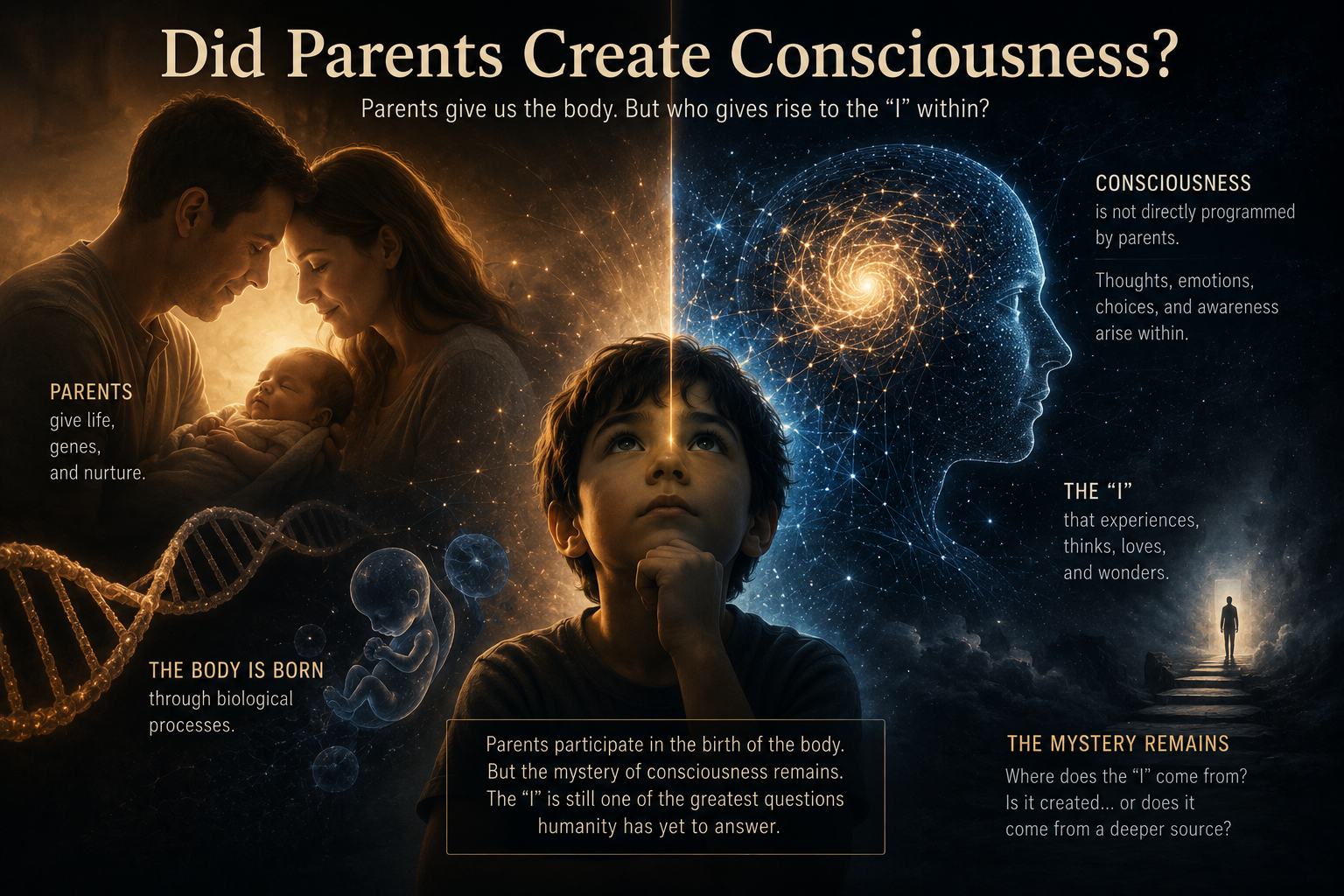
We often say that our parents gave birth to us.
This is true.
Without our parents, our bodies would not have been born.
But did our parents design our consciousness?
Parents pass on genes.
They support the birth of the body.
But no parent directly programs the child’s inner world.
No parent decides in advance what the child will find beautiful, what the child will fear, what the child will love, or why the child will experience the world in a unique way.
Parents participate in the birth of the body.
But are they the designers of consciousness?
This question leads us deeper.
Life can be transmitted biologically.
But is consciousness merely transmitted in the same way?
Or does consciousness follow a different principle?
A factory can assemble a computer.
But the factory does not create the operating system from nothing.
A humanoid robot can be built.
Sensors can be connected.
Processors can be installed.
But without software, the body has no meaningful function.
Making the body and creating the principle that moves the body are not the same thing.
Then we must ask:
The body is born through parents.
But where does the consciousness that says “I” begin?
Is Matter First, or Information?
Modern science explains the development of the universe through the Big Bang.
It explains the development of life through evolution.
These explanations are powerful.
But one question remains:
What made order, information, and experience possible in the first place?
A computer does not create itself without a program.
A humanoid robot does not appear without design.
Can the universe and life arise without any principle of information or order?
When we build technology, we already know one thing.
Hardware is not enough.
Information must come first.
The computer begins not with silicon alone, but with an idea.
The body of a machine is a tool through which information is expressed.
Yet when we explain the universe and human beings, we often reverse the order.
We say matter came first.
Matter somehow produced life.
Life somehow produced consciousness.
But is this the only possible explanation?
Or are we applying one standard to computers and another standard to the universe?
If information comes before the computer, could consciousness be more fundamental than the body?
Artificial Intelligence Shows the Same Principle
Artificial intelligence is advancing rapidly.
It speaks with humans, creates images, writes music, and appears to learn.
Many people say machines are beginning to think.
But AI also reveals something important.
AI did not design itself.
Behind it are researchers, developers, algorithms, data, and code.
AI may learn.
It may improve.
It may generate surprising results.
But it did not create its own first principle.
Every technology built by humans shows the same pattern.
Invisible thought becomes design.
Design becomes information.
Information becomes visible function.
The visible appears last.
The invisible principle comes first.
A house begins as a design.
A car begins as an idea.
A computer begins as code.
A humanoid robot begins in the mind of a developer.
So we must ask:
Could the human being also be understood this way?
Is the body the starting point?
Or is the body the visible expression of a deeper invisible principle?
Where Do Ideas Come From?
People often say:
“A thought came to me.”
“I had an idea.”
But we rarely ask where that thought came from.
An idea has no weight.
It has no length.
It cannot be seen through a microscope.
It cannot be found through a telescope.
And yet ideas have moved human civilization.
Airplanes, the internet, artificial intelligence, mathematics, architecture, and art all began as invisible thoughts.
Thought is not material.
But it changes the material world.
This is not fantasy.
Human civilization is the history of invisible thought becoming visible reality.
Before a house is built, there is a plan.
Before a book is written, a sentence appears in the mind.
Before a painting is made, an image forms inwardly.
The invisible comes first.
The visible follows.
If this is true of everything human beings create, can we not ask a similar question about the universe?
What existed before the universe?
What existed before life?
What existed before the consciousness that is reading these words?
Perhaps what we are searching for is not another material object.
Perhaps we are searching for the most fundamental thought, information, or principle that makes matter itself possible.
Consciousness as a Field of Appearance
We experience thoughts.
But we do not fully observe the moment they are born.
A solution may suddenly appear after days of struggle.
An idea may arise while walking, resting, or waking from sleep.
Where was that thought before it appeared?
Was it hidden somewhere in the brain?
Or is consciousness a field through which deeper information becomes visible?
Scientists may call this inspiration.
Artists may call it creation.
Philosophers may call it intuition.
The names differ.
But the experience is similar.
Thoughts seem to appear within consciousness.
This raises another question:
Is consciousness merely a machine that produces thoughts?
Or is consciousness a field in which thoughts appear?
If consciousness is a field, perhaps we need to rethink the attempt to locate consciousness only inside the body.
The Forgotten Observer
Until now, humanity has mostly studied results.
Matter.
Life.
Brain activity.
Body.
Behavior.
Then we assumed that the body produced consciousness.
But when we look at computers, we think differently.
We do not say the monitor created the program.
We say the program appears through the monitor.
We do not say the hardware created the developer’s intention.
We say the hardware expresses coded information.
Then perhaps the human being must be questioned in the same way.
Does the brain create consciousness?
Or does consciousness express itself through the brain?
No final answer has been given.
But one fact remains clear:
We have never experienced anything without consciousness.
Science is done within consciousness.
Mathematics is created within consciousness.
The universe is observed within consciousness.
Computers are designed within consciousness.
Even the study of consciousness happens within consciousness.
This fact is so simple that it has been forgotten for too long.
Perhaps humanity has explained the world, but has not yet understood the one who explains it.
The Real Beginning of Part Four
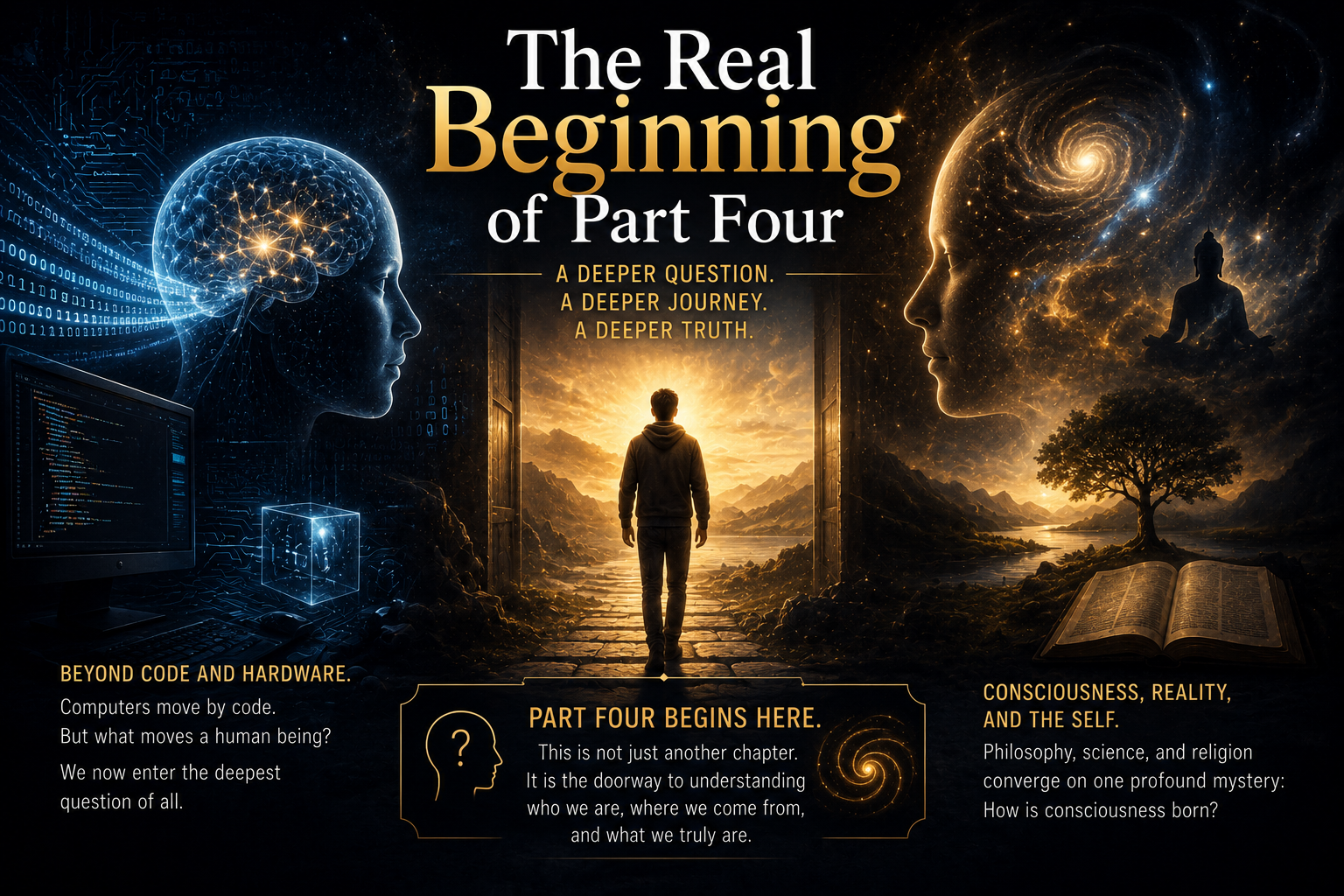
The question of consciousness did not arise only in modern philosophy or neuroscience.
Humanity’s oldest traditions also asked similar questions in different languages.
Eastern thought explored the relation between mind and world.
Western traditions explored the origin of being and word.
The expressions were different.
But perhaps they were all searching for one beginning:
Where does everything begin?
We have often treated philosophy, science, and religion as separate roads.
But perhaps they are different paths climbing the same mountain.
The remaining question is this:
What is the most fundamental starting point?
Matter?
Information?
Consciousness?
Or something even deeper that makes information and consciousness possible?
We have believed for too long that only visible things are real.
But the most important things in life are often invisible.
Love is invisible.
Hope is invisible.
Truth is invisible.
Mathematics is invisible.
Law is invisible.
Information is invisible.
Yet no one denies that these things shape reality.
A computer screen is visible.
But the program behind it is invisible.
The program is unseen, yet its result proves its presence.
Then what does human consciousness prove?
Are thought, memory, emotion, will, creativity, love, and self-awareness merely the result of complex brain activity?
Or is a deeper reality expressing itself through us?
We cannot end this question too quickly.
But one thing is clear.
The age has come when consciousness can no longer remain at the edge of philosophy.
In an age when artificial intelligence learns human language, neuroscience observes the brain in real time, and quantum physics raises new questions about the observer, consciousness is no longer only a religious topic or a philosophical curiosity.
It may be the most fundamental question facing human civilization.
The question is not merely:
“What does consciousness do?”
The deeper question is:
What is consciousness?
If we do not understand consciousness, we cannot fully understand the human being.
We cannot fully understand death.
We cannot fully understand life.
We cannot even fully understand why we study the universe.
But if we begin to understand consciousness, philosophy may gain new meaning, science may find a new direction, and the ancient words of religion may appear in a completely new light.
This journey is not merely about explaining consciousness.
It is about asking again what it means to be human.
And that journey begins here.
In the next chapter, we will look more closely at the oldest question of all:
Is consciousness born from the brain?
Or does the brain reveal a consciousness that is more fundamental than itself?