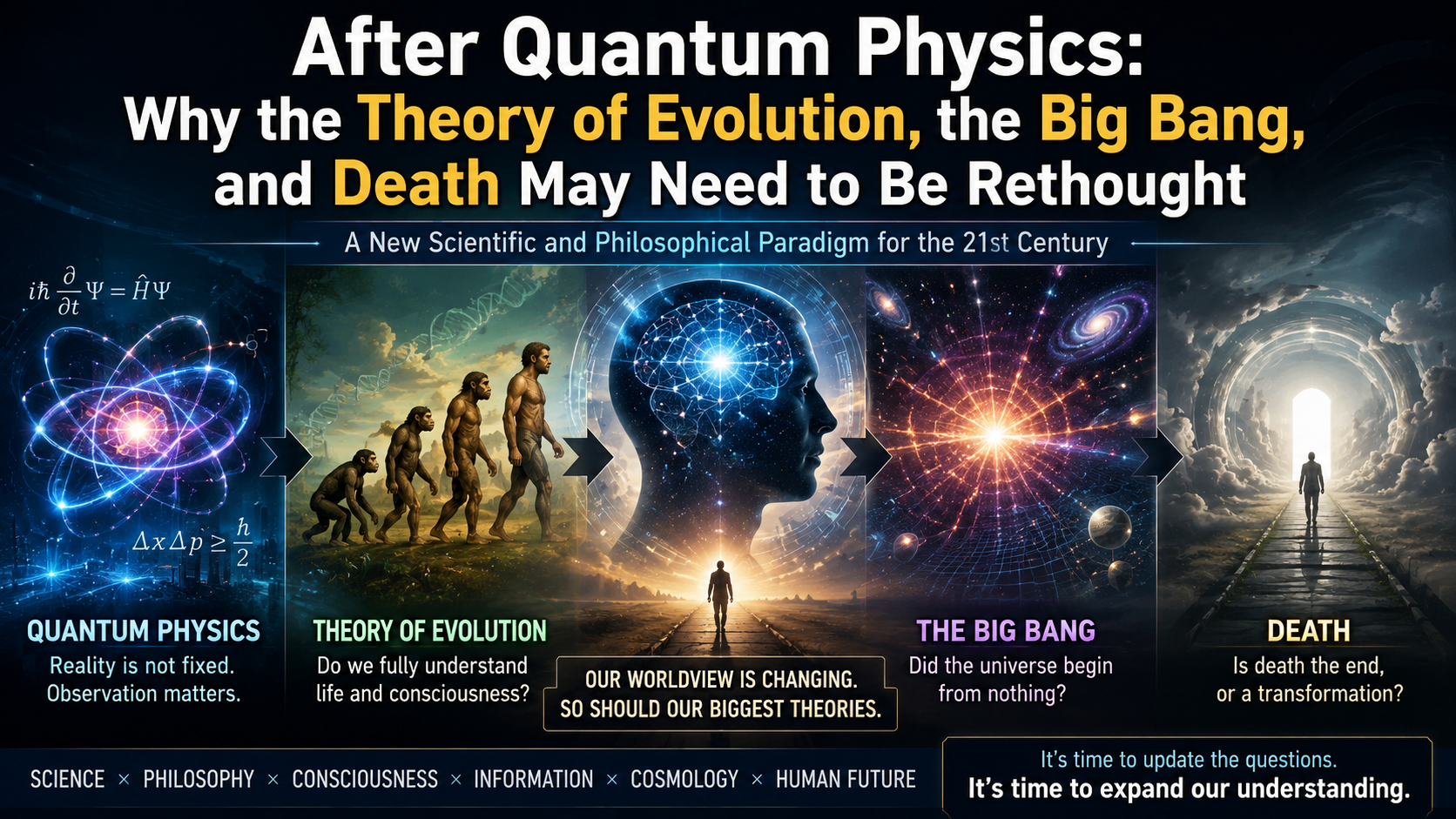
When a computer’s central processing unit or graphics card is upgraded, the system bus, memory, operating system, and the entire software ecosystem closely synchronize to sequentially elevate overall performance. Similarly, physical mechanisms in the natural world operate as a tightly interconnected network, where the fall of a single domino triggers a chain reaction that drives a state change across the entire system. In the domain of human academic disciplines, however, such an organic, interconnected system has failed to smoothly take effect. Crossing academic barriers to examine the sequential propagation of paradigm shifts, this report aims to establish a forum for discourse toward scholarly synchronization. Furthermore, it seeks to interdisciplinarily examine how the revolutionary discoveries of modern physics demand successive ruptures and reconstructions across evolutionary theory, cosmology, and our understanding of life and death.
The Stagnation of Scholarly Interconnection Systems and the Ideological Trajectory of Classical Materialism
The metrics by which humanity perceives and defines the world have been thoroughly driven by scientific standards. Starting from the natural philosophy of ancient Greece, science branched out into individual academic disciplines, ultimately progressing toward maximizing mechanistic materialism in the realm of micro-physics. In particular, the atomic theory represented by Richard Feynman ideologically entrenched the reductionist belief that the foundation of the universe is composed of indivisible, hard physical atoms. This physicalism, passing through Isaac Newton’s classical theory of gravity, became the foundation for viewing physical reality as the linear collision of billiard-ball-like particles existing independently within a fixed spacetime background.
Even after Einstein’s theory of relativity proved the relative variability of spacetime, and pioneers like Schrödinger and Heisenberg clarified the wave-particle duality and probabilistic superposition of microscopic particles through quantum mechanics, biology and adjacent disciplines remained stagnant in a 19th-century mechanistic view of matter. For example, Gerald Edelman’s modern neuroscience and Neural Darwinism have still relied entirely on the classical, electrochemical causality of physical synaptic networks of neurons to define consciousness and mental phenomena. This classical neurobiological paradigm—where a physical brain machine operates to emerge the mind as a mere epiphenomenon—stands as a prime example of academic interconnection failure, having failed to synchronize with the paradigm shifts occurring in the underlying layers of physics.
The Paradigm Shift from Matter to Relations, Information, and Loops
The forefront of modern physics has brought a complete end to the claim that the essence of the world consists of independent, fixed matter. Carlo Rovelli’s Relational Quantum Mechanics (RQM) demonstrates that the ‘state’ of any physical system is not an independently pre-existing physical entity, but a relative property temporarily defined solely through its interactional ‘relations’ with other physical systems. Similarly, Loop Quantum Gravity (LQG) has revealed that the universe is not composed of matter embedded in a continuous spacetime background. Instead, it is a structure where spacetime and matter emerge through an interaction network of microscopic gravitational quanta—or ‘loops’—discretely entangled at the Planck scale.
This relational physics resonates perfectly with John Archibald Wheeler’s information-physics manifesto, the ‘It from Bit’ paradigm. The physical reality of the universe (“It”) does not exist on its own; rather, it emerges through the binary questions posed via observational intervention and the subsequent registration of equipment-elicited answers (“Bit”). The Holographic Principle, developed by Leonard Susskind and Gerard ‘t Hooft, mathematically proves that all physical information within a three-dimensional space is a holographic projection of data encoded on a lower-dimensional boundary surface, declaring that the foundation of the universe is not solid matter but information and conceptual networks of relations.
| Physics Paradigm | Classical Mechanistic Materialism | Relational Quantum Mechanics (RQM) | Information Cosmology (It from Bit) |
|---|---|---|---|
| Fundamental Reality (Ontology) | Independent and fixed physical atoms | Relative relations and interactions between physical systems | Binary information patterns determined through questions and answers |
| Nature of Spacetime | Absolute and continuous geometric background | Discrete emergence through the entanglement of graviton loops | Holographic projection of lower-dimensional boundary information |
| Status of the Observer | Simple and passive measurer of physical quantities | Physical reference frame mediating the relational network | Participatory agent directly determining reality |
| Intrinsic Status of Laws | External and deterministic mechanical apparatus | Laws governing the maintenance of local correlations | Coordination between the architecture of conservation (Authority) and dynamics (Liberty) |
The Inevitable Revision of Evolutionary Theory Following the Collapse of Material Premises
As the essence of the world shifts from fixed matter to a product generated by the interaction between the observer and information, one of the first disciplines that must undergo a fundamental revision is evolutionary theory. Traditional Neo-Darwinian evolutionary theory is rooted in a strict classical materialism of random mutations in DNA—the physical substance holding genetic information—and mechanical natural selection driven by external environmental pressures. However, empirical discoveries in modern quantum biology demonstrate that living systems actively optimize their survival and adaptive efficiency by operating advanced quantum control mechanisms at the microscopic level, such as quantum coherence, quantum tunneling, and quantum entanglement.
Representative examples include light energy transfer within the Fenna-Matthews-Olson (FMO) complex of photosynthetic bacteria, which is optimized through quantum coherent pathway superpositions, and the magnetic field detection of migratory birds, which relies on changes in the entangled spin states of radical pairs inside cryptochrome proteins. In particular, the theory of quantum evolution established by molecular microbiologist Johnjoe McFadden revealed that proton tunneling within the hydrogen bonds of DNA base pairs serves as the starting point for spontaneous mutations. According to McFadden’s model, the genomic wavefunction inside a cell triggers ‘adaptive mutation’—directing and determining the mutation rate of specific genes to suit the environment—through metabolic interactions (quantum measurement and decoherence) with specific environmental substrates.
$\Psi_{CG}=a|F_{\text{not tun}}\rangle|C\rangle+b|F_{\text{tun}}\rangle|T\rangle$
As this equation suggests, the foundation of mechanistic evolutionary models that relied on chance and randomness has crumbled. Consequently, a total revision toward the Extended Evolutionary Synthesis (EES) paradigm—which advocates for developmental bias, inclusive inheritance, and active niche construction—has become inevitable. Life must be redefined not as passive matter mechanically filtered out by selection, but as a dynamical information-processing system that strives for complexity by interacting with the universe’s informational structure at the level of quantum coherence.
| Evolutionary Paradigm | Modern Synthesis (Neo-Darwinism) | Quantum Evolution & Extended Evolutionary Synthesis (EES) |
|---|---|---|
| Origin of Variation | Replication errors and random mutations driven by classical physical causality | Wavefunction superposition and transition relying on microscopic proton tunneling |
| Mechanism of Adaptation | Retrospective and mechanical filtering via natural selection | Induction of adaptive variation through interaction (decoherence) with environmental substrates |
| Direction of Causality | Unidirectional, top-down physical causality (DNA -> Phenotype) | Multidimensional and reciprocal causality among organism, development, and environment |
| Ontological Status of Life | Passive mechanical object subordinate to external physical selection pressures | Active information-processing system with quantum coherence and developmental bias |
The Dissolution of the Big Bang Singularity and Loop Quantum Cosmology
Big Bang cosmology also exhibits severe fractures upon the collapsed premises of classical materialism. The standard Big Bang theory, based on Einstein’s general theory of relativity, derives a hypothetical physical starting point when the history of the universe is traced backward—a Big Bang Singularity where the physical volume becomes zero and the density and spacetime curvature diverge to infinity. However, this is merely a theoretical distortion and a confession of limitation brought about by a geometric view of matter that assumes continuous spacetime and infinite divisibility.
Loop Quantum Cosmology (LQC) has demonstrated that when the density of the universe reaches the Planck density limit (ρPl≈ 5.1 x 10^96 kg/m³), gravity switches its sign from a classical attractive force to a powerful quantum-theoretical repulsive force (Effective Repulsive Force). As a result, the scenario of a mechanical explosion out of spacetime nothingness dissolves through rigorous physical and mathematical calculations.
$\left(\frac{\dot{a}}{a}\right)^2=\frac{8\pi G}{3}\rho\left(1-\frac{\rho}{\rho_{Pl}}\right)$
As specified in the dynamical equation above, the universe stops contracting at the critical Planck density and undergoes an elastic re-expansion known as the ‘Big Bounce.’ Consequently, the universe is not simply a collection of matter expanding inside a box called spacetime; rather, it is reorganized as an eternal and interactive informational phase-transition system that compresses and circulates information within infinitesimal critical limits.
The Ontological Revision of Human Death in a Consciousness-Driven Reality
The point where the most violent paradigm domino effect occurs is precisely the conceptual definition of human ‘Death.’ In the mechanistic-materialist view of life and death, death was merely a terminating event where the physical machine of the organism wears out, causing the biochemical operations of the organs to cease and the electrical signaling networks inside brain cells to permanently dissolve. In other words, this perspective posits that because consciousness is merely a sophisticated electrical epiphenomenon secreted by the brain—a highly advanced physical apparatus—the self and state of awareness permanently vanish once the machine is disassembled. However, in a paradigm-shifted structure where the observer and consciousness govern the fundamental reality of the universe, the conventional definition of death inevitably faces scientific bankruptcy.
According to the Orchestrated Objective Reduction (Orch-OR) theory proposed by Roger Penrose and Stuart Hameroff, human conscious awareness is generated non-computationally through the self-collapse of macroscopic quantum superpositions occurring inside microtubules, which are protein polymers within brain neurons. The rate of this collapse follows the Diósi-Penrose criterion, and consciousness is directly coupled with the fundamental Planck-scale quantum geometry of spacetime, transcending mere physical synaptic electrical impulses.
$\tau\approx\frac{\hbar}{E_G}$
Applying this theory to the moment of biological cardiac arrest and brain death triggers a remarkable ontological transition. When the heart stops beating and blood flow to the brain ceases, the physical quantum states within the microtubules lose their coherence (decoherence) and collapse. However, what is destroyed in this process is merely the local physical conductor—the neurons—while the core information patterns of the self, encoded as quantum information inside the microtubules, do not completely perish with the destruction of the physical machine. Grounded in the law of conservation of information, which states that fundamental physical information in the universe can never be destroyed, the quantum information inside the microtubules escapes the physical body to return and disperse fully into the non-local quantum-geometric information network of the universe.
Furthermore, Robert Lanza’s Biocentrism proves that space and time are not hard, independent external objects, but rather ‘mental filters and tools’ used by human consciousness to organize and synthesize reality. As demonstrated by delayed-choice experiments—where active perception and observational acts in the present transcend temporal boundaries to retroactively determine the actual physical paths of past photons—death as a fixed destination on a linear timeline simply does not exist in our cosmic structure.
The roughly 20-watt pattern of conscious energy awareness in the human body can only change forms and cannot be completely extinguished. Therefore, at the point of disconnection when the biological body reaches its functional limits, the human observing subject does not sink into eternal darkness. Instead, the observer naturally “slides” into another branching dimension of spacetime among the infinite coexisting pathways in the Multiverse where the ontological observation of the self remains valid, thereby continuously maintaining informational continuity.
| Category | Materialistic Limit View | Quantum and Information-Physics Reality View |
|---|---|---|
| Basic Definition of Death | Permanent cessation of biochemical metabolism and irreversible extinction of the self | Local phase transition of spacetime continuity and non-local transfer |
| Ontological Status of Consciousness | Passive byproduct generated by chemical reactions within the physical brain cell network | Intrinsic property of the universe coupled with the fundamental Planck spacetime geometry |
| Fate of Post-mortem Information | Completely volatilizes as the electrical signals of the neuronal network dissipate | Permanently returns to the non-local spacetime field in accordance with the law of conservation of information |
| Spacetime Continuity of Self | Severed at a linear stop-point in absolute physical time | Temporal transcendence using consciousness as a tool, and transition to coexisting paths in the Multiverse |
Conclusion: Proposals for Triggering the Academic Domino Effect
The physical structure of the universe identified in this report no longer permits isolated academic disciplines to remain complacent behind their own custom walls of materialism. The relational, informational, and observer-centric paradigm shifts that occurred in the underlying layers of physics entail interdisciplinary chain reactions—rejecting the randomness hypothesis of classical Darwinian evolutionary biology and completely transforming the Big Bang singularity into a model of continuous, circulating cosmic information bounces. Furthermore, it has driven a thorough revolution in our understanding of life and death—which was previously constrained by classical mechanistic orders—guiding it toward the acquisition of cosmic conservation of information and multiversal continuity.
The physical reality of spacetime we confront and sense is by no means an independently pre-existing, fixed matter. Instead, it is a highly compressed information-rendering screen interpreted by the cognitive filters of humanity. Academic communities must acknowledge this physical reality and achieve a companion upgrade of interdisciplinary synchronization, akin to the systematic co-advancement of upgraded computer hardware. By dismantling the collapsed walls of materialism and establishing information, relations, and participatory consciousness as the fundamental pillars of scholarship, the human system of knowledge will transcend its fragmented limitations. Ultimately, it will rise into a single, coherent wholeness that perfectly reflects the fundamental dynamics of the universe.