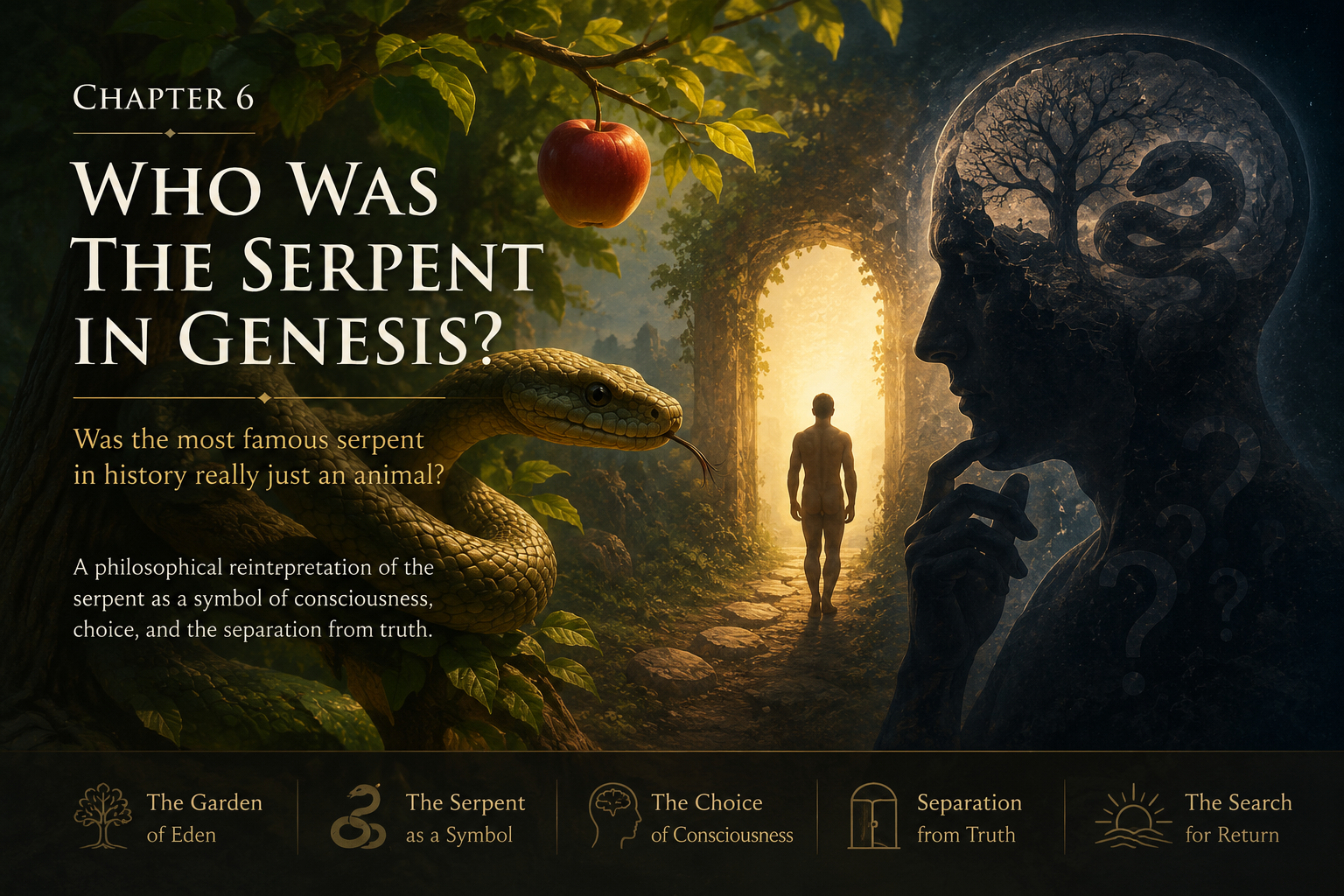
Chapter 6
Was the most famous serpent in history really just an animal?
Few symbols have shaped human civilization as profoundly as the serpent in the Book of Genesis.
According to Genesis, humanity’s encounter with the serpent marked the beginning of death, suffering, and separation from God.
For thousands of years, this story has been read by billions of people.
Yet one fundamental question has never disappeared.
Was the serpent in Genesis really just an animal?
If it was nothing more than a literal creature, another question naturally follows.
Why would God allow a single animal to become the cause of humanity’s greatest tragedy?
Why would the Bible explain the origin of human suffering through the actions of one serpent?
These questions are far more than religious curiosities.
They are philosophical questions about human existence itself.
The Serpent Appears Beyond the Bible
Surprisingly, the Bible is not the only ancient text that speaks of a serpent as the source of humanity’s deepest problem.
The Korean prophetic text Gyeokamyurok presents a strikingly similar idea.
Rather than describing a serpent in a garden, it speaks of “the serpent within human beings.”
Genesis tells the story of the serpent in Eden.
Gyeokamyurok speaks of a serpent hidden within the human heart.
These two texts emerged from entirely different cultures and historical periods.
Yet both use the same symbol to explain the origin of humanity’s suffering.
Is this merely a coincidence?
Or could different civilizations have been expressing the same truth through different symbolic languages?
This question forms the starting point of our inquiry.
Why Does the Bible Speak Through Symbols?
The Bible is filled with symbolic language.
Trees.
Light.
Water.
Sheep.
The vine.
Few readers interpret all of these literally.
Jesus Himself frequently taught through parables rather than direct explanations.
This suggests that Scripture may not function only as a historical record.
It may also communicate profound truths about consciousness and human existence through symbolic language.
If that is true, then perhaps the serpent should also be understood symbolically.
Perhaps the serpent is not merely an animal.
Perhaps it represents something taking place within every human being.
What Does the Serpent Represent?
If the serpent is symbolic, what exactly does it symbolize?
Across many cultures, serpents have represented temptation, deception, attachment, desire, pride, and self-centeredness.
Although these ideas appear different, they share one common characteristic.
Each has the power to pull human consciousness away from truth.
Significantly, the serpent’s first act in Genesis is not violence.
It begins by planting doubt.
It invites humanity to question the truth that had already been given.
Perhaps this is the real focus of the Genesis narrative.
The central issue is not the serpent itself.
The deeper question is this:
What does human consciousness choose to believe?
And how does that belief shape the reality we experience?
A New Perspective from the Consciousness Field Theory
The Consciousness Field Theory does not attempt to prove that the serpent was—or was not—a historical animal.
Nor does it seek to reject traditional religious interpretations.
Instead, it offers a philosophical possibility.
If the serpent symbolizes the movement of consciousness away from truth, then the story of Genesis is not simply describing an event that happened long ago.
It is describing something that continues to unfold within every human being today.
Viewed from this perspective, Genesis becomes far more than an ancient story.
It becomes a mirror reflecting the structure of human consciousness itself.
(To be continued in Part Two.)
The Tree of the Knowledge of Good and Evil
As the story of Genesis unfolds, the serpent leads humanity to another powerful symbol: the Tree of the Knowledge of Good and Evil.
For centuries, many readers have understood this tree as a literal tree standing in the middle of the Garden of Eden.
Yet another important question arises.
If God truly loved humanity from the beginning, why would He place a tree capable of bringing death at the very center of the garden?
The Consciousness Field Theory approaches this question from a symbolic perspective.
Perhaps the Tree of the Knowledge of Good and Evil does not represent a botanical object.
Perhaps it represents a state of consciousness.
It may symbolize the moment when human beings begin to judge reality according to themselves rather than according to ultimate truth.
If so, the true issue was never the fruit.
The deeper question has always been this:
What becomes the standard by which we understand reality?
That is the philosophical question hidden within the Genesis narrative.
Where Did Death Really Begin?
Genesis tells us that death entered human history through the serpent’s temptation.
But what exactly is meant by “death”?
Is it merely the end of biological life?
Or does the word point toward something far deeper?
Throughout the Bible, death is often described not only as the end of physical existence, but also as separation from God, separation from truth, and separation from the source of life itself.
Viewed from this perspective, death may represent more than the cessation of bodily functions.
It may describe a condition in which consciousness becomes disconnected from its original source.
This interpretation does not deny biological death.
Rather, it asks whether physical death is the whole story.
The Serpent Within Human Consciousness
Here, the Korean prophetic text Gyeokamyurok becomes especially intriguing.
Instead of locating the serpent outside the human being, it speaks of a serpent within.
This image carries profound philosophical meaning.
The greatest forces that shape human life often arise not from the outside world, but from within.
Desire.
Attachment.
Fear.
Pride.
Self-centered thinking.
These are not external enemies.
They emerge within human consciousness itself.
From this perspective, the serpent becomes a universal symbol of the inner patterns that distance us from truth.
Where the Bible and Eastern Thought Meet
The Bible and the Eastern prophetic traditions were written in different civilizations.
They speak different languages.
They belong to different historical worlds.
Yet both suggest something remarkably similar.
The deepest problem of humanity is not merely external.
It begins within.
Is this similarity accidental?
Or could different civilizations have been describing the same structure of human consciousness through different symbolic traditions?
The Consciousness Field Theory does not claim to prove this conclusion.
Instead, it invites us to explore the possibility with philosophical openness.
The Sixth Proposition of the Consciousness Field Theory
The Consciousness Field Theory proposes the following philosophical possibility:
The serpent in Genesis may symbolize not merely an external creature, but the movement of human consciousness away from truth.
This proposition is not intended to invalidate traditional religious interpretations.
Nor does it claim to offer the only correct reading of Scripture.
Its purpose is different.
It invites us to read Genesis not only as sacred history, but also as a profound exploration of consciousness, existence, and human perception.
Perhaps Genesis is not simply telling us about humanity’s distant past.
Perhaps it is describing the inner reality of every human being living today.
Preview of Chapter 7
Does Time Really Exist?
We experience time every moment of our lives.
It appears obvious.
It appears undeniable.
Yet philosophy and modern physics have both begun to ask a surprising question.
What if time is not an independent reality, but the very framework through which consciousness experiences the world?
In the next chapter, we will explore time through the perspectives of Immanuel Kant, modern physics, and the Consciousness Field Theory, asking whether time belongs to the universe itself, or whether it belongs first to consciousness.
Chapter 7
Does Time Really Exist?

Is the one thing we trust most actually real?
From the moment we are born, we live within the experience of time.
Morning becomes afternoon.
Afternoon becomes evening.
The seasons change.
Children become adults.
Everything around us appears to move through the continuous flow of time.
For most people, time seems so obvious that it hardly requires explanation.
Yet philosophy has asked a remarkably different question for centuries.
Does time truly exist as an independent reality?
Or is time simply the framework through which the human mind organizes experience?
This question is not merely philosophical.
It lies at the very foundation of how we understand reality itself.
Kant Looked for Time Within Consciousness
Among the great philosophers of history, Immanuel Kant offered one of the most revolutionary ideas about time.
Rather than treating time as something that exists independently in the external world, Kant argued that time is an a priori form of human intuition.
In other words, time is not something we discover.
It is something through which we experience everything else.
Every memory belongs to the past.
Every perception appears in the present.
Every expectation reaches toward the future.
Yet all of these experiences occur within consciousness.
If Kant was correct, then we never encounter time by itself.
We encounter reality through the structure that consciousness calls time.
A New Perspective from the Consciousness Field Theory
The Consciousness Field Theory extends this philosophical question one step further.
If time is fundamentally connected to consciousness, then what we call “time” may not be one of the basic building blocks of the universe.
Instead, it may be one of the primary ways consciousness organizes and interprets reality.
This theory does not deny the existence of time.
Rather, it asks a deeper question.
Do we experience time?
Or does consciousness actively construct the experience of time itself?
The difference is profound.
If consciousness participates in the creation of temporal experience, then many assumptions about reality deserve to be reconsidered.
Modern Physics Has Also Begun to Question Time
Surprisingly, philosophy is no longer alone in asking these questions.
Modern physics has also begun to reconsider the nature of time.
Albert Einstein’s theory of relativity demonstrated that time and space are not separate entities.
Together, they form a unified structure known as space-time.
More recently, several physicists have proposed that time may not be one of the universe’s most fundamental realities.
Instead, it may emerge from deeper physical relationships that exist beyond ordinary human experience.
Although philosophy and physics began from different directions, both have arrived at a remarkably similar destination.
They are asking the same question.
What is time?
And perhaps even more importantly,
What is the relationship between time and consciousness?
(To be continued in Part Two.)
Do We Experience Time, or Do We Construct It?
Consider a simple question.
Is one hour truly the same for everyone?
A joyful hour seems to disappear in a moment.
An hour of suffering can feel endless.
Waiting stretches time.
Deep concentration makes it almost disappear.
The clock measures every hour with perfect consistency.
Human consciousness does not.
This simple observation leads to an important philosophical question.
Is the time we experience an objective feature of reality?
Or is it shaped by the way consciousness interprets the world?
Perhaps what we call “time” is not merely something we pass through.
Perhaps it is also something we actively create through experience.
Can Consciousness Transcend Time?
Dreams provide one of the most fascinating examples.
Within only a few minutes of sleep, people sometimes experience what feels like years of living.
Memories constantly reshape the present.
Expectations about the future influence decisions we make today.
Human consciousness continuously brings the past into the present and allows the future to shape the present before it has even arrived.
Life, therefore, cannot be explained by the movement of a clock alone.
The Consciousness Field Theory proposes that consciousness is not simply trapped inside time.
Rather, consciousness may play an active role in organizing, interpreting, and giving meaning to temporal experience.
Time may not merely contain consciousness.
Consciousness may also participate in the experience we call time.
Why Might Prophecy Be Possible?
This perspective naturally leads to another ancient question.
What is prophecy?
If time is deeply connected with consciousness rather than existing as a completely independent reality, then prophecy may deserve to be understood differently.
This does not suggest that prophecy is a supernatural technique for predicting future events.
Instead, it raises a philosophical possibility.
If a fundamental consciousness exists beyond the ordinary human experience of time, then events that appear to us as “future” may be understood from a broader temporal perspective.
This is not presented as proof.
It is simply an invitation to reconsider whether prophecy may be philosophically possible.
The Seventh Proposition of the Consciousness Field Theory
The Consciousness Field Theory proposes the following philosophical possibility:
Time may not be an absolute reality independent of consciousness. Instead, it may be one of the fundamental forms through which consciousness experiences and understands the world.
This proposition does not deny time.
Rather, it encourages us to question something we have rarely questioned before.
Perhaps the greatest mystery is not time itself.
Perhaps the deeper mystery is the consciousness through which time becomes meaningful.
Preview of Chapter 8
Is Death the End, or a Transition?
If time is inseparable from consciousness,
then perhaps death must also be reconsidered.
Is death simply the end of biological life?
Or is it a transformation in the relationship between consciousness and the body?
In the next chapter, we will explore death, resurrection, and eternal life through philosophy, modern science, religious traditions, and the Consciousness Field Theory.
The journey now moves from the nature of time to the mystery of consciousness itself.
Chapter 8
Is Death the End, or a Transition?
Is death an event of the body, or an event of consciousness?
From the earliest civilizations to the modern world, humanity has feared death.
Every culture has tried to explain it.
Every religion has offered its own vision of what lies beyond it.
Modern science has devoted enormous effort to understanding the biological process of dying.
Yet one question remains unanswered.
What is death?
We usually define death as the moment when the heart stops beating.
Or when brain activity permanently ceases.
These definitions describe what happens to the body.
But they do not fully explain what happens to the one who says, “I.”
Is death truly the end of existence?
Or could it represent another kind of transition experienced through consciousness?
Does Consciousness End When the Body Ends?
Modern medicine has greatly expanded our understanding of the human body.
Cells age.
Organs gradually lose their function.
The brain eventually ceases its biological activity.
These are observable facts.
Yet another question naturally follows.
Does the end of biological function necessarily mean the end of consciousness itself?
At present, science has not reached a definitive answer.
For this reason, philosophy continues to ask questions that science alone cannot yet resolve.
The Consciousness Field Theory does not claim to prove life after death.
Nor does it attempt to establish any religious doctrine as scientific fact.
Instead, it proposes a philosophical possibility.
If consciousness belongs to a deeper level of reality than the physical body, then death may not be the annihilation of consciousness.
It may instead represent a transformation in the relationship between consciousness and the body.
Why Do Nearly All Religions Place Death at Their Center?
One remarkable fact deserves careful attention.
Religions that emerged in completely different cultures often speak about death in surprisingly similar ways.
The Bible speaks of resurrection.
Buddhism speaks of liberation.
Eastern prophetic traditions describe the arrival of a new age.
Their languages differ.
Their historical settings differ.
Yet all of them suggest that the present human condition is not final.
They all point toward the possibility of profound transformation.
Is this merely coincidence?
Or have different civilizations been approaching the same mystery from different directions?
The Consciousness Field Theory invites us to consider this question without rushing toward easy conclusions.
What Does the “First Resurrection” Really Mean?
The Book of Revelation speaks of the First Resurrection.
Traditionally, many readers have understood this as a future historical event.
But another interpretation may also deserve consideration.
What if resurrection first refers to an awakening of consciousness?
What if it describes the moment when human beings move from illusion to truth?
From separation to unity.
From unconscious living to awakened awareness.
Such an interpretation does not reject traditional theology.
Instead, it explores the deeper philosophical meaning that the language of resurrection may also contain.
(To be continued in Part Two.)
What Is Eternal Life?
When people hear the phrase “eternal life,” they often imagine living forever without dying.
But is that what eternal life truly means?
Or could it mean something far deeper?
If, as we explored in the previous chapter, time is fundamentally connected with consciousness, then eternal life may not simply refer to an endless extension of time.
Instead, it may describe a different mode of existence altogether.
Perhaps eternity is not measured by the length of time one lives.
Perhaps it is measured by the depth of consciousness through which life is experienced.
If this possibility is true, then eternal life is not merely a longer life.
It is a transformed way of being.
What Does Death Actually End?
Death undoubtedly brings biological life to an end.
The body ceases to function.
Its physical processes come to a close.
No serious philosophical discussion
Is Prophecy Possible? Rethinking the Future Through Consciousness and Time
SEO Title
Is Prophecy Possible? Rethinking the Future Through Consciousness and Time
URL Slugis-prophecy-possible
Meta Description
Can the future truly be known? Explore prophecy through philosophy, consciousness, time, the Bible, Eastern traditions, and the Consciousness Field Theory.
Chapter 9
Is Prophecy Possible?

Does the future already exist, or is it being created in every moment?
Since the beginning of civilization, human beings have longed to know the future.
Kings sought prophets before making great decisions.
Philosophers reflected on the direction of history.
Religious traditions recorded visions of things yet to come.
Even today, the desire to know tomorrow remains deeply rooted in the human heart.
Yet one simple question continues to challenge us.
Is it really possible to know the future?
Is prophecy merely a superstition inherited from the ancient world?
Or does it point toward a principle that we have not yet fully understood?
We Naturally Assume That the Future Does Not Yet Exist
Most of us experience time in a straightforward way.
The past has already gone.
The present is all that truly exists.
The future has not yet arrived.
This seems obvious because it matches our daily experience.
Yet, as we explored in Chapter 7, if time itself is deeply connected with consciousness, then perhaps our understanding of the future also deserves to be reconsidered.
The Consciousness Field Theory begins by questioning time.
Only then does it ask a new question about prophecy.
Does Fundamental Consciousness Experience Time as We Do?
Human beings experience time sequentially.
Yesterday.
Today.
Tomorrow.
Every decision appears to move forward through this continuous flow.
But what if a fundamental consciousness exists beyond ordinary human awareness?
Would such a consciousness also experience time one moment after another?
Throughout history, philosophy has proposed different possibilities.
Religious traditions often describe God as the Lord of time.
Philosophers have spoken of ultimate reality as something that transcends temporal limitation.
The Consciousness Field Theory continues this philosophical conversation by offering a simple possibility.
If fundamental consciousness encompasses a broader temporal structure than human awareness, then events that appear to us as future may be perceived differently within that greater reality.
This is not presented as proof.
It is offered as a philosophical question.
Could prophecy be understandable in principle, even if we do not yet fully understand its mechanism?
Prophecy Is More Than Predicting the Future
Many people think of prophecy as the ability to predict future events with perfect accuracy.
Yet a careful reading of sacred texts reveals something different.
The primary purpose of prophecy is not prediction.
It is transformation.
Prophecy challenges human beings to examine their direction.
It awakens sleeping consciousness.
It calls people to rethink the way they live in the present.
Perhaps prophecy is not primarily about revealing tomorrow.
Perhaps it exists to transform today.
(To be continued in Part Two.)
Why Do Different Sacred Traditions Describe Similar Futures?
One of the most fascinating observations in the study of religion is that many sacred traditions, despite emerging from different civilizations, describe remarkably similar visions of humanity’s future.
The Bible speaks of a New Heaven and a New Earth.
Buddhism speaks of awakening and liberation.
Many Eastern prophetic traditions describe the arrival of a new age.
Their languages are different.
Their symbols are different.
Their historical settings are different.
Yet they often point toward the same direction.
A transformation of human consciousness.
A renewed order of existence.
A higher way of living.
Is this simply coincidence?
Or have different civilizations been describing the same structure of reality through different symbolic languages?
The Consciousness Field Theory does not claim to answer this question definitively.
Instead, it invites us to consider the possibility with philosophical openness.
Revelation Is the Unveiling of What Was Already There
The word “revelation” does not necessarily mean the creation of a new truth.
More fundamentally, it means the unveiling of a truth that has always existed.
Imagine a landscape hidden beneath thick morning fog.
When the fog disappears, the world itself has not changed.
Only our ability to see it has changed.
Perhaps revelation works in the same way.
It is not reality that changes.
It is consciousness.
As consciousness develops, the very same text may reveal meanings that were previously invisible.
The sacred text remains the same.
The reader changes.
And with that change, an entirely new world of understanding becomes possible.
The Ninth Proposition of the Consciousness Field Theory
The Consciousness Field Theory proposes the following philosophical possibility:
Prophecy is not primarily a technique for predicting future events. Rather, it may be a language through which the relationship between consciousness, time, and ultimate reality can be understood more deeply.
This proposition does not claim that every prophecy is true.
Nor does it reject scientific inquiry.
Instead, it encourages us to move beyond the simple opposition between belief and skepticism.
Perhaps prophecy deserves to be explored within a broader philosophical framework that includes consciousness, time, meaning, and human existence itself.
Concluding Part Two
Throughout Part Two, we have explored four fundamental questions.
Who was the serpent in Genesis?
Does time truly exist?
Is death an ending or a transformation?
And finally,
Is prophecy possible?
At first glance, these appear to be separate subjects.
Yet they all converge toward one central question.
What is consciousness?
And why has humanity, despite thousands of years of philosophy, science, and religion, still not fully understood the nature of consciousness?
This question forms the heart of everything we have explored so far.
Preview of Part Three
Chapter 10
The Consciousness Field Theory
The journey now reaches its next stage.
It is time to bring together everything we have examined.
What has philosophy discovered?
How far has modern science progressed?
What has religion preserved across the centuries?
Are these disciplines truly in conflict?
Or are they different paths leading toward the same reality?
In Chapter 10, we will integrate philosophy, science, and religion into a single ontological framework and present the complete structure of the Consciousness Field Theory.
The questions raised throughout this book now begin to converge into one unified vision.