Are We Living in the Universe, or Does the Universe Appear Within Consciousness?
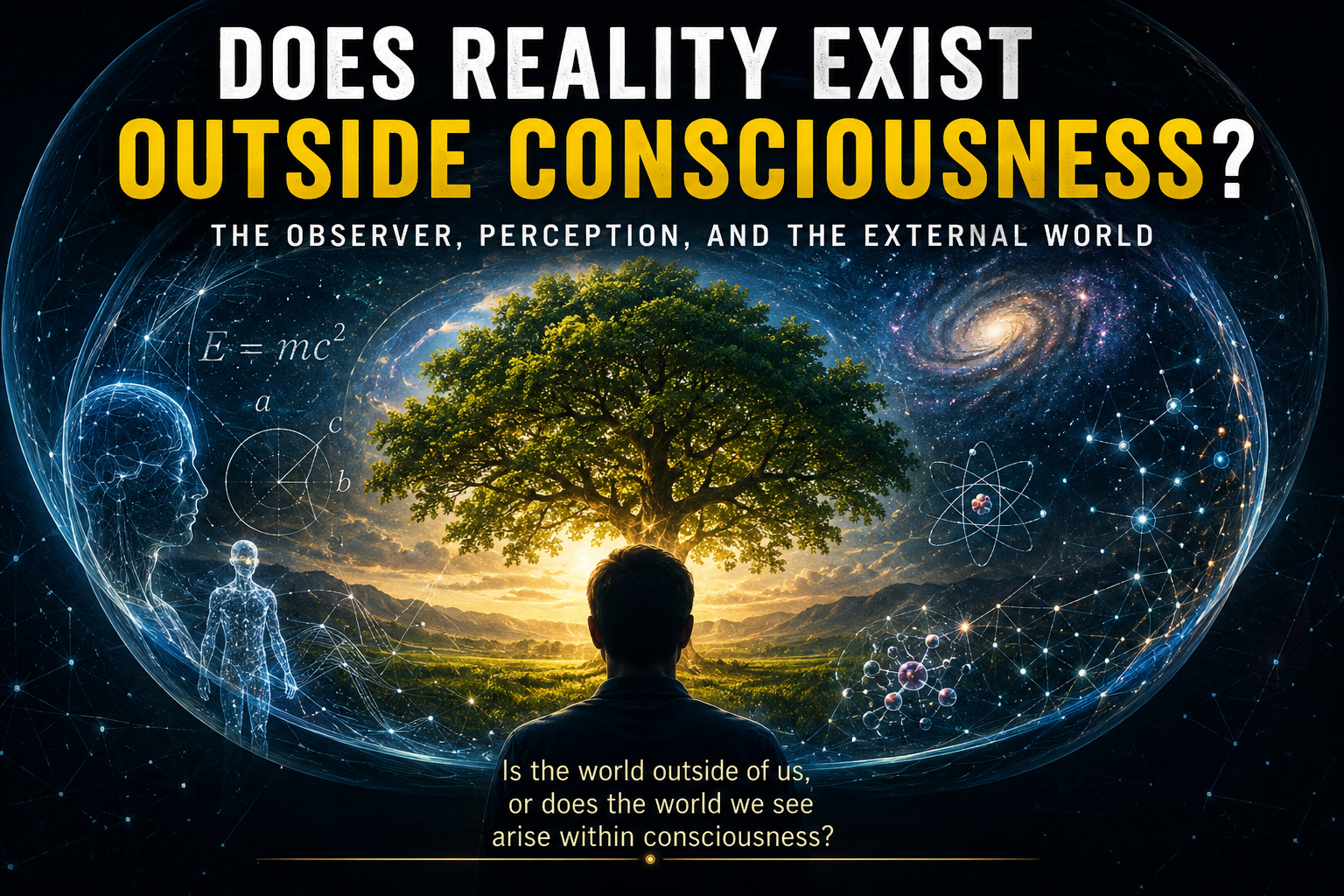
Are We Living in the Universe, or Does the Universe Appear Within Consciousness?
Does reality exist outside consciousness?
At first, the answer seems obvious.
Open your eyes.
A tree stands before you.
You see its trunk.
You see its branches.
The leaves move in the wind.
The tree seems to exist independently of you.
You turn away.
The tree remains.
You leave the forest.
Surely, the tree continues to exist.
So we naturally conclude:
The external world exists outside consciousness, and consciousness simply observes it.
This assumption forms the foundation of our ordinary understanding of reality.
But now close your eyes.
Can you still see the tree?
Perhaps the image is less vivid.
Yet you can recall the trunk.
You can imagine the branches.
You may see green leaves moving in your mind.
Now we have two trees.
The tree seen with open eyes.
And the tree seen with closed eyes.
Most people immediately say:
“The first tree is real. The second tree exists only in my mind.”
But let us ask a more difficult question.
Where did the first tree appear?
And where did the second tree appear?
The second tree clearly appeared within your experience.
But did the first tree ever appear anywhere else in your direct experience?
This is the beginning of one of the deepest problems in the study of consciousness and reality.
Does the external world exist exactly as we perceive it?
Does reality exist outside consciousness in a form that we directly know?
Or does the world we know always appear through perception, cognition, and consciousness?
To answer this, we must begin with something very simple.
The human eye.
1. How Does Visual Perception Create the Experience of a Tree?
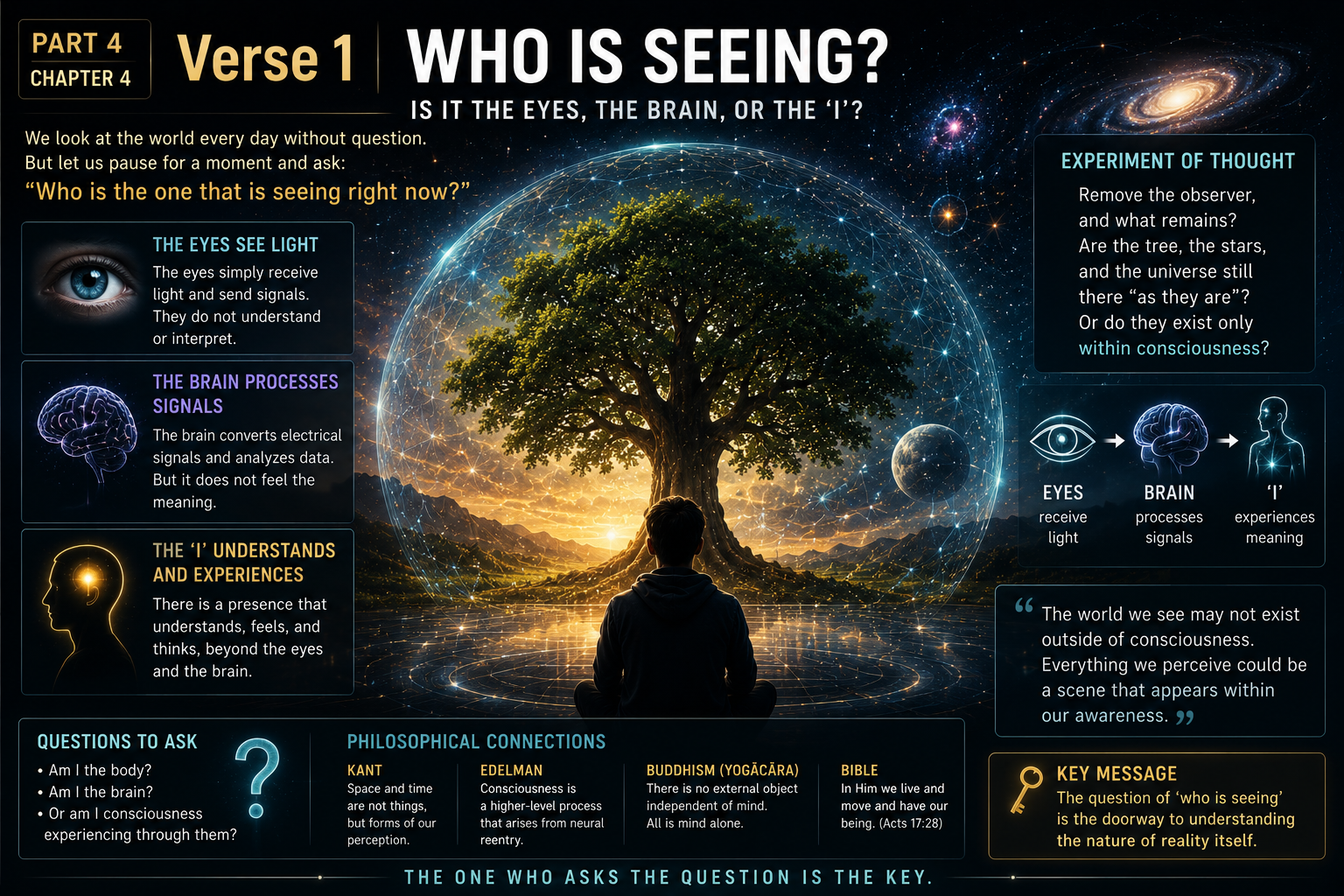
Look at the tree again.
We casually say:
“I see a tree.”
But does a tree enter your eyes?
Of course not.
No branch passes through your pupil.
No leaf travels along the optic nerve.
No miniature tree is delivered into your brain.
What reaches the retina is light.
Light reflected from the environment reaches the eye.
Photoreceptors in the retina respond to patterns of light.
Those patterns are transformed into neural signals.
The tree itself does not travel into your skull.
A mountain does not enter your brain.
The Moon does not squeeze through your pupil.
A distant galaxy does not physically move into your head.
Yet you experience:
A tree.
A mountain.
The Moon.
A galaxy.
An entire visible world.
This creates a remarkable problem.
The input to the visual system is not a finished tree.
The nervous system does not receive tiny branches, miniature leaves, or a small green object labeled “tree.”
It receives and processes signals.
Yet consciousness experiences a structured world.
A trunk.
Branches.
Leaves.
Color.
Depth.
Distance.
Movement.
Meaning.
A tree.
So let us ask a deceptively simple question.
How did light become a tree?
More precisely:
How did patterns of light, sensory transduction, and neural activity become the conscious experience of a tree?
This question takes us directly into the mystery of visual perception and consciousness.
2. Consciousness and Perception: The Eye Receives Light, but We Experience a World
Imagine standing on a hill at sunset.
Mountains rise in the distance.
Clouds turn orange and red.
A river reflects the sky.
Birds cross the horizon.
You say:
“I see the world.”
But what physically reaches your eyes?
Not mountains.
Not clouds.
Not rivers.
Not birds.
Light.
The retina responds to incoming light and transforms sensory information into neural signals.
Those signals are transmitted and processed through the visual system.
But you do not experience neural signals.
You do not see electrical impulses.
You do not look at the sunset and say:
“What a beautiful pattern of neuronal activity.”
You see a sunset.
This difference is extraordinary.
A neural signal is not orange.
An action potential is not blue.
A neuron does not contain a tiny mountain.
Electrical activity does not have leaves growing from it.
Yet within conscious experience, an entire perceptual world appears.
This does not mean neuroscience is wrong.
Quite the opposite.
Neuroscience has revealed how astonishing the problem really is.
The brain does not receive a complete, ready-made visual world.
Sensory systems receive information.
Neural processes organize, discriminate, integrate, and respond to that information.
And somehow, what we experience is not a collection of signals.
We experience a world.
The input is light.
The experience is a world.
What happened between them?
3. AI and Perception: How Can Simple Information Become a Complex World?
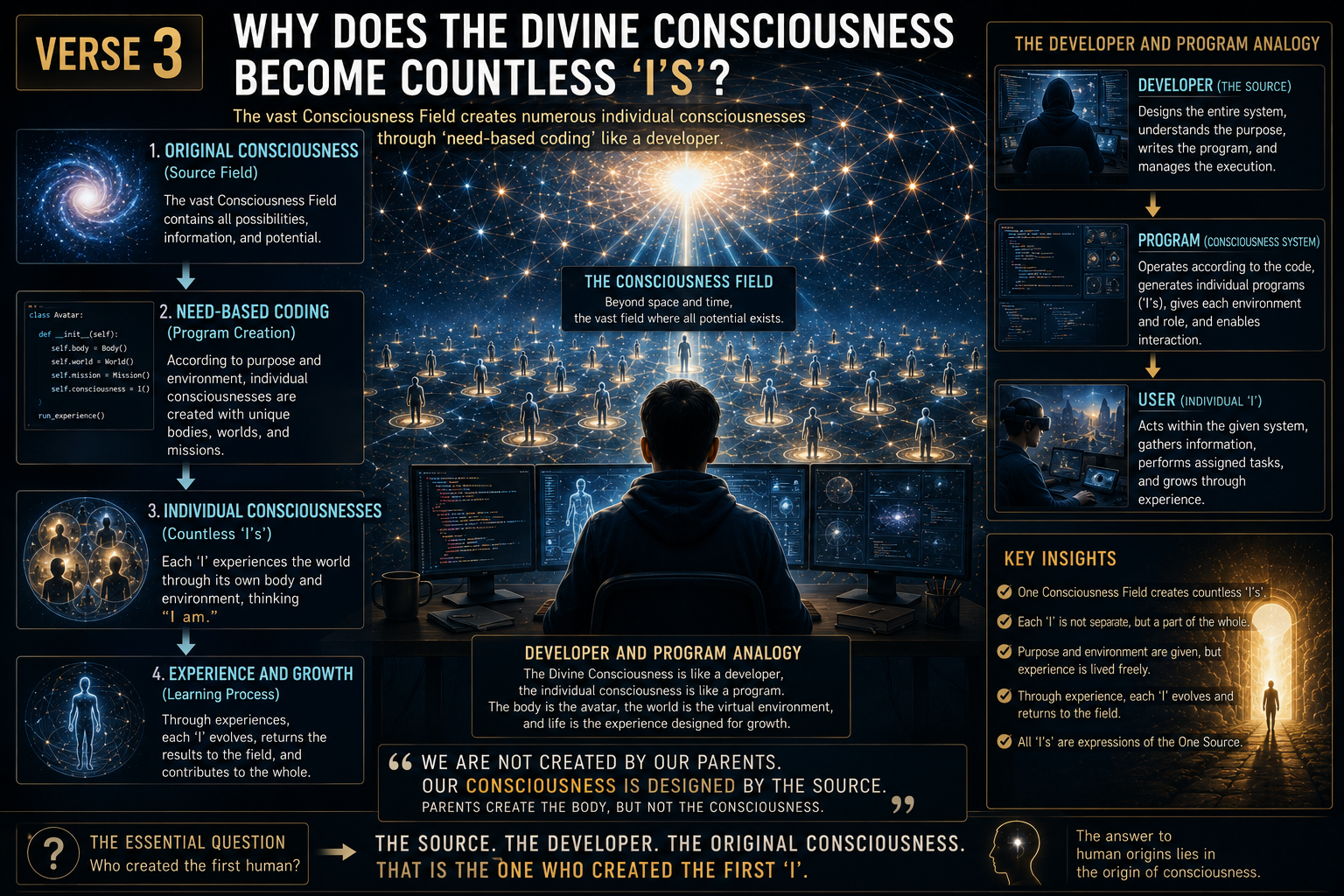
Modern artificial intelligence gives us a useful analogy.
Imagine entering a simple prompt into a generative AI system:
A lonely tree on a hill beneath a red sky.
Those words are not a tree.
There are no branches hidden between the letters.
A hill is not folded inside the sentence.
The color red is not physically stored inside the word “red.”
Yet an AI system can process the information and generate an image.
A tree appears.
A hill appears.
A red sky appears.
Give the system another instruction.
The wind begins to blow.
Branches move.
Clouds gather.
Rain falls.
The camera appears to move through the landscape.
From a limited source of information, a complex visual scene can be generated.
Or give an AI system a single image.
From that source image, it may generate movement, new perspectives, changing light, or an extended visual environment.
The analogy has limits.
The human brain is not simply an AI image generator.
And consciousness should not be reduced to computer software.
But the analogy reveals one important principle:
The source of information is not identical to the world that appears as output.
A prompt is not a forest.
Computer code is not physically a mountain.
Digital data is not green.
Yet information can be organized into a visual structure that appears on a screen.
Now return to the human eye.
The eye does not receive a tree.
It receives light.
The retina transforms patterns of light into neural signals.
Yet in conscious perception:
A tree appears.
A face appears.
A city appears.
The Moon appears.
Stars appear.
From light, a tree appears.
From light, a mountain appears.
From light, a human face appears.
From light arriving across vast cosmic distances, a galaxy appears.
The eye receives a source of sensory information.
But consciousness experiences a world.
Then we must ask:
Are we directly seeing reality as it is?
Or are we experiencing a world structured through the conditions and processes of perception?
More than two centuries ago, Immanuel Kant placed a similar problem at the center of philosophy.
4. Kant’s Thing-in-Itself: Do We Know Reality or Only Appearance?
Immanuel Kant transformed Western philosophy by asking a radical question.
Do we know things exactly as they are in themselves?
Or do we know them as they appear under the conditions of human cognition?
Kant distinguished between phenomena, things as they appear to us, and the problem of the thing-in-itself, the Ding an sich.
Return to the tree.
You see color.
You perceive shape.
You experience distance.
The tree appears in space.
Its leaves move in time.
But Kant questioned whether space and time are simply copied from an external reality exactly as it exists independently of the observer.
In Kant’s transcendental philosophy, space and time are forms through which human sensibility structures experience.
This means the tree you experience is always the tree as it appears to a human knower.
You do not first encounter a completely unprocessed tree and then decide how to interpret it.
The tree is already experienced under the conditions that make human experience possible.
Space.
Time.
Sensibility.
Cognition.
The experienced tree is a phenomenon.
But Kant left philosophy with a famous problem.
The thing-in-itself.
What is the tree independently of the way it appears to us?
Perhaps something exists independently of human perception.
But then a strange question arises.
Who has ever seen the thing-in-itself?
The moment you see it, it appears to you.
The moment you measure it, it becomes a measurement.
The moment you photograph it, you obtain an image.
The moment an instrument detects it, you receive data.
The moment you understand the data, it becomes part of cognition.
Then how can an observer remove every condition of observation and directly confront reality exactly as it exists outside all possible experience?
Kant drew a boundary around human knowledge.
But perhaps that boundary leaves us with an even deeper question.
If the thing-in-itself cannot be directly known as an object of experience, how do we determine what it is in itself?
And more provocatively:
On what basis do we confidently describe reality beyond all possible experience as material?
5. Does the External World Exist Independently of Consciousness?
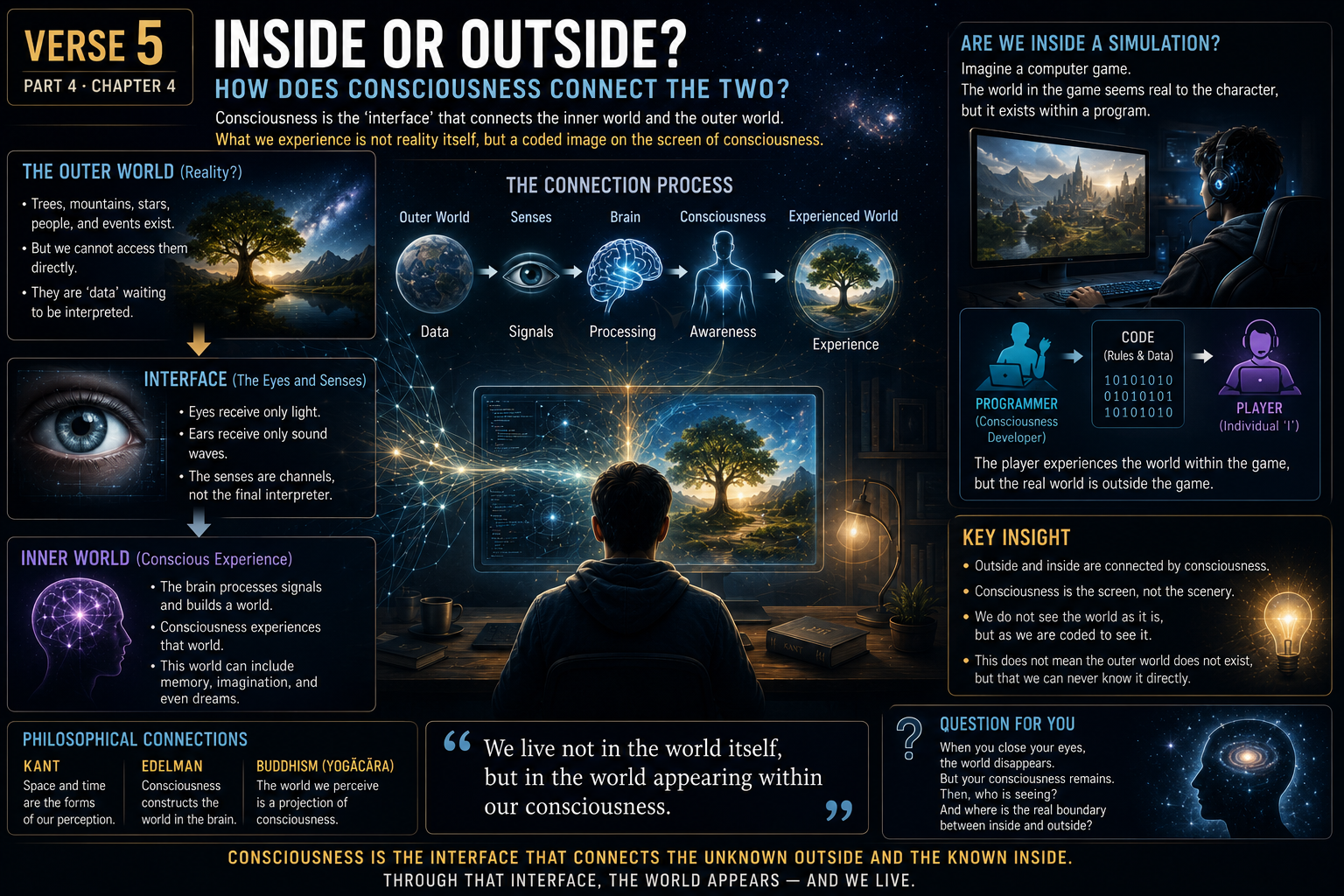
Suppose someone says:
“The material world exists independently of consciousness.”
Perhaps it does.
This chapter does not begin by denying that possibility.
Instead, we ask:
How is that claim known?
A scientist may point to an experiment.
But the experiment is observed.
The scientist may present data.
But the data is read.
A photograph may be shown.
But the photograph is seen.
An equation may be written.
But the equation is understood.
A telescope may detect light from a galaxy billions of light-years away.
But the telescope does not hand the galaxy itself to the scientist.
It collects information.
The information is processed.
It may be converted into images, graphs, spectra, or numerical values.
The scientist observes those representations.
The scientist interprets them.
Finally, the evidence becomes knowledge.
At no point does the galaxy itself enter the scientist’s mind as an unmediated thing-in-itself.
Knowledge of the galaxy arises through observation, measurement, representation, interpretation, and cognition.
Then a difficult question appears.
Has any observer ever stepped outside consciousness to verify a reality completely independent of consciousness?
Notice what this question does not say.
It does not say:
“Matter does not exist.”
It does not say:
“Science is false.”
It does not say:
“The world is imaginary.”
The question is more fundamental.
Can we claim direct knowledge of reality entirely outside the conditions through which anything becomes known?
The problem becomes even more powerful when we stop looking only at the object.
And turn our attention toward the observer.
6. The Observer Problem: The Scientist Who Studies Matter Is Also an Observer
Science studies matter.
Particles.
Atoms.
Cells.
Brains.
Planets.
Stars.
Galaxies.
The universe.
But who studies them?
The scientist.
And what position does the scientist occupy in the structure of knowledge?
The scientist is an observer.
A subject.
Consider particle physics.
The scientist is the observer.
The particle is the object of investigation.
Consider neuroscience.
The neuroscientist is the observer.
The brain is the object of investigation.
Consider astronomy.
The astronomer is the observer.
The galaxy is the object of observation.
Consider cosmology.
The cosmologist is the observer.
The universe becomes the object of study.
The scale changes.
The basic structure remains.
Observer and observed.
Subject and object.
From the smallest particle to the observable universe, scientific knowledge involves this relationship.
Science studies the objective world.
Yet no scientific knowledge has ever become scientific knowledge without observation, measurement, interpretation, and understanding.
The instrument may detect.
The computer may calculate.
The sensor may record.
But a result becomes meaningful scientific knowledge within a system of interpretation.
This is not merely the “observer effect” discussed in quantum physics.
The question here is more fundamental.
It is an epistemological problem.
Every scientific claim requires a knower to whom evidence becomes known.
The materialist studies matter.
But the materialist is an observer.
The particle is observed.
The atom is observed.
The brain is observed.
The galaxy is observed.
The universe is observed.
Then where do the observer and the observed meet?
Where do the scientist and the particle become related?
Where does the astronomer know the galaxy?
Where does the cosmologist understand the universe?
Within the event of knowing.
And where is that event known?
In consciousness.
This is where the old philosophical division between subject and object begins to become unstable.
And this is where Hegel enters our story.
7. Hegel on Subject and Object: Where Does Reality Appear?
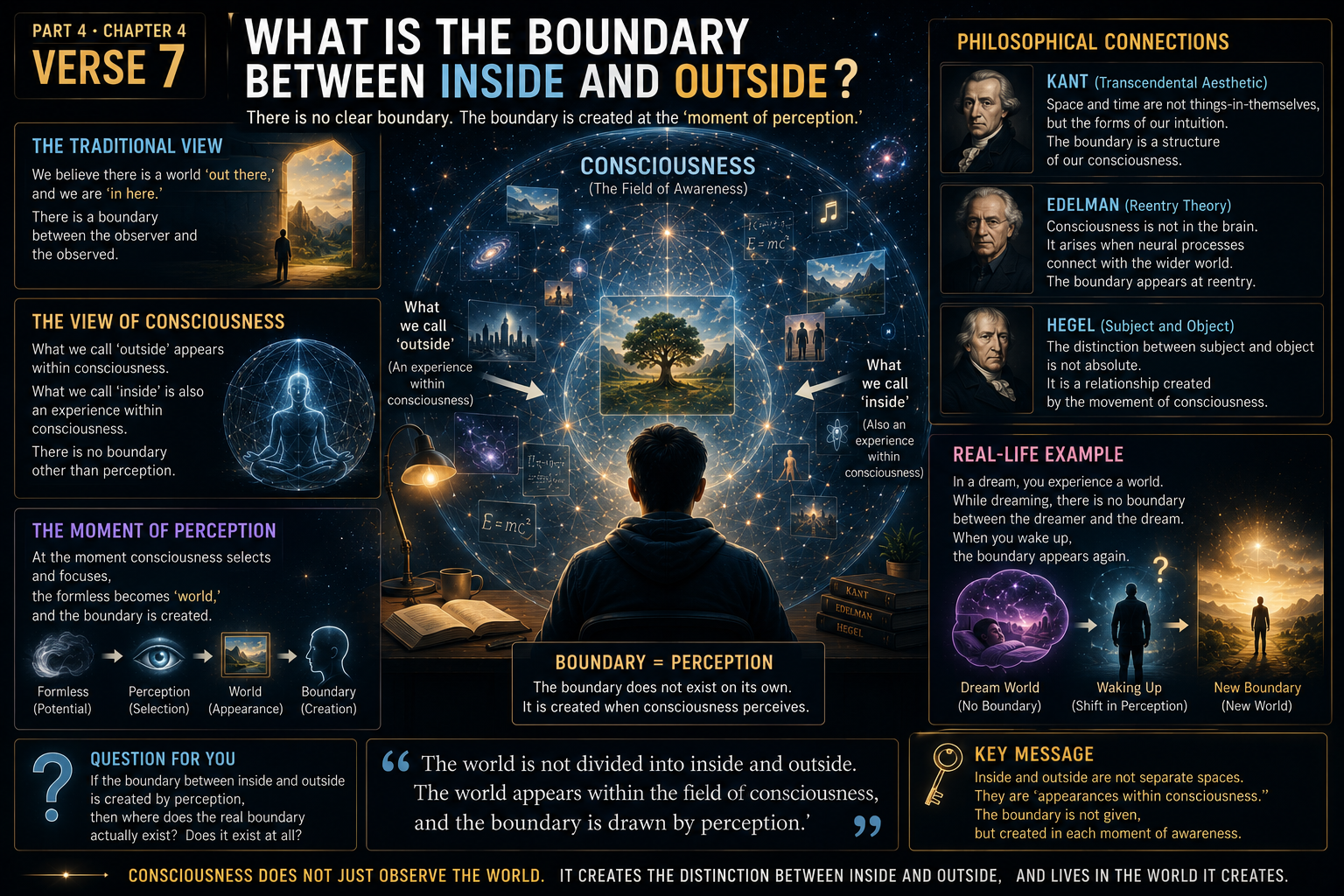
Kant revealed the limits of human knowledge.
He distinguished the world of phenomena from the problem of the thing-in-itself.
But German Idealism did not simply leave subject and object separated forever.
Georg Wilhelm Friedrich Hegel challenged the permanent division between the knower and the known.
The subject is not an isolated island.
The object is not simply another isolated island.
Consciousness knows an object.
Through knowing the object, consciousness also becomes aware of itself as the one who knows.
The object is understood as an object within a relation to the subject.
The subject becomes a knowing subject through its relation to what is known.
In Hegel’s philosophy, this relation develops within the movement of Geist, often translated as Spirit or Mind.
Here we must ask a question that is rarely stated in simple language.
If subject and object are reconciled within Spirit, where does that reconciliation occur?
Outside Spirit?
That would be strange.
Outside the very movement in which subject and object become intelligible?
Or within the field in which both the knower and the known appear?
Consider a film.
Inside the film, a man stands before a tree.
The man looks at the tree.
Within the story, the structure is obvious.
The man is the subject.
The tree is the object.
The man is here.
The tree is there.
Observer.
Observed.
But now consider the viewer sitting in the theater.
Where is the man?
On the screen.
Where is the tree?
On the same screen.
Inside the film, subject and object appear separate.
From another level, both appear within one field of presentation.
The man who sees and the tree that is seen both belong to the same appearing world of the film.
Now return to the scientist.
The scientist is the subject.
The particle is the object.
The astronomer is the subject.
The galaxy is the object.
I am the subject.
The tree is the object.
But where does the distinction between subject and object itself become known?
Where does “here” appear?
Where does “there” appear?
Where does distance appear?
Where does the observer become known as an observer?
Where does the object become known as an object?
Within consciousness.
Then the question becomes unavoidable.
If both subject and object appear within one field of knowing, why do we assume that only the object possesses a fully knowable reality outside that field?
Hegel did not formulate the Consciousness Field Theory.
We should not place our theory into Hegel’s mouth.
But Hegel’s challenge to the permanent separation of subject and object opens a door.
The Consciousness Field Theory asks one further question:
What if both the observer and the observed appear within consciousness?
8. What If Consciousness Is the Screen of Reality?
Return to the film.
Inside the film, the character says:
“That tree is outside me.”
Within the world of the film, he is correct.
His body is here.
The tree is ten meters away.
There is spatial separation.
The tree is outside the character’s body.
But from the viewer’s perspective, the character and the tree appear on the same screen.
The distinction between “inside the character” and “outside the character” exists within the world presented on that screen.
Now consider a dream.
You walk through a city.
Buildings surround you.
Cars pass.
People speak.
Rain falls.
Within the dream, the city seems external to you.
You are here.
The building is there.
You are the subject.
The city is the object.
The dream contains distance.
Space.
Movement.
Other people.
Perhaps even fear.
Then you wake up.
And something astonishing becomes clear.
The dream subject and the dream city both appeared within one experiential field.
The “you” inside the dream was part of the dream world.
The building was also part of the dream world.
The observer and the observed appeared together.
This does not prove that waking life is a dream.
That would be an unjustified leap.
But the dream reveals something philosophically important.
The experience of an external world does not, by itself, prove that the experienced world exists exactly as it appears independently of consciousness.
Consciousness can contain an experiential distinction between:
Self and world.
Here and there.
Observer and observed.
Near and far.
Past and future.
An object can appear “outside me” while the entire distinction between “me” and “object” appears within one field of experience.
Then perhaps consciousness is not simply another object inside the world.
Perhaps consciousness is more like the field in which the distinction between observer and world appears.
Or, using our analogy:
What if consciousness is the screen?
9. Gerald Edelman and the Brain: Why Perception Is Not a Copy of Reality
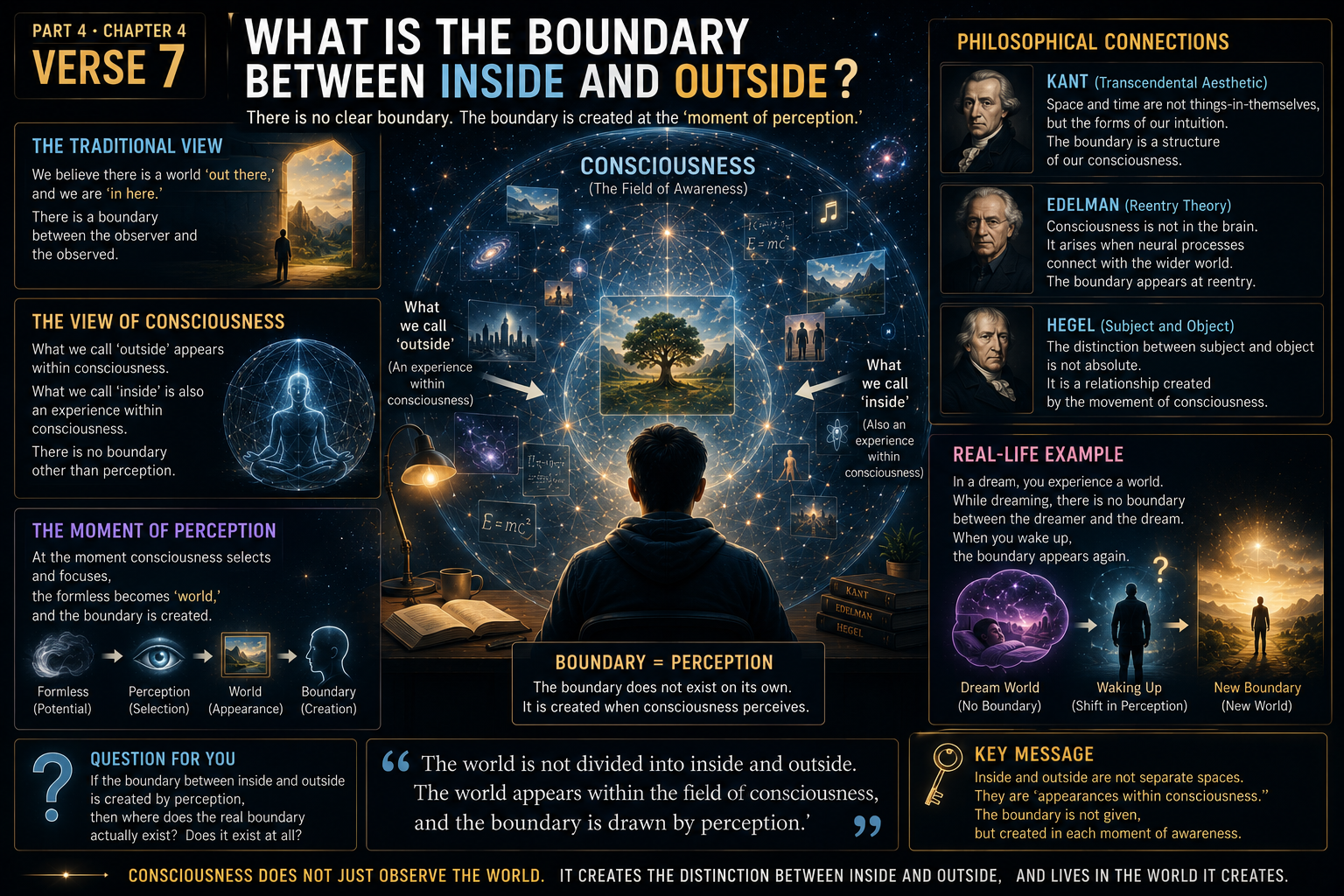
Modern neuroscience makes this question even more interesting.
Gerald Edelman’s work on Neural Darwinism and reentrant signaling emphasized the dynamic and selective nature of brain processes.
The brain is not simply a passive camera waiting for a complete external world to be delivered.
Neural systems interact continuously.
Signals move through complex reciprocal pathways.
Different brain regions participate in coordinated activity.
Memory matters.
Past experience matters.
Attention matters.
The biological state of the organism matters.
The brain does not contain a perfect miniature copy of the external world.
And there is no tiny observer sitting inside the brain watching an internal movie screen.
If there were a small observer inside the brain, we would immediately have another problem.
Who observes the world inside the small observer’s brain?
Then another observer would be required.
And another.
The explanation would continue forever.
This is the classic problem of the homunculus.
Instead, visual perception must arise through the integrated activity of the nervous system and the organism.
Return to the tree.
Light reaches the retina.
Patterns of light are transformed into neural signals.
Those signals participate in complex neural activity.
Yet in conscious experience:
A tree appears.
A neural signal is not a leaf.
A neuron is not green.
Electrical activity is not ten meters tall.
Yet the experienced tree has color.
Shape.
Distance.
Movement.
And meaning.
Perhaps you recognize it as an oak tree.
Perhaps it reminds you of your childhood.
Perhaps another person sees the same tree and remembers someone who died.
The sensory source may be similar.
But the experienced world is not simply a mechanical photocopy.
This is where our AI analogy becomes useful again.
A source of information can be processed into an enormously complex visual structure.
But human consciousness presents an even deeper mystery.
Because we do not simply generate an image.
We experience a world.
Kant asked how the conditions of cognition shape experience.
Edelman’s neuroscience shows us a brain that does not passively copy a finished reality.
Different fields.
Different languages.
Yet the same simple tree continues to ask us an uncomfortable question.
What exactly are we seeing?
10. From Light to Reality: How Does an Experienced Universe Appear?
Now expand the problem.
You look at your hand.
Light reaches the visual system.
A hand appears.
You look at a mountain.
Light reaches the visual system.
A mountain appears.
You look at the Moon.
Light reaches the visual system.
The Moon appears.
You look through a telescope.
Information from distant objects is detected and processed.
Different instruments observe different aspects of the cosmos.
Visible light.
Infrared radiation.
Radio waves.
X-rays.
Gravitational effects.
Spectral patterns.
Redshift.
Scientists combine measurements.
Computers process data.
Mathematical models organize relationships.
And gradually, an intelligible universe appears within human knowledge.
This is one of the greatest achievements of science.
But there is a strange question hidden inside that achievement.
Where does the known universe finally appear as a known universe?
A telescope does not understand a galaxy.
A detector does not wonder about the Big Bang.
A mathematical symbol does not understand itself.
Measurements become part of scientific knowledge through interpretation and understanding.
The scientist studies the universe.
But the scientist is also part of the universe being studied.
Then, within consciousness, the scientist forms a model of the universe.
This creates a remarkable loop.
The universe contains the observer.
The observer experiences the universe.
The experienced universe appears within consciousness.
Which one contains which?
Physically, we say the human being is inside the universe.
Experientially, the universe we know appears within consciousness.
Perhaps these are not simply contradictory statements.
Perhaps they reveal two different levels of description.
But if so, consciousness may occupy a far more fundamental place in our understanding of reality than modern materialism usually assumes.
11. Yogācāra and Consciousness-Only: Is There an External World Beyond Experience?
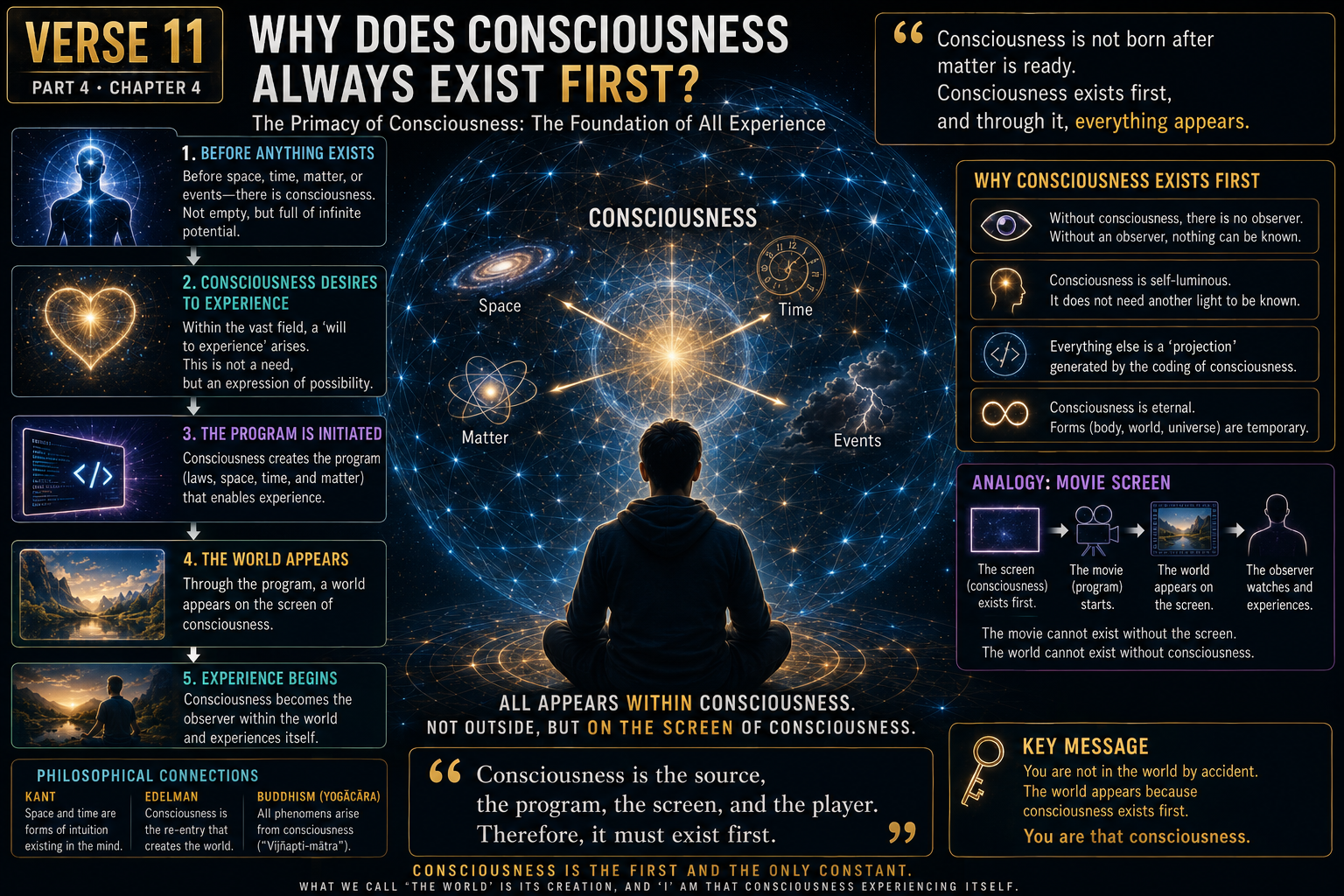
Long before modern neuroscience, Buddhist Yogācāra philosophy investigated the relationship between consciousness and the experienced world.
One important expression associated with this tradition is vijñapti-mātra, often translated as representation-only, cognition-only, or consciousness-only.
In East Asian Buddhist thought, we also encounter the expression:
唯識無境
Only consciousness.
No independently experienced external object.
This idea is easily misunderstood.
It does not simply mean:
“Nothing exists.”
It does not mean:
“The world is meaningless.”
It does not mean:
“Imagine a mountain and a physical mountain will suddenly appear.”
The deeper question concerns the status of the world as experienced.
Every color you know appears in experience.
Every sound you know appears in experience.
Every mountain you have seen appears in experience.
Every star you have observed appears in experience.
Even the concept of matter becomes meaningful as a concept within consciousness.
Then Yogācāra asks, in its own philosophical language:
Can the experienced object be completely separated from the cognition in which it is known?
Now place this question beside Kant.
We know phenomena under the conditions of human cognition.
Place it beside Hegel.
Subject and object cannot remain absolutely isolated in the movement of knowing.
Place it beside neuroscience.
The brain does not simply receive a perfect miniature copy of a finished world.
Place it beside the observer problem.
No scientist conducts an observation from outside all possible consciousness.
Different traditions.
Different historical periods.
Different vocabularies.
But one question begins to emerge.
Have we mistaken the world as experienced for a world directly known entirely apart from experience?
If so, the ancient phrase 唯識無境 may contain a philosophical challenge that modern science has not yet fully exhausted.
Where is the 境, the independently known external object?
Who has encountered it outside all consciousness?
And who returned to tell us what it was?
12. Is the Observer Science’s Greatest Blind Spot?
Science has examined almost everything.
Atoms.
Genes.
Neurons.
Black holes.
The cosmic microwave background.
The early universe.
But one participant is present in every scientific discovery.
The observer.
A scientist can place a human brain inside a scanner.
The brain becomes an object of observation.
But the scientist interpreting the scan remains the observer.
Another scientist can study the first scientist’s brain.
Now the first scientist becomes an object.
But the second scientist becomes the observer.
A third scientist could observe the second.
The chain can continue.
At every level, something is known from a standpoint of knowing.
We can investigate neural correlates of consciousness.
We can compare conscious and unconscious brain states.
We can examine anesthesia.
Sleep.
Attention.
Memory.
These investigations are essential.
But a philosophical problem remains.
Who confirms that matter exists entirely outside consciousness?
A conscious observer.
Who argues that consciousness is produced by matter?
A conscious observer.
Where is that argument understood?
Within consciousness.
Even the sentence:
Consciousness is nothing more than brain activity.
appears as a meaningful claim within consciousness.
This does not automatically make materialism false.
But it reveals a circle that deserves careful examination.
The observer uses consciousness to investigate matter.
The observer then concludes that matter produced consciousness.
Perhaps that conclusion is correct.
But the observer has never occupied a position outside consciousness from which the entire sequence could be independently observed.
The scientist can observe matter.
The scientist can observe the brain.
But can the scientist observe reality from outside the very field in which observation becomes possible?
Perhaps the greatest blind spot in science is not matter.
Perhaps it is the observer who claims to know matter.
13. Does Consciousness Come From Matter, or Have We Reversed Reality?
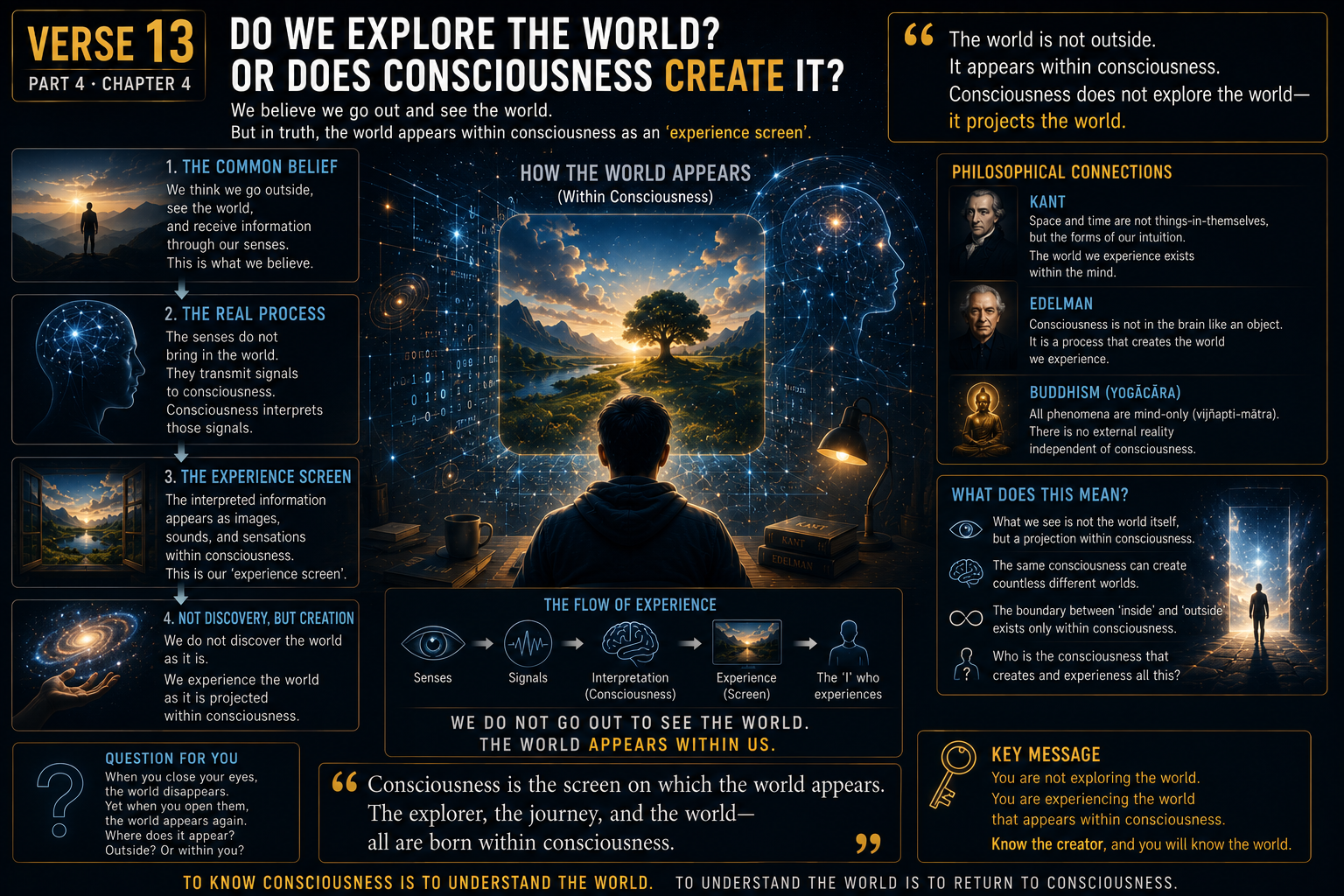
Modern thought usually tells the story of reality in one direction.
First, the universe.
Then matter.
Then stars.
Planets.
Chemistry.
Life.
Evolution.
Brains.
And finally:
Consciousness.
The order is:
Universe → Matter → Life → Brain → Consciousness
Consciousness comes last.
It is a late arrival.
A small flame produced by matter in one tiny corner of an enormous cosmos.
But now examine the problem from the standpoint of actual knowledge.
What is immediately present?
Conscious experience.
Within experience, observation occurs.
Through observation and cognition, a world becomes known.
Through scientific investigation, a universe becomes intelligible.
From the standpoint of knowledge, the order appears different:
Consciousness → Observation → Perception → Experienced World → Universe as Known
This does not prove that human consciousness created the physical cosmos.
That conclusion would go beyond the argument.
But it reveals a profound asymmetry.
We can describe a universe without human beings.
We can construct models of a time before life.
We can calculate conditions billions of years before any human observer existed.
But every equation is presently understood within consciousness.
Every model is presently interpreted within consciousness.
The concept “13.8 billion years” is meaningful now within consciousness.
The scientific image of the early universe is known now within consciousness.
We can describe a world without an observer.
But the description always has an observer.
Then perhaps we have accepted one direction of reality too quickly.
Perhaps consciousness is not simply the final product at the end of a material chain.
Perhaps consciousness is connected to the very field in which matter, space, time, and universe become known as reality.
This possibility does not destroy science.
It changes the question science must ask.
14. Are We Inside the Universe, or Is the Universe Within Consciousness?
You have seen images of Earth from space.
A blue planet surrounded by darkness.
You know you live somewhere on Earth.
Earth moves through the Solar System.
The Solar System belongs to the Milky Way.
The Milky Way is one galaxy among an immense number of galaxies.
So you naturally conclude:
“I am a tiny human being inside an enormous universe.”
Within the ordinary physical description of reality, this makes sense.
But now ask another question.
Where is your present image of Earth?
Where is your concept of the Milky Way?
Where is your understanding of cosmic distance?
Where is the idea of an expanding universe?
They appear in your present consciousness.
This creates a strange structure.
You say:
“I am inside the universe.”
Yet the universe you know appears within consciousness.
The body appears inside the experienced world.
But the experienced world appears within awareness.
You are in the world.
And the world is in your experience.
It is almost like a film within a film.
A dream within a dream.
Inside the film, the character lives in a universe.
But the character and the universe both appear on the screen.
Then we must ask:
What is the human being?
Are you only the body appearing within the world?
Or are you the consciousness in which both body and world become experienced?
Perhaps we do not simply live inside the universe.
Perhaps the universe as we know and experience it appears within consciousness, while the person we call “I” lives within that experienced universe.
Then the structure of reality becomes astonishing.
We may not merely be tiny observers looking outward at an enormous cosmos.
The entire known cosmos may appear within the field of knowing.
15. Consciousness Field Theory: Does Reality Exist Outside Consciousness?
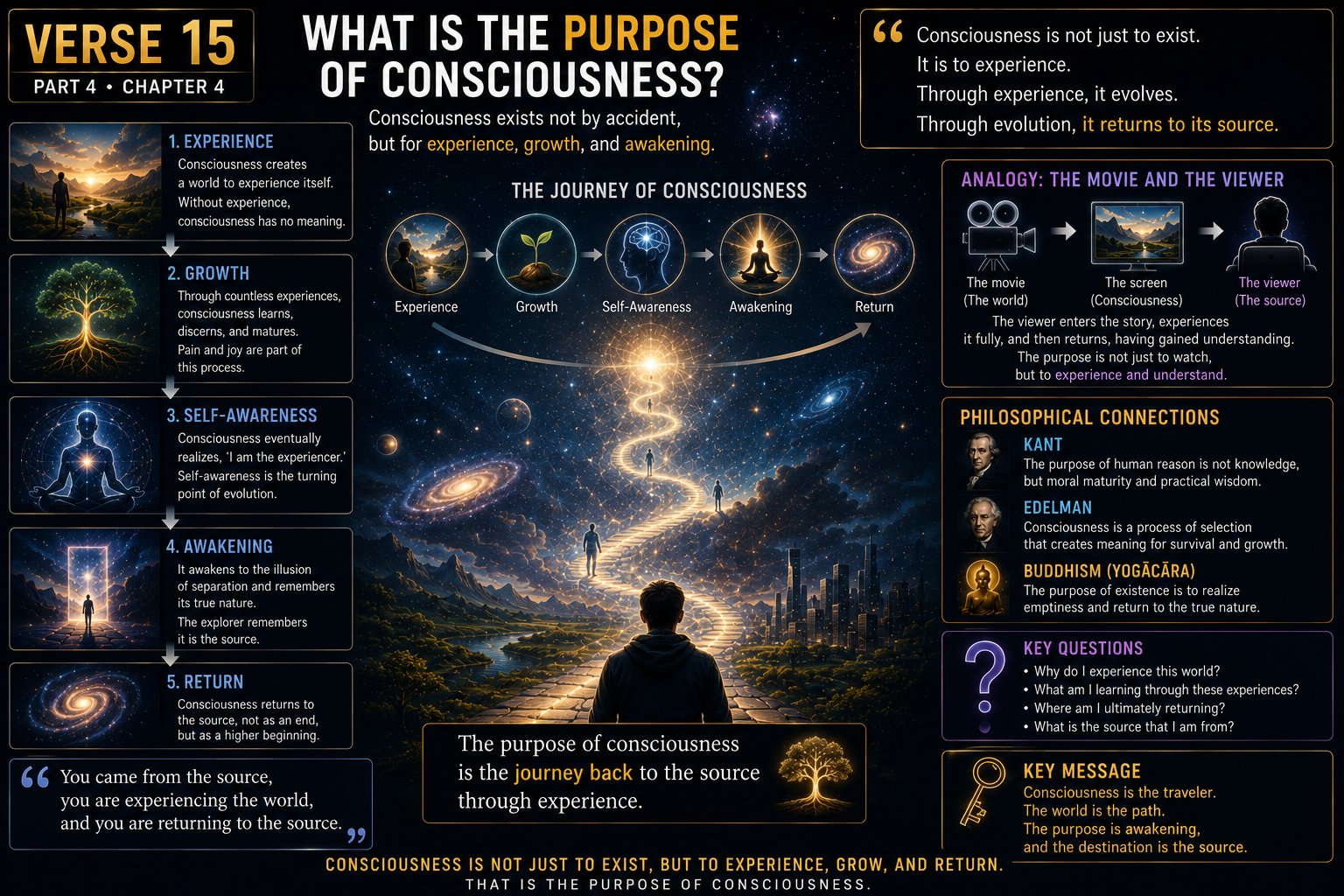
We have now returned to our first question.
Does reality exist outside consciousness?
The Consciousness Field Theory does not begin by declaring:
“Matter is unreal.”
It begins with a more careful question.
Has matter ever been known outside consciousness?
The tree becomes known in consciousness.
The scientist becomes known in consciousness.
The particle becomes known through observation and understanding.
The brain becomes known through observation and understanding.
The galaxy becomes known in consciousness.
The universe becomes intelligible in consciousness.
Subject and object appear together within the event of knowing.
Then perhaps consciousness should not be treated merely as one small object among all the other objects in the universe.
Perhaps consciousness is a field.
Not necessarily a physical field like electromagnetism.
Not yet a mathematical field established by accepted scientific equations.
But a fundamental field of appearance, experience, and knowing.
Within this field:
The observer appears.
The observed appears.
The body appears.
Space appears.
Time appears.
The world appears.
Even the distinction between “inside” and “outside” appears.
Then a radical possibility emerges.
What if the world is not first experienced as a finished reality outside consciousness and then copied into consciousness?
What if the world we know is formed as an experienced world within consciousness?
Kant showed that human beings do not know reality independently of the conditions of cognition.
Hegel challenged the permanent separation of subject and object.
Gerald Edelman’s neuroscience presents a brain that does not passively photograph a finished external world.
Yogācāra questioned the independence of the experienced object from cognition.
And the observer problem reveals that science itself cannot conduct an observation from outside all possible consciousness.
The Consciousness Field Theory takes one further step.
It asks:
What if consciousness is not simply inside the universe?
What if the universe we know appears within consciousness?
For thousands of years, humanity has searched outward.
We studied matter.
We divided the atom.
We mapped the brain.
We measured stars.
We discovered galaxies.
We reconstructed the history of the cosmos.
But who saw the atom?
The observer.
Who interpreted the brain scan?
The observer.
Who measured the star?
The observer.
Who constructed the model of the early universe?
The observer.
And where did every discovery finally become known?
In consciousness.
The observer was present at every discovery.
Yet the observer remained almost invisible.
Perhaps we have spent centuries searching the universe for the origin of consciousness.
But perhaps we have been looking in the wrong direction.
Perhaps the greatest mystery in the universe is not the universe.
Perhaps it is the consciousness in which the universe appears.
And if that is true, the next question can no longer be avoided.
Where did consciousness come from?
That is where our next journey begins.
Explore This Chapter in Three Formats
Start with a quick question, continue with a deeper exploration, or listen to the full philosophy audio. Choose the format that fits your time.
⚡ 2-Minute Question
Is the World Really Outside You?
A quick introduction to the central question of this chapter. Open your eyes and you see a tree. Close them, and the tree can still appear. So where does the world you experience actually appear?
▶ Watch the 2-Minute Video
🎥 10-Minute Exploration
You See a Tree. But Where Does It Really Appear?
Go deeper into light, visual perception, Kant, and the strange gap between sensory input and the world we consciously experience.
▶ Watch the 10-Minute Exploration
🎧 20-Minute Deep Audio
Does Reality Exist Outside Consciousness?
A slower, deeper philosophical journey through the observer, perception, Kant, Hegel, Gerald Edelman, Yogācāra, and Consciousness Field Theory.
▶ Listen to the Deep Philosophy Audio