Introduction | Let the Bible Explain Genesis
In the previous chapter, we placed Genesis 1 and Acts 17 side by side and raised an unfamiliar question:
Does every biblical account of “creation” refer to the same kind of creation?
In Acts 17, Paul describes God as the One who “made the world and everything in it.” He says that God gives life, breath, and all things to humanity, and speaks about the origin of humankind and the nations.
Now let us return to Genesis 1.
As we have long assumed, does Genesis 1 creation describe the formation of the universe, the Earth, plants, animals, and the first biological human beings?
In this chapter, we will not decide the answer in advance.
Instead, we will trace several important expressions found in Genesis:
light and darkness,
the sun, moon, and stars,
seed, trees, and fruit,
and the image of God.
How are these same images and expressions used elsewhere in the Bible?
Our method is simple:
Let the Bible help explain the Bible.
When we begin reading Genesis this way, another dimension of the familiar creation story gradually comes into view.
1. What Does “In the Beginning” Really Mean?
Genesis opens with one of the most famous sentences in the Bible:
“In the beginning God created the heavens and the earth.”
Genesis 1:1
When we read these words, we naturally tend to imagine the absolute first moment when the physical universe came into existence.
But whenever the Bible speaks of “the beginning,” must it always refer exclusively to the first moment of the material universe, the kind of beginning investigated by modern cosmology?
The Gospel of John opens with remarkably similar language:
“In the beginning was the Word.”
John 1:1
John immediately connects the Word with life, light, and humanity:
“In him was life, and that life was the light of all mankind.”
John 1:4
This raises our first question.
Does “the beginning” in biblical language always refer only to the first moment of the physical universe?
Or can the language of creation also describe the beginning of a new work, order, or relationship brought about by God?
We do not need to decide yet.
Let us carry this question with us as we move deeper into Genesis 1 creation.
2. Formless, Empty, and Dark
Genesis 1:2 introduces three important ideas:
formlessness, emptiness, and darkness.
“Now the earth was formless and empty, darkness was over the surface of the deep…”
Genesis 1:2
When Genesis is read primarily as an account of physical creation, these words can naturally be understood as describing an unfinished world that was still unformed, empty, and dark.
But as we continue reading the Bible, we encounter strikingly familiar language in Jeremiah 4:23.
Jeremiah looks at the earth and describes it as formless and empty, while the heavens have no light.
Yet Jeremiah is not describing the condition of the universe before its initial creation.
Human beings already exist.
Cities already exist.
He is describing a world devastated by judgment.
This gives us an important clue.
At the very least, within the Bible itself, the language of formlessness, emptiness, and the absence of light is not restricted exclusively to the physical beginning of the universe.
That does not by itself prove that Genesis 1 must be interpreted symbolically.
But it does give us a reason to ask whether these expressions in Genesis should be understood only as descriptions of physical nature.
3. Does Darkness Simply Mean the Absence of Sunlight?
Now let us follow the biblical language of darkness and light.
In the darkness of Genesis, God’s first command is heard:
“Let there be light.”
If we read the passage only in terms of natural phenomena, the meaning appears straightforward:
A physically dark world receives physical light.
But when we follow the language of light and darkness throughout the Bible, the picture becomes more complex.
In Isaiah 9, the people walking in darkness see a great light.
Matthew 4 connects this prophecy with the ministry of Jesus in Galilee.
John 1 describes life as the light of humanity.
In John 8, Jesus calls himself the light of the world.
And in 1 Thessalonians 5, people are called children of light and children of the day, in contrast with night and darkness.
One point, therefore, is clear:
In the Bible, light and darkness do not refer only to natural phenomena.
They can also describe the human condition, life, truth, Christ, and the work of God.
This does not automatically mean that the light of Genesis 1 is identical with Christ.
But it does raise a legitimate interpretive question:
Should “Let there be light” in Genesis be restricted from the outset to physical light alone?
4. But Light Appears Before the Sun
Here Genesis itself presents an intriguing puzzle.
Light appears on the first day.
Yet the great light, the lesser light, and the stars, the celestial bodies commonly associated with natural light, appear on the fourth day.
There are, of course, traditional interpretations of this sequence.
One may argue, for example, that some other form of physical light existed before the sun.
Our purpose here is not to disprove those interpretations.
The question is different.
If the Bible repeatedly uses light as language for life, truth, Christ, divine action, and the condition of human beings, should we assume from the beginning that the light in Genesis can only be astronomical light?
That possibility deserves investigation.
The important point is not to rush toward another dogmatic conclusion and declare:
“The light in Genesis definitely means this.”
Instead, we should ask whether we have sometimes moved too quickly in the opposite direction, importing modern scientific categories into an ancient biblical text before allowing the Bible’s own language to speak.
That question lies at the heart of our investigation into Genesis 1 creation.
5. Let the Bible Explain Genesis 1
We can now establish an important principle for this chapter:
When an expression in Genesis appears repeatedly elsewhere in the Bible, we should examine how the Bible itself uses that expression.
This does not mean turning everything in Genesis into a symbol.
Nor does it mean deciding in advance that everything must refer to a physical object.
Instead, we will follow the biblical language itself:
Light and darkness.
The sun, moon, and stars.
Seed, trees, and fruit.
The image of God.
As these words reappear throughout Scripture, something interesting begins to happen.
Genesis 1 starts to look less like an isolated text standing at the beginning of the Bible and more like the opening movement of themes that continue throughout the entire biblical story.
The question, therefore, is not merely:
How was the physical world made?
A larger question begins to emerge:
What kind of creation is the Bible ultimately trying to reveal, and where is that creation leading?
That question will become even more important as we turn next to the sun, moon, and stars, and then to seed, trees, fruit, humanity, and the image of God.
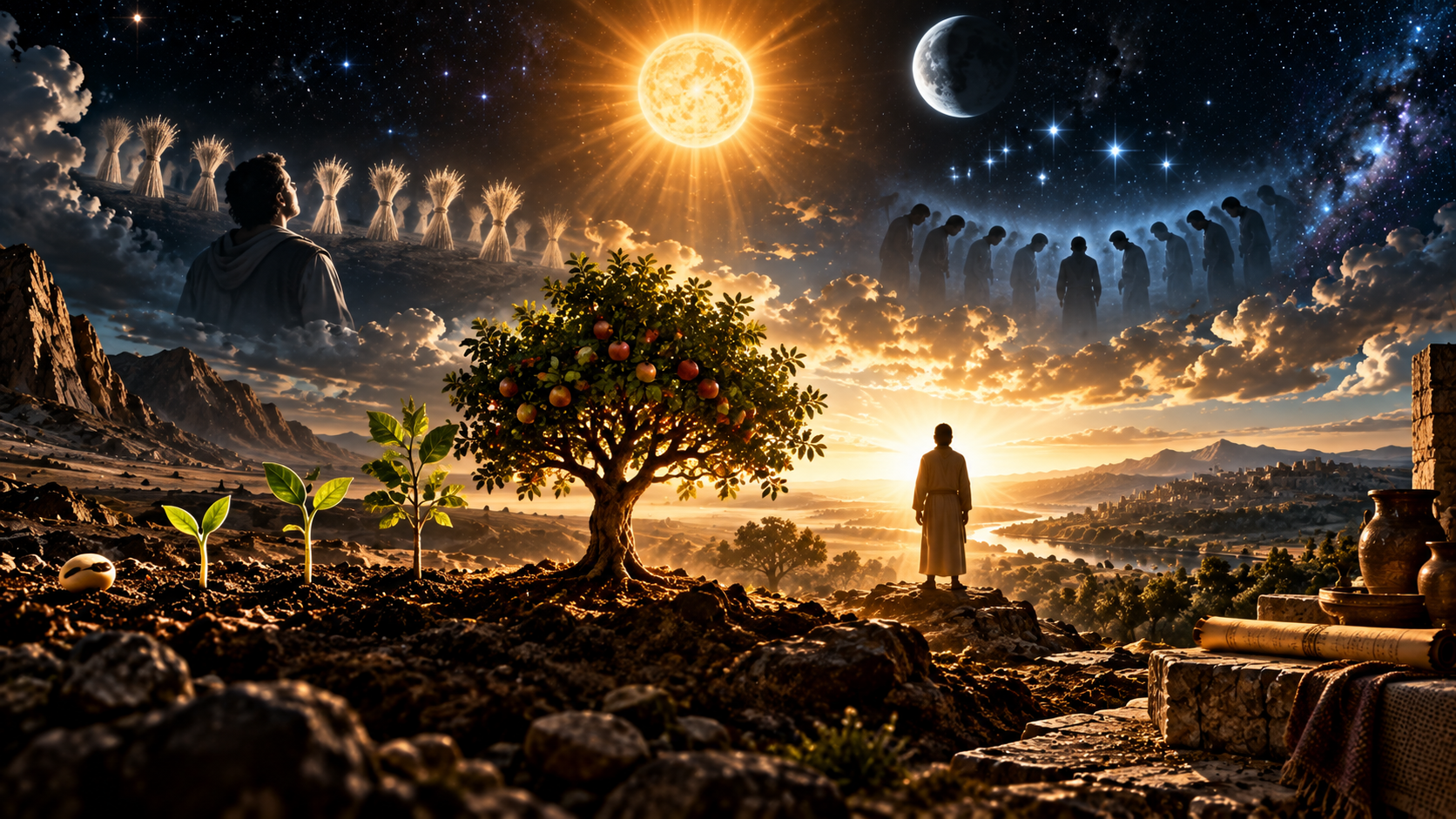
6. Do the Sun, Moon, and Stars Always Mean Celestial Bodies?
On the fourth day of Genesis 1 creation, the greater light, the lesser light, and the stars appear.
When read from the perspective of physical creation, this naturally appears to describe the creation of celestial bodies.
But something interesting happens later in the same book of Genesis.
In Genesis 37, Joseph has a dream in which the sun, the moon, and eleven stars bow down to him.
Jacob does not interpret the dream as though actual celestial bodies are bowing before Joseph.
He understands the imagery as referring to himself and his family.
In other words, even within Genesis itself, the sun, moon, and stars can function as symbolic language representing people.
The Book of Revelation gives us an even clearer example.
Revelation 1:20 explicitly explains the meaning of the seven stars within its own vision.
Those stars are clearly not physical stars in the astronomical sense.
Of course, this does not prove that the sun, moon, and stars in Genesis 1 must also represent human beings.
We should not jump from one symbolic use to a universal rule.
But it does establish something important:
Biblical language about celestial bodies cannot always be interpreted as literal astronomy.
That alone gives us good reason to investigate Genesis 1 creation within the wider language of Scripture.
7. Are Seed, Trees, and Fruit Only About Plants?
Genesis 1 also speaks repeatedly of seed, trees, and fruit.
From the perspective of natural creation, the passage describes the appearance of plant life.
But when Jesus speaks about the Kingdom of God, he repeatedly uses the language of seed, trees, and fruit.
In the parable of the sower, seed becomes closely associated with the word that is received by human beings.
In Matthew 13, the Kingdom of Heaven is compared to a tiny mustard seed that grows and becomes something much larger.
In John 15, Jesus describes himself as the true vine and speaks of people as branches.
And at the very end of the Bible, in Revelation 22, something that appeared near the beginning of Genesis appears once again:
the Tree of Life.
A tree introduced near the beginning of the biblical story returns at its conclusion.
So another question emerges:
Do the seed, trees, and fruit of Genesis exhaust their meaning at the level of botany?
Again, we do not need to force an answer.
The point is not to declare every tree in Genesis a symbol.
But the vocabulary of Genesis is beginning to echo across the rest of Scripture.
Seed.
Tree.
Fruit.
Life.
Kingdom.
The beginning and the end of the Bible are starting to speak to one another.
8. Humanity Appears at the Climax of Creation
Now step back and look at the overall movement of Genesis 1.
Light appears.
Light and darkness are separated.
Waters and land are separated.
Seed-bearing plants and trees appear.
The lights in the heavens and living creatures appear.
And finally, humanity appears.
But something unique is said about humanity that is not said about the previous creatures:
“Let us make mankind in our image, in our likeness…”
Genesis 1:26
At the climax of Genesis 1, therefore, we encounter more than the appearance of a biological species.
We encounter the extraordinary idea of the image of God.
This leads to a crucial question:
Is the ultimate destination of Genesis 1 simply a completed Earth?
Or is its climax:
Humanity made in the image of God?
If the image of God is central to the climax of the chapter, then understanding Genesis 1 creation may require us to ask not only how the physical world came to exist, but also what kind of human being the biblical story is ultimately concerned with.
9. Are Human Origins and the Image of God the Same Question?
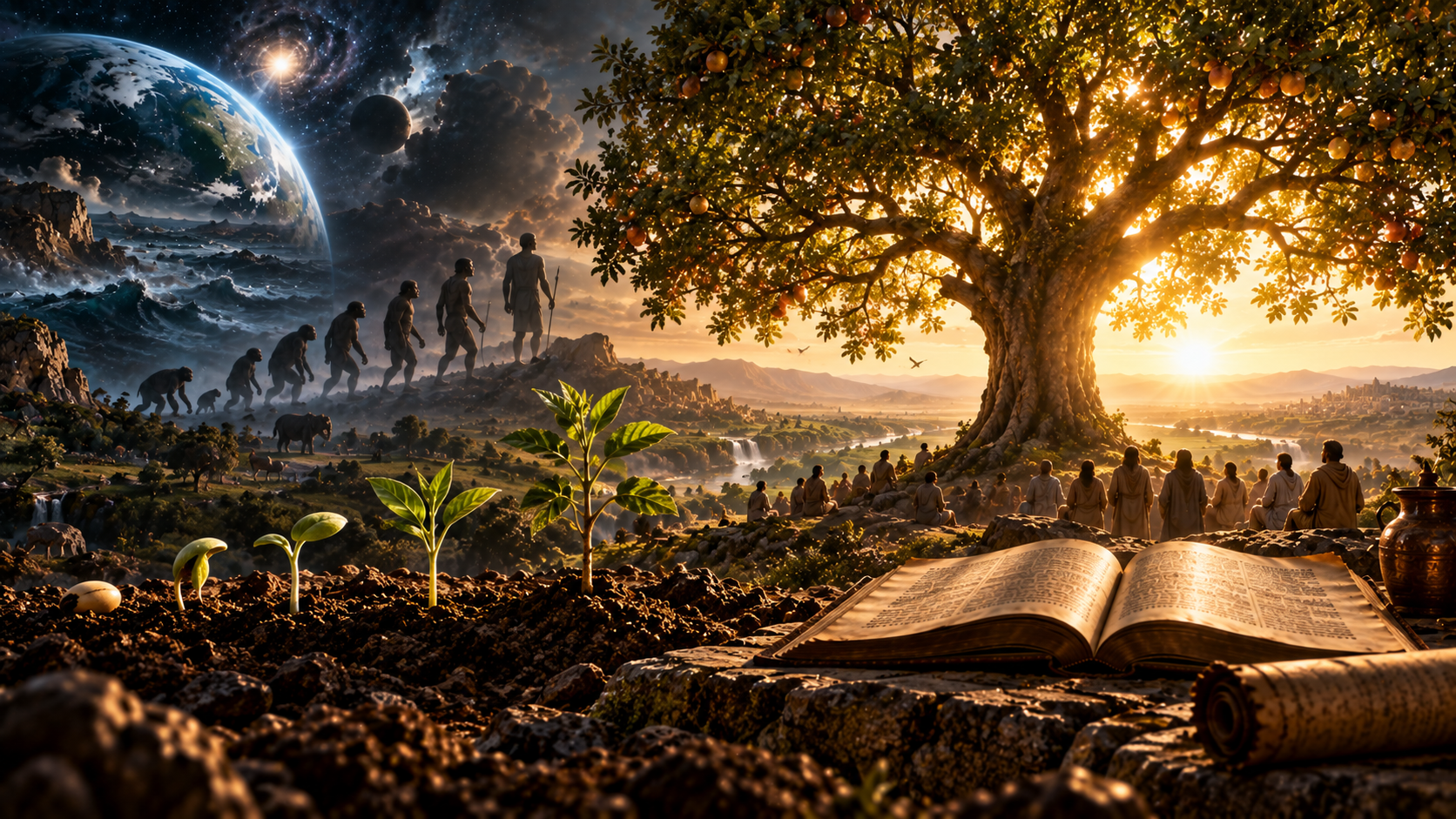
Science investigates how the human body and the human species came to their present form.
It studies fossils and genetics.
It traces ancient populations, migration, biological change, and the long history of human life.
These are legitimate scientific questions.
But even a detailed account of biological human history does not, by itself, answer another question:
What does it mean to bear the image of God?
Perhaps we need to distinguish between two questions.
How did the human body and the human species arrive at their present form?
And:
What is a human being made in the image of God?
Must these necessarily be the same question?
If science and Scripture have, at least in part, been investigating questions at different levels, then perhaps we have sometimes placed two different stories on a single timeline and created more conflict than the texts themselves require.
The discovery of an ancient biological history of humanity does not necessarily cause the Bible to collapse.
And believing the Bible does not necessarily require us to reject the long history of nature and humanity uncovered by science.
This distinction may open a different path through one of the oldest conflicts surrounding Genesis.
Instead of forcing science and Scripture to compete over a single question, we can first ask:
What question is each actually trying to answer?
10. Creation Becomes a Story of Word and Relationship
As we move from Genesis 1 into Genesis 2 and 3, the center of the story begins to shift.
God’s word is given to humanity.
A command is given concerning what may be eaten and what must not be eaten.
And the human being must respond to that word.
The biblical story is no longer concerned only with the question:
What was created?
It increasingly becomes concerned with another question:
What relationship will human beings have with the word of God?
As we continue through Scripture, this pattern appears again and again.
God calls people.
God gives his word.
God establishes covenants.
And human beings respond to that word through trust, rejection, obedience, or disobedience.
In Exodus 19, nations already exist, yet Israel is called into a particular covenant relationship with God.
This suggests an important possibility:
Creation and covenant may be more deeply connected in the biblical story than we have often assumed.
If so, creation is not merely about producing objects.
It also points toward relationship.
Toward calling.
Toward response.
And ultimately, toward the kind of humanity God intends to form.
That possibility will become even more important when we ask why Scripture speaks repeatedly about covenant, salvation, rebirth, restoration, and the Kingdom of God.

11. Why Do We Need the Bible?
At this point, we need to ask an even more fundamental question.
Why was the Bible given to us?
Was it simply to tell us that God exists?
Is the Bible’s ultimate purpose merely to teach us to call upon God, pray in the name of Jesus, and believe?
Faith and prayer are certainly important.
But if that were the entire purpose, we would still need to ask why the Bible contains such a vast story stretching from Genesis to Revelation.
Why is creation necessary?
Why does the image of God appear?
Why is covenant necessary?
Why do the prophets speak of things yet to come?
Why does Jesus speak of a new covenant?
Why does Scripture speak of salvation and being born again?
And why, at the end of the Bible, do we encounter once again a new heaven and a new earth, and the Tree of Life?
Could all these themes be moving toward a larger purpose that unfolds from the beginning of Scripture to its end?
Perhaps the Bible is not merely telling us what happened long ago.
Perhaps it is also revealing where the story of humanity is going.
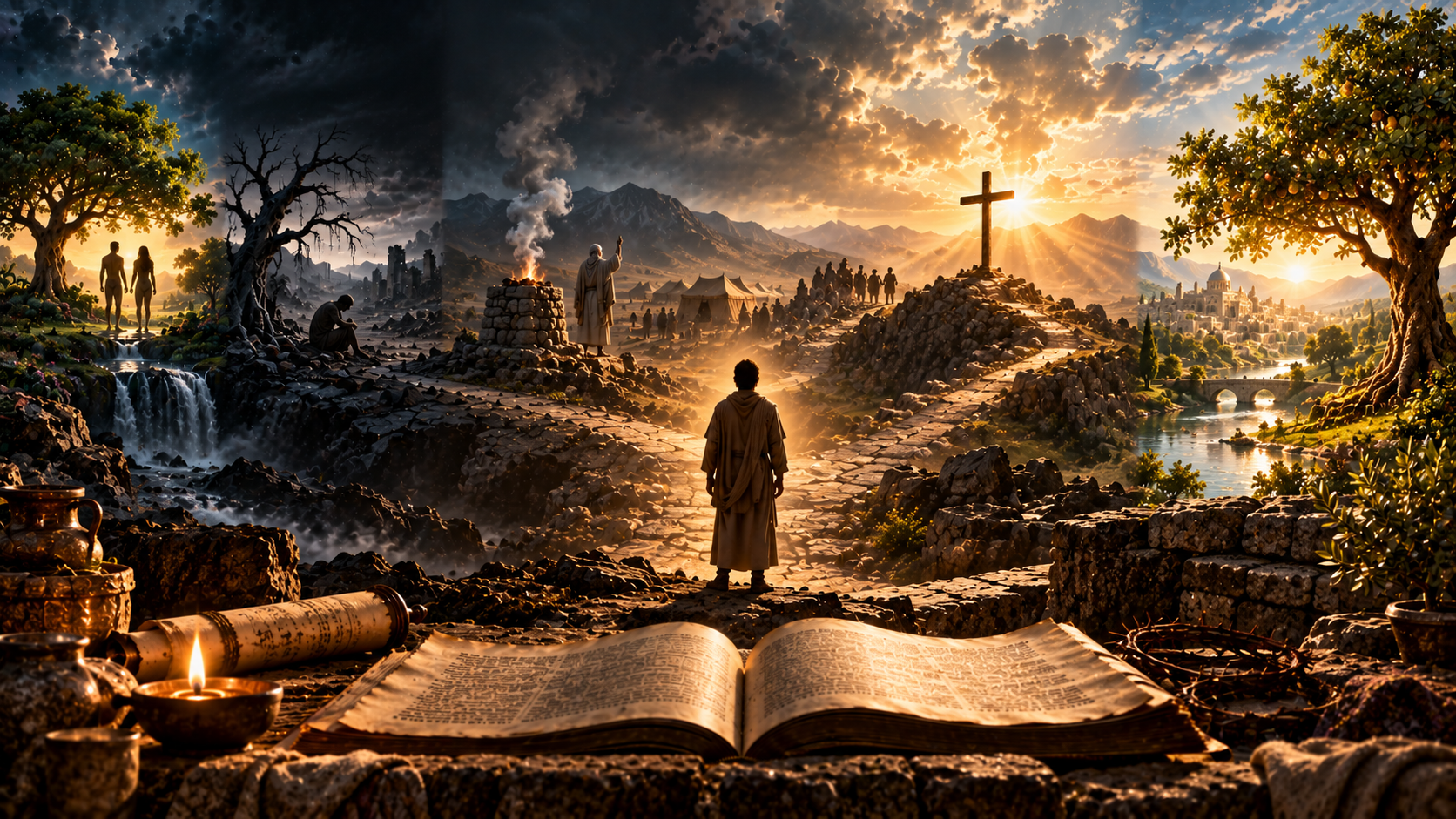
12. From the Image of God to the Story of Restoration
Genesis 1 declares that humanity is created in the image of God.
But the story that follows shows that the relationship between God and humanity does not remain as it was intended to be.
Human beings turn away from God’s word.
The relationship is broken.
Then covenant enters the biblical story.
Covenants are broken.
Promises are given again.
The prophets continue to speak.
And in the New Testament, the story develops toward salvation through Christ and the making of a renewed humanity.
Seen from this perspective, salvation cannot easily be reduced to the idea of simply “going to a better place after death.”
A more fundamental question lies beneath it:
How can broken humanity be restored to what God intends human beings to become?
From this perspective, the image of God is not merely an expression that appears briefly in the first chapter of Genesis and then disappears.
It may provide an important starting point for understanding the direction of the entire biblical story.
Creation.
Image.
Broken relationship.
Covenant.
Promise.
Christ.
Salvation.
Restoration.
These may not be isolated doctrines.
They may be parts of one unfolding story.
13. What Is the Kingdom of God?
This brings us to another familiar expression that deserves to be reconsidered:
Heaven. The Kingdom of God.
We often imagine heaven primarily as a place where the soul goes after death.
But the way Jesus speaks about the Kingdom of God is far richer.
In Matthew 13:31–32, the Kingdom of Heaven is compared to a tiny mustard seed.
It begins small.
It grows.
It becomes something much larger.
It becomes a tree.
The Kingdom is therefore pictured as something that begins, grows, and transforms.
So we can ask another question.
Is the Kingdom of God only a distant place completely separated from human life?
Or does it also include God’s reign taking shape among people and communities transformed through his word?
We will explore this question more deeply in a later chapter.
For now, one connection deserves our attention.
Genesis speaks of seed and trees.
Jesus uses seed and trees when teaching about the Kingdom of God.
And Revelation brings us again to the Tree of Life.
What relationship, if any, exists among these images?
That question deserves a much closer investigation.
14. Misunderstanding Genesis Is About More Than Chronology
This is why rereading Genesis 1 creation is not merely about deciding whether the Earth is six thousand years old or billions of years old.
Something more important may be at stake.
If we miss the central concern of Genesis and focus exclusively on the physical creation of nature and humanity, we may overlook the larger questions Scripture is asking us.
What kind of human being does God intend to form?
What does the image of God mean?
Why was the relationship between God and humanity broken?
Why do covenants appear repeatedly?
Why is prophecy necessary?
Why is salvation necessary?
Why does the Tree of Life appear again at the end of the Bible?
How we read Genesis, therefore, may involve more than biblical chronology.
If we become trapped in the wrong questions, we may miss the purpose and hope toward which Scripture is directing us.
If the Bible merely tells us that God created nature and humanity long ago, then we can remain spectators of an ancient event.
But if the Bible reveals what God intends humanity to become, how broken humanity is restored, and where that history is ultimately leading, everything changes.
The Bible is no longer merely a story about the past.
Its story turns toward us and asks:
What am I being transformed into?
That question brings Genesis much closer to the present.
15. The Story That Begins in Genesis Ends in Hope
Now let us move to the final pages of the Bible.
The closing vision of Revelation 21 and 22 is not a vision of despair.
Revelation 21 speaks of a new heaven and a new earth.
It describes God dwelling with humanity and a world in which tears, death, mourning, and pain are no more.
Then Revelation 22 presents something particularly striking.
Something that appeared near the beginning of the biblical story appears again:
the Tree of Life.
The story that begins in Genesis returns, at the end of Scripture, to life, God, and humanity in restored relationship.
Genesis and Revelation therefore stand at opposite ends of the Bible, yet important images echo between them.
Creation and new creation.
Life and the Tree of Life.
Humanity and God.
Broken relationship and restored relationship.
Beginning and completion.
This does not settle every question about how individual passages should be interpreted.
But it gives us a larger biblical landscape in which to investigate them.
And within that landscape, Genesis 1 creation may be the beginning of a story whose destination cannot be understood by looking only at the physical origins of the universe.
The story ends with hope.