
What Was the First Seal of Revelation?
In the previous article, we explored the nature of revelation itself.
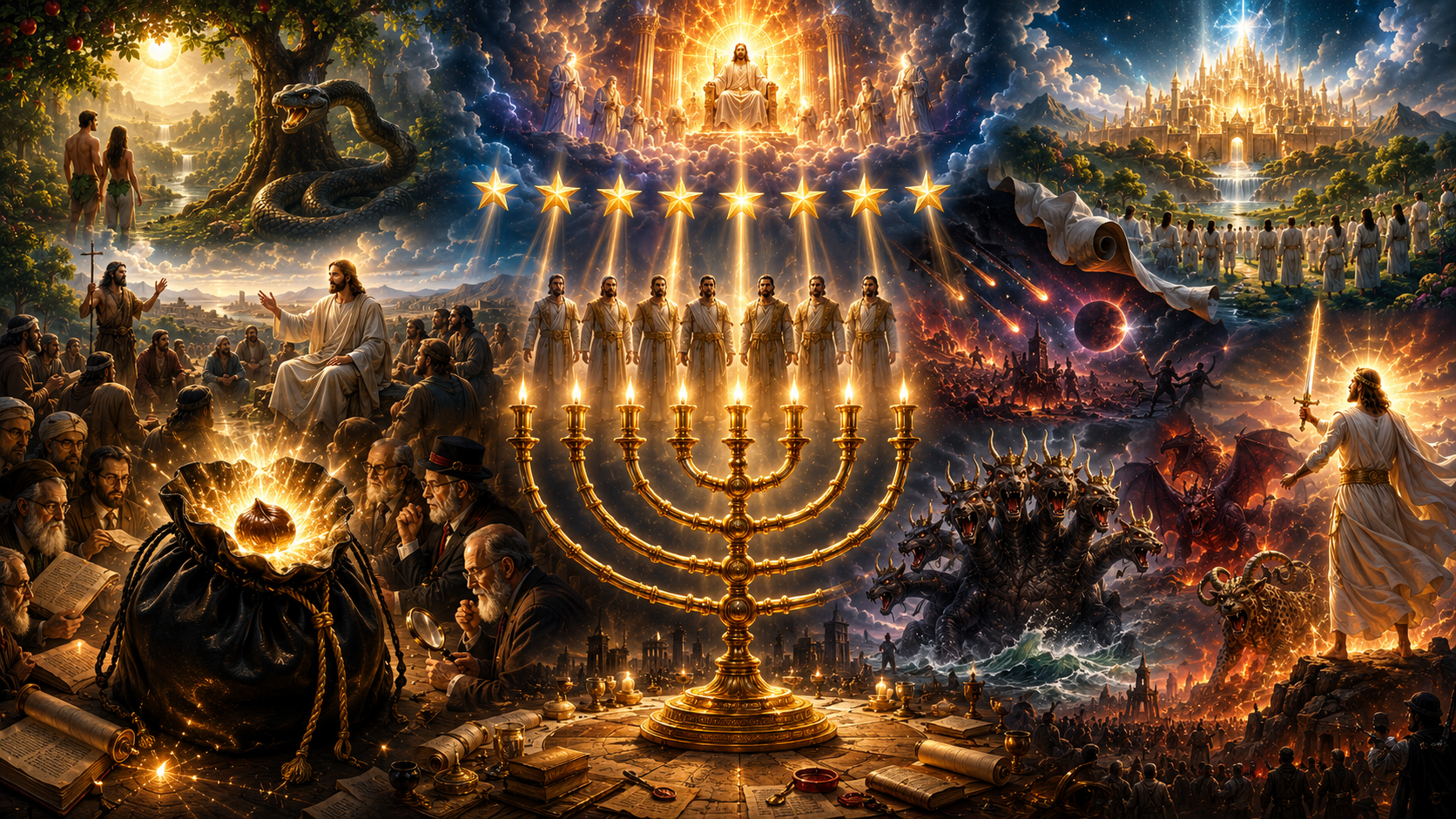
I compared revelation to a chestnut hidden inside a sealed black bag.
As long as the bag remains closed, no one can know what is inside.
Not the greatest scholars.
Not the most brilliant theologians.
Not even the most educated experts.
Yet the moment the bag is opened, everything changes.
A child can understand.
A professor can understand.
A scholar can understand.
Revelation is not difficult because it is complicated.
It is difficult because it is hidden.
This leads us to an important question:
What is the first hidden mystery concealed within the Book of Revelation?
According to Revelation 1:20, the answer is the mystery of the Seven Stars and the Seven Golden Lampstands.
Surprisingly, Jesus Himself calls this a mystery.
Therefore, the starting point of Revelation is not the Beast, the number 666, or the Antichrist.
The first key is the mystery of the Seven Stars and the Seven Golden Lampstands.
Everything that follows in Revelation unfolds from this foundation.
In other words, Revelation Chapter 1 contains the first key that unlocks the entire prophetic structure of the book.
The Hidden Plan That Began in Genesis
To understand Revelation, we must begin where the Bible begins: Genesis.
Most people read Genesis as a record of the physical creation of humanity and the world.
However, this interpretation suggests something deeper.
Psalm 78 declares that God spoke through mysteries and parables from the beginning.
Isaiah repeatedly speaks of God declaring the end from the beginning.
From this perspective, Genesis is not merely history.
It is a prophetic blueprint describing the spiritual journey of humanity.
Human beings were originally created in the image of God as living souls.
Yet the serpent entered the story.
The connection between humanity and God became broken.
Genesis 6:3 describes the beginning of separation between mankind and the source of life.
But God did not abandon humanity.
Instead, a vast plan of restoration was established.
That plan was concealed within symbols, parables, and prophetic language throughout Scripture.
The ultimate goal was the restoration of life and the establishment of the Kingdom of God.

The First Coming of Christ and the Hidden Mystery of the Kingdom
Genesis 3:15 contains one of the most important prophecies in the entire Bible.
It describes a conflict between the seed of the woman and the seed of the serpent.
According to this interpretation, the first coming of Jesus fulfilled only part of that prophecy.
Jesus revealed the mysteries of the Kingdom of Heaven.
However, He did not reveal everything openly.
To His disciples, He explained the meaning of parables.
To the wider public, He often spoke only through parables.
Matthew 13 states that the Kingdom of Heaven is a mystery.
John 16:12 records Jesus saying:
“I still have many things to say to you, but you cannot bear them now.”
Why?
Because the complete fulfillment belonged to a future time.
The full unveiling would occur during the period associated with the Second Coming.
The Seven Stars and the Seven Golden Lampstands
Before Jesus began His earthly ministry, John the Baptist appeared first.
His role fulfilled the prophecy concerning Elijah, who would prepare the way before the Lord.
The same prophetic pattern appears again in Revelation.
Before the final fulfillment, another preparatory stage must exist.
That stage is revealed in Revelation 1:20:
“The seven stars are the angels of the seven churches, and the seven lampstands are the seven churches.”
The Seven Stars represent seven messengers.
The Seven Golden Lampstands represent the spiritual community established through those messengers.
Revelation 4 describes the Seven Spirits before the throne of God.
The Seven Stars are connected to this heavenly pattern.
In this interpretation, the Seven Stars symbolize chosen messengers connected with the work of God’s Spirit.
The Seven Golden Lampstands represent the community established through them.
The prophetic events of Revelation begin with this foundation.

Who Are the Sun, Moon, and Stars?
Matthew 24:29 describes the darkening of the sun and moon and the falling of the stars.
Many interpret this as a cosmic catastrophe.
However, Scripture itself provides symbolic clues.
In Genesis 37:9, Joseph dreams that the sun, moon, and stars bow before him.
The sun represents Jacob.
The moon represents his mother.
The stars represent the sons of Israel.
The imagery therefore points to a covenant community rather than astronomical objects.
From this perspective, the sun, moon, and stars in Revelation symbolize a spiritual people.
Their darkening and falling represent the collapse of a spiritual structure rather than the destruction of the physical universe.
Apostasy and the Fall of the Lampstands
Second Thessalonians Chapter 2 introduces two crucial prophetic events:
Apostasy.
And the appearance of the son of destruction.
The return of Christ does not occur before these events.
Revelation Chapters 2 and 3 contain warnings directed toward the seven churches.
They are rebuked for abandoning their first love.
They are warned concerning spiritual compromise.
They are called to repent.
According to this interpretation, these warnings reveal the beginning of apostasy within the lampstand community.
As a result, judgment follows.
Revelation Chapter 6 describes the darkening of the sun, the changing of the moon, and the falling of the stars.
The heavens roll away like a scroll.
Rather than describing astronomical disaster, these images symbolize the collapse of a spiritual order.
The Appearance of the Beast
Revelation 13 introduces the beast rising from the sea.
It possesses seven heads and ten horns.
Another beast appears as well.
Both receive authority from the dragon.
Revelation 17 depicts a woman riding the beast.
According to this interpretation, these figures represent the continuation of the serpent’s influence first introduced in Genesis.
The conflict that began in Eden reaches its climax in Revelation.
This is not merely a story about future events.
It is the final conflict between truth and deception.
Life and death.
The seed of the woman and the seed of the serpent.
Why Revelation Chapter 1 Matters
Many readers focus immediately on the Beast or the number 666.
Yet Revelation begins elsewhere.
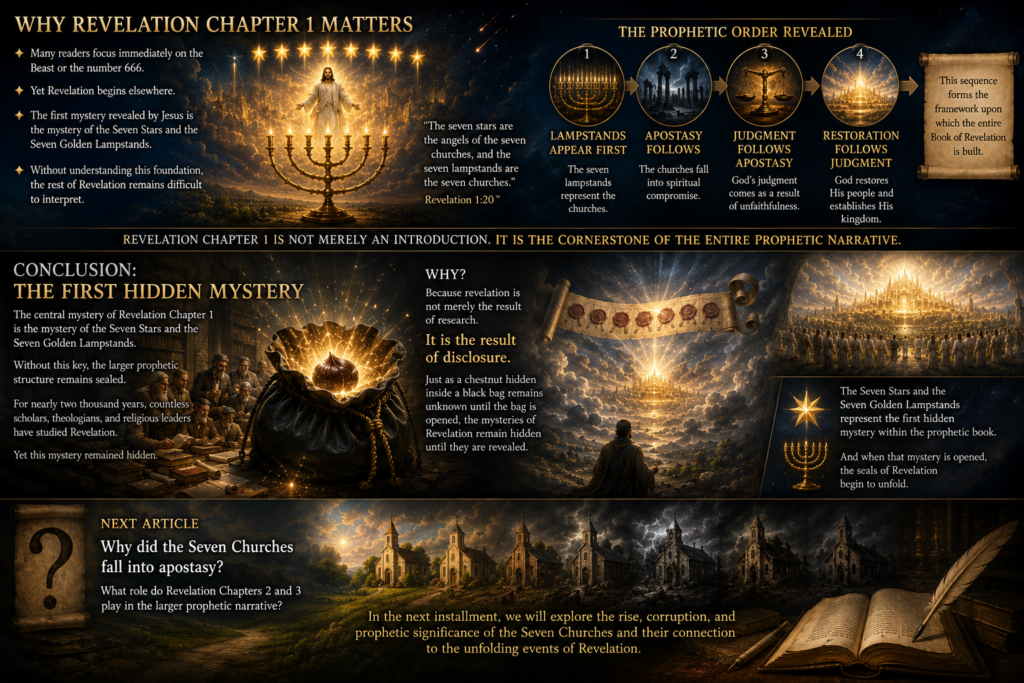
The first mystery revealed by Jesus is the mystery of the Seven Stars and the Seven Golden Lampstands.
Without understanding this foundation, the rest of Revelation remains difficult to interpret.
The lampstands appear first.
Apostasy follows.
Judgment follows apostasy.
Restoration follows judgment.
This sequence forms the framework upon which the entire Book of Revelation is built.
For this reason, Revelation Chapter 1 is not merely an introduction.
It is the cornerstone of the entire prophetic narrative.
Conclusion: The First Hidden Mystery
The central mystery of Revelation Chapter 1 is the mystery of the Seven Stars and the Seven Golden Lampstands.
Without this key, the larger prophetic structure remains sealed.
For nearly two thousand years, countless scholars, theologians, and religious leaders have studied Revelation.
Yet this mystery remained hidden.
Why?
Because revelation is not merely the result of research.
It is the result of disclosure.
Just as a chestnut hidden inside a black bag remains unknown until the bag is opened, the mysteries of Revelation remain hidden until they are revealed.
The Seven Stars and the Seven Golden Lampstands represent the first hidden mystery within the prophetic book.
And when that mystery is opened, the seals of Revelation begin to unfold.
Next Article
Why did the Seven Churches fall into apostasy?
What role do Revelation Chapters 2 and 3 play in the larger prophetic narrative?
In the next installment, we will explore the rise, corruption, and prophetic significance of the Seven Churches and their connection to the unfolding events of Revelation.