Introduction | Are There Two Creations in the Bible?
Does the Bible describe creation in only one way?
At first, the question may sound strange.
Genesis begins with one of the most famous sentences ever written:
“In the beginning God created the heaven and the earth.”
For centuries, many readers have understood this primarily as an account of the physical beginning of the universe and the first appearance of humanity.
But then we encounter Acts 17.
When Paul speaks in Athens about God as Creator, his language is strikingly explicit.
He speaks of the God who made the world and everything in it, who gives life and breath to all people, and who made every nation of humanity to live upon the earth.
That raises an important question.
If Acts 17 explicitly speaks about the Creator of the world, all things, all people, and every nation, what exactly is Genesis tracing?
Are Genesis 1 and Acts 17 simply repeating the same account?
Or could Scripture be showing us two different dimensions of God’s creative work?
This chapter begins with that question.
And once we ask it, some of the most familiar words in Genesis begin to look surprisingly different:
Light. The sun, moon, and stars. The image of God. The breath of life. The Tree of Life. The Tree of the Knowledge of Good and Evil. The serpent. Life and death.
What if these are not isolated details in an ancient scientific chronology?
What if they belong to a continuous biblical story that begins in Genesis and reaches its completion in Revelation?
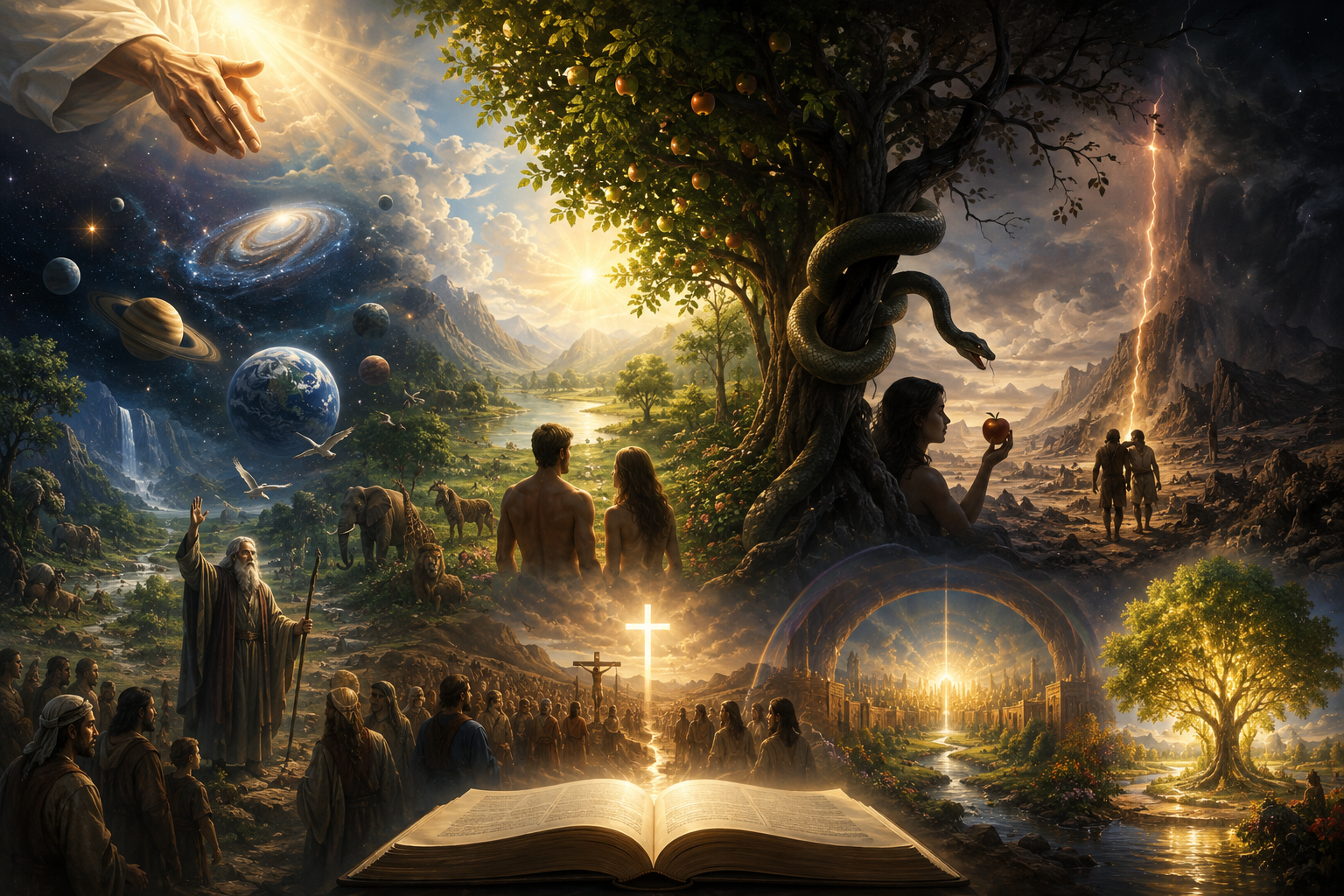
1. Is Genesis 1 Really an Account of the Beginning of the Physical Universe?
Genesis 1 opens the entire Bible.
And almost immediately, something unusual happens.
Light appears before the sun, moon, and stars.
God says, “Let there be light,” and there is light.
Yet the sun, moon, and stars do not appear until the fourth day.
If Genesis 1 is intended primarily as a modern chronological explanation of the physical formation of the universe, this sequence naturally raises a question:
How is there light before the astronomical bodies normally associated with physical light on Earth?
This is often treated as a difficulty that must somehow be explained away.
But perhaps it is not merely a difficulty.
Perhaps it is a clue.
Because when we continue reading the Bible, we discover that Scripture does not always use the sun, moon, stars, light, trees, mountains, heavens, and earth merely as descriptions of physical objects.
They can also function as spiritual and prophetic language.
Consider Joseph’s dream in Genesis 37:9.
Joseph sees the sun, the moon, and eleven stars bowing before him.
The text itself connects those images with people in his family. The astronomical objects function as symbols.
Psalm 84 also uses the image of the sun in relation to God, declaring that the LORD is a “sun and shield.”
Joel 2 speaks of the sun becoming dark and the moon turning to blood in prophetic language.
Jesus uses similar imagery in Matthew 24:29: the sun is darkened, the moon does not give its light, and the stars fall from heaven.
Revelation 6:12–13 again presents the sun becoming dark, the moon becoming like blood, and the stars falling.
This does not mean that every mention of the sun, moon, or stars in the Bible must be symbolic.
It establishes something more fundamental:
The Bible itself demonstrates that cosmic language can carry spiritual and prophetic meaning.
Therefore, before deciding that every element in Genesis 1 must describe physical astronomy, we should first ask how Scripture itself uses these words.
And this leads us to another familiar object in Genesis.
A tree.
2. Does a “Tree” in the Bible Always Mean a Literal Tree?
Genesis contains two extraordinary trees: the Tree of Life and the Tree of the Knowledge of Good and Evil.
If we read Genesis only as a physical description of the natural world, we naturally imagine botanical trees bearing physical fruit.
But is that the only way the Bible uses the language of trees and fruit?
No.
Throughout Scripture, trees, branches, vines, seeds, and fruit can represent people, spiritual conditions, teachings, kingdoms, and the results produced by a particular source.
Jesus says in John 15 that He is the true vine and His disciples are the branches.
Obviously, He is not claiming to be a botanical vine.
The language communicates a relationship of life, source, connection, and fruitfulness.
Likewise, when Scripture speaks of good trees producing good fruit and bad trees producing bad fruit, the concern is not agriculture alone.
The visible fruit reveals the nature of its source.
This biblical pattern gives us permission to ask a question that is rarely asked:
What if the two trees in Genesis are also telling us something about two spiritual sources of life and knowledge?
That question brings us directly to the Tree of Life.
3. What Does the Tree of Life Represent?
The Tree of Life appears near the beginning of the Bible.
Then, remarkably, it appears again near the very end.
That alone should make us pay attention.
Genesis presents humanity with access to the Tree of Life.
After the fall, that access is lost.
But in Revelation 22, the Tree of Life appears again.
This creates a massive biblical arc:
Life is present.
Life is lost.
Life is restored.
The Tree of Life therefore cannot be treated merely as an incidental plant decorating the Garden of Eden.
It stands at the center of the Bible’s question of life.
Jesus later declares that He is the life.
He describes His words as spirit and life.
The Gospel of John repeatedly connects life with Christ, the Word, and the Spirit.
So the central question becomes deeper than, “What kind of fruit grew on the Tree of Life?”
The more important question is:
What is the source of the life that the tree represents?
If the life of God is communicated through His Word and Spirit, then the Tree of Life points us toward a reality in which humanity lives through connection with God.
And if there is a Tree of Life, there is also another tree.
4. What Does the Tree of the Knowledge of Good and Evil Represent?
The second tree produces the opposite result.
Its fruit leads to death.
But notice what happens in the narrative.
The serpent speaks.
Human beings listen.
A word is received.
A different judgment enters consciousness.
And the relationship between humanity and God changes.
The decisive event is therefore not simply chewing a forbidden piece of fruit.
The narrative revolves around whose word is believed, whose knowledge is received, and what kind of life that word produces.
One source leads toward life.
Another leads toward death.
This pattern continues throughout Scripture:
Truth and deception.
Spirit and flesh.
Life and death.
The Word of God and another word.
The Tree of Life and the Tree of the Knowledge of Good and Evil can therefore be read as part of a much larger biblical contrast.
And this brings us to the serpent.
The serpent does not merely appear as an unusual animal in a garden.
Revelation eventually identifies the ancient serpent with the deceiver.
The image introduced in Genesis returns at the end of Scripture.
Once again, Genesis and Revelation begin to speak to one another.
5. Why Did Humanity, Created in the Image of God, Become “Flesh”?
Genesis begins with an extraordinary declaration:
Humanity is to be made in the image and likeness of God.
This is one of the most important statements in the entire Bible.
If God is Spirit, what does it mean for humanity to bear His image?
The question cannot be reduced merely to the shape of the physical human body.
The biblical emphasis moves toward the inner nature of the human being, toward life, spirit, character, consciousness, and relationship with God.
Genesis 2 describes the human becoming a living being through the breath of life from God.
But after the fall, the language changes.
By Genesis 6, God says that humanity is flesh.
This contrast deserves attention.
The biblical story moves from the image of God and the breath of life toward a condition described as flesh.
The New Testament repeatedly places flesh and Spirit in opposition.
From this perspective, “flesh” is more than a reference to having a biological body.
It describes a condition in which humanity is no longer governed by the life and Spirit of God.
The tragedy of Genesis, then, is not merely biological death.
It is the collapse of humanity’s original relationship with the divine source of life.
The image remains the goal.
But the life corresponding to that image has been lost.
And once that happens, the rest of the Bible can be read as the history of its restoration.
6. How Is the Lost Image of God Restored?
If Genesis describes the loss of God’s life and image, the Bible must eventually answer another question:
Can that image be restored?
The New Testament repeatedly brings us back to the image of God through Christ.
Christ is presented as the image of the invisible God.
Those who belong to Him are transformed.
They are renewed.
They are born again.
They move from death to life.
The Spirit returns to the center of the story.
This means salvation is not merely a legal cancellation of wrongdoing.
Within the larger biblical narrative, salvation also involves restoration.
What was lost must be recovered.
What died must live.
What was corrupted must be renewed.
What ceased to reflect God must again bear His image.
This makes the entire Bible begin to look like one long movement:
Image → Fall → Covenant → Christ → Restoration → New Creation
7. Genesis 1 and Acts 17: Are They Describing the Same Creation?
Now we arrive at the decisive comparison.
Acts 17:24–26 gives us one of the clearest statements in Scripture concerning God, the world, and humanity.
Paul speaks of the God who made the world and everything in it.
He says God gives life and breath to all people.
And he speaks of every nation of humanity living upon the earth.
Notice the scope:
The world.
Everything in it.
All people.
Every nation.
The earth.
This is universal language.
The passage describes God as Creator of the cosmos and the source of life for humanity as a whole.
Now compare that with the narrative developed in Genesis:
the Word,
light,
the image of God,
the breath of life,
the Tree of Life,
the Tree of the Knowledge of Good and Evil,
the serpent,
the fall,
life,
and death.
The difference in emphasis is striking.
So why must we assume that Genesis 1 and Acts 17 are simply repeating the same scientific chronology?
The question is not whether God created the universe.
Acts 17 answers that clearly.
God is the Creator of the world and of humanity.
The deeper question is:
What particular work of God does Genesis begin to trace within that larger creation?
This is where Exodus 19:5–6 becomes crucial.
God declares:
“All the earth is mine.”
Yet immediately within that whole earth, He sets apart a particular people.
Israel is called to become God’s treasured possession, a kingdom of priests, and a holy nation.
The pattern is important:
The whole earth belongs to God.
Yet within the whole, a people are chosen.
Universal ownership and particular election exist together.
They are not contradictory.
And they are not identical.
This gives us a powerful biblical lens.
Acts 17 speaks universally of the Creator of the world and all humanity.
But Scripture also traces a particular covenant history within humanity:
Adam → A lineage → Abraham → Israel → The covenant → Christ → The new covenant → A renewed people in Revelation.
Acts 17 tells us who created the whole world and all humanity.
Genesis begins to trace what God does within that world.
One concerns universal creation.
The other begins the biblical drama of image, covenant, fall, life, death, and restoration.
8. Must Adam Be the First Biological Human Being?
This distinction leads to another difficult question.
Must Adam necessarily be read as the first biological human being ever to exist?
If Acts 17 already places all humanity and every nation under the creative work of God, another possibility becomes available.
Adam may stand at the beginning of the particular history Scripture intends to trace.
The Bible frequently works this way.
God acts within the whole by choosing particular people.
He chooses Abraham.
He chooses Israel.
He establishes a covenant with a particular nation even though the whole earth belongs to Him.
Later, through Christ, the promise expands outward toward all nations.
Therefore, election does not mean that everyone outside the chosen line does not exist.
It means that Scripture follows a particular line because a particular divine purpose is unfolding through it.
Read this way, Adam becomes central not because the Bible must function as a modern biological genealogy of every human being, but because the biblical history of image, covenant, fall, and restoration begins with him.
This also helps us revisit familiar questions surrounding Cain and the world outside Adam’s immediate family.
Instead of forcing every human being on earth into a narrowly reconstructed family chronology, we can ask what history Scripture itself has chosen to follow.
The Bible is not required to record every human lineage.
It follows the covenantal line relevant to its message.
And this brings us back to one tiny but enormously important word:
Beginning.
9. What Do “In the Beginning” in Genesis and John Really Mean?
Genesis begins:
“In the beginning…”
But Genesis is not the only biblical book to begin that way.
The Gospel of John also opens:
“In the beginning was the Word…”
John’s language recalls Genesis.
Then the Word becomes flesh and enters human history in Jesus Christ.
Why does John return us to the language of “the beginning”?
Perhaps because a biblical “beginning” is not limited to a timestamp for the first physical instant of the cosmos.
It can also mark the beginning of a decisive work of God.
Genesis opens one great stage of God’s work.
John announces another.
With Christ comes a new covenant.
At the Last Supper, Jesus speaks of the new covenant in His blood.
Something new is beginning.
And yet it is also the continuation and fulfillment of what came before.
The Creator remains the same.
The purpose unfolds through stages.
10. Does the “New Heaven and New Earth” Mean Another Physical Universe?
Near the end of Revelation, we encounter language that sounds remarkably familiar:
a new heaven and a new earth.
The Bible began with heaven and earth.
Now it ends with a new heaven and a new earth.
Revelation gathers themes introduced in Genesis.
The Tree of Life returns.
The curse is removed.
Death is overcome.
God dwells with His people.
Life flows again.
What was lost at the beginning is restored at the end.
The symmetry is remarkable:
Genesis: heaven and earth.
Revelation: new heaven and new earth.
Genesis: Tree of Life.
Revelation: Tree of Life restored.
Genesis: humanity in God’s presence.
After the fall: separation.
Revelation: God dwelling with humanity again.
The final creation therefore looks less like an unrelated cosmic episode and more like the completion of the biblical story that Genesis began.
11. Can “Heaven and Earth” Also Describe God’s Rule and His People?
Once biblical creation language is read across Scripture rather than in isolation, another question emerges.
Must “heaven and earth” always refer only to physical astronomy and geology?
Biblical prophecy frequently uses cosmic language to describe kingdoms, rulers, peoples, judgment, and the overturning of an existing order.
This is why the imagery of the sun, moon, and stars becomes so important.
Genesis 37 already demonstrates that such objects can represent people.
The prophets use the shaking of heaven and earth in descriptions of divine judgment.
Jesus uses cosmic imagery when speaking prophetically.
Revelation continues the same vocabulary.
Therefore, when Revelation speaks of a new heaven and a new earth, we should at least consider whether this language includes the establishment of a new divine order, a renewed people, and God’s restored reign.
This possibility becomes even more significant when we see what appears around that new creation:
God’s people.
God’s name.
God’s dwelling.
God’s throne.
Life.
And the Tree of Life.
12. Why Do the Seal of God and the Twelve Tribes Appear Again?
Revelation introduces another striking image:
the seal of God.
Those who belong to God are marked.
His name is associated with them.
They are identified as His.
This brings us back to the original language of Genesis:
the image of God.
At the beginning, humanity is to bear God’s image.
At the end, a people belong fully to God and bear His identifying mark.
The vocabulary is not identical, but the theological movement is striking.
The biblical story begins with the intention to form humanity according to God.
It ends with a people restored to God’s presence and belonging.
The twelve tribes also return in Revelation.
Why?
Because the covenant history has not simply disappeared.
It reaches its culmination.
What began with particular election ultimately opens toward the nations.
The biblical story moves from the particular toward the universal.
13. Why Are Mysteries Hidden in Parables?
If Genesis contains spiritual and prophetic language, another question naturally follows.
Why would Scripture speak this way?
Psalm 78 speaks of opening the mouth in a parable and uttering hidden things from ancient times.
Matthew 13 connects this language with Jesus’ use of parables and things hidden from the foundation of the world.
This gives us an important principle.
Biblical mystery is not necessarily hidden because it is never meant to be known.
Something can be hidden until the time of revelation.
A seed contains a future tree, but the tree is not visible at the beginning.
Likewise, a biblical symbol introduced in Genesis may not reveal its full meaning until later Scripture develops it.
The serpent becomes clearer in Revelation.
The Tree of Life returns in Revelation.
The image of God develops through Christ.
The covenant develops through Israel and the new covenant.
The beginning becomes clearer when viewed from the end.
14. When Is the Sealed Word Opened?
The Bible repeatedly uses the language of sealing and opening.
A sealed word cannot be fully understood merely by staring harder at the seal.
It must be opened.
This is why later fulfillment matters.
Prophecy becomes clearer when the promised event occurs.
Symbols become clearer when Scripture itself identifies their counterparts.
The end illuminates the beginning.
This is particularly important for Genesis.
If Genesis introduces central symbols and Revelation returns to them at the completion of the biblical story, then Revelation can function as a key for rereading Genesis.
The Tree of Life at the end helps us reconsider the Tree of Life at the beginning.
The ancient serpent identified at the end helps us reconsider the serpent at the beginning.
The new heaven and new earth at the end help us reconsider the heaven and earth at the beginning.
And the completion of God’s work helps us understand what kind of work was begun.
15. What Does Fulfilled Prophecy Finally Confirm?
Scripture presents God as One who declares the end from the beginning.
Biblical history therefore has direction.
There is an intention.
There is a beginning.
There is a promised outcome.
And there is fulfillment.
This is why the language of completion is so important.
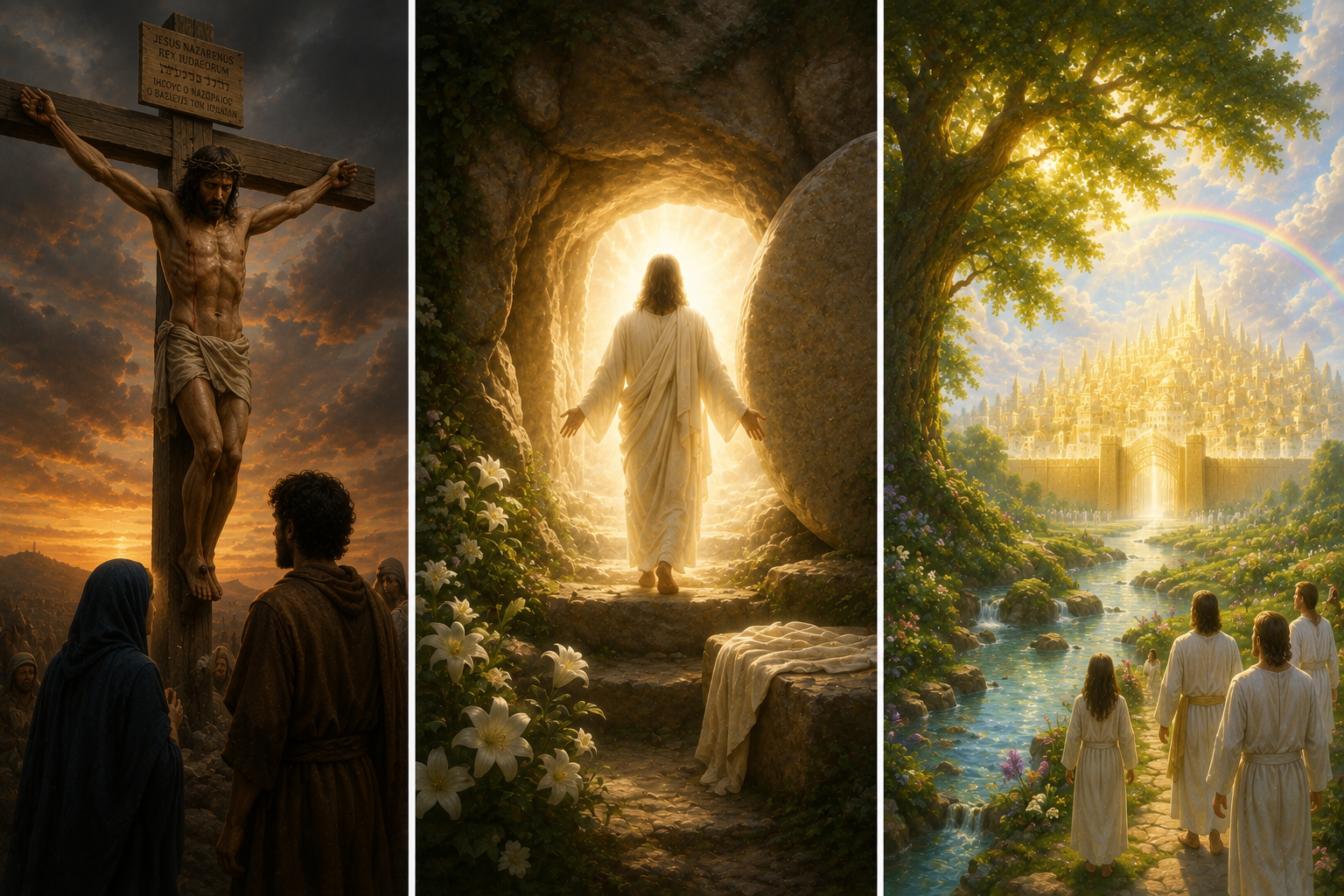
At the cross, Jesus says:
“It is finished.”
Within the Gospel narrative, this declaration stands at the culmination of the work and Scripture being fulfilled in His suffering and death.
The Old Testament covenantal and prophetic story reaches a decisive fulfillment in Christ.
But the biblical story continues toward the fulfillment of the new covenant and the final restoration described in Revelation.
And there, in Revelation 21, another declaration appears:
“It is done.”
These statements should not be flattened into identical moments, but together they reveal an important biblical pattern:
God begins a work.
God declares what He will accomplish.
The work unfolds.
Fulfillment confirms what was promised.
The Bible therefore invites us to read not only from beginning to end, but also from fulfillment back toward promise.
Only then can the architecture of the whole story become visible.

Epilogue | From Genesis to the New Heaven and New Earth
We can now return to the very first verse of the Bible:
“In the beginning God created the heaven and the earth.”
At the beginning of this chapter, we asked whether these words must be read only as a description of the physical origin of the universe.
Acts 17 gave us an important distinction.
Paul explicitly speaks of the God who made the world and everything in it, who gives life and breath to all people, and who made every nation of humanity.
God is unquestionably the Creator of the physical world and of humanity.
But Genesis follows another extraordinary thread within that creation:
the image of God,
life,
the Word,
light,
the Tree of Life,
the serpent,
the fall,
death,
covenant,
and restoration.
And when we arrive at the final chapters of Revelation, those threads converge again.
Revelation 21 announces:
“A new heaven and a new earth.”
Then God declares:
“Behold, I make all things new.”
That statement is crucial.
What was corrupted is renewed.
What was lost is restored.
What was separated is brought back into relationship.
Humanity is renewed.
God’s people are renewed.
God’s dwelling with humanity is restored.
Death is overcome.
And the Tree of Life, lost in Genesis, appears again in Revelation.
Then comes the declaration:
“It is done.”
Now the beginning and the end can be placed side by side:
Genesis 1:1
“In the beginning God created the heaven and the earth.”
Revelation 21:1
“A new heaven and a new earth.”
Revelation 21:5
“Behold, I make all things new.”
Revelation 21:6
“It is done.”
Seen through this structure, Genesis 1:1 can be read as more than a statement looking backward toward the physical origin of the cosmos.
It can also be read as the opening declaration of a biblical drama whose full meaning becomes visible at its completion.
The beginning contains the seed of the end.
Genesis opens the story.
Revelation reveals where the story was moving.
And “It is done” announces its completion.
The new heaven and new earth are therefore not an unrelated second creation suddenly attached to the end of Scripture.
They complete the movement that began in Genesis:
Creation → Image → Life → Fall → Covenant → Christ → Restoration → New Creation
This brings us back to the provocative question with which we began:
Are there two creations in the Bible?
Not two Creators.
And not two competing explanations of the same scientific event.
There is one Creator.
Acts 17 presents Him as Creator of the world, everything in it, all humanity, and every nation.
But within that universal creation, Scripture traces a particular history:
God forming a people according to His image and life,
that life being lost,
a covenant history unfolding,
and what was lost finally being restored and made new.
Exodus 19 gives us the pattern:
“All the earth is mine.”
Yet within that whole, God sets apart a covenant people.
The whole and the chosen are not the same category.
And the particular ultimately moves toward the universal.
The Bible begins with creation.
It ends with creation renewed.
It begins with the Tree of Life.
It ends with the Tree of Life.
It begins with humanity made in the image of God.
It ends with God dwelling with a renewed people who belong to Him.
The first page and the final page meet.
Genesis begins it.
Revelation completes it.
And between those two pages unfolds the biblical history of how God makes all things new.
Previous Chapter | Start Here
If you have not yet read the previous chapter, we recommend starting with Part 1, Chapter 1.
It introduces the central question behind this series: What is consciousness, and how does it connect with the biblical story of creation, humanity, and the image of God?
Reading Chapter 1 first will make the ideas explored in this chapter — Genesis 1, the two dimensions of creation, the Tree of Life, and the restoration of God’s image — much easier to follow as one continuous story.
→ Read Part 8, Chapter 1: Consciousness and the Bible
🎥 Watch the Video: Genesis 1 and Acts 17
This article is also explored in a new 25-minute video documentary:
“Did Acts 17 Solve the 6,000-Year Genesis Problem?”
For generations, the apparent conflict between Genesis and modern science has centered on one assumption: that Genesis 1 is describing the physical creation of the universe and the biological beginning of humanity.
But what if that assumption itself needs to be examined?
This video compares Genesis 1 with Acts 17 and follows the Bible’s own use of light, the sun, moon and stars, the Tree of Life, Adam, Cain, the image of God, and the new heaven and new earth.
It explores a provocative possibility: Acts 17 may describe God’s creation of the physical world and humanity as a whole, while Genesis traces a different story within that world, the formation, loss, and restoration of a people in the image of God.
Rather than asking viewers simply to accept this interpretation, the video invites them to compare the passages for themselves.
Genesis 1. Acts 17. Exodus 19. The Prophets. The Gospels. Revelation.
Read them together, and an unexpected question emerges:
What if the long conflict between Genesis and science began because we were asking Genesis to answer the wrong question?