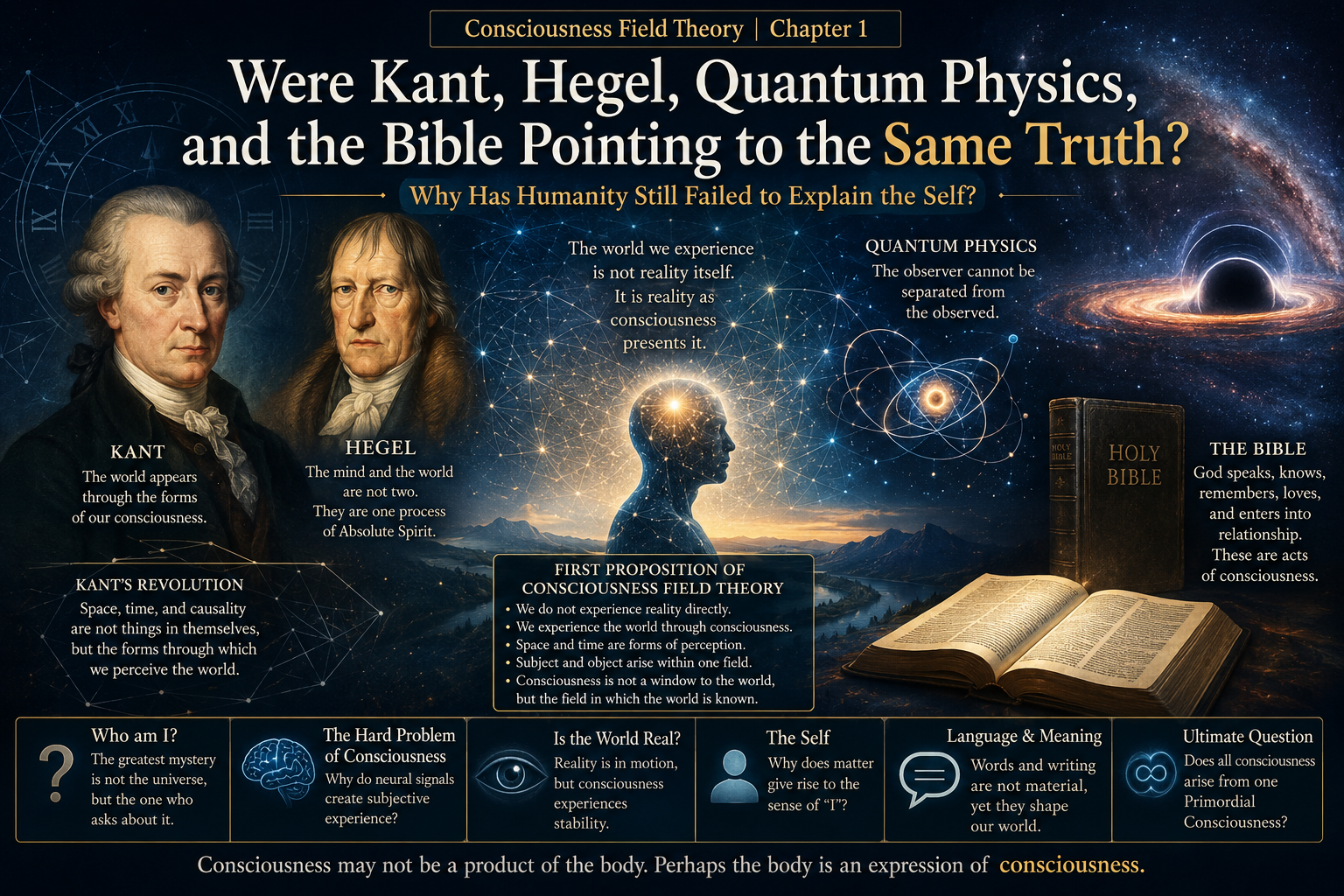
Consciousness Field Theory | Chapter 1 (Part I)
Why Has Humanity Still Failed to Explain the Self?
Meta Description
Can modern science truly explain consciousness? Explore how Kant, Hegel, quantum physics, and the Bible may converge in a new philosophical framework called Consciousness Field Theory.
SEO Keywords
Consciousness Field Theory, consciousness, hard problem of consciousness, Immanuel Kant, Hegel, quantum physics, philosophy of mind, ontology, epistemology, consciousness and reality, observer effect, science and religion, Bible and philosophy
Suggested URL
/consciousness-field-theory-chapter-1
Why Has Humanity Still Failed to Explain the Self?
Human civilization has entered an age of extraordinary scientific achievement.
We have uncovered the structure of the atom, decoded the human genome, estimated the age of the universe, and even captured the shadow of a black hole.
Yet despite these remarkable accomplishments, one question remains fundamentally unanswered.
Who am I?
Every day we think, feel, remember, choose, and dream.
Yet the very subject that performs all of these acts, the “I” behind every experience, continues to resist a complete explanation.
Modern neuroscience investigates the brain.
Physics studies matter and energy.
Biology explores the origin and evolution of life.
Each discipline has achieved astonishing progress within its own domain.
Yet all of them encounter an extraordinary obstacle when confronted with consciousness itself.
Philosophers describe this as the Hard Problem of Consciousness.
Why should electrical activity among billions of neurons become the subjective experience of seeing a crimson rose as beautiful?
Why should a collection of physical particles generate the first-person awareness we call the self?
No universally accepted explanation has yet emerged.
Perhaps the greatest mystery is not the universe.
Perhaps it is the one asking questions about the universe.
Is the World We Experience the Real World?
Most of us naturally assume that the world we see is reality itself.
It feels immediate.
Solid.
Obvious.
Yet a closer examination reveals something remarkable.
The Earth rotates at roughly 1,600 kilometers per hour at the equator.
At the same time, it revolves around the Sun at approximately 107,000 kilometers per hour.
Our solar system, in turn, races through the Milky Way at an even greater speed.
And the Milky Way itself continues its own motion through the expanding universe.
Despite all of this movement, we experience none of it directly.
We feel as though we are standing perfectly still upon solid ground.
Reality is constantly in motion.
Consciousness experiences stability.
These are not identical.
This simple observation suggests an important philosophical insight.
What we experience is not reality presented exactly as it exists.
Rather, reality appears through the way consciousness organizes experience.
The world we know is already interpreted before we become aware of it.
In other words,
experience is not reality itself.
It is reality as consciousness presents it.
This distinction may appear subtle.
In fact, it changes everything.
Kant’s Revolutionary Discovery
In the eighteenth century, Immanuel Kant transformed the direction of philosophy.
Before Kant, philosophers mainly asked:
How can human beings obtain knowledge about the world?
Kant proposed a far more radical question.
What if the world appears according to the conditions of human cognition?
This shift became one of the greatest turning points in the history of philosophy.
According to Kant, space and time are not objects existing independently outside the mind.
Instead, they are a priori forms of intuition.
They are the fundamental structures through which consciousness organizes every possible experience.
A simple analogy may help.
Imagine wearing a pair of glasses from the moment you were born.
You would never notice the lenses themselves.
You would simply assume that everything naturally looks that way.
Kant argued that consciousness functions in a similar manner.
We perceive reality through the “lens” of space.
We perceive change through the “lens” of time.
Even concepts such as causality and quantity are not simply discovered in the external world.
They are organizing principles through which consciousness makes experience intelligible.
This insight fundamentally reversed the traditional relationship between mind and world.
Rather than assuming that the human mind merely copies an independent reality, Kant suggested that the experienced world is already shaped by the structures of consciousness.
This idea became known as the Copernican Revolution of Philosophy.
Just as Nicolaus Copernicus transformed astronomy by placing the Sun rather than the Earth at the center of the solar system, Kant transformed philosophy by placing the structures of cognition at the center of human knowledge.
For the first time, philosophy began asking not merely what reality is, but how reality becomes experience.
That question continues to shape philosophy, psychology, neuroscience, and cognitive science to this day.
To be continued in Chapter 1 (Part II)
In the next section, we will explore:
- Kant’s concept of the Thing-in-Itself (Ding an sich)
- Why this concept raises new philosophical questions
- How Hegel extended Kant’s revolution
- The first proposition of Consciousness Field Theory
- Why consciousness may be understood not merely as an observer, but as the fundamental field through which reality is experienced.

The Thing-in-Itself: The Final Question Kant Left Behind
Kant’s philosophical revolution reshaped the way humanity understood knowledge.
Yet he deliberately left one profound question unanswered.
He introduced a concept known as the Thing-in-Itself (Ding an sich).
According to Kant, everything we experience belongs to the world of phenomena.
Phenomena are not reality as it exists independently.
They are reality as it appears through the structures of human consciousness.
Behind every phenomenon, Kant proposed, there exists an unknowable reality.
This hidden reality is the Thing-in-Itself.
It exists independently of human perception.
Yet, by definition, it can never be directly experienced.
This idea became one of the most influential concepts in modern philosophy.
At the same time, it raises another important question.
If the Thing-in-Itself can never be experienced,
how can we meaningfully speak about it?
We have never observed it.
We have never encountered it directly.
Even the concept itself appears only within consciousness.
In other words,
our idea of a reality beyond consciousness is itself a product of consciousness.
This observation marks the point where Consciousness Field Theory begins to ask a different question.
Perhaps every concept concerning a world “outside” consciousness already exists within consciousness.
If this is true,
consciousness is not merely a passive observer.
It may be the very field within which every possible understanding of reality is formed.
Hegel Opened the Door Even Further
The generation after Kant refused to leave philosophy at the boundary of the unknowable.
Among them,
Georg Wilhelm Friedrich Hegel carried Kant’s revolution to its furthest conclusion.
Hegel questioned the strict separation between subject and object.
Instead of treating consciousness and reality as two independent domains,
he proposed that both belong to a single unfolding process.
According to Hegel,
history,
nature,
culture,
knowledge,
and individual consciousness
are all expressions of what he called the Absolute Spirit.
Reality is not divided into two worlds.
It is one dynamic movement gradually becoming aware of itself.
From this perspective,
the individual self and the external world are not ultimate opposites.
They are two perspectives within one continuous process.
The observer and the observed participate in the same unfolding reality.
This insight represents one of the most ambitious philosophical visions ever proposed.
Yet today,
its language may be translated into concepts more familiar to contemporary readers.
Reinterpreting Absolute Spirit as a Consciousness Field
Consciousness Field Theory proposes that Hegel’s Absolute Spirit can be reinterpreted through a modern philosophical vocabulary.
Rather than imagining Absolute Spirit as a distant metaphysical entity,
we may understand it as a Consciousness Field.
Within this field,
subject and object arise together.
Mind and world are not independent substances.
They are complementary expressions of a deeper reality.
Time may emerge within this field.
Space may emerge within this field.
Even causality may represent one way consciousness organizes experience.
From this perspective,
the universe is not simply a collection of material objects.
It is a meaningful structure experienced within consciousness.
This does not deny the existence of an external world.
Instead,
it shifts the philosophical question.
Rather than asking whether consciousness exists inside the universe,
we begin asking whether the universe, as experienced, appears within consciousness.
This distinction changes the foundation of ontology itself.
The First Proposition of Consciousness Field Theory
The discussion so far leads to the first proposition of Consciousness Field Theory.
We do not experience reality directly.
We experience reality through consciousness.
Space and time are forms through which experience becomes possible.
Subject and object are not absolutely separate.
They emerge together within one field of experience.
If these propositions are correct,
an even deeper question naturally follows.
Where does consciousness itself originate?
Does the brain produce consciousness?
Or does consciousness make the experience of the brain possible?
This question stands at the intersection of philosophy,
neuroscience,
physics,
and theology.
It may also become one of the defining questions of the twenty-first century.
Consciousness Field Theory begins precisely at this point.
Not by claiming final answers,
but by asking whether consciousness should no longer be treated as a secondary phenomenon,
but as one of the most fundamental realities through which the universe is known.
Coming Next
Chapter 2
Does the Brain Produce Consciousness, or Does Consciousness Produce the Experience of the Brain?
In the next chapter, we will explore:
- Is consciousness produced by the brain, or does the brain appear within consciousness?
- The observer problem in quantum physics.
- Why language and meaning are fundamentally non-material.
- What the Bible and Gyeokam Yurok may reveal about consciousness.
- Can God be understood philosophically as the Primordial Consciousness?
The journey has only begun.
The deepest mystery may not be the universe itself,
but the consciousness through which the universe becomes knowable.
Chapter 2
Does the Brain Produce Consciousness, or Does Consciousness Produce the Experience of the Brain?

The Observer Problem and the Beginning of a New Question
For centuries, one assumption has quietly guided almost every scientific discipline.
The brain produces consciousness.
This idea appears so self-evident that few people stop to question it.
Damage the brain, and memory changes.
Stimulate certain neurons, and perception changes.
Alter brain chemistry, and emotions change.
From these observations, many conclude that consciousness must simply be a product of neural activity.
At first glance, the conclusion seems reasonable.
Yet an important philosophical question remains.
Do these observations actually prove that the brain creates consciousness?
Or do they merely demonstrate that changes in the brain alter conscious experience?
These are not the same claim.
Confusing them may be one of the greatest philosophical assumptions of modern science.
Correlation Is Not Causation
Throughout the history of science, correlation has often been mistaken for causation.
When two events occur together, we naturally assume that one produces the other.
Yet this conclusion does not always follow.
Imagine watching a movie on a television screen.
If the screen becomes damaged, the picture changes.
The colors distort.
The sound disappears.
The image may even vanish completely.
Would anyone conclude that the television screen created the actors?
Of course not.
The screen is the medium through which the movie appears.
Damage the medium, and the appearance changes.
The source may remain untouched.
This analogy does not prove that consciousness exists independently of the brain.
But it illustrates an important logical possibility.
The brain may not generate consciousness.
It may organize, transmit, or express consciousness.
Modern neuroscience has not yet established which interpretation is ultimately correct.
The Mystery of Subjective Experience
Even if every neuron in the human brain were mapped with perfect precision,
one mystery would remain.
No physical measurement reveals what an experience actually feels like.
A neuroscientist may observe electrical activity when someone tastes coffee.
Another scientist may record brain waves while someone listens to music.
Yet neither measurement contains the taste of coffee.
Neither measurement contains the feeling of beauty.
Neither measurement contains the experience of being “me.”
Objective observation can describe neural activity.
It cannot directly capture subjective awareness.
This distinction lies at the heart of the Hard Problem of Consciousness.
Science explains mechanisms remarkably well.
But mechanisms alone do not explain experience.
The gap remains.
Quantum Physics Introduces an Unexpected Question
At the beginning of the twentieth century,
physics itself encountered an astonishing discovery.
The smallest building blocks of nature did not behave like ordinary objects.
Instead,
they behaved according to probabilities.
The famous double-slit experiment revealed something extraordinary.
Particles behaved like waves until a measurement was made.
Under certain experimental conditions,
the act of measurement altered the observed outcome.
This discovery did not prove that human consciousness creates reality.
Such a conclusion would go far beyond the available evidence.
However,
it demonstrated something equally important.
The observer cannot always be ignored.
Observation itself became part of the scientific description.
For centuries,
science had assumed a completely independent universe existing apart from observation.
Quantum theory suggested that the relationship between observer and observed is more subtle than previously imagined.
The question was no longer simply,
“What is reality?”
It became,
“How does reality appear through observation?”
The Observer and Consciousness
What, then, is an observer?
Is an observer merely a measuring instrument?
Is it a physical interaction?
Or does observation ultimately involve consciousness?
Physicists continue to debate these questions.
There is no universally accepted answer.
Consciousness Field Theory does not claim that quantum mechanics proves its conclusions.
Instead,
it observes that modern physics has reopened philosophical questions once thought to be settled.
Perhaps the observer is not an accidental feature of reality.
Perhaps observation belongs to the very structure through which reality becomes meaningful.
If so,
consciousness is no longer a secondary phenomenon.
It becomes central to understanding existence itself.
The Second Proposition of Consciousness Field Theory
The second proposition of Consciousness Field Theory is therefore simple.
The relationship between consciousness and the brain cannot be fully explained by physical correlation alone.
The brain and consciousness are undeniably connected.
Yet connection does not necessarily establish origin.
The possibility remains that consciousness is more fundamental than previously assumed.
This possibility deserves philosophical investigation rather than premature dismissal.
Coming Next
Chapter 3
Why Are Language, Meaning, and Mathematics Not Material?
If consciousness is fundamental,
why are thoughts invisible?
Why do words possess meaning despite having no physical weight?
Why does mathematics describe the universe with astonishing precision?
In the next chapter,
we will explore how language, meaning, mathematics, and information challenge a purely material understanding of reality,
and why these invisible structures may reveal that consciousness occupies a deeper level of existence than matter alone.
Chapter 3
Why Are Language, Meaning, and Mathematics Not Material?
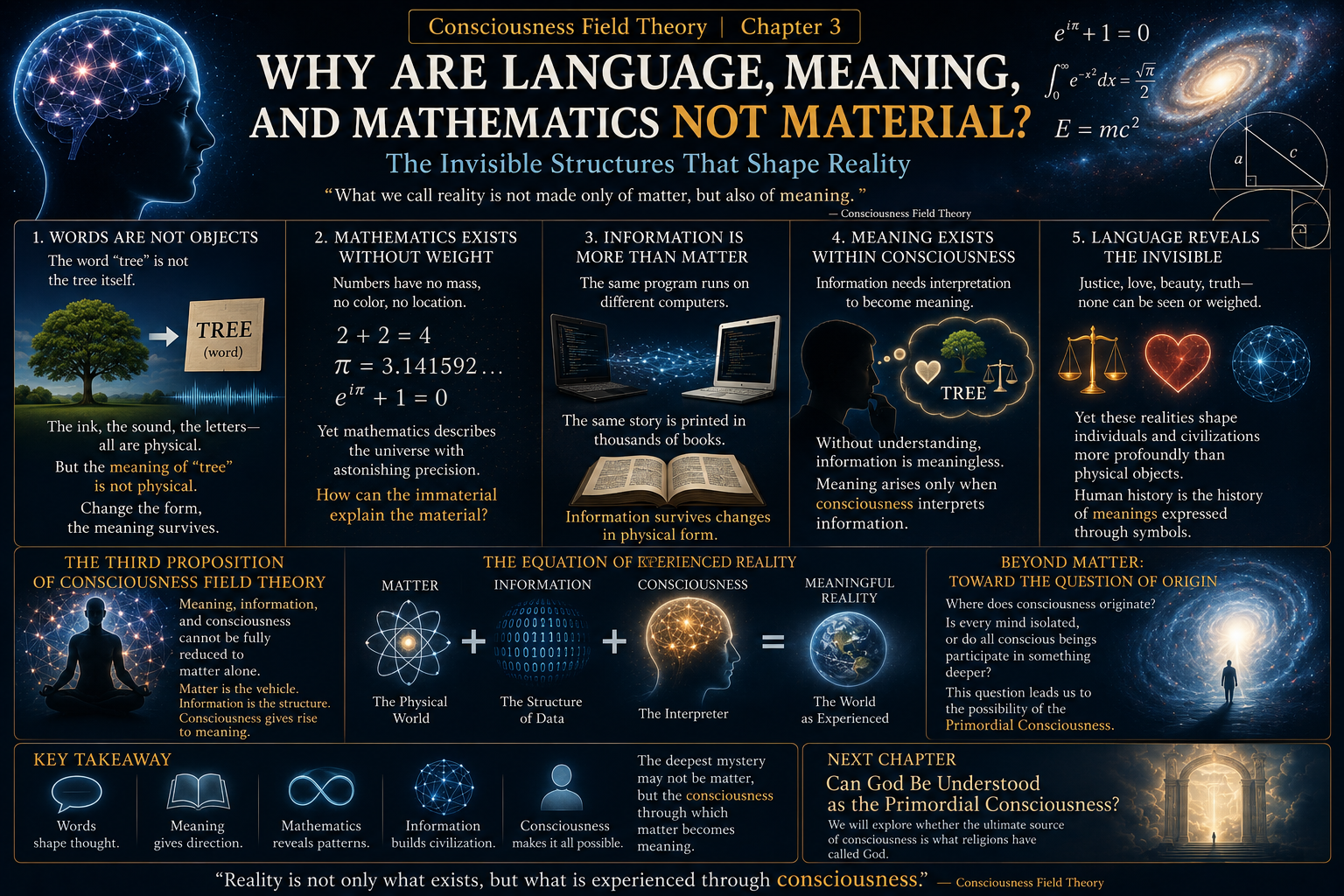
The Invisible Structures That Shape Reality
If consciousness is fundamental,
then another profound question naturally follows.
Why do the most powerful forces shaping human civilization have no physical form?
We cannot see meaning.
We cannot touch truth.
We cannot weigh mathematics.
Yet without them,
science itself could not exist.
Civilizations could not develop.
Knowledge could not be transmitted.
The modern world depends not only on matter,
but on invisible structures that give matter significance.
Perhaps the greatest mystery is not matter itself,
but meaning.
Words Are Not Objects
Consider a single written word.
Take the word:
“Tree.”
The ink on a page is physical.
The pixels on a screen are physical.
The sound produced when someone speaks the word is physical.
Yet the meaning of “tree” is none of these things.
Destroy the paper,
and the meaning survives.
Erase the pixels,
and the meaning remains.
Translate the word into another language,
and the meaning continues to exist despite completely different sounds and symbols.
Meaning is remarkably independent of its physical carrier.
The material form changes.
The meaning persists.
This suggests that information belongs to a different category than matter itself.
Mathematics Exists Without Weight
The same mystery appears in mathematics.
The number 2 has no mass.
It occupies no location in space.
No microscope can observe it.
No telescope can detect it.
Yet mathematics governs nearly every successful scientific theory ever developed.
The motion of planets.
The structure of atoms.
The behavior of light.
The expansion of the universe.
All can be described through mathematical relationships.
How can something without physical existence describe the physical universe with such extraordinary precision?
This question has puzzled philosophers for centuries.
Perhaps mathematics is not invented.
Perhaps it is discovered.
But if mathematical truth is discovered,
where does it exist?
Not inside a laboratory.
Not inside a particle.
Not inside a neuron.
Its existence appears fundamentally different from material objects.
Information Is More Than Matter
Modern information theory offers another intriguing clue.
A computer consists entirely of physical components.
Silicon.
Metal.
Electricity.
Yet none of these materials explains software.
The same program can run on different computers.
The hardware changes.
The information remains.
A novel may be printed in thousands of books.
The paper differs.
The ink differs.
The language may even differ through translation.
Yet the story remains recognizable.
Information survives changes in physical form.
Matter carries information.
Matter is not identical to information.
This distinction has become increasingly important in computer science,
artificial intelligence,
and modern physics.
Meaning Exists Within Consciousness
Information alone, however, is not enough.
Meaning requires interpretation.
Imagine discovering a page filled with unfamiliar symbols.
Without understanding the language,
the page carries almost no meaning.
The information exists.
The meaning does not.
Meaning arises only when consciousness interprets information.
The same sentence can inspire one person,
confuse another,
and leave a third completely indifferent.
The symbols remain unchanged.
The consciousness encountering them does not.
This observation leads to an important insight.
Meaning does not exist solely within physical objects.
It emerges through the relationship between information and consciousness.
Language Reveals the Invisible
Language itself demonstrates that reality extends beyond material existence.
Justice cannot be held in one’s hand.
Freedom cannot be placed inside a container.
Beauty cannot be measured with a ruler.
Truth has no measurable weight.
Love cannot be photographed as an independent object.
Yet few people would argue that these realities are therefore meaningless.
In fact,
they often shape history more profoundly than physical objects.
Wars have been fought over ideas.
Civilizations have been transformed by beliefs.
Entire cultures have risen around invisible meanings.
Human history is, in many ways,
the history of consciousness expressing itself through symbols.
The Third Proposition of Consciousness Field Theory
Consciousness Field Theory therefore proposes its third proposition.
Meaning, information, and consciousness cannot be fully reduced to matter alone.
Matter serves as a vehicle.
Information provides structure.
Consciousness gives rise to meaning.
Without consciousness,
information remains uninterpreted.
Without meaning,
matter becomes silent.
Reality, as human beings experience it,
always involves the participation of consciousness.
Toward the Question of God
If consciousness plays such a fundamental role,
another question inevitably appears.
Where does consciousness itself originate?
Is every individual consciousness completely isolated?
Or do all conscious beings participate in something deeper?
Throughout history,
different civilizations have answered this question using different names.
Some spoke of the Absolute.
Others spoke of Brahman.
Buddhism speaks of Buddha-nature or Suchness.
The Bible speaks of God.
The names differ.
The question remains the same.
Is there an ultimate source of consciousness?
This question leads directly into the next chapter.
Coming Next
Chapter 4
Can God Be Understood as the Primordial Consciousness?
Rather than approaching God only through theology,
we will explore whether philosophy itself points toward the possibility of a universal ground of consciousness.
Could the world’s religious traditions,
despite their differences,
be pointing toward the same fundamental reality?
And if so,
what would that mean for science,
philosophy,
and our understanding of ourselves?
Chapter 4
Can God Be Understood as the Primordial Consciousness?
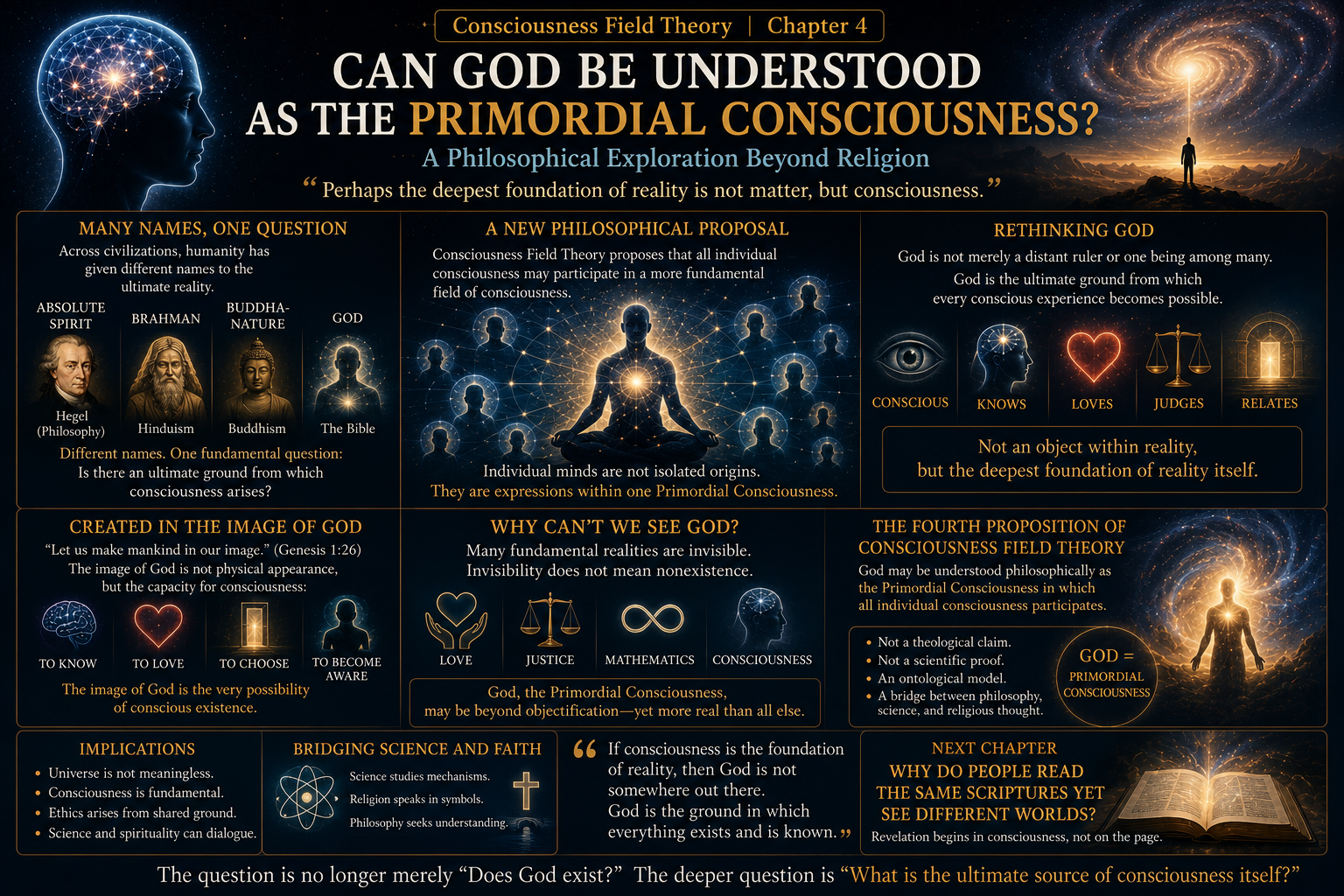
A Philosophical Exploration Beyond Religion
Throughout history,
humanity has never stopped asking one fundamental question.
Where does consciousness come from?
Science investigates the mechanisms of consciousness.
Philosophy examines its nature.
Religion asks about its ultimate origin.
Although these disciplines often appear to disagree,
they may all be attempting to answer the same question from different perspectives.
Perhaps the greatest differences lie not in the question itself,
but in the language used to answer it.
Many Names, One Question
Across civilizations,
human beings have given different names to what they regarded as the ultimate reality.
Hegel spoke of the Absolute Spirit.
Ancient Indian philosophy described Brahman.
Buddhist traditions speak of Buddha-nature (Tathāgatagarbha) or Suchness (Tathatā).
The Bible speaks of God.
At first glance,
these ideas appear fundamentally different.
They belong to different cultures,
different histories,
and different religious traditions.
Yet beneath their differences lies a remarkably similar philosophical question.
Is there an ultimate ground from which consciousness arises?
This question transcends any single religion.
It belongs to philosophy itself.
A New Philosophical Proposal
Consciousness Field Theory approaches this question from an ontological perspective.
It proposes neither a theological proof nor a scientific certainty.
Instead,
it offers a philosophical model.
The theory suggests that every individual consciousness may participate in a more fundamental field of consciousness.
Individual minds are not isolated origins.
They are localized expressions within a greater whole.
Just as countless waves arise from one ocean,
individual consciousness may arise within one primordial field.
This proposal does not claim empirical proof.
Rather,
it provides a coherent framework through which philosophy,
science,
and religious thought may begin a meaningful dialogue.
Rethinking God
If such a primordial consciousness exists,
then the traditional image of God may require reconsideration.
God would not merely be a distant supernatural ruler watching the universe from outside.
Nor would God simply be another powerful being among many.
Instead,
God could be understood as the ultimate ground from which every conscious experience becomes possible.
In this view,
God is not one object within reality.
God is the deepest foundation of reality itself.
Such a perspective shifts the discussion away from mythology and toward ontology.
The question is no longer,
“Does God exist somewhere?”
The deeper question becomes,
“Could existence itself be grounded in a primordial consciousness?”
What Does the Bible Actually Describe?
The Bible consistently portrays God not merely as power,
but as consciousness.
God speaks.
God knows.
God remembers.
God loves.
God judges.
God enters into relationships.
These are not characteristics of impersonal energy.
They are characteristics traditionally associated with conscious agency.
From this perspective,
the biblical description becomes philosophically significant.
Perhaps Scripture presents God not primarily as a physical being,
but as the ultimate conscious reality from which all finite consciousness derives.
This interpretation does not replace theology.
Rather,
it opens a philosophical way of reading biblical language.
What Does It Mean to Be Created in the Image of God?
One of the most influential statements in the Bible appears in the opening chapter of Genesis:
“Let us make mankind in our image.”
For centuries,
this phrase has inspired countless interpretations.
Many have assumed that the “image of God” refers to moral character,
rationality,
or spiritual capacity.
Consciousness Field Theory suggests another possibility.
Perhaps the image of God refers fundamentally to consciousness itself.
Human beings may not resemble God in physical appearance,
but in the capacity to know,
to understand,
to love,
to choose,
and to become aware.
If consciousness is the defining characteristic,
then the image of God is not external.
It is the very possibility of conscious existence.
Why Can’t We See God?
One of the oldest objections to belief in God is simple.
“If God exists, why can’t we see Him?”
Yet many of the most fundamental realities in human life are invisible.
Love cannot be photographed.
Justice has no measurable weight.
Mathematics occupies no location in space.
Meaning cannot be placed inside a laboratory.
Even consciousness itself cannot be observed directly by another person.
Its existence is known through experience,
not through visual inspection.
If consciousness is invisible,
then the invisibility of a primordial consciousness becomes far less surprising.
Perhaps invisibility is not evidence of nonexistence.
Perhaps it reflects the kind of reality being considered.
The Fourth Proposition of Consciousness Field Theory
The fourth proposition of Consciousness Field Theory is therefore this:
God may be understood philosophically as the Primordial Consciousness in which all individual consciousness participates.
This proposition is not presented as scientific proof.
Nor is it intended as a theological doctrine.
It is an ontological model.
Its purpose is to explore whether philosophy,
science,
and the world’s religious traditions may ultimately converge upon a common question concerning the origin of consciousness.
Whether this model proves correct remains an open question.
Yet it invites a dialogue that has rarely been attempted.
Coming Next
Chapter 5
Why Do People Read the Same Scriptures Yet See Different Worlds?
The Bible has been read for thousands of years.
So have the Buddhist sutras.
So has Gyeokam Yurok.
Yet sincere readers often arrive at radically different conclusions.
Is the difference found in the text?
Or does it arise within the consciousness of the reader?
In the next chapter, we will explore revelation, interpretation, spiritual awakening, and the possibility that understanding is shaped not only by the words we read, but by the state of consciousness through which we read them.
Chapter 5
Why Do People Read the Same Scriptures Yet See Different Worlds?
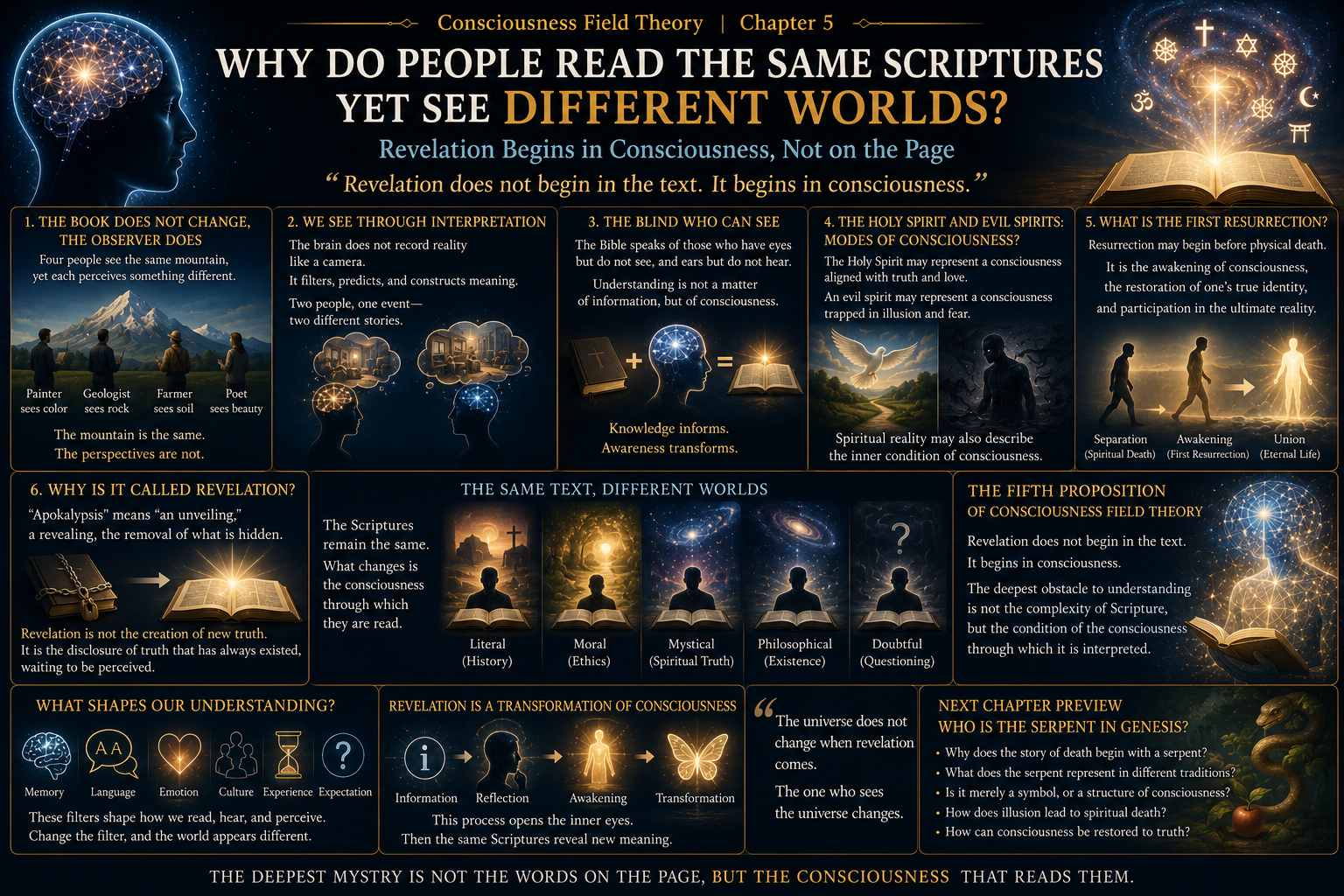
Revelation Begins in Consciousness, Not on the Page
The Bible is one of the most widely read books in human history.
For thousands of years,
it has been studied by theologians,
philosophers,
scientists,
kings,
artists,
and ordinary people.
Yet one remarkable fact remains.
People often read the same text
and arrive at entirely different conclusions.
Some see literal history.
Others see mythology.
Some discover moral teachings.
Others perceive profound metaphysical truths.
Some find faith.
Others find doubt.
The words remain the same.
The interpretations do not.
Why?
The Book Does Not Change
Imagine four people standing before the same mountain.
A painter notices its colors.
A geologist studies its rocks.
A farmer observes the soil.
A poet sees beauty.
The mountain has not changed.
Only the observers have.
The same principle applies to every sacred text.
The Bible does not change.
The Buddhist sutras do not change.
Ancient prophetic writings do not change.
What changes
is the consciousness through which they are read.
Meaning is never extracted by words alone.
Meaning is always completed by the consciousness that encounters them.
We See Through Interpretation
Modern cognitive science increasingly supports a remarkable insight.
The human brain does not simply record reality.
It actively constructs models,
predicts patterns,
filters information,
and assigns meaning.
We do not experience raw reality.
We experience interpreted reality.
Every perception is shaped by memory.
By language.
By emotion.
By culture.
By expectation.
Two people may witness the same event
yet remember entirely different stories.
The event remains the same.
Consciousness does not.
This suggests that understanding is never purely objective.
Interpretation is always present.
The Blind Who Can See
The Bible repeatedly speaks of people who have eyes
yet fail to see,
and ears
yet fail to hear.
These words have often been understood as moral criticism.
They may also point toward something deeper.
Perhaps they describe states of consciousness.
Physical eyesight is not enough.
Information alone is not enough.
One may possess knowledge
without possessing understanding.
Another may hear a single sentence
and find that an entire worldview changes.
The words are identical.
The consciousness receiving them is not.
Rethinking the Holy Spirit and Evil Spirits
Traditional theology often understands the Holy Spirit and evil spirits as distinct spiritual beings.
Consciousness Field Theory asks a different philosophical question.
What if these expressions also describe modes of consciousness?
The Holy Spirit may represent a consciousness aligned with truth,
love,
and ultimate reality.
An evil spirit may represent consciousness trapped in illusion,
deception,
fear,
or separation.
This interpretation does not deny spiritual reality.
Instead,
it examines how spiritual language may also describe the inner condition of human consciousness.
Throughout history,
entire civilizations have been transformed not only by external events,
but by changes in collective consciousness.
Perhaps spiritual transformation begins there.
What Is the First Resurrection?
The Book of Revelation speaks of the First Resurrection.
Many readers interpret this as a future physical event.
Consciousness Field Theory proposes another possibility.
Suppose death is not merely biological.
Suppose death also describes a state of separation from ultimate truth.
Then resurrection may begin before physical death.
The First Resurrection could symbolize
the awakening of consciousness.
The rediscovery of one’s deepest identity.
The restoration of participation in the Primordial Consciousness.
Such an interpretation does not reject bodily resurrection.
It simply suggests that Scripture may speak on more than one level simultaneously.
Throughout history,
many sacred texts have combined historical narrative,
symbolic language,
and philosophical insight.
Perhaps Revelation does the same.
Why Is It Called Revelation?
The final book of the New Testament is known in Greek as Apokalypsis.
The word does not primarily mean destruction.
It means
an unveiling.
A revealing.
The removal of what has been hidden.
Revelation is therefore not the creation of new truth.
It is the disclosure of truth that has always existed,
waiting to be perceived.
From the perspective of Consciousness Field Theory,
this idea becomes profoundly significant.
When consciousness changes,
the world itself appears different.
The same Scriptures become a different book.
The same universe becomes a different universe.
Not because reality has changed,
but because the one experiencing reality has changed.
The Fifth Proposition of Consciousness Field Theory
The fifth proposition of Consciousness Field Theory is this:
Revelation does not begin in the text. It begins in consciousness.
Sacred writings remain unchanged.
What changes
is the consciousness of the reader.
Therefore,
the deepest obstacle to understanding may not be the complexity of Scripture,
but the condition of the consciousness through which it is interpreted.
Knowledge informs.
Awareness transforms.
And transformation is the true beginning of revelation.
Looking Ahead
Chapter 6
Who Is the Serpent in Genesis?
Why does the biblical story of death begin with a serpent?
Why do ancient Korean prophetic traditions also describe a serpent dwelling within humanity?
Are these merely religious symbols?
Or could they represent a universal structure of consciousness?
In the next chapter,
we will explore one of the oldest symbols in human civilization,
not only as a theological image,
but as a philosophical key to understanding illusion,
self-deception,
and the origin of spiritual death.
Series Summary (Chapters 1–5)
So far, Consciousness Field Theory has proposed five foundational propositions:
- Reality is experienced through consciousness, not directly.
- The relationship between the brain and consciousness cannot be reduced to physical correlation alone.
- Meaning, information, and consciousness cannot be fully explained by matter.
- God may be understood philosophically as the Primordial Consciousness in which all individual consciousness participates.
- Revelation is fundamentally an event of consciousness rather than merely an event of reading.
These five propositions do not claim to settle the question of consciousness.
They invite a different way of asking it.
Perhaps the deepest mystery is not the universe we observe,
but the consciousness through which every observation becomes possible.