

A 21st-Century Scientific Inquiry into the Observer, Consciousness, and God
Modern Science Upgraded the CPU, but Other Disciplines Stagnated
What happens when you replace a computer’s CPU with the latest model? The memory changes, the operating system updates, and software programs are modified to fit the new version. If only the CPU is upgraded while everything else remains obsolete, the computer cannot function properly.
The academic world faces the exact same dilemma.
In the 20th century, physics experienced the most monumental revolution in human history: the Theory of Relativity and Quantum Mechanics. These two theories fundamentally shook the worldview that had been taken for granted for 300 years since Isaac Newton.
Yet, something strange occurred. While physics shifted entirely, the theory of evolution remained unchanged. Cosmology remained the same. The definition of death stagnated, and consciousness research saw little transformation. It is precisely like running a 30-year-old operating system on a computer equipped with the latest cutting-edge CPU. I define this phenomenon as the “Domino Failure of Academics.”
The Unanswered Questions Left by Richard Dawkins and Stephen Hawking
Richard Dawkins sought to explain the origin of life strictly through natural selection. Stephen Hawking attempted to explain the beginning of the universe solely through the laws of physics. Their common ground is unmistakable: both asserted that the universe and life could be fully explained without the intervention of a higher power. Their achievements have left a profound mark on modern science.
However, an essential question persists: Can quantum mechanics truly coexist with such a mechanistic worldview?
The Greatest Question Quantum Mechanics Posed to the World
Many perceive quantum mechanics merely as the study of microscopic particles. But that is only half the truth. The profoundest question raised by quantum physics centers not on the particle itself, but on the “observer.”
Consider a simple analogy from a video game. In a virtual world, only the screen currently viewed by the protagonist is actually rendered. The areas outside of the field of vision remain in a state of unrendered data. While the actual universe is not literally a video game, this analogy illustrates why “observation” is so critical in quantum physics.
Within quantum mechanics, numerous interpretations exist regarding the precise meaning of measurement and observation. The role of the observer remains one of the most core and highly debated issues in contemporary physics. Consequently, post-20th-century physics no longer supports a simplistic worldview claiming that “matter alone explains everything.”
Should Evolution and the Big Bang Be Reconsidered?
This leads to an intriguing proposition: if the problem of the observer is raised at the deepest foundations of physics, shouldn’t evolution and cosmology—which are built upon those very foundations—also face new inquiries?
This does not imply that evolution is invalid or that the Big Bang is a fabrication. Rather, it demands a more fundamental question: Who is the observer?
We explain the universe. Yet, who is the “I” explaining the universe? Who conducts the experiments? Who formulates the equations? Ultimately, all science is processed through the consciousness of the observer. Paradoxically, modern science has failed to sufficiently explain the nature of that observer.
How the Bible Defines Consciousness
Genesis 2:7 provides a remarkably distinct description of human existence:
“Then the Lord God formed a man from the dust of the ground and breathed into his nostrils the breath of life, and the man became a living being.”
In this context, the dust represents matter. The breath of life is the divine breath of God. The resulting “living being” (or living soul) is an active entity that thinks, judges, and perceives the world. Philosophy labels this as consciousness, psychology calls it the mind, and theology defines it as the soul or spirit. Though the terminology varies, the core question remains identical: Who is the subject perceiving reality?
Questions the 21st-Century Science Must Re-encounter
Today, quantum mechanics has brought us to a frontier where reality cannot be explained by materialism alone. Relational Quantum Mechanics (RQM), information physics, quantum information theory, and consciousness studies are all converging upon the same question: Who is the observer?
This inquiry is no longer confined to religion or philosophy; it is a question that modern science must answer. Richard Dawkins and Stephen Hawking are undeniably monumental figures. Yet, while they attempted to decipher the universe, they left the “observer” who deciphers it unexplained. Perhaps the next scientific revolution will not come from discovering a new particle, but from the very moment we comprehend consciousness and the observer. Only then will we realize that physics, biology, cosmology, philosophy, and theology are not isolated disciplines, but pieces of one magnificent puzzle.
Who, Then, Is the “Observer”?
A common misconception must be addressed. The “observer” in quantum mechanics does not strictly mean a human eye. Modern physics encompasses various frameworks—such as the Copenhagen interpretation, Relational Quantum Mechanics, the Many-Worlds interpretation, and decoherence theory—and the definition of “observation” is not singular. Nonetheless, one fact remains absolute: post-quantum physics cannot escape the dilemma of the observer. This is a question that simply did not exist in the Newtonian era.
Matter First, or Consciousness First?
Classical physics states: “Matter exists first, and consciousness is merely a byproduct generated by matter.” In other words, the brain creates consciousness.
However, the post-quantum era introduces a completely inverted question: “Is consciousness truly just a byproduct of matter?”
Science has yet to deliver a final verdict. Instead, consciousness has become one of the most difficult problems unresolved by modern science, known in philosophy as the “Hard Problem of Consciousness.”
The Grand Void Left by Dawkins and Hawking
Richard Dawkins mapped the evolution of life, and Stephen Hawking mapped the evolution of the cosmos. Yet, both left a void regarding the existence of the “explaining self”—the observer. It is consciousness that explains life, calculates the cosmos, and constructs equations. But no one has yet explained what consciousness itself is. This is the greatest missing link in modern science.
The Bible Starts from the Opposite Direction
Remarkably, the Bible does not begin by defining humanity solely as matter. Genesis 2:7 outlines three distinct phases:
- Dust: The material, physical component.
- The Breath of Life: The invisible source of vitality.
- A Living Being: An entity that thinks, judges, loves, and chooses.
It is profoundly fascinating that modern science now stands before the exact same threshold: How did consciousness arise?
The Academic Domino Revolution Must Begin
While physics continues to expand into relations, information, observation, loop quantum gravity, and the holographic principle, biology still relies heavily on the language of 19th-century materialism. The same applies to cosmology, the definition of death, and conventional philosophy. It resembles installing a 30-year-old operating system on a brand-new smartphone.
When the foundation changes, the disciplines built upon it must shift accordingly. This is a matter of course in computer science; why should it be any different in academia? I call this the “Academic Domino Revolution.”
Conclusion: A New Era of Inquiry
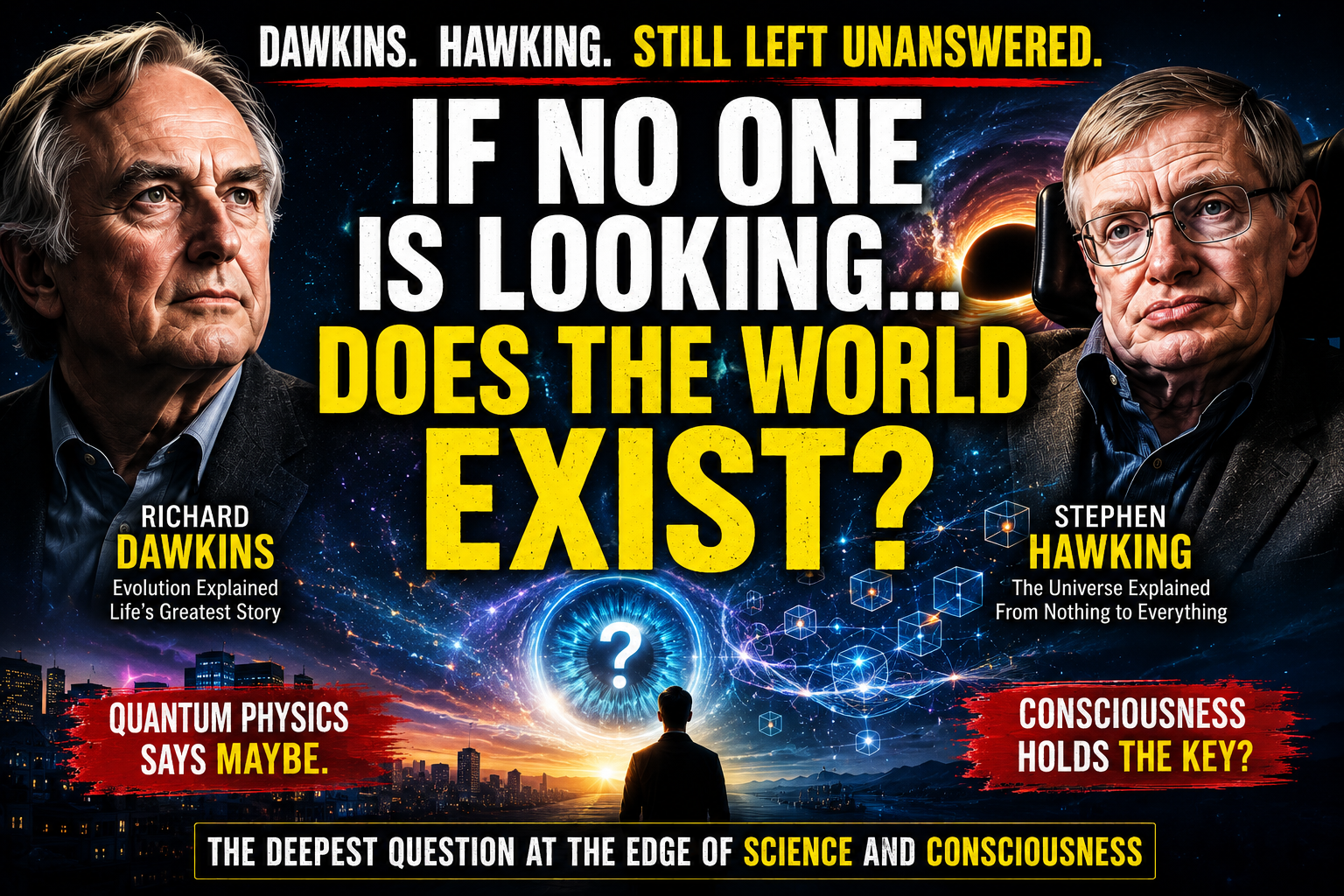
The 21st century is not merely the era of AI; it is the era of the quantum revolution. This revolution will reshape not just physics, but evolution, cosmology, consciousness studies, philosophy, religion, and our understanding of mortality. Richard Dawkins and Stephen Hawking were great scientists, but even the greatest minds cannot answer every question. Their ultimate legacy might not be the conclusion that “God does not exist,” but rather the realization of the massive questions they left unresolved.
That question stands silently before us today: “Who is the observer?”
True advancement does not occur when one field dismisses another, but when they grow together through mutual discovery. If quantum mechanics has questioned a matter-centric worldview, extending that question to life, consciousness, and human existence is the natural next step. The greatest discovery of our century may begin not with a new particle, but the moment we unlock the true identity of the observer—the “I.”