
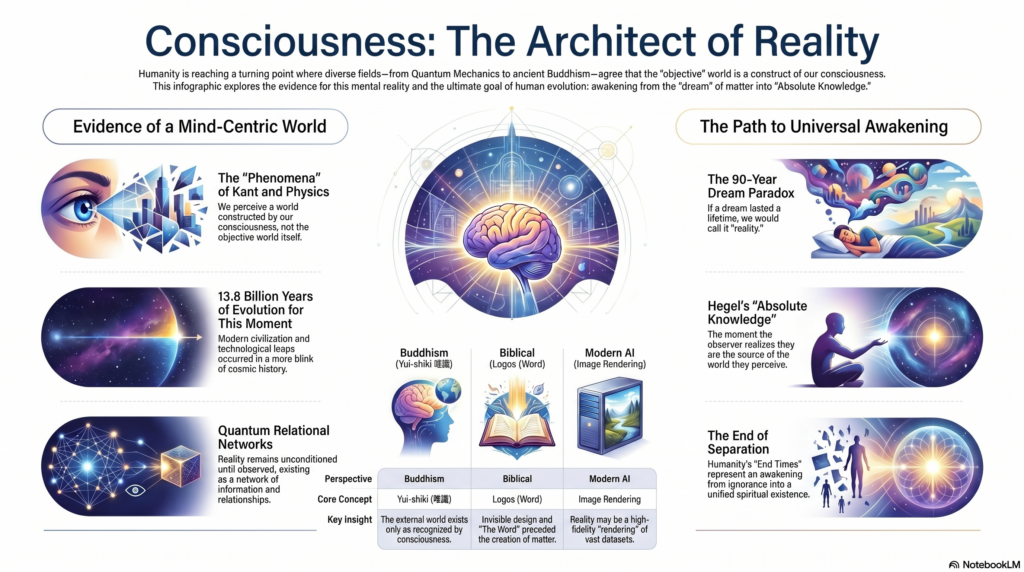
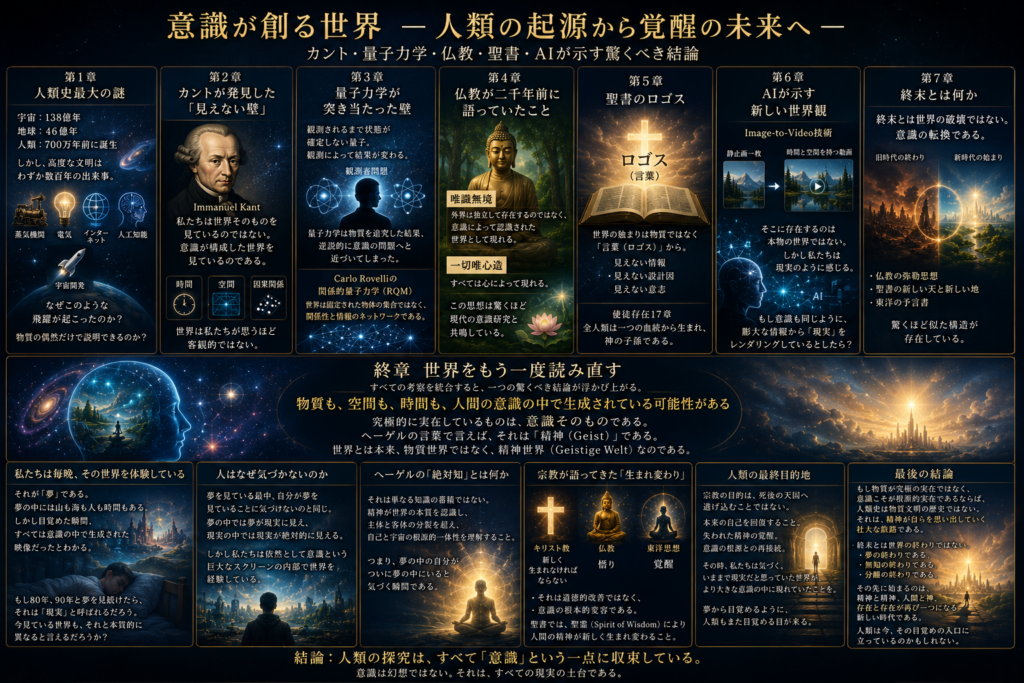
Reinterpreting Reality, Human History, and the Future of Civilization

Chapter 1: The Greatest Mystery in Human History
According to modern science, the universe is approximately 13.8 billion years old.
The Earth is about 4.6 billion years old.
Humanity is believed to have emerged roughly 7 million years ago.
Yet there is a remarkable puzzle hidden within this timeline.
Advanced civilization has existed for only a tiny fraction of human history.
The steam engine.
Electricity.
The Internet.
Artificial Intelligence.
Space exploration.
From the perspective of millions of years of human existence, this explosion of technological progress occurred in what amounts to a brief moment.
Why did such an extraordinary leap occur?
Can it truly be explained by nothing more than the accidental interactions of matter?
Or is there a deeper principle operating beneath the surface of history?
Chapter 2: Kant and the Invisible Wall of Reality
German philosopher Immanuel Kant proposed a revolutionary idea.
What we perceive is not reality itself, but phenomena.
In other words, we do not directly experience the world as it is.
We experience a world that has already been structured through consciousness.
Time.
Space.
Causality.
According to Kant, these are not objective features that exist independently of us.
Rather, they are forms imposed by human cognition in order to organize experience.
This insight leads to a startling conclusion:
The world may not be nearly as objective as we assume.
What we call reality may already be filtered through the architecture of consciousness.
Chapter 3: The Wall Encountered by Quantum Physics
Twentieth-century physics discovered something equally strange.
Quantum particles do not appear to possess definite states until measurement occurs.
Observation changes outcomes.
Probability precedes certainty.
And at the center of the mystery stands the observer.
The deeper physics investigated matter, the closer it came to questions traditionally associated with consciousness.
More recently, theoretical physicist Carlo Rovelli introduced Relational Quantum Mechanics (RQM).
In this framework, reality is not composed of independently existing objects.
Instead, the universe is understood as a network of relationships and information.
Things do not simply exist in isolation.
They exist through interaction.
Reality becomes less like a collection of solid objects and more like a dynamic web of interconnected events.

Chapter 4: What Buddhism Said Two Thousand Years Ago
Long before modern neuroscience or quantum theory, Buddhist philosophy explored similar questions.
One of the central concepts in the Yogācāra tradition is the doctrine often translated as “Consciousness-Only”.
The external world is not regarded as an independently existing reality.
Rather, it appears as a world perceived and interpreted through consciousness.
Another famous Buddhist expression declares:
“All phenomena are created by the mind.”
Everything that appears is inseparable from awareness.
Remarkably, these ancient teachings resonate with many contemporary discussions in consciousness studies, cognitive science, and the philosophy of perception.
While the language differs, the underlying question remains the same:
What if consciousness is more fundamental than we have assumed?
Chapter 5: The Logos of the Bible
The Bible approaches the mystery from a different direction.
Instead of explaining the origin of reality through matter, it begins with Logos.
The Word.
Invisible information.
An unseen blueprint.
A hidden intelligence.
A creative intention.
According to the Gospel tradition, the universe emerges from Logos before it emerges as physical form.
The Book of Acts further states that all humanity originates from a single source and that human beings are, in a profound sense, descendants of the divine.
The biblical narrative therefore places meaning, information, and consciousness-like principles at the foundation of existence.
Matter comes later.
The invisible precedes the visible.
Chapter 6: The New Worldview Revealed by AI
Artificial intelligence offers a fascinating modern analogy.
Image-to-video generation systems can take a single static image and create an entire moving world complete with depth, motion, and temporal continuity.
The resulting video is not an actual world.
Yet it feels real.
The viewer experiences movement, space, and causality even though all of it has been computationally generated.
This raises an intriguing possibility.
What if consciousness functions in a similar way?
What if the reality we experience is not passively received, but actively rendered from vast streams of information?
Just as AI generates a convincing world from data, perhaps consciousness constructs the reality we call everyday life.

Chapter 7: What Is the End Times?
Perhaps the greatest misunderstanding concerns the idea of the end of the world.
In many traditions, the end is not primarily about destruction.
It is about transformation.
The end of an old mode of existence.
The beginning of a new one.
Buddhist visions of Maitreya.
The biblical vision of a New Heaven and a New Earth.
Ancient Eastern prophetic traditions.
Though separated by culture and language, these traditions often share a remarkably similar structure.
They speak of transition.
Awakening.
Renewal.
And the emergence of a fundamentally transformed humanity.
Final Chapter: Reading the World Again
When we bring together the insights of Kant, Hegel, quantum physics, Buddhist consciousness philosophy, the Bible, and modern AI research, a surprising possibility emerges.
Matter.
Space.
Time.
These may not be ultimate realities.
They may be generated within consciousness itself.
If that is true, then what ultimately remains?
Only one thing:
Consciousness itself.
In the language of philosopher Georg Wilhelm Friedrich Hegel, this would be called Geist.
Spirit.
Mind.
The self-knowing dimension of reality.
From this perspective, the world is not fundamentally a material universe.
It is a world of mind.
A world of spirit.
A Geistige Welt, a spiritual reality.
We Experience That World Every Night
There is one place where we already encounter such a reality.
Dreams.
Within a dream there are mountains.
Oceans.
Cities.
People.
Conversations.
Emotions.
Even the passage of time.
Yet when we awaken, we realize that none of these things existed as physical objects.
They were experiences generated within consciousness.
Consider a thought experiment.
If a dream lasted not a few hours, but eighty or ninety years, what would we call it?
Would we still call it a dream?
Or would we call it reality?
And if so, how certain can we be that waking reality is fundamentally different?
Why We Do Not Notice
The answer may be surprisingly simple.
When we are dreaming, we do not realize that we are dreaming.
The dream appears completely real.
Likewise, everyday reality appears unquestionably real while we are immersed within it.
Yet the underlying principle may be the same.
We continue to experience the world from within the vast screen of consciousness itself.
Hegel’s Absolute Knowledge
Hegel referred to the highest stage of human development as Absolute Knowledge.
This is not merely the accumulation of information.
It is the recognition of reality’s deepest nature.
It is the overcoming of the separation between subject and object.
It is the realization of the fundamental unity between self and cosmos.
In a sense, it is the moment when the dreamer realizes that he is dreaming.
And from that moment forward, the world appears entirely different.
What Religions Mean by Rebirth
Interestingly, the world’s great spiritual traditions point in a similar direction.
Christianity speaks of being “born again.”
Buddhism speaks of enlightenment.
Eastern traditions speak of awakening.
These are not merely moral improvements.
They refer to a profound transformation of consciousness itself.
In biblical language, this transformation occurs through the Spirit.
A renewal of mind.
A rebirth of awareness.
A return to wisdom.
Humanity’s Ultimate Destination
The ultimate purpose of religion is not escape into a distant heaven after death.
It is the recovery of our original nature.
The awakening of forgotten spirit.
The reconnection of consciousness with its deepest source.
And when that reconnection occurs, something extraordinary becomes visible.
We begin to recognize that what we once called reality may have appeared within a greater field of consciousness all along.
Just as an individual awakens from a dream, humanity itself may one day awaken.
Hegel called it Absolute Knowledge.
Buddhism called it Enlightenment.
The Bible calls it Spiritual Rebirth.
The names differ.
The direction is remarkably similar.
The Final Conclusion
If matter is not the ultimate reality,
and consciousness is fundamental,
then human history is not merely the story of material civilization.
It is the story of spirit remembering itself.
A vast journey of awakening.
From ignorance to understanding.
From separation to unity.
From unconsciousness to awareness.
The end times, then, are not the destruction of the world.
They are the end of the dream.
The end of ignorance.
The end of division.
What begins afterward is a new era in which spirit and spirit, humanity and the divine, being and being, become reunited once again.
Perhaps humanity now stands at the threshold of that awakening.
Keywords
consciousness studies, quantum physics and consciousness, Kant philosophy, Hegel absolute knowledge, consciousness and reality, simulation theory, Buddhism and consciousness, Logos in the Bible, observer effect, philosophy of mind, nature of reality, spiritual awakening, consciousness research, AI and consciousness, enlightenment, human evolution, future of humanity, meaning of existence, consciousness-first worldview, reality and perception
🎥 Watch the Video Version
What if consciousness is more fundamental than matter?
What if Kant, quantum physics, Buddhism, the Bible, and modern AI are all pointing toward the same hidden truth?
This article explores these ideas in depth.
For those who prefer a visual presentation, I have also created a short video version that summarizes the key concepts and connections discussed here.
▶ Watch the video:
[YouTube Video Link]
The video covers:
• The mystery of human history
• Kant and the limits of perception
• Quantum physics and the observer problem
• Buddhism and Consciousness-Only philosophy
• The Logos of the Bible
• AI and the construction of reality
• Consciousness, awakening, and the future of humanity