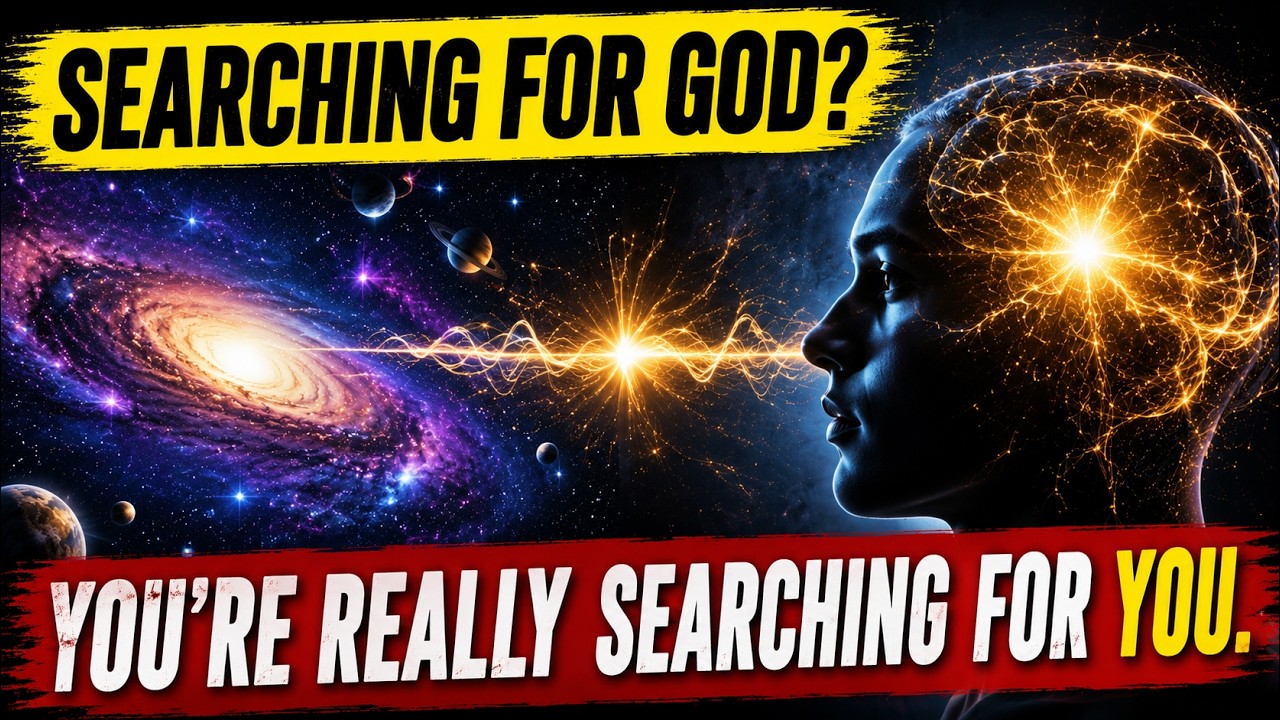
Why Searching for God and Searching for Yourself May Be the Same Journey
The One Question Shared by Physics, Genetics, Philosophy, Buddhism, and the Bible
At first glance, physics, genetics, philosophy, Buddhism, and the Bible appear to belong to completely different worlds.
Physics studies matter and energy.
Genetics studies DNA and biological inheritance.
Philosophy investigates knowledge and existence.
Buddhism explores the nature of consciousness.
The Bible speaks about God, creation, and the meaning of life.
Most people assume these fields are moving in different directions.
Yet when we look deeper, something surprising begins to emerge.
These seemingly unrelated disciplines gradually converge toward a single question.
A question so simple that every human being has asked it at some point:
Who am I?
What DNA Reveals About Humanity
Modern genetics has revealed something remarkable.
Despite our differences in race, language, nationality, and culture, humanity is far more connected than most people realize.
The genetic differences between human populations are surprisingly small.
Beneath the surface, we are members of the same biological family.
Long before modern genetics existed, the Bible spoke of humanity as originating from a common source.
In Acts 17, Paul declares that God “made from one blood all nations of mankind.”
Science and Scripture speak different languages.
Yet both point toward a profound truth:
Human beings are deeply interconnected.
The Mystery That Science Still Cannot Explain
DNA explains inheritance.
Biology explains cells.
Neuroscience explains many functions of the brain.
Yet one mystery remains unsolved.
Consciousness.
Why are we aware that we exist?
Why do we experience love, fear, hope, wonder, and meaning?
A heart beats.
A liver functions.
Bones support the body.
Yet none of these know they exist.
Consciousness does.
Consciousness alone says:
“I am.”
This simple fact may be the deepest mystery in the universe.
Kant and the Nature of Reality
The German philosopher Immanuel Kant asked a revolutionary question.
Do we perceive reality exactly as it is?
Or do we experience reality through the structures of human consciousness?
Kant argued that we never encounter reality completely independent of perception.
What we call “the world” is always experienced through the lens of human awareness.
In other words, consciousness is not merely observing reality.
It is inseparable from our experience of reality itself.
Quantum Physics and the Limits of Materialism
Modern physics introduced another surprising challenge.
At the quantum level, observation and measurement play crucial roles.
Reality behaves in ways that often defy common sense.
This does not necessarily mean consciousness creates the universe.
However, it does suggest that reality is far more mysterious than a simple mechanical machine.
The deeper science investigates existence, the more profound the questions become.
Buddhism and the Nature of Appearance
Centuries before modern science, Buddhism explored similar territory.
One of its most famous teachings is:
Form is emptiness, and emptiness is form.
The visible world appears solid and permanent.
Yet deeper examination reveals that things are far less fixed than they seem.
Buddhism encourages us to look beyond appearances and question the nature of the self.
What exactly is the “I” that experiences life?
This question continues to challenge philosophers and scientists alike.
The Bible and the Primacy of the Word
The Bible begins from a very different starting point.
Rather than placing matter at the beginning of existence, it places the Word.
The Gospel of John opens with the famous declaration:
“In the beginning was the Word.”
The Greek term Logos carries meanings beyond spoken language.
It can refer to reason, order, meaning, intelligence, and the underlying principle of reality itself.
From the beginning, the biblical narrative suggests that existence is rooted in something deeper than matter alone.
Different Languages, One Question
Genetics speaks of human connectedness.
Philosophy speaks of consciousness.
Quantum physics speaks of mystery.
Buddhism speaks of emptiness.
The Bible speaks of the Word and the Source.
The terminology differs.
The methods differ.
The cultural backgrounds differ.
Yet all of these disciplines ultimately revolve around a single question:
“Who am I?”
Searching for God and Searching for Yourself
Most people imagine the search for God as a journey directed outward.
Toward heaven.
Toward the cosmos.
Toward some distant transcendent reality.
Yet many of humanity’s greatest traditions point in a different direction.
Not outward.
Inward.
Who am I?
Why do I exist?
What makes me who I am?
These are not merely philosophical questions.
They may be the deepest spiritual questions humanity has ever asked.
Is the Other Person Truly Separate From You?
Consider the possibility that humanity shares a common origin.
If that is true, then every person you encounter is connected to you far more deeply than you may realize.
The stranger you pass on the train.
The coworker who frustrates you.
The political opponent with whom you strongly disagree.
Even the person you dislike.
All of them share the same human story.
The same biological heritage.
The same existential questions.
And the same search for meaning.
The moment we recognize this, our way of seeing the world begins to change.
The Question Behind All Questions
Today, many people debate whether God exists.
Yet there may be an even deeper question.
Before asking whether God exists somewhere beyond the clouds, perhaps we should first ask:
What is this consciousness within me?
Who am I?
Why do I exist?
How am I connected to other human beings?
Perhaps the Source we have been searching for is not hidden at the edge of the universe.
Perhaps it has quietly been present within the mystery of consciousness all along.
Final Conclusion: Where Did Consciousness Come From?
After examining genetics, philosophy, quantum physics, Buddhism, and the Bible, one final question remains.
Where did consciousness come from?
Every person has parents.
Parents have ancestors.
Ancestors have earlier generations before them.
Following this chain backward eventually leads to humanity’s common origin.
Yet the question remains.
Where did the first consciousness come from?
Acts 17:24-29 offers a remarkable answer.
There, God is described as the Creator of heaven and earth.
Humanity is described as being made from one blood.
Then comes a striking statement:
“For we are also His offspring.”
An offspring shares the life of its parent.
If human beings are God’s offspring, then human consciousness may reflect something deeper than biological processes alone.
Bodies change from generation to generation.
Yet consciousness continues through the stream of human existence.
Parents exist within the lineage of their ancestors.
Ancestors exist within the lineage of humanity.
Humanity exists within the lineage of its ultimate Source.
If we follow the genealogy of consciousness to its furthest point, we arrive at a profound conclusion.
The Bible calls that Source God.
Buddhism may call it Buddha-nature.
Philosophy may call it Absolute Spirit.
The names differ.
Yet the question remains the same.
What is the ultimate origin of consciousness?
This perspective proposes a simple answer:
Human consciousness originates from a divine Source, and humanity is the offspring of that Source.
Therefore, searching for God is not merely searching for a distant being.
It is discovering the origin of your own existence.
Perhaps this is why the search for God and the search for the true self have always been the same journey.
Acts 17 summarizes the entire idea in a single sentence:
“For we are also His offspring.”
🎥 Prefer watching instead of reading?
This article is also available as a short video presentation.
Watch here:
👉 [YouTube]
🎧 Full Audiobook Edition
If you would like to explore this question more deeply, the complete audiobook version is available below.
Where did consciousness come from?
And why have science, philosophy, Buddhism, and the Bible all been asking the same question?
👉 Listen here:
[Audiobook Link]