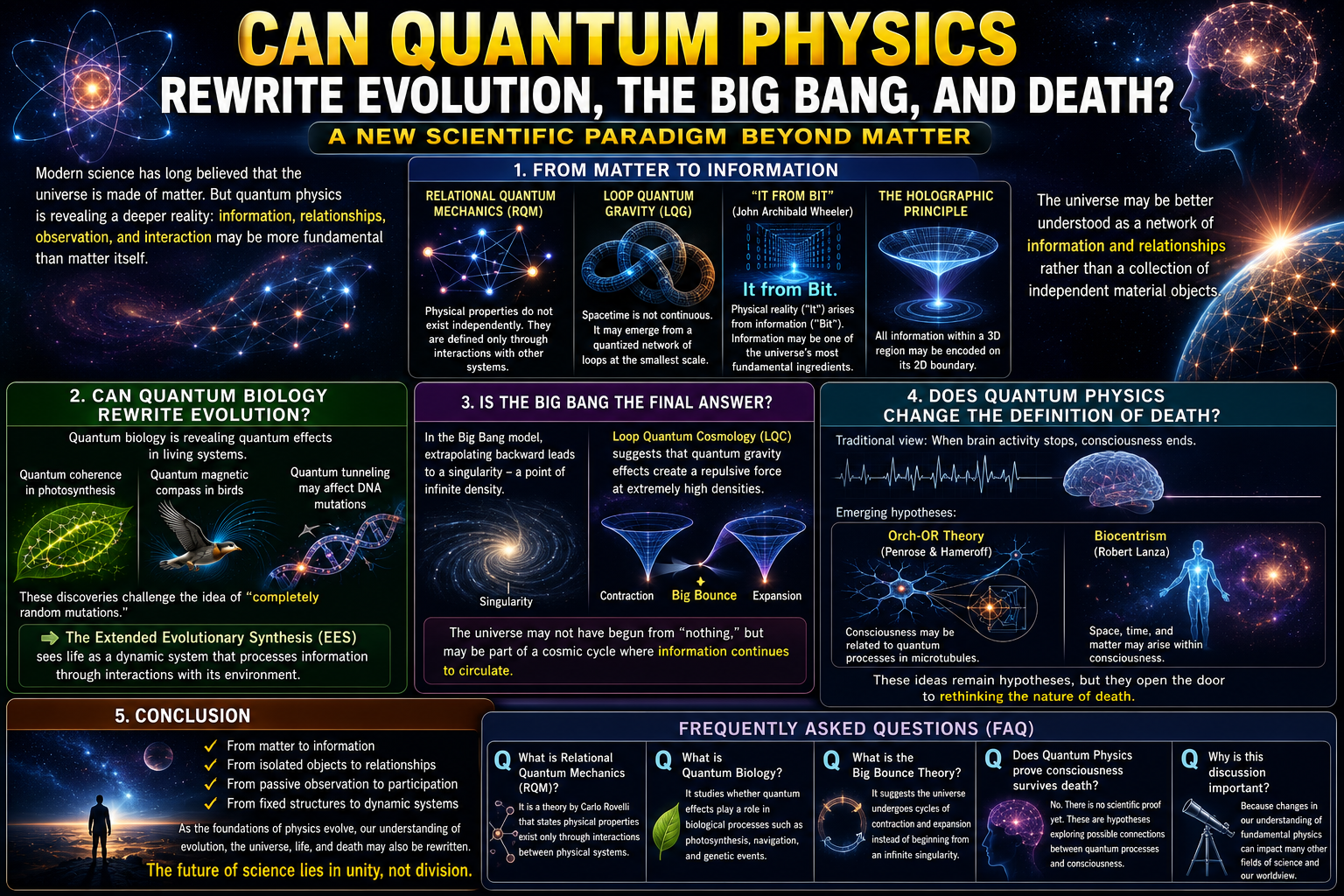
A New Scientific Paradigm Beyond Matter
Introduction

For centuries, modern science has been built upon a simple assumption: the universe is fundamentally made of matter.
From ancient Greek atomism to Newtonian mechanics, classical physics viewed reality as a giant machine composed of tiny physical particles obeying deterministic laws.
This worldview profoundly shaped biology, cosmology, neuroscience, and even our understanding of life and death.
However, the rapid development of quantum physics over the last century has begun to challenge that foundation.
Many leading physicists now describe reality not merely as matter, but as a network of information, relationships, observation, and interaction.
If this emerging perspective continues to develop, it may require us to reconsider several of science’s most established ideas, including evolution, cosmology, consciousness, and even the definition of death.
From Matter to Information
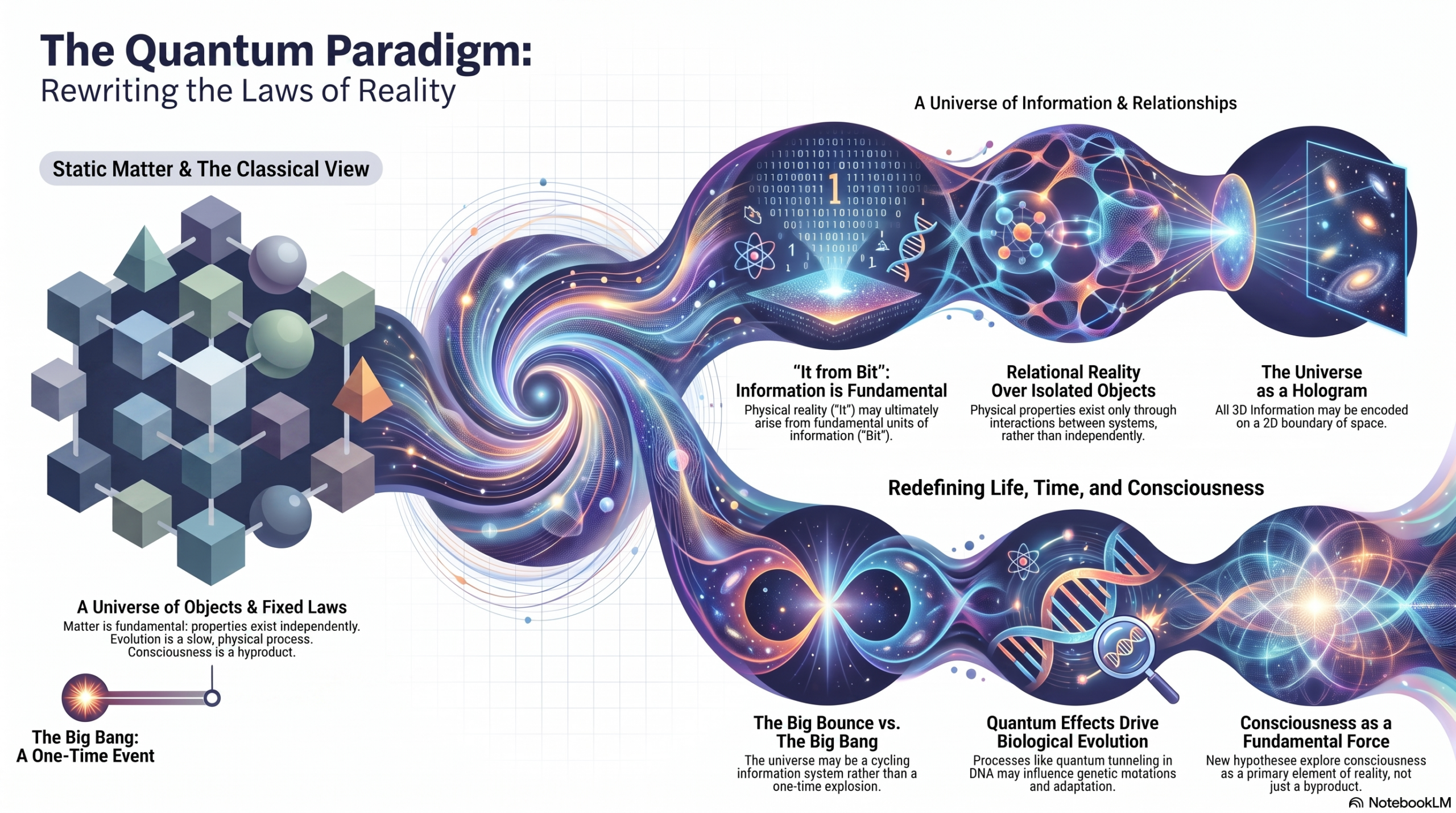
One of the most significant changes in modern physics is the shift from a material-centered universe to an information-centered universe.
Several influential theories illustrate this transition.
Relational Quantum Mechanics (RQM)
Italian physicist Carlo Rovelli proposed that physical properties do not exist independently.
Instead, they exist only through interactions with other physical systems.
Reality is fundamentally relational rather than composed of isolated objects.
Loop Quantum Gravity (LQG)
Loop Quantum Gravity suggests that spacetime itself is not continuous.
Instead, space and time may emerge from an extremely small network of quantized loops.
“It from Bit”
Physicist John Archibald Wheeler introduced the famous concept:
It from Bit.
According to Wheeler, physical reality (“It”) ultimately arises from information (“Bit”).
Information is not merely something stored within the universe.
It may be one of the universe’s most fundamental ingredients.
The Holographic Principle
The holographic principle, developed by Leonard Susskind and others, proposes that all information contained within a three-dimensional region may be encoded on its two-dimensional boundary.
Although still an active area of theoretical research, this idea further emphasizes the central role of information in contemporary physics.
Taken together, these developments suggest an important possibility:
The universe may be better understood as a dynamic network of information and relationships rather than as a collection of independent material objects.
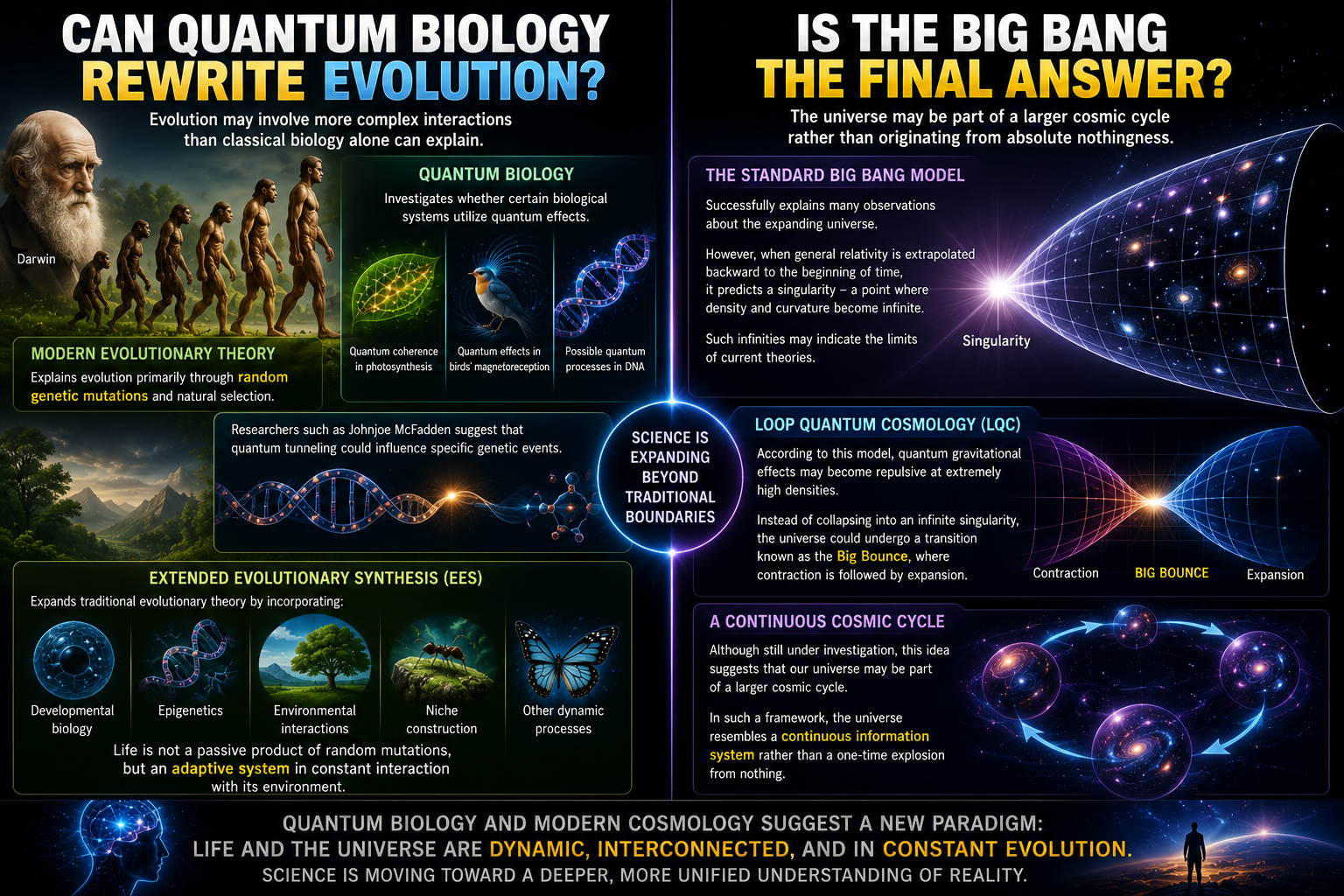
Can Quantum Biology Rewrite Evolution?
Modern evolutionary theory explains biological evolution primarily through random genetic mutations and natural selection.
This framework has been extraordinarily successful.
However, an emerging field known as Quantum Biology investigates whether certain biological systems utilize quantum effects.
Examples include:
- Quantum coherence during photosynthesis.
- Quantum effects that may contribute to birds’ magnetic navigation.
- Possible quantum processes occurring inside DNA.
Some researchers, including Johnjoe McFadden, have suggested that quantum tunneling could influence specific genetic events.
These proposals remain active scientific hypotheses rather than established scientific consensus.
Nevertheless, they raise an interesting possibility:
Evolution may involve more complex interactions than classical biology alone can explain.
This broader perspective has contributed to growing interest in the Extended Evolutionary Synthesis (EES), which expands traditional evolutionary theory by incorporating developmental biology, epigenetics, environmental interactions, niche construction, and other dynamic processes.
Rather than viewing living organisms as passive products of random mutations, this approach increasingly recognizes life as an adaptive system constantly interacting with its environment.
Is the Big Bang the Final Answer?
The standard Big Bang model successfully explains many observations about the expanding universe.
However, when general relativity is extrapolated backward to the beginning of time, it predicts a singularity, a point where density and curvature become infinite.
Most physicists consider such infinities to indicate the limits of current theories.
Loop Quantum Cosmology (LQC) offers one possible alternative.
According to this model, quantum gravitational effects may become repulsive at extremely high densities.
Instead of collapsing into an infinite singularity, the universe could undergo a transition known as the Big Bounce, where contraction is followed by expansion.
Although still under investigation, this idea suggests that our universe may be part of a larger cosmic cycle rather than originating from absolute nothingness.
In such a framework, the universe resembles a continuously evolving information system rather than a one-time mechanical explosion.
Does Quantum Physics Change the Definition of Death?
Perhaps the most profound question concerns consciousness itself.
Traditional neuroscience generally explains consciousness as an emergent property produced by neural activity inside the brain.
When brain activity permanently ceases, consciousness is assumed to end.
However, several alternative hypotheses have explored different possibilities.
Roger Penrose and Stuart Hameroff proposed the Orch-OR theory, suggesting that quantum processes inside neuronal microtubules may contribute to conscious experience.
Meanwhile, Robert Lanza’s Biocentrism argues that consciousness may play a more fundamental role in reality than traditionally assumed.
These ideas remain controversial and have not been established as scientific consensus.
Nevertheless, they illustrate an important trend:
Modern science is increasingly willing to investigate consciousness as a legitimate scientific problem rather than treating it solely as a byproduct of matter.
If future discoveries reveal that information, observation, and consciousness are more fundamental than previously believed, then our understanding of death itself may eventually require revision.
Conclusion

Quantum physics is no longer simply another branch of physics.
It is gradually reshaping how we understand reality itself.
The scientific conversation is shifting:
From matter to information.
From isolated objects to relationships.
From passive observation to participation.
From fixed structures to dynamic systems.
Whether these emerging ideas ultimately transform evolution, cosmology, neuroscience, and our understanding of consciousness remains an open scientific question.
What is already clear, however, is that modern physics has initiated one of the most significant paradigm shifts since the Scientific Revolution.
As the foundations of physics continue to evolve, other disciplines may also need to reconsider some of their deepest assumptions.
The future of science may not belong to isolated academic fields, but to an integrated understanding that connects physics, biology, cosmology, philosophy, and consciousness into a more unified picture of reality.
Frequently Asked Questions (FAQ)
What is Relational Quantum Mechanics (RQM)?
Relational Quantum Mechanics, proposed by Carlo Rovelli, argues that physical properties do not exist independently. Instead, they are defined through interactions between physical systems.
What is Quantum Biology?
Quantum Biology studies whether quantum effects contribute to biological processes such as photosynthesis, enzyme activity, magnetoreception, and possibly genetic mutations.
What is the Big Bounce Theory?
The Big Bounce is a cosmological hypothesis suggesting that the universe may undergo repeated cycles of contraction and expansion rather than beginning from an infinite singularity.
Does Quantum Physics prove consciousness survives death?
No. Current scientific evidence does not demonstrate that consciousness survives death. Several hypotheses explore possible relationships between quantum processes and consciousness, but none has been confirmed as established scientific fact.
Why is this discussion important?
Because changes in our understanding of fundamental physics often influence many other scientific disciplines. As physics evolves, questions about life, consciousness, evolution, and the universe may also be revisited from new perspectives.