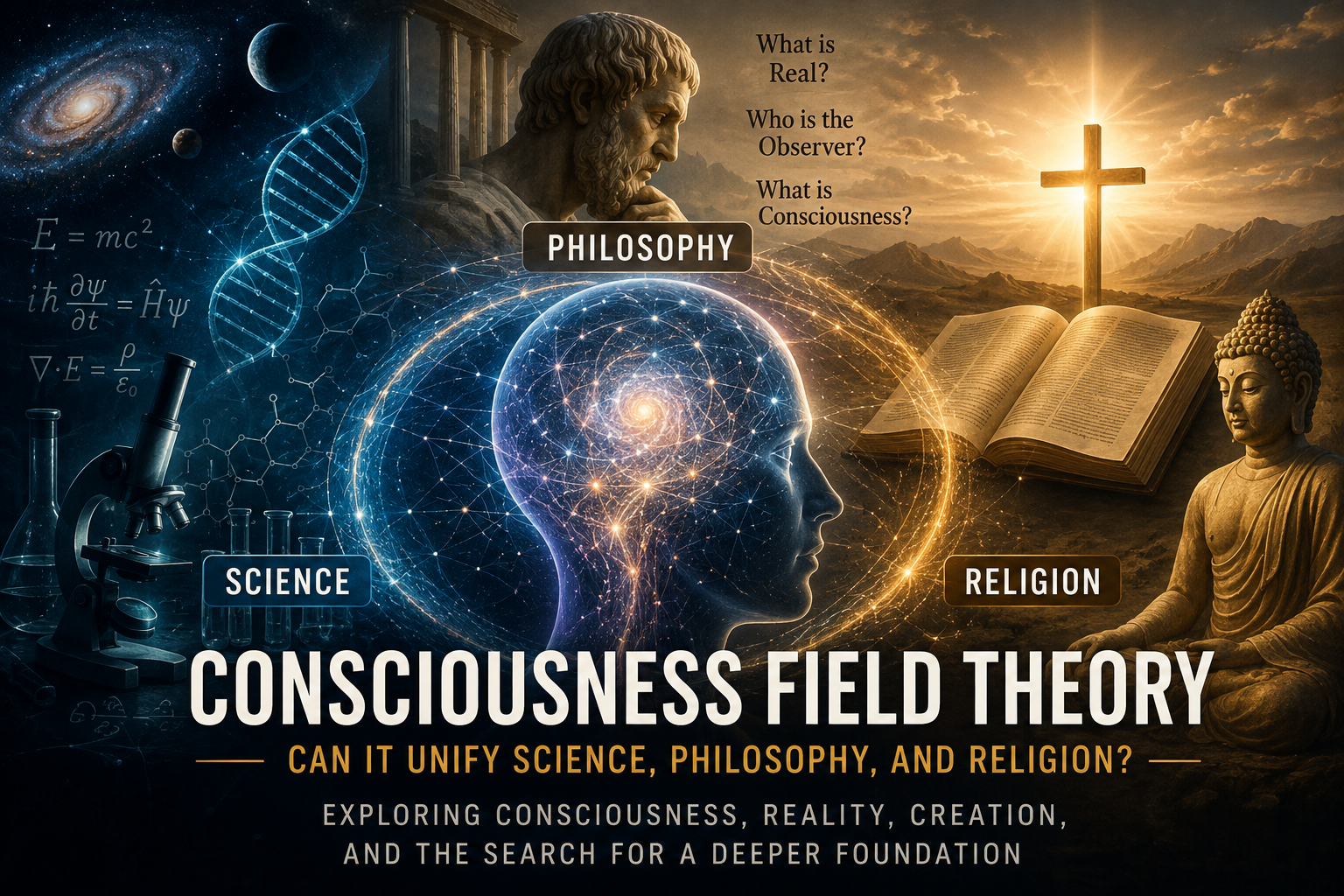
Prologue | Can Consciousness Field Theory Connect Three Different Paths?
Why do we need Consciousness Field Theory?
The Consciousness Field Unified Theory is not an attempt to mix science, philosophy, and religion into a single doctrine.
Rather, it asks what these three fields, each following its own path, have discovered about humanity and the world, and whether those discoveries might be connected within a deeper and more fundamental structure.
For a very long time, humanity has followed different paths in its attempt to understand the world.
Science has explored matter and energy, life, and the workings of the universe.
Philosophy has asked what existence is, how human beings perceive the world, and what we actually mean when we speak of reality.
Religion has sought the ultimate source and meaning of humanity and the world.
At first glance, these three paths appear to move in very different directions.
Science demands observation and experiment.
Philosophy investigates through reason and logic.
Religion speaks of the meaning of human existence and of a transcendent source.
As a result, in the modern world these three domains have come to appear increasingly distant from one another.
Yet when we step back, something curious becomes visible.
Their languages and methods may be different, but the questions they encounter at the farthest edges of their inquiry are surprisingly similar.
Where did this world begin?
How do human beings experience this world?
And what is the consciousness that knows all of this?
Perhaps science, philosophy, and religion differ not because they are searching for completely different truths, but because they are looking at one enormous problem from different directions.
If so, we may need to change the question.
Instead of asking whether one of these fields is right and the other two are wrong, we can ask:
Is there a more fundamental foundation capable of explaining the discoveries of all three at once?
This chapter explores that possibility through Consciousness Field Theory.
1. Why Did Human Knowledge Divide into Science, Philosophy, and Religion?
Human beings did not begin by trying to understand the world in only one way.
When looking up at the stars in the night sky, one person measured their movements.
Another asked what it meant for a human being to stand beneath those stars and observe them.
Still another wondered about the source that brought both the stars and humanity into existence.
From these different questions, the paths of science, philosophy, and religion gradually began to diverge.
The great strength of science lies in its ability to test and verify measurable phenomena.
Through observation and experiment, science explains how objects move, how light travels, how living organisms change, and how the universe is structured.
This method has transformed human civilization beyond anything earlier generations could have imagined.
But the scientific method also has boundaries that arise from its own principles.
Science primarily investigates phenomena that can be observed and measured.
And here a question remains.
What is the consciousness that observes, measures, and understands all those phenomena?
Philosophy has wrestled with precisely these questions for centuries.
Is the world we see the world exactly as it is in itself?
Or is it a world that appears through the structure of human perception?
When I say “I,” am I referring to the body?
The brain?
Or the consciousness that experiences, judges, and knows?
Religion approached the problem from another direction.
Does the world have an ultimate source?
Why do human beings exist?
Is there meaning behind life and consciousness?
Science, philosophy, and religion therefore may not have separated merely because they deal with completely different worlds.
They may have separated because they have been investigating the same world through different questions and different methods.
Here we encounter the first condition required for genuine integration.
Integration does not mean erasing the differences among these three fields.
It does not mean turning science into religion, converting religion into philosophy, or reducing philosophy to science.
True integration must recognize what each field has discovered while explaining
how those discoveries relate to one another within a larger and more fundamental structure.
2. Science Explained the World, But Where Is the Observer?
Modern science has achieved extraordinary success in explaining the material world.
It revealed the structure of the atom.
It investigated the behavior of light and electrons.
It analyzed DNA and the mechanisms of life.
And it continues to trace the history of the universe itself.
Today, we can observe galaxies billions of light-years away and measure the activity of neurons inside the human brain.
Yet at the center of this astonishing body of knowledge is something so familiar that it is easily overlooked.
The observer.
A telescope captures a galaxy.
A computer processes data.
Brain-imaging equipment records neural activity.
But who understands what that data means?
A machine can record numbers.
But seeing those numbers,
comparing them,
assigning meaning to them,
and understanding them as part of a theory involves human cognition.
This does not mean that consciousness alone creates physical reality through scientific observation.
To claim that would go far beyond what science itself has established.
But at least one thing is clear.
The scientific world as we know it is always a world that has been observed, interpreted, and understood.
This tension between physical reality and observation also appeared in Einstein’s long debate with quantum mechanics. Around 1950, while walking in Princeton with physicist Abraham Pais and discussing quantum theory and physical observation, Einstein challenged him with a famous question: “Do you really believe that the moon exists only if I look at it?”
Einstein’s question was not an argument that consciousness creates the Moon. Rather, it expressed his resistance to the idea that physical reality should depend fundamentally on observation. The question remains powerful because it exposes a boundary that still matters here: What belongs to reality itself, and what belongs to the conditions through which reality becomes observable and knowable?
At this point, Consciousness Field Theory asks another question.
Until now, we have concentrated on studying the objects that are observed.
Should we not also investigate the conditions that make observation possible in the first place?
The eyes receive light.
The brain processes signals.
But seeing color,
hearing sound,
understanding meaning,
and experiencing,
“I am seeing this right now,”
remain questions of consciousness.
Therefore, Consciousness Field Theory does not propose abandoning science.
Quite the opposite.
It accepts the structures of matter, life, and the universe that science has discovered, while proposing that we extend the range of inquiry to include another question:
How can all of this be experienced and known at all?
If science has studied the structure of the world,
we must now also ask
to whom, and in what way, does that world appear as a world?
3. Has Philosophy Always Placed Consciousness Near the Center?
While science has investigated the structure and operation of the world, philosophy has long approached the problem from a somewhat different direction.
Are we seeing the world itself?
This question is deeper than it first appears.
We say that there is a tree in front of us.
But what do we directly experience?
The tree itself?
Light enters the eye.
Neural signals are generated.
Various processes take place in the brain.
And then a “tree” appears in our experience.
Can we therefore say with complete certainty that the world as we know it and the world in itself are absolutely identical?
Immanuel Kant argued that human beings do not simply receive the world without any conditions of their own.
We experience the world through the conditions and structures of human cognition.
The important point here is not the simplistic conclusion that “there is no external world.”
The crucial point is that the reality we experience always includes the conditions of cognition through which that reality appears to us.
This is where philosophy and Consciousness Field Theory begin to meet.
Consciousness Field Theory does not simply deny the world.
Mountains exist.
Oceans exist.
Stars exist.
Other people exist.
But for all of these to become a “world” that we experience, conditions that make experience possible are required.
Can consciousness be completely removed from those conditions?
Here the question becomes deeper.
Matter may exist.
But what is required for matter to become an “experienced world”?
Light may exist.
But what is required for light to appear as the experience of “brightness” and “color”?
Vibrations may exist.
But what is required for them to be experienced as “music” and “voices”?
Philosophy has stood at this boundary and asked such questions for a very long time.
Consciousness Field Theory seeks to extend those questions into a larger framework.
Are the existence of the world and the experience of the world the same problem?
It is precisely here that consciousness ceases to be a peripheral issue and becomes a central one.

4. Can Religious Ideas of Creation Meet the Question of Consciousness?
Religion uses a language different from that of science or philosophy.
Science speaks of laws.
Philosophy speaks of being and cognition.
Religion has traditionally spoken of creation and origin, purpose and meaning.
For this reason, religious language can appear to conflict easily with scientific language.
But before comparing their statements literally, we should ask a more fundamental question.
What fundamental problem has religion been asking about for thousands of years?
Why does the world exist?
Where did humanity come from?
What is the relationship between an invisible source and the visible world?
These are not questions that belong exclusively to religion.
Philosophy has asked many of the same questions.
Modern cosmology and consciousness research also investigate questions of origins, although through very different methods.
The important point is not to immediately convert religious expressions into scientific facts.
If we identify the biblical account of creation or Eastern religious cosmologies directly with the formulas of modern physics, we risk forcing fundamentally different systems of knowledge into an artificial agreement.
The integration proposed by Consciousness Field Theory should not proceed in that way.
Instead, we must examine which fundamental problem each language is pointing toward.
If the source of creation described by religion is not merely another material object,
what relationship might it have to the philosophical question of the ground of being?
And if consciousness is a fundamental condition through which the material world becomes experienceable,
could we ask again, from a new perspective, about the relationship between the invisible source long discussed by religion and the visible world?
At this point, Consciousness Field Theory proposes a possibility.
What if creation is understood not only as an event in which something is physically produced, but also as a process through which a world becomes capable of appearing and being experienced?
Then the questions of science,
the questions of philosophy,
and the questions of religion
may gain the possibility of meeting from a new position.
Science asks:
How does the world work?
Philosophy asks:
How can we experience and know that world?
Religion asks:
What is the ultimate source of that world and of human existence?
Consciousness Field Theory places another question among these three:
What is the most fundamental condition that allows all of this to appear as a single, experienceable world?
To answer that question, it is no longer enough simply to place science, philosophy, and religion side by side.
We must show where these three domains might actually connect within a single structure.
That is where the next section begins.
5. Where Can Science, Philosophy, and Religion Meet?
If science, philosophy, and religion have followed different paths, where could they possibly meet?
At first, the answer seems difficult to find.
Science studies matter and energy.
Philosophy examines existence and cognition.
Religion asks about creation and ultimate meaning.
Their terminology is different, their methods are different, and the standards by which they justify their claims are also different.
Yet there is one question that none of them can completely avoid.
What is the human being who knows the world?
Science investigates the brain.
Philosophy investigates the subject.
Religion speaks of the soul, spirit, or inner being.
The words are different, but all three eventually encounter the problem of the being who experiences the world.
Imagine that there were no conscious beings anywhere in the universe.
Stars might still exist.
Galaxies might still rotate.
Planets might still orbit their suns.
But who would call them “stars,” “galaxies,” and “planets”?
Who would distinguish past from future?
Who would experience beauty, fear, love, or meaning?
This does not mean that the universe physically disappears when there is no observer.
That conclusion goes beyond what we can establish.
But it does reveal an important distinction.
The existence of a physical world and the existence of an experienced world are not necessarily the same question.
Science is extraordinarily powerful in explaining the former.
Philosophy has long investigated the conditions of the latter.
Religion has asked where the capacity for such experience and meaning ultimately comes from.
This is precisely where Consciousness Field Theory seeks a point of connection.
Not by claiming that science, philosophy, and religion are saying the same thing.
And not by reducing one field to another.
Instead, it asks whether their different questions may converge around a deeper problem:
How does reality become a world that can be experienced, known, and given meaning?
Consciousness may be the place where these three paths first begin to touch.
But if that is so, another question immediately follows.
Is consciousness merely something produced inside each individual brain?
Or could individual consciousness itself be connected to a more fundamental ground?
6. Is Individual Consciousness Entirely Separate?
Each of us experiences the world through an individual consciousness.
I see through my eyes.
You see through yours.
I cannot directly enter your experience, and you cannot directly enter mine.
In this sense, consciousness appears profoundly personal.
Yet human beings do not live in completely isolated worlds.
We look at the same sun.
We recognize the same mountains.
We communicate through language.
We construct shared knowledge.
We build civilizations together.
How is this possible?
If every individual consciousness were an entirely sealed universe, the existence of a stable shared world would itself become a remarkable problem.
Of course, science can explain much of this through common sensory systems, similar brain structures, language, social interaction, and a shared physical environment.
Consciousness Field Theory does not reject these explanations.
But it asks whether there may be a deeper level to the problem.
Why is experience structured in such a way that billions of individual subjects can participate in one apparently coherent world?
This question becomes especially important when we consider the distinction between private experience and shared reality.
My pain is directly accessible only to me.
My memory appears within my own consciousness.
My dream may belong entirely to my private world.
Yet when I wake, I return to a world that others also recognize.
The chair remains where it was.
The street continues beyond my field of vision.
Other people remember events that I also remember.
There is therefore a curious dual structure to human existence.
We each possess a private center of experience,
yet we participate in a common world.
Consciousness Field Theory asks whether these two facts might be understood within a larger framework.
Perhaps individual consciousness should not be thought of only as an isolated point enclosed within the skull.
Perhaps it can also be considered as a localized center of experience participating in a more fundamental structure.
This does not prove that such a field exists.
But it gives us a new conceptual question:
Could there be a foundation that allows individual consciousness and shared reality to coexist?
If so, consciousness may have to be understood not merely as a private event, but as part of a larger relational structure.
This possibility leads directly to the central hypothesis of this chapter.

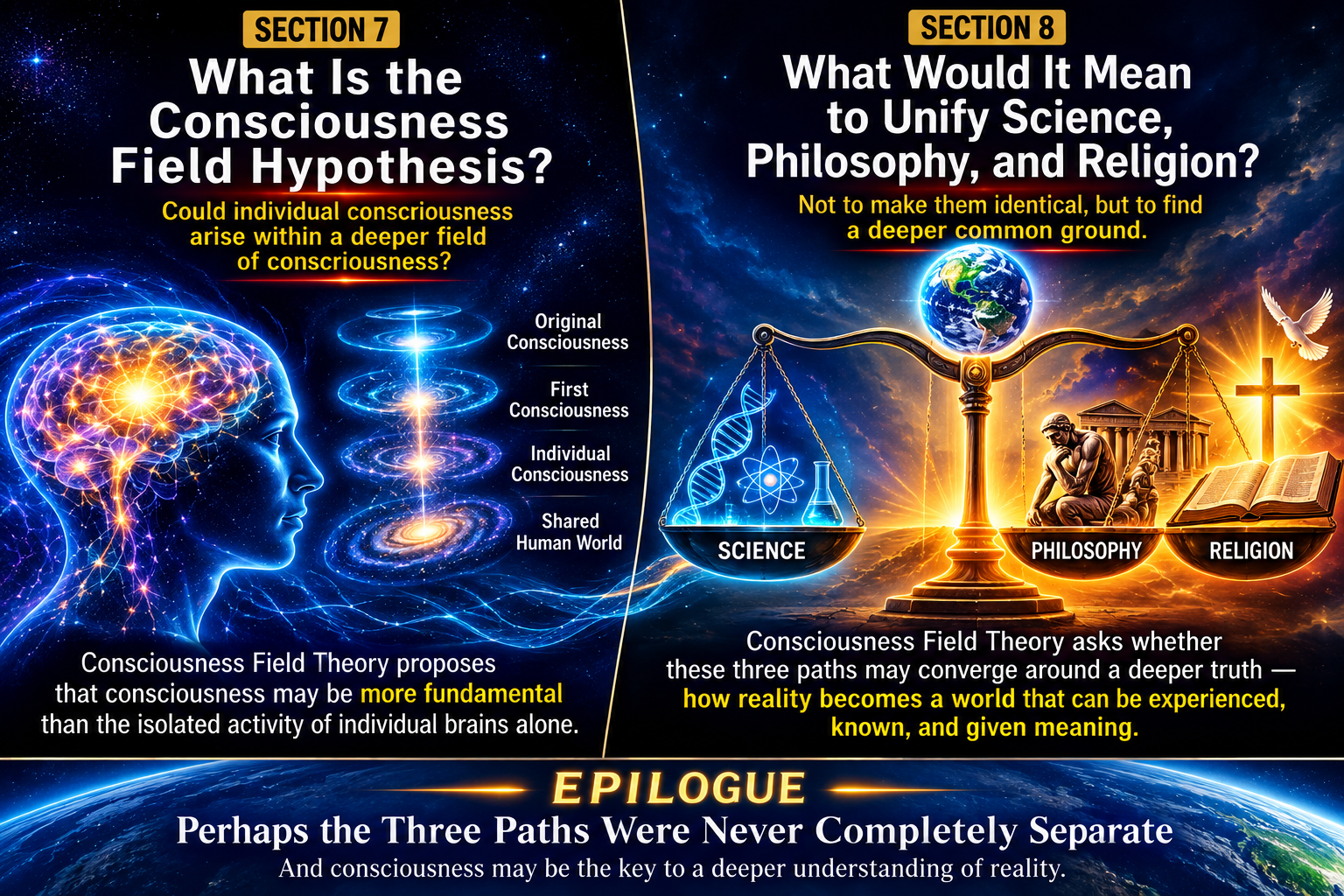
7. What Is the Consciousness Field Hypothesis?
The term Consciousness Field can easily be misunderstood.
In physics, a field has a precise technical meaning.
Electromagnetic fields, gravitational fields, and quantum fields are described through mathematical structures and tested through observation and experiment.
Consciousness Field Theory does not claim that consciousness has already been demonstrated to be a physical field of this kind.
At this stage, the Consciousness Field should be understood primarily as a philosophical hypothesis and conceptual framework.
Its purpose is to ask whether consciousness might be more fundamental than the isolated activity of individual brains alone.
The hypothesis begins with several observations.
First, every world we directly know appears within experience.
Second, individual consciousness is private, yet human beings participate in a remarkably stable shared reality.
Third, science can correlate brain activity with conscious states, but the existence of subjective experience itself remains one of the deepest unresolved problems in the study of consciousness.
From these points, Consciousness Field Theory proposes a question rather than a completed scientific conclusion:
Could individual consciousness arise within, participate in, or be related to a more fundamental field of consciousness?
Within the conceptual structure developed in this work, we can imagine a sequence such as:
Original Consciousness → First Consciousness → Individual Consciousness → Shared Human World
This sequence should not be treated as an experimentally established scientific model.
It is a philosophical framework for organizing questions that science, philosophy, and religion have often approached separately.
Science asks how the brain and the physical world operate.
Philosophy asks how a subject experiences and knows reality.
Religion asks about the ultimate source from which existence and consciousness arise.
The Consciousness Field hypothesis asks whether these questions might be connected through a deeper common foundation.
Here an important distinction must be preserved.
To say that experience appears through consciousness is not the same as saying that an individual human mind arbitrarily creates the entire universe.
The first claim concerns the conditions of experience.
The second would be a much stronger metaphysical claim requiring far more justification.
Consciousness Field Theory therefore begins from the more cautious position.
The world we know is always a world encountered through consciousness.
From there, we ask whether consciousness itself may point toward a deeper structure of reality.
If that structure exists, it may offer a conceptual bridge between the measurable world studied by science, the experienced world examined by philosophy, and the question of ultimate origin explored by religion.
But can such a theory truly be called a unification?
That question requires one final distinction.
8. What Would It Mean to Unify Science, Philosophy, and Religion?
To unify science, philosophy, and religion does not mean making them identical.
A genuine unified framework must preserve their differences.
Science must remain science.
Its claims about the physical world must continue to depend on observation, measurement, mathematical description, and empirical testing.
Philosophy must remain philosophy.
It must continue to examine concepts, assumptions, logic, knowledge, and the conditions of experience.
Religion must also be understood within its own domain of questions concerning ultimate origin, meaning, transcendence, and human existence.
If Consciousness Field Theory simply declares that all three are saying the same thing, it has explained nothing.
A meaningful integration requires something more demanding.
It must identify a structure in which the questions of all three can be related without erasing their boundaries.
Consciousness may provide such a candidate.
Science encounters consciousness when it studies the brain, perception, cognition, and the observer.
Philosophy encounters consciousness when it asks how reality becomes experience and how knowledge is possible.
Religion encounters consciousness when it asks about life, spirit, creation, and the relationship between human beings and an ultimate source.
The three approaches are not identical.
But they may intersect around a common mystery:
How does existence become experience?
And beyond that:
Why is there a being capable of knowing that existence at all?
Consciousness Field Theory proposes that consciousness should not be treated merely as a small secondary phenomenon appearing at the end of a material universe.
It asks whether consciousness might instead belong to the deeper conditions through which reality becomes knowable and experienceable.
This remains a hypothesis.
It is not a substitute for neuroscience.
It is not a new law of physics.
And it is not an attempt to prove religious doctrine through scientific terminology.
Its value lies elsewhere.
It provides a framework in which discoveries and questions that have long been separated can be placed into conversation.
Science can tell us increasingly more about how the universe works.
Philosophy can investigate how the universe becomes a world for a knowing subject.
Religion can continue asking why existence, consciousness, and meaning are here at all.
Consciousness Field Theory asks whether beneath these three questions there may be a deeper common ground.
If such a ground exists, the unification of science, philosophy, and religion would not mean the end of their differences.
It would mean discovering why their different paths keep returning to the same mystery.
And that mystery is consciousness.
Epilogue | Perhaps the Three Paths Were Never Completely Separate
Science looked outward and discovered an immense universe.
Philosophy turned toward the knower and discovered that the world we experience cannot be separated from the conditions through which it is known.
Religion looked toward the origin of existence and asked what lies behind the visible world.
For centuries, these paths often appeared to move away from one another.
Yet the deeper each path travels, the more difficult it becomes to avoid the question of consciousness.
Who observes the universe described by science?
How does the reality examined by philosophy become experience?
Why does the human being described by religion possess an inner world capable of asking about its own origin?
Consciousness Field Theory begins at this intersection.
It does not claim that every question has already been answered.
Rather, it proposes that questions previously separated among science, philosophy, and religion may need to be reconsidered together.
Perhaps consciousness is not simply one object among countless objects in the universe.
Perhaps it is one of the fundamental conditions through which a universe can become known, experienced, and meaningful.
And perhaps individual consciousness is not the final level of the problem.
Behind billions of individual centers of experience, there may be a deeper question still waiting.
Where did consciousness itself come from?
Why did one world become experienceable through countless individual minds?
And if there is a more fundamental ground of consciousness, what is its relationship to human beings?
These questions take us beyond the problem of integration.
They lead toward the next stage of the inquiry.
The task ahead is no longer merely to ask whether science, philosophy, and religion can meet.
It is to investigate the structure of consciousness itself.
If consciousness is fundamental, how did it become the consciousness of each individual human being?
That is the question that opens the next chapter.
Previous Chapter | How Does Consciousness Create the Human World?
Before asking whether Consciousness Field Theory can connect science, philosophy, and religion, Chapter 3 explored a more fundamental question:
How does consciousness create the human world?
From individual experience to shared reality, language, civilization, and history, the chapter examined how consciousness may participate in the formation of the world human beings experience together.
Read Part VI, Chapter 3 | How Does Consciousness Create the Human World
Next Chapter | Part VI, Chapter 5
If science, philosophy, and religion can begin to meet through the question of consciousness, an even deeper question now emerges.
What lies beyond the individual consciousness we experience as “I”?
Where does individual consciousness come from?
And what relationship might exist between individual consciousness and a more fundamental source of consciousness?
Part VI, Chapter 5 will take the next step into this question, moving from the unification of knowledge toward the deeper origin and structure of consciousness itself.
🎬 Explore This Chapter in Video
This chapter is also available as a three-part video series.
Each version approaches the same question at a different depth:
Can Consciousness Field Theory connect science, philosophy, and religion?
▶ 2-Minute Introduction | Start with the Question
A short introduction designed to challenge one assumption:
Science studies the world.
Philosophy asks how we know it.
Religion asks where it came from.
Could consciousness be the missing link between all three?
🎬 Watch the 2-Minute Introduction
[2-MINUTE VIDEO URL]
▶ 10-Minute Exploration | Follow the Argument
Go beyond the initial question and explore how science, philosophy, and religion approach consciousness from different directions.
Why does the observer matter?
How does physical reality become conscious experience?
And could consciousness provide a conceptual bridge between these three fields?
🎬 Watch the 10-Minute Exploration
[10-MINUTE VIDEO URL]
▶ 20-Minute Deep Audio | Explore the Full Question
For those who want to go deeper, this extended audio exploration examines the Consciousness Field hypothesis, individual consciousness, shared reality, creation, and the possibility of a deeper foundation connecting science, philosophy, and religion.
🎧 Listen to the 20-Minute Deep Audio
[20-MINUTE VIDEO URL]
📖 Read · Watch · Explore Deeper
Choose the depth that fits you:
2 Minutes → Encounter the question
10 Minutes → Explore the reasoning
20 Minutes → Go deeper into the theory
Full Article → Read the complete argument
Cheonbong Archive | One Question, Four Paths to Explore It