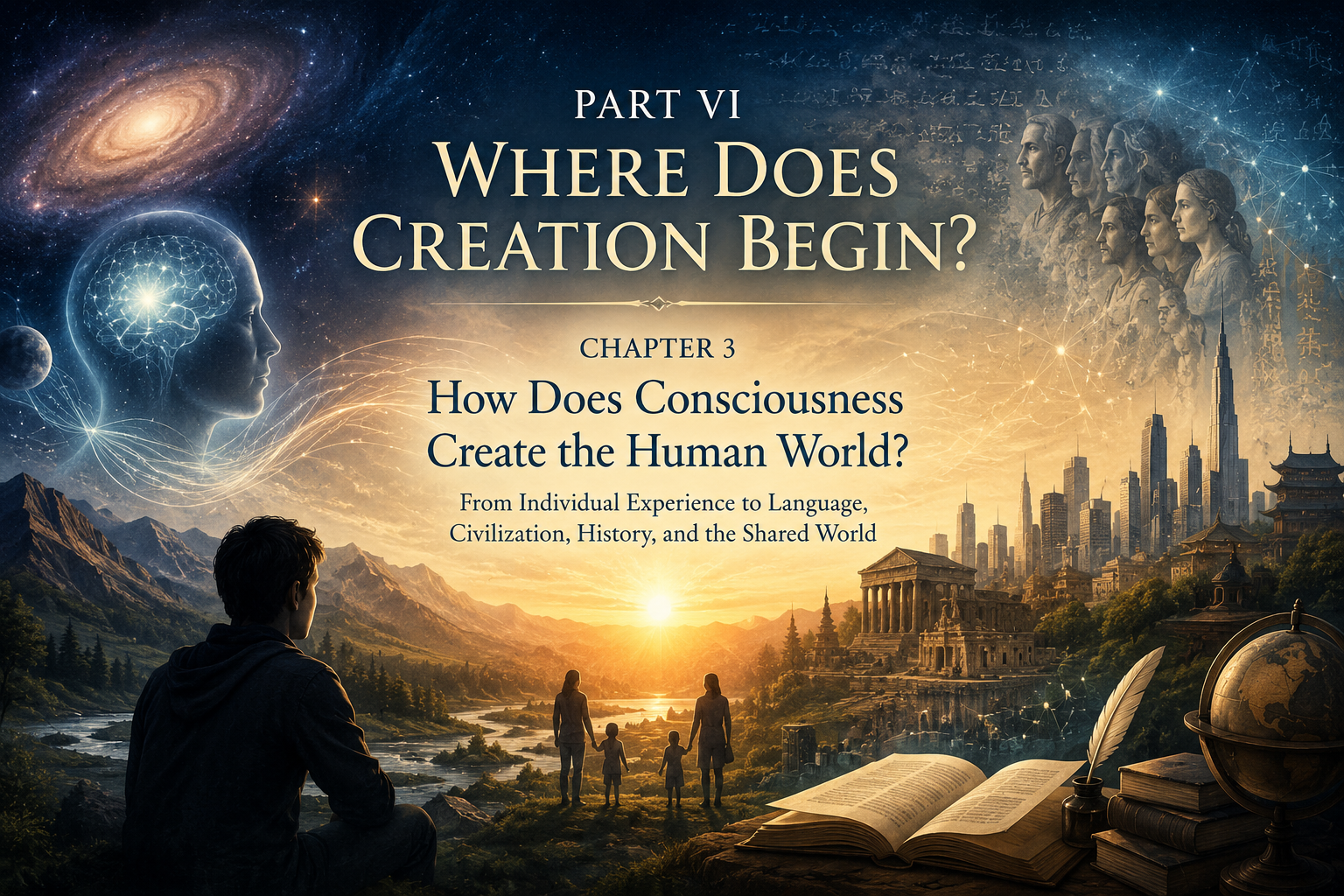
Prologue
How does consciousness create the human world?
So far, we have encountered one remarkable fact.
In a dream, there is no physical light entering from the outside. There is no material world physically present before us.
And yet, we see mountains.
We look across oceans.
We meet people.
We walk through places that seem to possess distance, shape, color, and space.
While dreaming, we experience an entire world.
Could waking reality, at its deepest level, involve a similar principle?
We do not experience the external world itself directly.
Light reaches our eyes. Sound reaches our ears. Sensory signals travel through the body and brain.
And through these signals, a world is constructed and experienced within consciousness.
This leads us to a much larger question.
Why did consciousness need the human being?
If consciousness can present an entire world within a dream, perhaps a private world of consciousness would have been enough.
Why, then, do we encounter one another through human bodies?
Why did language arise?
Why did societies form?
Why did civilizations emerge and histories unfold across generations?
This chapter is not primarily asking where humanity came from.
It asks something deeper.
By what mechanism does creation become a human world?
That is the question we will now explore.
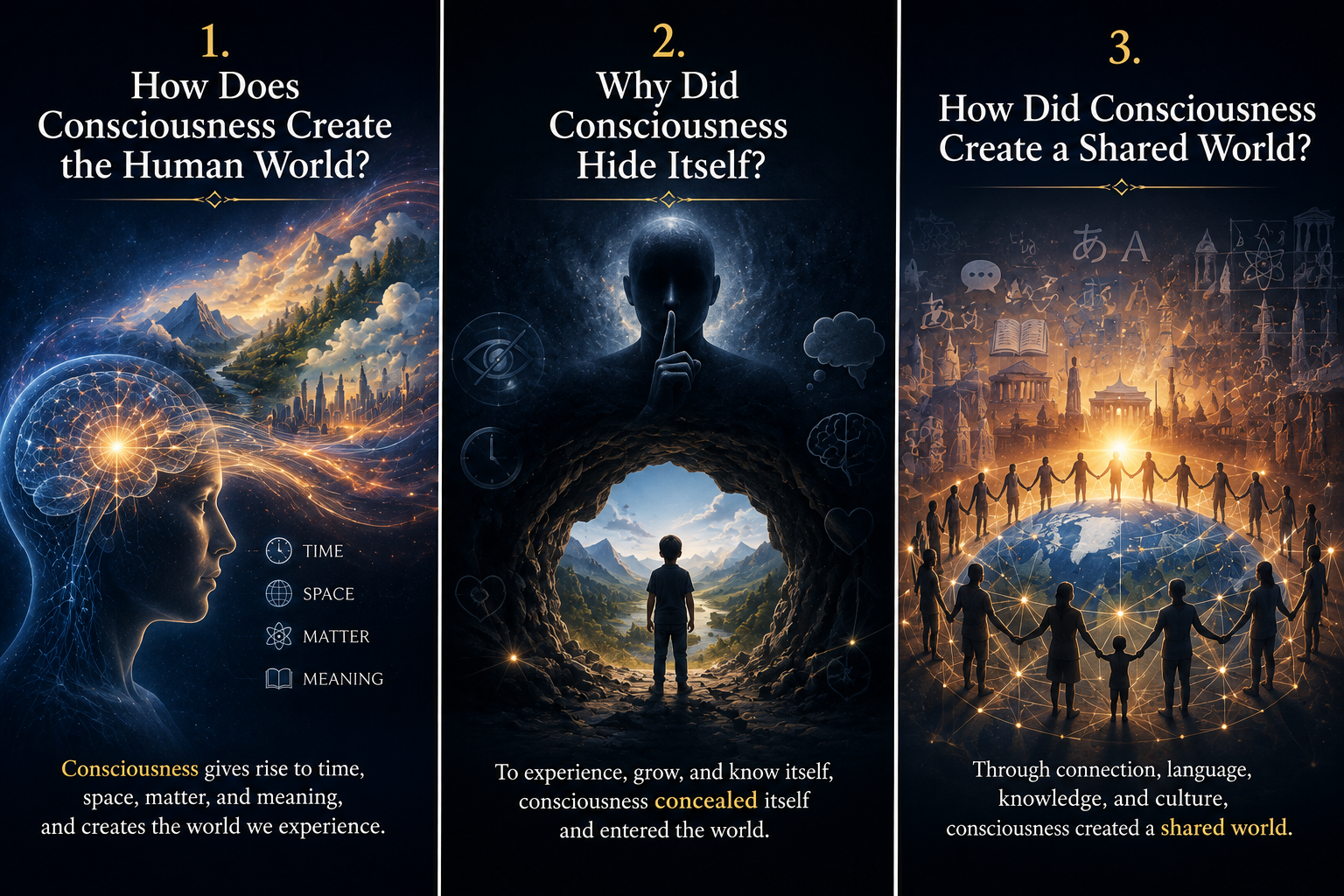
1. How Does Consciousness Create the Human World?
In the previous chapter, we discovered something extraordinary through the experience of dreaming.
A dream requires no light entering from the external world.
It requires no physical mountain standing before us.
No actual ocean needs to stretch toward the horizon.
Even our physical eyes and ears need not be actively receiving the dream world from outside.
And yet consciousness can present a mountain.
It can present an ocean.
It can present people.
It can even present what appears to be an entire universe.
While we are dreaming, we experience that world as reality.
This fact deserves careful attention.
It suggests that consciousness has the capacity to present a world without directly borrowing the physical objects and external light that appear within that experience.
Now a difficult question arises.
If consciousness can present a world in this way, why is waking reality not created in precisely the same manner as a dream?
Why is there light?
Why is there matter?
Why is there a body?
Why do we have eyes and ears?
Why does there appear to be an enormous universe extending far beyond us?
Perhaps the answer is not that consciousness lacks the ability to create otherwise.
Dreams suggest precisely the opposite.
Consciousness can present a world even when those external objects are not physically present to the dreamer.
And yet waking reality presents us with light.
It presents matter.
It unfolds through time.
It extends through space.
And within this world stands the human body.
From the perspective explored in this book, this suggests another possibility:
the structure of waking reality may itself be part of the architecture of creation.
Imagine for a moment that waking reality operated exactly like a dream.
Suppose everything appeared instantly according to an individual’s consciousness.
What would happen to civilization?
What would happen to history?
Could there be families?
Societies?
Cultures?
Education?
Could knowledge accumulate from one generation to another?
Human beings are born.
They learn.
They love.
They speak to one another.
They preserve what they have discovered and pass it to the next generation.
From these countless interactions emerges the extraordinary diversity of the human world.
In this sense, the physical structure of reality may serve as the stage upon which shared human creation becomes possible.
But this produces a strange reversal.
Because the physical world appears so solid and immediate, human beings naturally notice matter first.
We see mountains.
We see oceans.
We see our bodies.
And we assume that these things constitute reality itself.
Consciousness then appears to be secondary, something produced by the brain or body.
Dreaming, however, forces us to reconsider that assumption.
In a dream, the mountain does not need to be physically present.
The ocean does not need to be physically present.
External light does not need to illuminate the scene.
And yet consciousness presents a world.
So perhaps we should ask whether waking reality, too, is inseparable from the consciousness through which it is experienced.
At this point, an objection naturally arises.
Can we really draw such a large conclusion from dreams alone?
That is a fair question.
So we do not have to rely on dreams alone.
Try a simple experiment right now.
Close your eyes.
Imagine a flower.
Or a tree.
Imagine a mountain.
An ocean.
A blue sky.
The stars at night.
A galaxy.
You may even try to imagine the entire universe.
Now picture your own face.
Or the face of someone you love.
You were able to bring at least some of these images to mind.
But your eyes were closed.
The objects you imagined were not physically standing before your eyes.
And yet something appeared in experience.
You can go even further.
In imagination, you can fly through the sky.
You can rotate a galaxy.
You can look down upon an imagined universe from a perspective no human body could physically occupy.
Consciousness can present possibilities that ordinary physical experience does not permit.
The important question here is not whether these imagined worlds are physically real.
The important point is much simpler:
consciousness possesses the capacity to present a world in experience.
But we must make one crucial distinction.
You can imagine a world.
That does not mean that you designed this shared physical reality.
You may participate in creation through thought, language, action, and culture, but you are not necessarily the consciousness that established the conditions of the universe itself.
So another question appears.
What kind of consciousness could stand behind the vast architecture of the universe and the human world?
That question leads us toward what this work calls Original Consciousness.
And it is here that our investigation into creation truly begins.
2. Why Did Consciousness Hide Itself?
If consciousness is fundamental to the creation of the world, a puzzling question immediately follows.
Why are we usually unaware of it?
This question is central to the Consciousness Field Theory.
Every day, we see mountains.
We look at the sea.
We meet other people.
We look up at the sky.
Yet we rarely become aware of the consciousness through which all of these experiences appear.
We believe that we are simply seeing the world.
But what we actually experience is a world that appears through consciousness.
Nevertheless, human beings have generally begun with matter.
We see the physical world first and then assume that consciousness must somehow emerge from the brain and body.
Why did this reversal occur?
One possible answer lies in the extraordinary completeness of waking reality.
Think about what happens when we watch a compelling film.
We know that actors are performing.
We know that cameras, sets, lighting, editing, and screens are involved.
But when we become deeply absorbed in the story, we stop thinking about how the film was made.
We experience the story itself.
Reality may present us with a similar philosophical problem.
If every flower carried a visible sign saying,
“This world is appearing through consciousness,”
we could hardly experience life in the ordinary way.
If every time we met another person we immediately perceived the underlying structure of consciousness, our attention would constantly shift away from living the experience toward analyzing how the experience was produced.
The deeper our immersion in the world, the less visible its underlying mechanism becomes.
From the perspective developed in this book, this may help explain why consciousness does not stand prominently before us.
Instead, what stands before us is a remarkably coherent reality.
Mountains appear solid.
The ocean appears external.
Other people appear independent of us.
Time seems to flow.
Space seems to extend outward.
Matter seems to exist on its own.
As a result, human beings naturally came to believe that reality begins with matter and that consciousness appears only afterward.
But dreams challenge that order.
Imagination challenges it as well.
And the very fact of conscious experience continues to raise a question that cannot simply be dismissed:
Is matter the source of consciousness, or is consciousness a condition through which matter becomes an experienced world?
The purpose here is not to claim that dreams prove that the physical universe is unreal.
They do not.
Rather, dreams reveal something more modest but profound:
a world can appear within consciousness even when the corresponding external objects are not physically present to the dreamer.
That fact gives us reason to examine consciousness more carefully.
Consciousness is the closest thing to us.
Every sight, sound, memory, thought, emotion, and question appears through it.
And yet consciousness itself remains strangely difficult to see.
But invisibility does not mean nonexistence.
We do not see gravity itself.
We observe its effects.
We do not see the air as an object before us in ordinary circumstances.
Yet we live within it and depend upon it.
Perhaps consciousness presents us with an even deeper version of the same puzzle.
It may be so intimately involved in every experience that we overlook it precisely because we never step outside it.
So instead of looking only at the world that appears before us, we must turn our attention toward that which makes experience of a world possible at all.
And when we do, the question of creation begins to change.
The question is no longer merely:
What is the world made of?
It becomes:
What makes a world appear as a world to a conscious being?
That shift opens the door to the next stage of our investigation.
How did countless individual consciousnesses come to inhabit and construct meaning within one shared human world?
3. How Did Consciousness Create a Shared World?
A dream can create an entire world within a single consciousness.
There are mountains.
There are oceans.
There are people.
There may even be cities, roads, conversations, and entire landscapes.
But there is one crucial limitation.
The dream belongs to one consciousness.
No one else can enter your dream at the same moment and experience exactly the same world from within your consciousness.
A dream may appear to be a complete world.
But it is not a shared world.
Waking reality is different.
Billions of human beings live on Earth.
Each person has a different life.
Each person accumulates different memories and experiences.
And yet we look up at the same sun.
We call the same mountain a mountain.
We recognize the same ocean.
And we live together within what we understand as one shared world.
This raises an extraordinary question.
If each consciousness is individual, how can billions of consciousnesses share one human world?
One of the first keys is language.
A flower does not call itself a “flower.”
A mountain does not name itself.
Neither the ocean nor the sky was born carrying a name.
Human consciousness gives names to things.
The moment an object is named, something remarkable happens.
What was once an individual experience can become a concept shared by many minds.
Imagine that one person sees a flower.
That experience initially belongs to that person.
But once the word “flower” is shared, another person can understand what is being referred to.
The experience begins to cross the boundary between one consciousness and another.
Language, therefore, is more than sound.
Language is one of the first bridges connecting consciousness to consciousness.
Through words, human beings can share what cannot be physically transferred from one mind to another.
A memory can be described.
An idea can be communicated.
A warning can be given.
A discovery can be taught.
A question can move from one person into the consciousness of another.
But spoken language has a limitation.
Sound disappears.
A sentence spoken today may vanish when the people who heard it are gone.
So human consciousness produced another extraordinary creation:
writing.
Writing allowed language to remain across time.
An experience that existed within one person’s consciousness could now be recorded.
Knowledge could survive the person who discovered it.
A thought could travel beyond a single lifetime.
Through writing, the consciousness of someone who lived hundreds or even thousands of years ago can still reach another consciousness today.
Knowledge accumulated.
Knowledge became culture.
Culture contributed to civilization.
And the accumulated record of this process became what we call history.
From this perspective, history is more than a sequence of external events.
It is also a record of consciousness moving through time.
Ideas survive their creators.
Questions cross generations.
Discoveries become foundations for later discoveries.
One generation does not always have to begin again from zero.
This is how human consciousness moved beyond the private world represented by dreams and participated in the construction of a shared human world.
Civilization was not created by stone or iron alone.
Stone does not decide to become a temple.
Iron does not imagine a bridge.
Paper does not decide to become a book.
Human consciousness gives materials purpose, organizes them according to ideas, and transmits those ideas to others.
Language connects minds.
Writing preserves knowledge.
Knowledge accumulates.
And accumulated knowledge transforms the world in which later generations live.
This is why civilization can be understood not merely as a collection of buildings, machines, and institutions, but as an immense process of shared creation through consciousness.
The human world is therefore more than the physical environment surrounding us.
It also consists of meanings, names, languages, laws, stories, sciences, philosophies, religions, technologies, and memories that countless human beings have created and transmitted.
A dream shows us how a world can appear within an individual consciousness.
Human civilization presents another mystery:
How can individual consciousnesses participate in building one shared world together?
Language provided a bridge.
Writing gave that bridge continuity through time.
And from their accumulation emerged something no individual consciousness could have created alone:
civilization.
That brings us to the next question.
How did civilization begin, and what role did consciousness play in its creation?
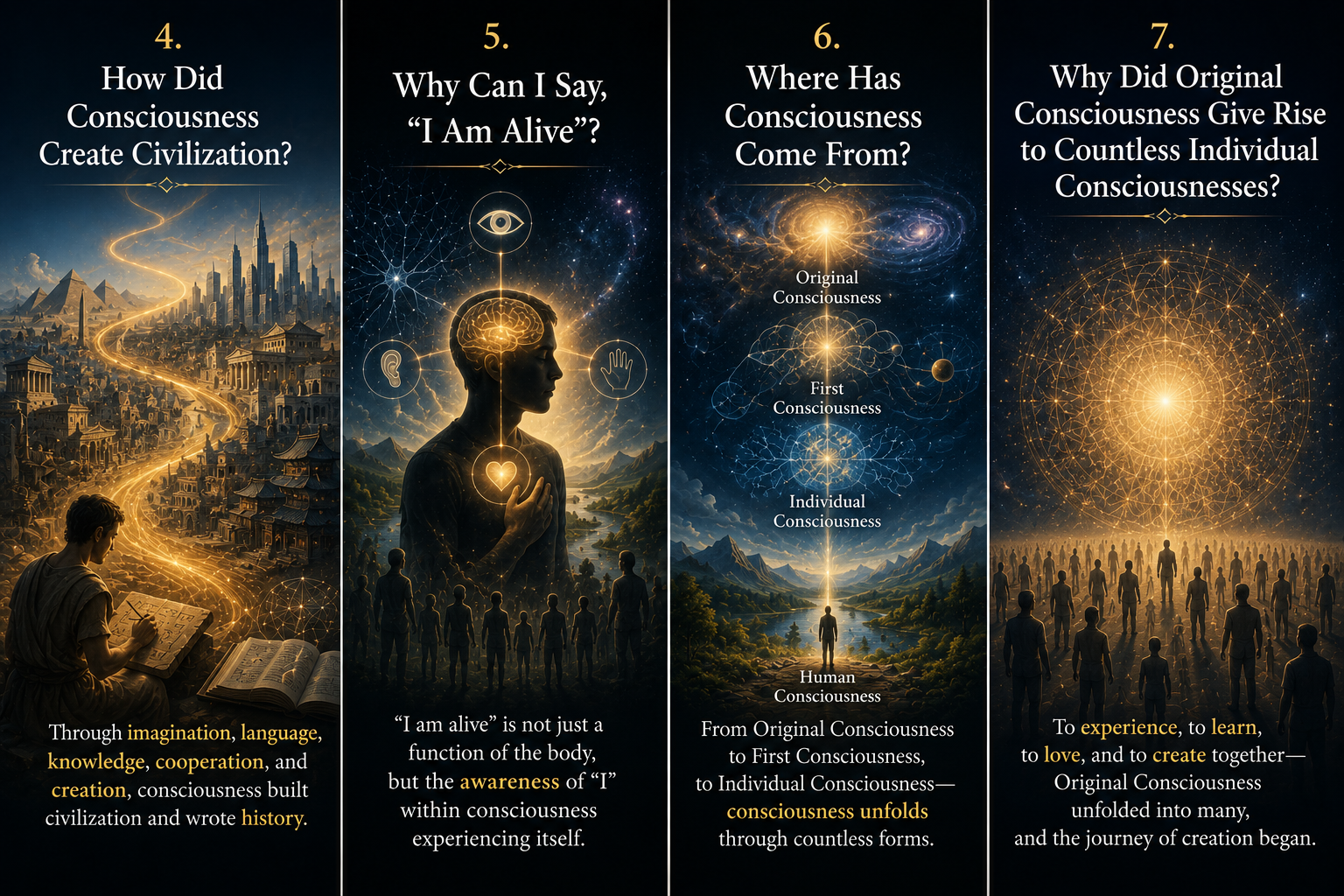
4. How Did Consciousness Create Civilization?
When human consciousness began to share a common world, something extraordinary happened.
Human beings did not merely adapt to the world around them.
They began to transform it.
Look around you.
Cities.
Roads.
Bridges.
Schools.
Hospitals.
Books.
Computers.
The internet.
None of these things existed in their present form from the beginning.
Before they became physical objects, they first existed as ideas within consciousness.
A building begins as an image in someone’s mind.
A bridge begins as a possibility.
A book begins as a thought.
A scientific theory begins as a question.
A new society begins with an idea of how people might live together.
In this sense, human civilization reveals something important about creation.
Creation often moves from the invisible to the visible.
First there is an idea.
Then the idea is expressed through language.
Language allows the idea to be shared.
The shared idea can then become action.
And action can transform matter.
Consider a simple chair.
A tree does not naturally become a chair.
Wood does not contain a visible command saying,
“Become a chair.”
A human being first imagines a form and a purpose.
Then the material is shaped according to that idea.
The physical object appears afterward.
The same pattern can be found on a much larger scale.
Before a city exists, someone imagines roads, buildings, water systems, transportation, and places where people can live and work.
Before an airplane exists, the possibility of human flight must first be conceived.
Before a computer exists, someone must imagine a machine capable of processing information according to designed rules.
Matter provides the material.
But consciousness provides meaning, purpose, design, and direction.
This does not mean that consciousness can simply imagine anything and instantly make it physically real.
The physical world has conditions and limitations.
Human beings must work within them.
A bridge must withstand gravity.
A building must obey the properties of its materials.
A machine must operate according to physical laws.
But within those conditions, consciousness continually reorganizes matter according to ideas.
This is one reason human civilization is so different from the natural environment alone.
Mountains existed before cities.
Rivers existed before bridges.
Metals existed before machines.
Silicon existed before computers.
But civilization emerged when human consciousness began to assign purposes, create designs, cooperate, preserve knowledge, and transform materials accordingly.
And no single human being created civilization.
It is the accumulated result of countless individual consciousnesses interacting across generations.
One person discovers something.
Another improves it.
Another records it.
Another teaches it.
Another combines it with a different idea.
Over time, individual acts of consciousness become collective knowledge.
Collective knowledge becomes technology, institutions, culture, science, philosophy, religion, art, and social systems.
What begins within individual consciousness can eventually reshape the shared physical world.
This gives us another way to understand human history.
History is not only the movement of armies, governments, economies, and technologies.
It is also the visible trace of ideas moving from consciousness into the world.
Every civilization carries such traces.
Its architecture reveals what people imagined.
Its laws reveal what they considered right and wrong.
Its religions reveal the ultimate questions they asked.
Its philosophy reveals how they understood existence.
Its science reveals how they tried to understand nature.
Its art reveals what could not always be expressed through ordinary language.
Civilization, then, can be understood as consciousness leaving its fingerprints upon the physical world.
But an even deeper question now appears.
Human beings can create cities, languages, technologies, and civilizations because they already exist within a universe that provides matter, energy, time, space, and physical laws.
We can rearrange what is already here.
But we did not create the fundamental conditions that make human creation possible.
So who, or what, established those conditions?
If human consciousness can transform an existing world through ideas, could there be a more fundamental level of consciousness related to the existence of the world itself?
This brings us back to the distinction between individual consciousness and Original Consciousness.
And from here, the question of creation becomes much larger.
5. Why Can I Say, “I Am Alive”?
Look up at the vast universe.
Countless stars shine in the darkness.
Galaxies continue their silent rotation.
Mountains have stood for hundreds of millions of years.
The oceans never cease their waves.
The wind moves endlessly across the world.
And yet, if we were to ask this magnificent natural world,
“Are you alive?”
no answer would return.
The mountain remains silent.
The ocean remains silent.
The stars remain silent.
The galaxies remain silent.
Even the universe itself remains silent.
But human beings are different.
We can say,
“I am alive.”
This simple statement carries an extraordinary meaning.
It means that somewhere within the universe, a being has appeared that can know its own existence.
The body itself does not say,
“I am alive.”
Nor does the brain, considered merely as a physical organ, speak those words by itself.
It is consciousness that recognizes and expresses its own existence.
Consciousness can know that it exists.
And consciousness can also give meaning to the existence of the world.
Without consciousness, a mountain would simply be there.
The ocean would simply be there.
The stars and the universe might exist, but there would be no conscious knower to recognize their existence.
In other words,
it is not the universe itself that gives meaning to the universe.
It is consciousness.
This does not mean that human beings are special merely because of their physical bodies.
What is remarkable, in the framework developed in this book, is the consciousness experienced through the human being.
And that consciousness does not stand entirely alone.
The consciousness of each individual is connected through the succession of human life, from parents to ancestors and backward toward the earliest human consciousness.
If we follow that chain conceptually all the way to its deepest origin, this book proposes that we eventually arrive at a fundamental source.
We call it Original Consciousness.
Perhaps the very fact that we can say,
“I am alive,”
is itself a sign of the continuity of life and consciousness that this theory traces back to Original Consciousness.
And that leads to our next question:
Where did consciousness itself come from, and how far back does its continuity reach?
6. Where Has Consciousness Come From?
We can say,
“I am alive.”
But this leads to another question.
Where did the consciousness that can say these words come from?
Did consciousness suddenly appear at the moment of our birth?
Or does it belong to a much longer continuity?
We were born through our parents.
Our parents were born through their parents.
And their parents were also born through those who came before them.
If we follow this chain backward,
we eventually arrive at the earliest human beings.
But even there, the question does not disappear.
Rather, it becomes more fundamental.
Where did the first human consciousness come from?
A physical body can be explained through biological inheritance.
Genes are transmitted.
Cells divide.
Bodies develop.
But does this fully explain consciousness itself?
Can biological processes alone explain why there is an experiencing subject who can say,
“I exist”?
This is where the question of consciousness begins to move beyond the history of an individual human life.
Imagine a river.
At one point along the river, we scoop up a cup of water.
The water in the cup appears separate.
It has a boundary.
We can point to it and say,
“This water is here.”
But the water did not begin with the cup.
It came from a much larger flow.
In the framework of this book, individual consciousness can be considered in a similar way.
Each of us experiences ourselves as an individual “I.”
Your memories are yours.
Your experiences are yours.
Your thoughts appear within your own consciousness.
Yet the existence of individual consciousness may belong to a much deeper continuity.
Parents connect us to ancestors.
Ancestors connect us to earlier generations.
And if this chain is traced conceptually back to its deepest source, we confront the possibility of an original ground of consciousness.
This book calls that ground Original Consciousness.
Original Consciousness should not be understood merely as one individual consciousness that existed long ago.
It refers to the proposed fundamental source from which the continuity of consciousness ultimately begins.
From this perspective, the history of consciousness can be imagined as a movement:
Original Consciousness → First Consciousness → Individual Consciousness
And individual consciousness does not simply remain isolated within itself.
Through human beings, consciousness encounters other consciousnesses.
It creates language.
It preserves knowledge through writing.
It forms societies.
It builds civilizations.
And it participates in history.
The flow therefore continues:
Original Consciousness → First Consciousness → Individual Consciousness → Shared Human World → Civilization → History
This changes the way we look at ourselves.
Perhaps a human being is not merely a biological organism that somehow acquired consciousness.
Perhaps the human being can also be understood as a point through which consciousness enters, experiences, interprets, and participates in the shared world.
The body, then, is not insignificant.
It becomes enormously important.
It is through the body that we see.
Through the body that we hear.
Through the body that we speak.
Through the body that we act upon the physical world.
The body may therefore be understood, within the framework of Consciousness Field Theory, as an interface through which individual consciousness participates in the human world.
If so, birth is more than the appearance of another physical body.
It is also the appearance of another perspective from which the world can be experienced.
Another “I” opens its eyes.
Another center of experience enters human history.
Another consciousness begins to participate in the shared creation of the world.
And this brings us to an even deeper question.
If individual consciousness ultimately traces back to Original Consciousness,
what relationship exists between Original Consciousness and the countless individual consciousnesses alive today?
7. Why Did Original Consciousness Give Rise to Countless Individual Consciousnesses?
If Original Consciousness exists, another fundamental question arises.
Why did it not remain as one consciousness?
Why did it give rise to countless individual consciousnesses?
And why did it create the shared world we call humanity?
To approach this question, we should first look again at human beings themselves.
A person may be able to survive alone.
But very few people would choose a life in which they never meet anyone, never speak with anyone, never love anyone, and remain alone forever.
Through encounters with others, human beings discover joy.
They discover love.
They create families.
They build cultures.
And they create civilizations.
For human beings, living together may not be merely an accident.
It may belong to something fundamental about human existence.
If that is true of human beings, could we consider a similar possibility regarding Original Consciousness, the proposed source from which individual consciousness ultimately emerges?
Within the framework of Consciousness Field Theory, we may ask whether Original Consciousness remained not as one isolated existence, but unfolded its life into countless individual consciousnesses.
Through them, consciousness could encounter.
Learn.
Love.
And create.
From this perspective, human society can be understood as part of an immense unfolding of consciousness into relationship and shared creation.
Of course, each individual possesses free will.
Human life contains countless choices.
The future is not predetermined like the operation of a machine.
But the existence of free will does not necessarily contradict the possibility of a larger structure or direction within creation.
Consider a tree.
The exact direction in which every branch will grow is not completely predetermined.
One branch may stretch toward the sunlight.
Another may bend in a different direction.
Yet the tree already possesses the underlying principle by which it grows as a tree.
Human life may be understood in a similar way.
We make choices.
We change directions.
We create possibilities.
Yet life itself may unfold within deeper principles of creation that, according to this theory, originate in Original Consciousness.
Now look at the human world.
Countless lives have been born.
Countless people have met one another.
Languages have developed.
Knowledge has accumulated.
Cultures have emerged.
Civilizations have been built.
Rather than viewing all of this only as an accumulation of isolated events, Consciousness Field Theory proposes another possibility:
life may participate in a vast creative process in which consciousness develops through connection, experience, and creation.
And that process has not ended.
It is happening now.
Each of us lives within it.
We are not merely observers standing outside creation.
We nurture new life.
We create culture.
We inherit knowledge.
We transform what earlier generations gave us.
And through our choices and actions, we participate in creating the future.
This leads to one of the central ideas of this chapter.
Human beings are not merely creations.
Within the framework proposed here, we are also participants in the continuing creation initiated by Original Consciousness.
We are, in that sense,
co-creators.
And if this is so, the appearance of human beings was not necessarily the end of creation.
It may have marked the beginning of an entirely new stage of creation.
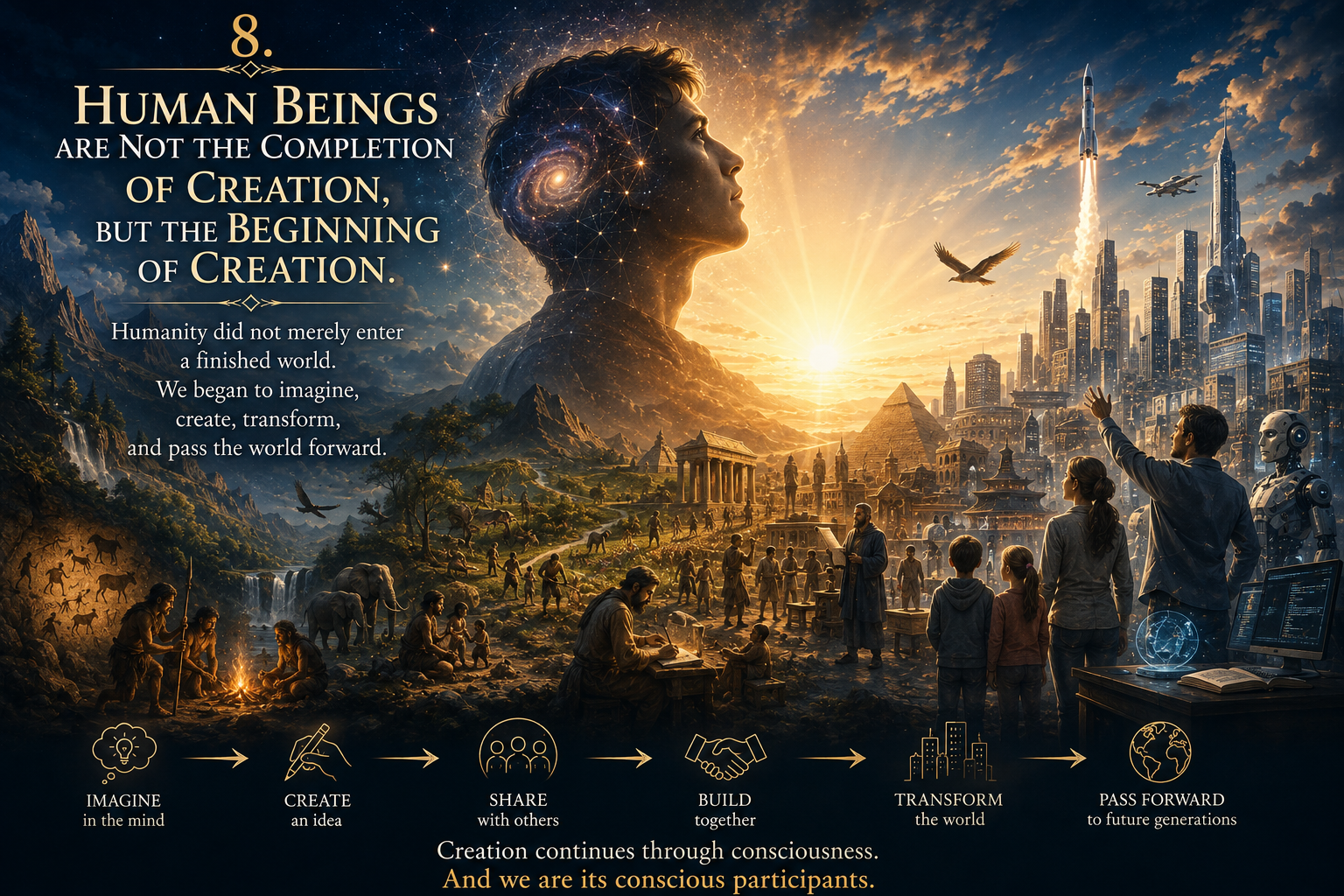
8. Human Beings Are Not the Completion of Creation, but the Beginning of Creation
So far, we have explored how consciousness creates the human world.
Dreams show us that consciousness can present an entire world within experience.
Waking reality presents something even more elaborate.
There is time.
There is space.
There is matter.
There are physical laws.
And within this ordered world, countless human beings live together.
But perhaps the appearance of human beings was not the completion of creation.
Perhaps it was the beginning of a new kind of creation.
Think about the Earth before human civilization emerged.
Mountains existed.
Oceans existed.
Rivers flowed.
Forests grew.
Stars illuminated the night sky.
But there were no cities.
No books.
No universities.
No philosophy.
No science.
No airplanes.
No computers.
No internet.
These things appeared through human beings.
Matter already existed, but human consciousness began to reorganize it.
Stone became architecture.
Metal became machines.
Sound became language.
Symbols became writing.
Experience became knowledge.
Knowledge became civilization.
And civilization became history.
In this sense, human beings did not merely enter a finished world.
They began to participate in its continuing transformation.
This is why the human being occupies such an important position within the framework of Consciousness Field Theory.
Human beings can imagine something that does not yet exist.
They can give that possibility a name.
They can communicate it to others.
They can cooperate.
And eventually, an idea that once existed only within consciousness can appear in the shared physical world.
A city is imagined before it is built.
A machine is conceived before it operates.
A book exists as thought before it becomes words on a page.
Even the future begins, in part, as a possibility within consciousness.
This means that creation does not belong only to some distant beginning of the universe.
Creation is still taking place.
Every generation inherits a world created by those who came before it.
And every generation changes that world before passing it on.
We inherit language.
We inherit knowledge.
We inherit culture.
We inherit technology.
But we do not merely preserve them.
We transform them.
We add something new.
And the next generation begins from the world we leave behind.
Seen this way, human history becomes an extraordinary chain of creation.
One consciousness produces an idea.
Another receives it.
Another develops it.
Another records it.
And centuries later, that idea may become part of the foundation upon which an entirely new civilization is built.
So perhaps the most important question is not simply,
“When was creation completed?”
Perhaps we should ask,
“What if creation was never completed?”
What if the universe provided the conditions,
life provided the participants,
and consciousness opened the possibility of continuing creation?
Within the framework proposed in this book, human beings are therefore not merely passive inhabitants of reality.
We are participants in an unfinished creative process.
And this gives new meaning to the idea of the co-creator introduced in the previous section.
We receive a world.
We experience it.
We interpret it.
And then we change it.
The world our descendants encounter will partly depend on what we create today.
So the emergence of humanity may not represent the final chapter of creation.
It may represent the moment when creation acquired countless new centers of experience, choice, imagination, and action.
Human beings are not the completion of creation.
They may be the beginning of creation becoming conscious of, and participating in, its own continuation.
Previous Chapter
Part VI | Where Does Creation Begin?
Chapter 2 | What Does Consciousness Do?
Before asking how consciousness creates the human world, we first explored a more fundamental question:
What does consciousness actually do?
Chapter 2 examines how consciousness relates to reality, time, space, and matter, and asks whether the world we experience can be understood apart from consciousness.
→ Read Chapter 2
[Chapter 2 WordPress Link]
Next Chapter
Part VI | Where Does Creation Begin?
Chapter 4 | Why Is Consciousness Field Theory a Unified Theory?
If consciousness is involved in the creation and experience of the human world, another question follows.
Philosophy investigates existence.
Science investigates nature and the universe.
Religion searches for ultimate origin and meaning.
Could these different paths be approaching different dimensions of the same reality?
Chapter 4 explores why Consciousness Field Theory proposes a framework connecting philosophy, science, and religion.
→ Continue to Chapter 4
[Chapter 4 WordPress Link]
🎬 Explore Chapter 3 in Video
▶ 2-Minute Introduction
Begin with the central question: How does consciousness create the human world?
[2-Minute Video Link]
▶ 10-Minute Exploration
Explore the journey from dreams and individual consciousness to language, shared reality, and civilization.
[10-Minute Video Link]
▶ 20-Minute Deep Exploration
Go deeper into Original Consciousness, individual consciousness, civilization, history, and humanity’s role as a co-creator.
[20-Minute Video Link]
🔙 Previous Chapter
Part VI, Chapter 2 | What Does Consciousness Do?
Before exploring how consciousness creates the human world, you may want to begin with the previous chapter:
What does consciousness actually do? How are reality, time, space, and matter experienced through consciousness?
📖 Read the Previous Chapter
Part VI, Chapter 2 | What Does Consciousness Do