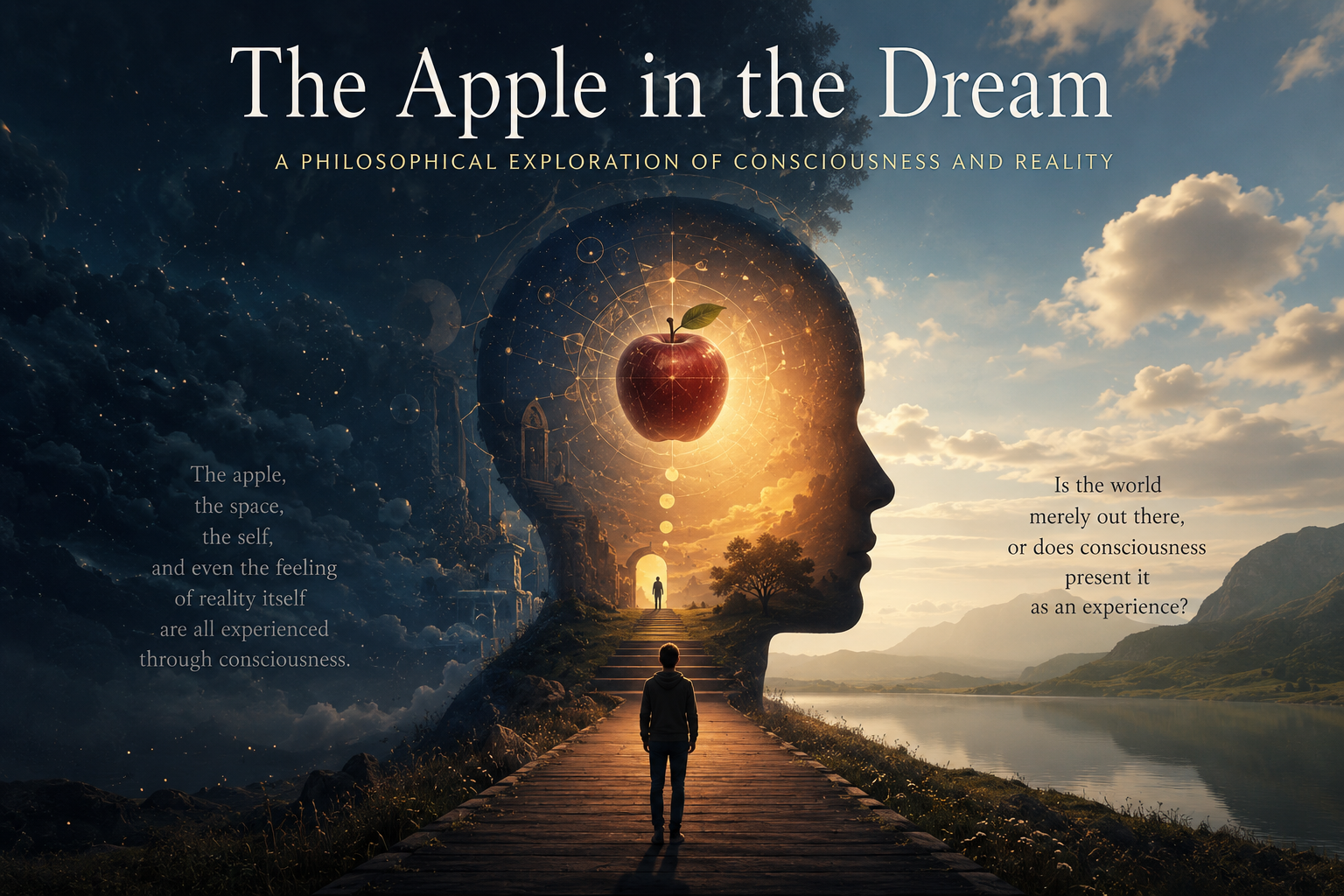
This chapter asks a fundamental question: Does Consciousness Create Reality?
Table of Contents
How Does Consciousness Create Reality?
1. The Red Apple in a Dream
Imagine that tonight you have a dream.
Before you lies a ripe, red apple.
Its crimson skin glistens in the sunlight.
As you pick it up, you feel its satisfying weight in your hand.
You take a bite, and sweet juice fills your mouth.
It has a fragrance.
It has a taste.
It has texture.
Nothing about it feels artificial.
You do not doubt for a single moment that the apple is real.
It is clearly lying before you, and you are holding it in your hand as you eat it.
At that moment, you have no idea that you are dreaming.
Then you wake up.
In an instant, everything changes.
The apple that had seemed so vivid disappears.
The hand that held it disappears.
The mouth that tasted it disappears.
Even the space in which the apple existed vanishes.
Yet one important question remains.
Where, exactly, was that apple?
We often answer too quickly,
“It was only a dream.”
But that is not really an answer.
The real question is this:
Where did that astonishingly vivid apple appear, and where did it disappear to?
This is not merely a question about dreams.
It is the starting point for understanding the world we now call reality.
2. Who Was the One Eating the Apple?
When we wake up, we say,
“The apple was just a dream.”
That is true.
The apple was part of a dream.
But there is something we often overlook.
Was only the apple a dream?
Who was the person who picked up the apple?
Whose mouth tasted its sweetness?
Who was the “I” who thought,
“This is delicious”?
We usually assume that only the apple was unreal.
But if we look more carefully, something remarkable becomes clear.
The apple was part of the dream.
The hand was part of the dream.
The mouth was part of the dream.
And the “I” who was eating the apple was also the dream self.
Within the dream,
I was the subject,
and the apple was the object.
I was here,
and the apple was over there.
There seemed to be distance between us,
and even space itself appeared to exist.
Yet the moment we awaken,
all of these distinctions collapse before a single fact.
The apple existed within consciousness.
The one eating the apple also existed within consciousness.
The subject and the object were not inhabitants of two separate worlds.
They were simply two different roles appearing within a single field of consciousness.
This insight is profoundly important.
Because the very same structure may also underlie what we call reality today.
3. How Is the Apple in Reality Experienced?
Now let us leave the dream behind and return to waking life.
Imagine that there is a red apple lying before you.
You say,
“This time, it is not a dream.”
“This is a real apple.”
But is it?
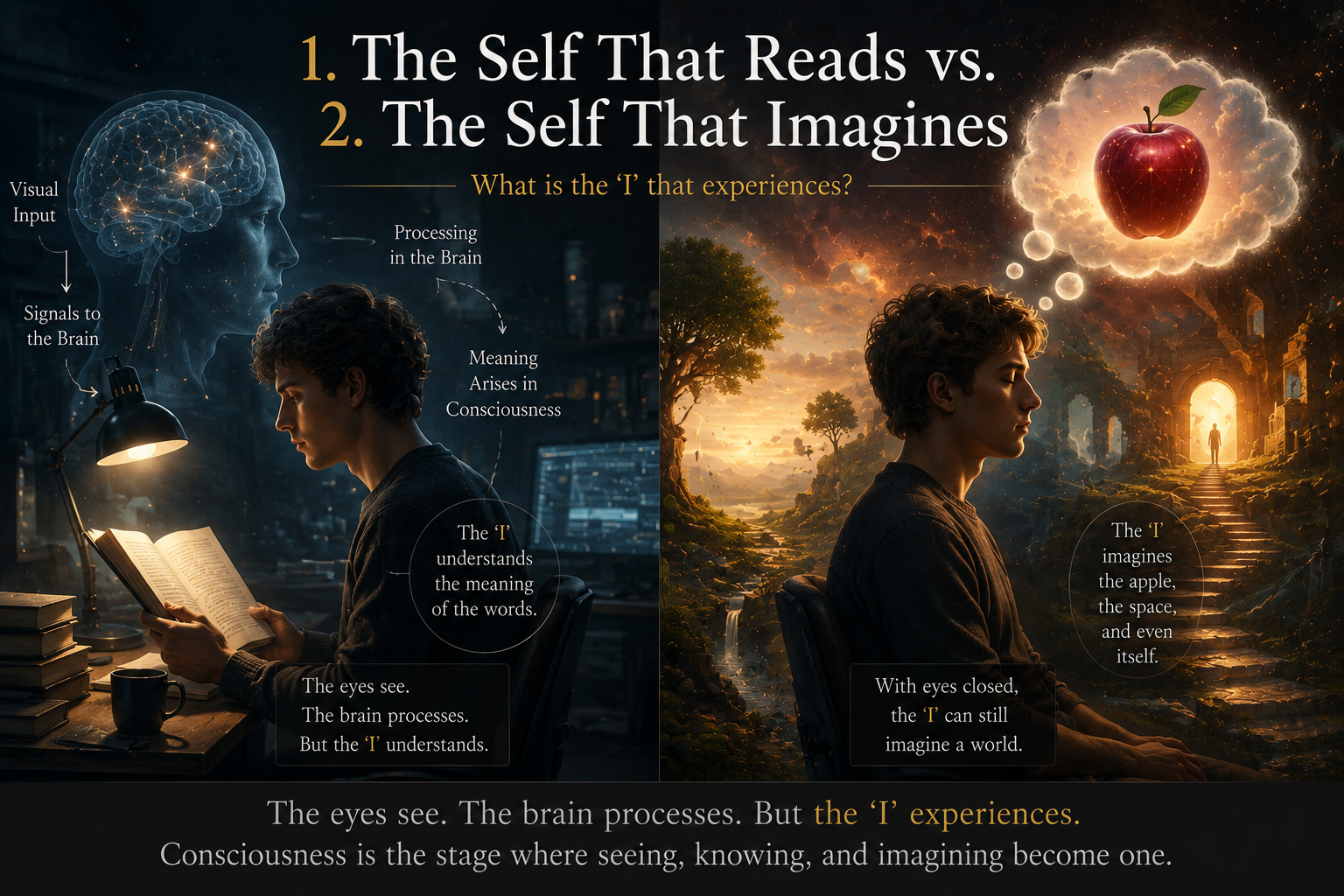
We believe that we are seeing the apple itself.
Yet if we look more carefully, we discover that the apple never enters consciousness directly.
First, light reflected from the apple enters the eyes.
The eyes convert that light into electrical signals.
Those signals travel through the optic nerve.
The brain then organizes them into the experience of an apple.
Its redness,
its round shape,
the texture of its surface,
and even the distance between you and the apple,
all emerge through this process as a single experience.
What we encounter directly is not the apple itself,
but the experience produced through the apple.
This raises another question.
Have we ever, even once, seen an apple without consciousness mediating the experience?
If we think carefully, the answer is no.
Every apple we have ever known
has always been perceived through our eyes,
processed by our nervous system,
and revealed within consciousness.
The apple in a dream
arose within consciousness.
The apple in waking life
appears within consciousness through the senses and the nervous system.
These two experiences are not identical.
Yet one thing is undeniable.
The world we actually experience is always a world experienced through consciousness.
And this naturally leads to another question.
Is what we call reality truly a world existing outside consciousness?
Or is it
a world that consciousness presents to us as reality?
4. The Human Mind Is a Mill That Grinds Reality
Imagine a traditional village mill.
Farmers bring in wheat.
They bring in barley.
They bring in soybeans.
The mill does not return these grains exactly as they were.
The wheat becomes flour.
The barley becomes flour.
The soybeans become flour as well.
Everything that passes through the mill is transformed according to the way the mill works.
When we look at the flour, we do not say that we are looking directly at the original grain.
We understand that it has already been processed by the mill.
The human mind works in much the same way.
The world does not enter consciousness exactly as it is.
First, light enters the eyes.
That light is converted into electrical signals.
The signals pass through the brain.
Finally, within consciousness,
they become colors,
they become shapes,
they become distance and space,
and together they appear as a single apple.
The world we experience
is a world that has already passed through the mill of the human mind.
Perhaps, throughout our lives,
we have been experiencing only the flour,
while believing that we were seeing the original grain itself.
This is important because the same is true of everything else.
The mountains.
The oceans.
The stars.
Other people.
Everything we experience
appears within consciousness only after passing through the mill of human perception.
This leaves us with another question.
Are we seeing only the product that has passed through the mill?
Or are we truly seeing the world as it exists beyond the mill?
This is one of the oldest questions in philosophy,
and it is the point from which the next stage of our inquiry begins.
5. How Are the Subject and the Object Separated?
From the moment we are born, we naturally believe the following:
I am here.
The world is over there.
I am the one who sees,
and the apple is the thing being seen.
We make this distinction between “I” and “the world” so effortlessly that we rarely stop to question it.
But let us return to the dream.
In the dream, I was here.
The apple was over there.
I walked toward it.
I reached out and picked it up.
I ate it.
Even then,
the subject and the object seemed clearly separated.
Yet the moment we woke up,
we realized something remarkable.
They had never belonged to two separate worlds.
A single consciousness
had created the position called “I”
and the position called “the apple.”
In other words,
the subject and the object
were not originally separate realities existing outside consciousness.
They were simply two different roles
appearing within a single field of consciousness.
What about waking reality?
Even now,
I call myself the subject,
and I call the apple before me the object.
Yet what I actually experience
is always the “I” that appears through consciousness
and the “apple” that appears through consciousness.
Not once have I ever experienced
a self apart from consciousness,
or an object apart from consciousness.
What we know with certainty is only this:
The subject is an experience.
The object is also an experience.
This leaves us with one final question.
Is it truly the world itself that separates the subject from the object?
Or is consciousness itself what organizes our experience into subject and object?
6. Where Do Space and Distance Come From?
Imagine that there is an apple lying in front of you.
You say,
“The apple is about one meter away from me.”
It sounds perfectly obvious.
But pause for a moment.
Are you really seeing one meter?
What actually enters your eyes is light.
Your retina converts that light into electrical signals.
Those signals are processed by the brain and become a single experience.
Within that experience
are the apple’s red color,
its round shape,
and even the distance between you and the apple.
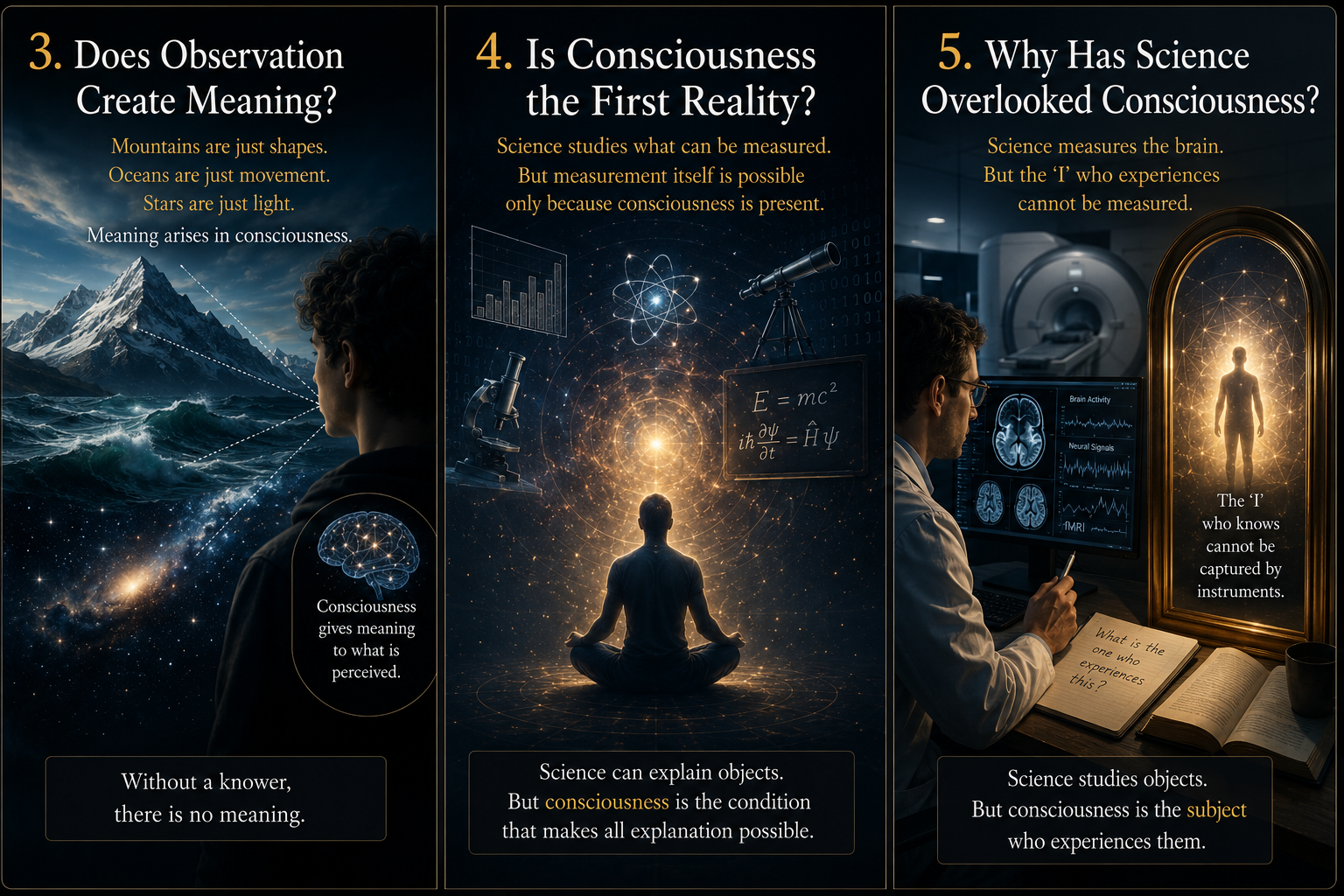
We usually think that only the apple is experienced through consciousness.
But that is not the whole story.
Distance, too, is experienced through consciousness.
Space is experienced through consciousness.
Nearness,
farness,
up and down,
front and back,
all appear as an ordered structure within consciousness.
The same was true in the dream.
The apple was far away,
and I walked toward it.
There were stairs.
There was a room.
There was even a vast open field.
Yet when I woke up,
I realized that this enormous space
had never existed “out there.”
It had been a space experienced within a single consciousness.
What, then, about waking reality?
We cannot simply conclude that physical space is identical to dream space.
But at least one thing is certain.
The space we directly experience is always space as it is experienced through consciousness.
We have never experienced space apart from consciousness.
Nor have we ever perceived distance without consciousness.
In the end, this is what we can say with confidence.
The world we live in
is not merely a place where objects appear.
Consciousness
reveals objects,
distinguishes the subject from the object,
and even organizes the distance and space between them,
allowing us to experience a coherent reality.
Perhaps this is precisely why reality feels so real.
7. Why Does Reality Feel More Real Than a Dream?
Many people say,
“Dreams are unreal, but reality is real.”
But is that really true?
While we are dreaming,
we never think,
“This is only a dream.”
If we fall from a great height in a dream,
our heart races.
If something tragic happens,
we may even cry.
If we eat delicious food,
we can taste it.
At that moment,
the dream can feel even more real than reality itself.
Yet the instant we wake up,
we say,
“It was only a dream.”
So why does waking reality seem different?
We usually assume that reality feels real because it truly is real.
But there is another possibility.
Could it be that reality feels real because consciousness is structured to experience it that way?
Consider what happens when we watch a movie.
We laugh with the characters.
We cry with them.
We feel their fear and their excitement.
When we play a video game,
we experience a virtual world as though it were real.
When we put on a virtual reality headset,
our body may tremble at the edge of a virtual cliff,
even though we know we are standing safely on a flat floor.
Whenever consciousness encounters an experience that is sufficiently convincing,
our body responds as if it were real.
This raises an important question.
Is the feeling of reality
a property that belongs to the world itself?
Or is it
a function that consciousness bestows upon experience?
In dreams,
consciousness makes the dream feel real.
In waking life,
consciousness makes reality feel real.
The difference may lie in the continuity of the experience,
its consistency,
and the fact that it is shared by many people.
But one thing remains certain.
We experience reality as real.
And even that feeling of reality
is itself experienced through consciousness.
This brings us back to our original question.
Is reality inherently real?
Or is it consciousness that makes us experience it as reality?
8. Have We Ever Seen Reality Itself?
We have lived our entire lives within what we call reality.
For that reason,
we have rarely questioned it.
We believe that what we see with our eyes is reality,
that what we touch with our hands is reality,
and that the ground beneath our feet is reality.
But let us recall what we have discovered so far.
The apple in the dream
appeared completely real.
The self within the dream
acted as though it were real.
The space within the dream
felt just as vast and convincing as the space of waking life.
Only after awakening
did we realize that the entire world had been experienced within a single consciousness.
The same is true of waking life.
We do not perceive the apple directly.
We perceive light.
That light passes through the nervous system
and appears within consciousness as an apple.
Distance,
space,
the subject,
the object,
and even the feeling of reality itself
are all experienced through consciousness.
This leaves us with one final question.
Have we ever, even once, experienced reality itself apart from consciousness?
Pause for a moment and consider.
Every landscape you have ever seen.
Every person you have ever met.
Every star.
Every sky.
Every ocean.
All of them have been experienced through consciousness.
We cannot live outside reality.
Yet neither have we ever experienced reality apart from consciousness.
This does not mean that reality does not exist.
Rather, it means that the only reality we can know with certainty
is reality as it is revealed through consciousness.
This has been one of philosophy’s oldest questions.
It is the issue that Kant described as the problem of phenomena,
and it remains one of the central questions explored by modern neuroscience.
From here, another, even deeper question naturally arises.
If this is so, how does consciousness bring forth the vast reality we experience?
That question
marks the beginning of the next chapter.
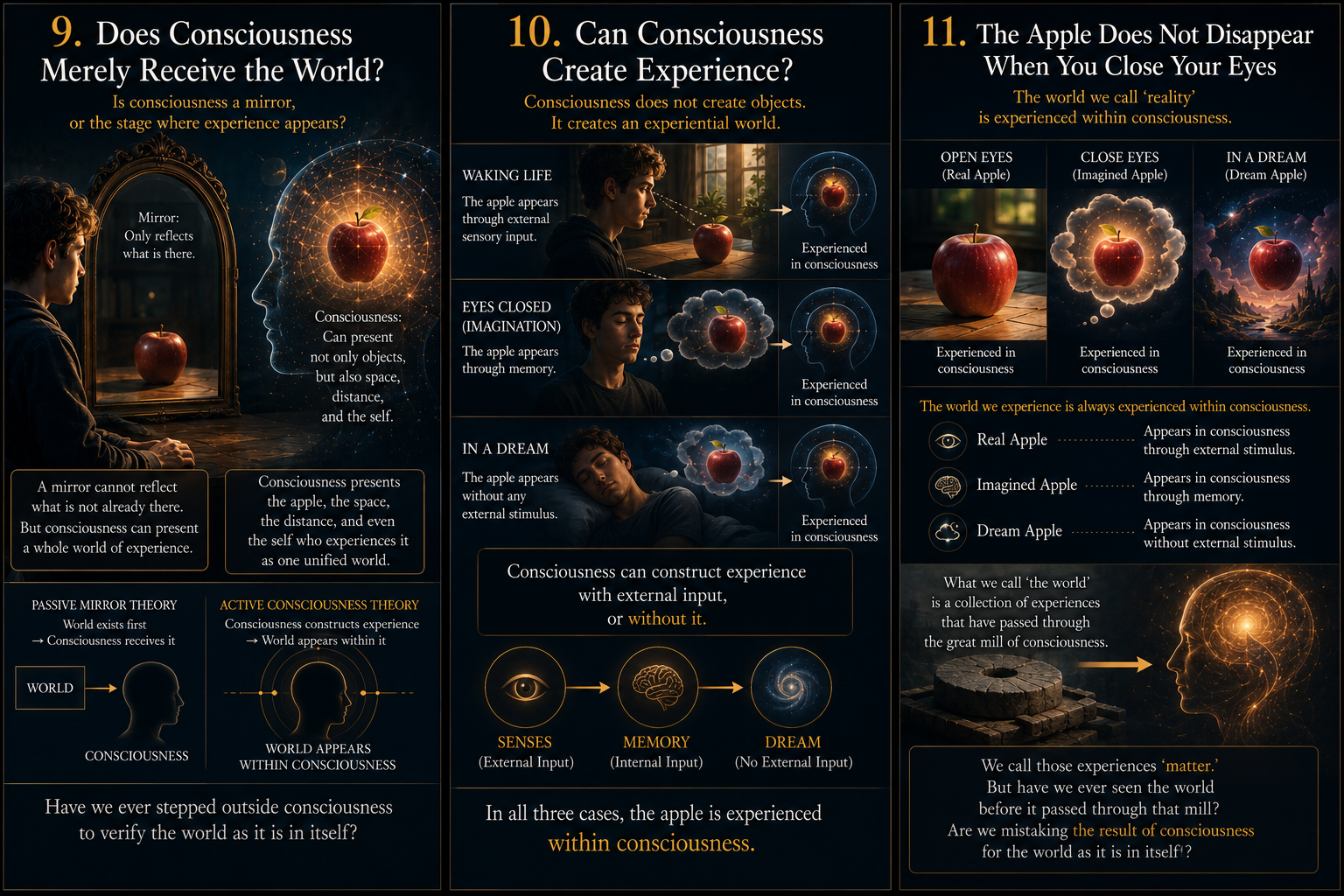
9. Does Consciousness Merely Receive the World?
We usually think of the world like this.
The world exists out there,
and I simply look at it.
The apple sits on the table,
and I see it with my eyes.
Birds fly across the sky,
and I watch them.
When it rains,
I hear the sound of the falling drops.
When the wind blows,
I feel it against my skin.
For this reason,
we have often imagined consciousness as nothing more than a window through which the outside world is perceived.
According to this view,
the world exists first,
and consciousness comes afterward,
merely observing a reality that is already complete.
If this is true,
consciousness is entirely passive.
When something enters from the outside,
we experience it.
When nothing enters,
nothing should appear in consciousness.
It would be much like a mirror.
If an apple stands before the mirror,
the mirror reflects the apple.
Remove the apple,
and its reflection disappears.
A mirror cannot create an apple on its own.
It can only reflect what is already there.
But is human consciousness really like a mirror?
Is there already a fully formed world outside us,
with consciousness doing nothing more than receiving it?
Earlier, we considered the apple in a dream.
There was no physical apple in the ordinary sense.
Yet the apple appeared.
We saw it.
We held it in our hands.
Sometimes we even ate it.
While we were dreaming,
the apple was not merely an idea.
It existed as an object,
standing at a certain distance from us,
with its own color,
shape,
and taste.
Nor was the apple the only thing that appeared.
The self who saw the apple appeared as well.
The space between the self and the apple appeared.
Even the sense of distance, that the apple lay before us, appeared at the same time.
The subject and the object,
the inner and the outer,
the near and the far,
all came into being together within a single scene.
Yet the moment we awakened,
that entire world disappeared.
The apple disappeared.
The space surrounding it disappeared.
Even the dream self who had been observing it vanished.
What remained
was the consciousness that had experienced the whole world.
This challenges the idea that consciousness is merely a passive mirror reflecting an external reality.
A mirror cannot reflect what is not already before it.
Yet consciousness was able to present
not only the apple,
but also the surrounding space,
the distance,
and even the self who perceived it,
as one coherent world of experience.
If this is true,
perhaps we should ask the same question about the waking world.
Until now,
we have assumed that the external world exists first,
and that consciousness simply receives it.
But what we have actually experienced
has always been colors,
sounds,
textures,
forms,
space,
and distance,
all appearing within consciousness.
Never have we stepped outside consciousness
to verify the world as it exists in itself.
And yet,
we continue to believe
that a fully formed world exists independently outside consciousness.
Is that belief something we know with certainty,
or is it itself part of the way consciousness presents reality to us?
10. Can Consciousness Create Experience?
In the previous section,
we questioned a familiar assumption.
The world is already complete “out there,”
and consciousness merely receives it.
Dreams challenged that belief.
Even though there was no external apple,
an apple appeared within consciousness.
And it was not only the apple that appeared.
The self looking at the apple,
the space in which the apple rested,
and even the distance between the self and the apple
all appeared together.
If so,
perhaps consciousness is not merely a mirror
reflecting a world that already exists.
Perhaps consciousness possesses the capacity
to construct an experience on its own.
At this point,
however,
we must be clear about what we mean by create.
This does not mean that consciousness literally produces
a material apple in the palm of your hand.
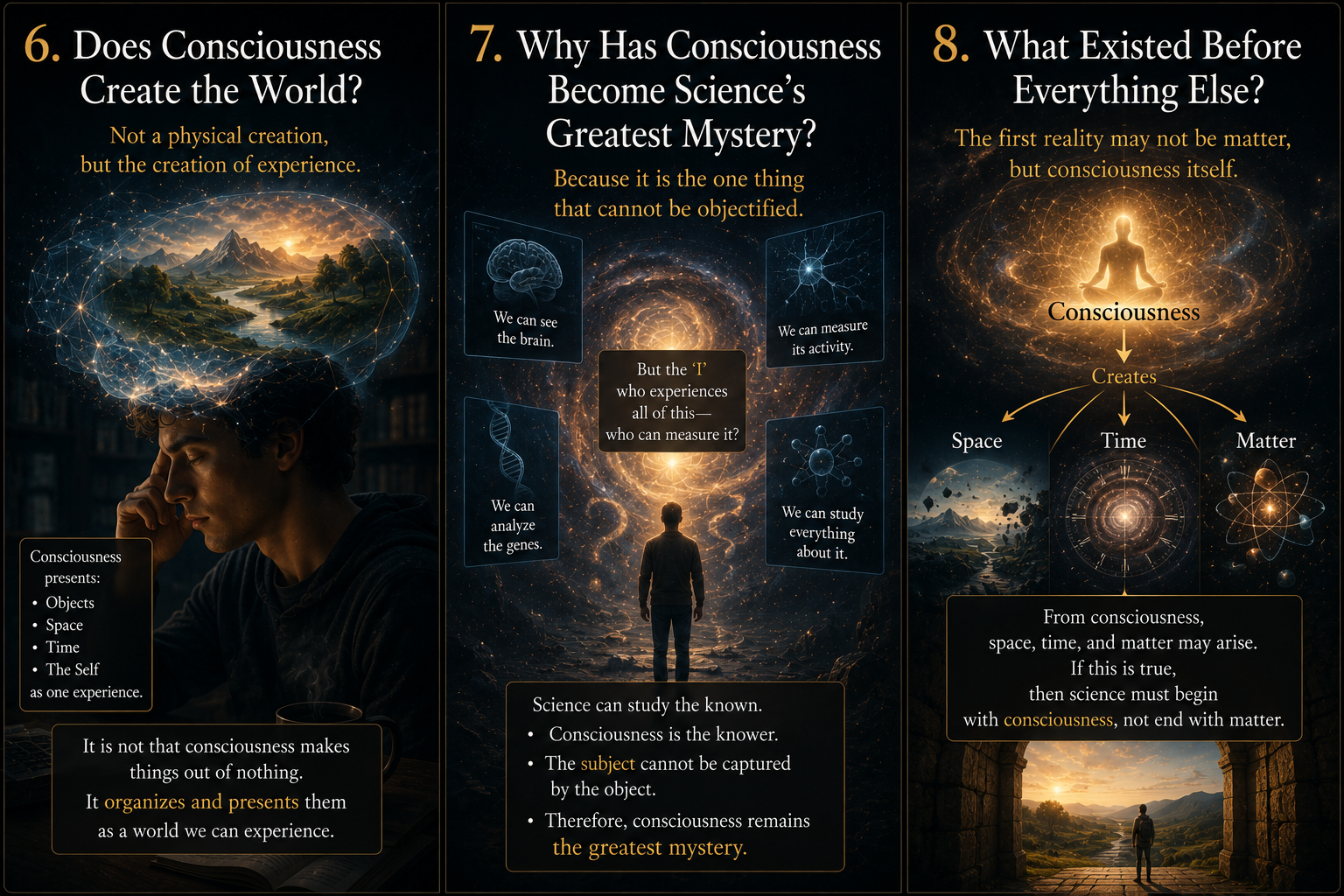
What consciousness creates
is not the physical object itself,
but the experiential world
in which an apple is seen, touched, and tasted.
Think again of the apple in a dream.
While dreaming,
we feel that we are truly seeing the apple.
We experience it as something standing before us,
believing that we could reach out and touch it.
If we bite into it,
we may even taste its sweetness or its tartness.
At that moment,
the dream self never imagines
that the apple is an experience created by consciousness.
Instead,
it simply believes
that it is looking at an apple existing outside itself.
This point is crucial.
Consciousness can create an experience while concealing the fact that the experience is arising within itself.
The dream world
appears within consciousness,
yet the dream self mistakes it
for an external world.
The apple seems to exist outside me,
and I experience myself
as the one looking at it.
Only after awakening
do I realize the truth.
The apple,
the surrounding space,
and even the self who was observing the apple
were all contained within a single conscious experience.
What, then,
about waking reality?
Here, too,
we feel that the apple exists outside us.
I am here.
The apple is over there.
A certain distance separates us.
The structure is remarkably similar to that of a dream.
In waking life as well,
the subject and the object are divided,
the inner and the outer are distinguished,
and things are arranged within space.
Of course,
waking experience is far more stable than a dream.
When we return to the same place,
we usually encounter the same objects.
We also share many experiences with other people.
Yet the greater stability of waking reality
does not prove
that the experienced world exists exactly as it appears outside consciousness.
Stability and repeatability
may characterize waking experience,
but they are not, by themselves,
direct evidence
that the world exists independently of consciousness.
Even in dreams,
while the dream lasts,
we believe the dream world is real.
Within it,
objects,
spaces,
and events
follow their own order
and their own patterns of cause and effect.
Only after that order collapses
do we recognize
that it was a dream.
This leads to another question.
On what basis
do we judge that something is reality?
Because it lasts a long time?
Because many people experience it in similar ways?
Because it behaves according to consistent rules?
These may indeed be important criteria
for distinguishing waking reality from dreams.
But they do not, by themselves,
justify the conclusion
that reality exists independently outside consciousness.
Suppose many people watch the same movie.
That does not mean
the world within the film
exists as an independent place beyond the screen.
Or imagine many people entering the same online world.
Its mountains,
rivers,
and buildings
do not thereby become part of the physical world outside the computer.
Being shared
and
existing independently of consciousness
are not the same thing.
Perhaps, then,
reality is better understood
as a shared structure of experience.
Not because each individual consciousness
creates its own private world at will,
but because many conscious beings
may participate
in a larger and common order,
through which they experience a similar world.
This is not yet a conclusion.
But dreams
at least open the door
to considering such a possibility.
In a dream,
consciousness presents
objects,
space,
and the self
as one unified experience.
If so,
perhaps in waking life as well,
consciousness is not merely copying
something that arrives from outside,
but organizing it
into a world that human beings can experience.
Color is an experience.
Sound is an experience.
Distance is an experience.
Even the feeling
that an object exists before us
is an experience arising within consciousness.
What we call the world
is a vast scene
woven together
from these interconnected experiences.
And that scene
always appears within consciousness.
If this is true,
consciousness is not merely the spectator of experience.
It may be the very stage
upon which experience unfolds,
the place where
objects,
space,
and time
are woven together
into a single world.
Yet one final question remains.
Even now,
while we are fully awake,
can consciousness present an object
without any external thing being there?
This question
does not have to remain a matter of speculation.
You can test it for yourself,
right now.
Imagine a single red apple
before your eyes.
Then,
slowly,
close your eyes.
From this point on,
there is no need to rely on the words of a philosopher.
Instead,
look directly into your own consciousness.
Ten seconds will be enough.
When you close your eyes, does the apple truly disappear?
11. The Apple Does Not Disappear When You Close Your Eyes
When we open our eyes,
we can see the apple.
This is such an ordinary experience
that we rarely give it a second thought.
Now,
close your eyes.
Picture the same red apple
you were just looking at.
Something remarkable happens.
The apple
still appears within consciousness.
It may not be as vivid
as the actual apple before your eyes.
Yet one fact remains unmistakable.
Even though your eyes are closed, the apple has not disappeared.
This raises an important question.
With your eyes closed,
where is the light
that illuminates the apple?
No image of the apple
is reaching your retina any longer.
The external apple
is no longer visible.
And yet,
you can still imagine its red color,
its round shape,
and see it once again
within your mind.
Dreams are even more remarkable.
Your eyes are closed.
There is no external apple.
No light.
No image projected onto the retina.
Yet you still see the apple.
You can hold it.
You can bite into it.
You can even taste it.
Consider these three experiences together.
The apple you see in waking life.
The apple you imagine with your eyes closed.
The apple you encounter in a dream.
Each begins in a different way.
Yet all three
share one fundamental characteristic.
In every case, the apple is ultimately experienced within consciousness.
The apple of waking life
appears in consciousness
through external sensory input.
The imagined apple
appears in consciousness
through memory.
The dream apple
appears in consciousness
without any external stimulus at all.
When we place these three experiences side by side,
an important insight begins to emerge.
Consciousness is not merely a vessel
that receives the external world.
It can construct experience
with the aid of external input,
and it can also construct experience
without it.
This may be
not only the key
to understanding reality,
but also
the most fundamental condition
that makes reality itself experienceable.
In the end,
what we call the world
may simply be
the collection of experiences
that have passed through
the vast mill of human consciousness.
We call those experiences
matter.
Yet not once
have we ever seen
the world before it passed through that mill.
If so,
might it be
that what we call matter
is actually the product of consciousness,
mistaken for the world as it is in itself?
If consciousness gives form, meaning, and experience to the world, we must ask again: Does Consciousness Create Reality?
Previous Chapter and Next Chapter Preview
In Part 5, Chapter 2, we explored the previous stage of consciousness and reality. This chapter asks a deeper question: Does Consciousness Create Reality?
In Part 5, Chapter 4, we will continue by exploring the next question in the relationship between consciousness and the world.
For a broader philosophical overview, see the Stanford Encyclopedia of Philosophy’s entry on consciousness.
🎬 2-Minute Version
Understand the core idea in just 2 minutes.
A clear and concise introduction to the essential question of consciousness and reality.
🎬 10-Minute Version
Explore the core concepts in about 10 minutes.
Using the example of the dream apple, this video examines how consciousness shapes our experience of reality.
🎬 20-Minute Version
The complete version with the full philosophical journey.
Beginning with the apple in a dream, this video explores reality, space, distance, memory, imagination, and how consciousness may construct the world we experience.