
1. Humanity Has Overlooked the Closest Act of Creation
Tonight, before you fall asleep, you will perform the greatest act of creation you have ever witnessed.
Yet tomorrow morning, you will simply call it “a dream.”
We have built giant telescopes to observe galaxies billions of light years away, launched spacecraft into deep space, and invested vast resources in understanding the Big Bang. Science has always searched for the beginning of creation in the farthest reaches of the cosmos.
Yet the greatest act of creation has been taking place much closer to us.
In fact, it happens every single night.
Tonight, as you fall asleep, you will create an entire universe.
Without using any physical materials, mountains, oceans, cities, countless people, and even another version of yourself will come into existence.
Every morning, however, we dismiss this astonishing event with a single sentence.
“It was only a dream.”
But what if dreams are not merely illusions?
What if they reveal the very principle by which reality itself comes into existence?
2. Every Night, You Create Another Universe
The moment you begin to dream, another world appears.
Within that world, there is another “you.”
That person has a body, a name, memories, emotions, and relationships. You meet people, walk through unfamiliar cities, climb mountains, feel the wind against your face, and believe without question that everything around you is real.
Yet your physical body has never left the bed.
Your eyes remain closed.
No external light enters your brain.
No physical objects surround you.
Nevertheless, an entire universe unfolds with remarkable clarity.
Who created that world?
It was not your sleeping body.
The dream suggests the existence of a deeper level of consciousness capable of creating both the observer and the world being observed at the same time.
The subject and the object arise together from a single source.
3. Dreams Reveal the Principle of Creation
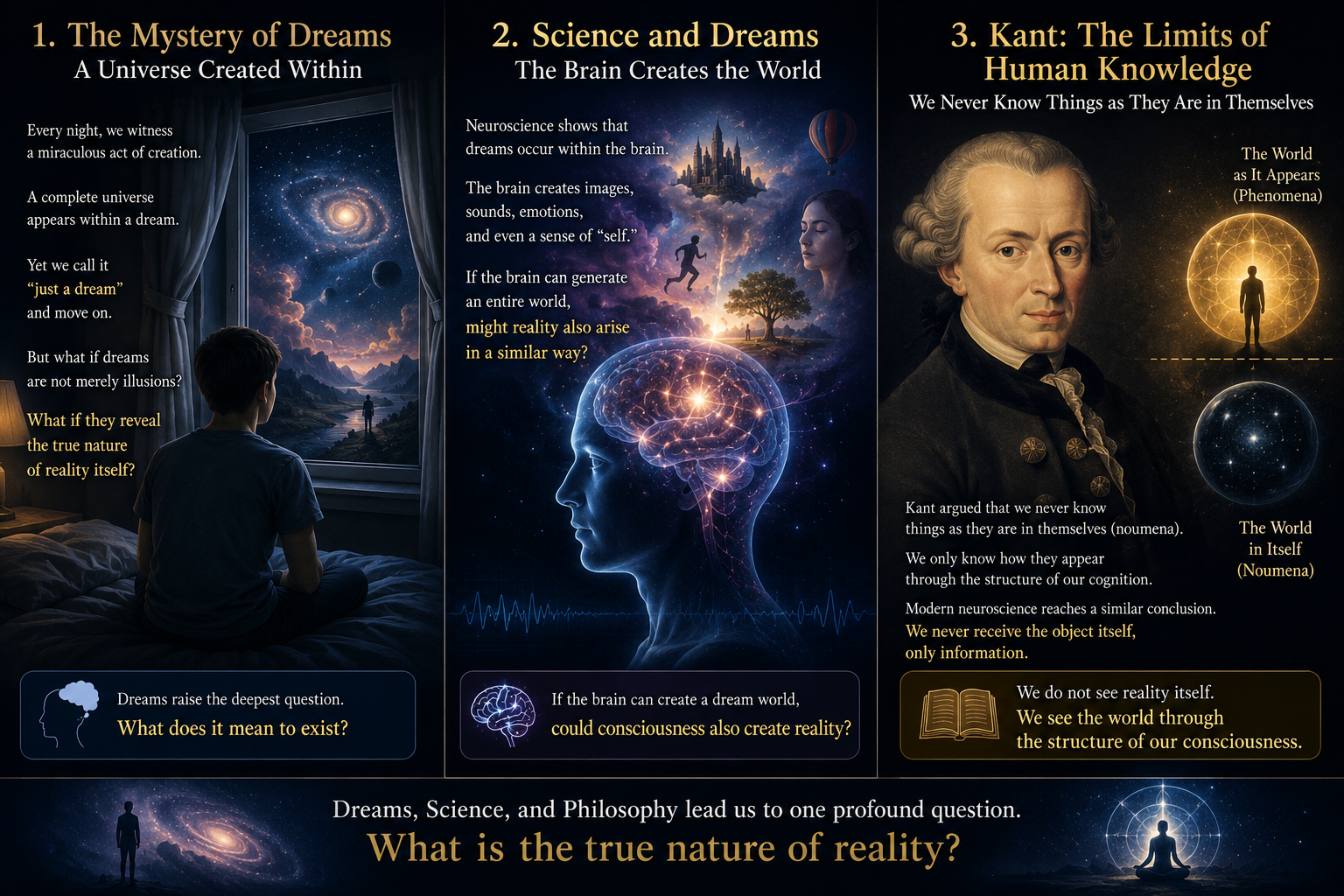
Modern neuroscience tells us that we never perceive the external world directly.
Objects themselves do not enter the brain.
Light reflected from those objects reaches the retina, where it is converted into electrical signals. The brain then reconstructs those signals into what we experience as reality.
Strictly speaking, we never encounter the external object itself.
We experience only the world reconstructed within consciousness.
Dreams reveal something even more extraordinary.
During a dream, there is no external light, no physical objects, and no sensory input from the outside world.
Yet mountains still rise before us.
People continue to speak.
Cities stretch into the distance.
An entire universe appears with astonishing realism.
Even now, while fully awake, you can close your eyes and imagine a red apple.
The apple does not exist outside you.
Yet it immediately appears within your awareness.
If consciousness can manifest a complete world without external matter in dreams, and can instantly bring images into awareness through imagination, then perhaps the true meeting place of the subject and the object is not outside us at all.
Perhaps both exist within consciousness itself.
That possibility marks the beginning of what this book calls the Third Copernican Revolution.
4. Where Do the Subject and the Object Meet?
Here we encounter one of philosophy’s oldest questions.
If the external object never enters the mind directly, where do the subject and the object actually meet?
Immanuel Kant argued that human beings can never know the thing-in-itself.
What we experience is not reality as it exists independently, but reality as it appears through the structure of our own cognition.
Modern neuroscience reaches a remarkably similar conclusion.
The brain never receives the object itself.
It receives only information, processes it, and reconstructs the world we perceive.
If that is true, then our direct encounter is never with the external object.
It is always with the reality that appears within consciousness.
This raises an even deeper question.
Where, then, does the object truly exist?
5. Hegel’s Answer: The Unity of Subject and Object
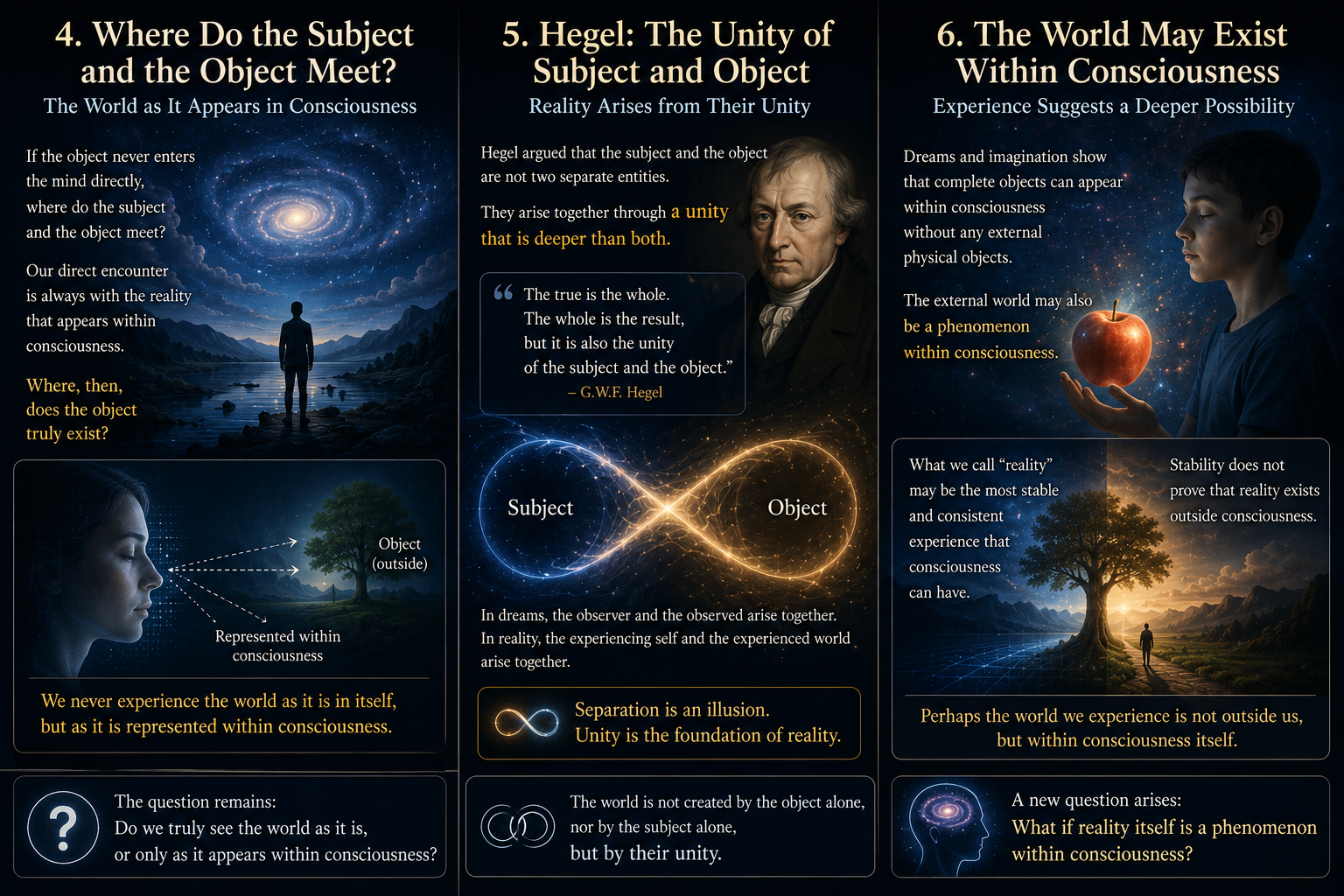
Georg Wilhelm Friedrich Hegel offered a radically different perspective.
He did not regard the subject and the object as two completely separate realities.
Instead, he argued that they ultimately belong to a single unified whole.
Dreams provide a striking illustration of this idea.
Within a dream, both the observer and the observed arise together.
The mountain, the ocean, the people, and even your own body appear to exist outside you.
Yet when you awaken, you realize that every one of them originated from the same consciousness.
The subject and the object were never truly separate.
They appeared separate only within the experience itself.
Dreams suggest that the apparent distinction between “self” and “world” may be part of the way consciousness presents reality, rather than proof that they exist independently.
6. The World May Exist Within Consciousness
Dreams reveal that consciousness can create an entire universe without any external matter.
Even imagination demonstrates the same principle.
Close your eyes for a moment and picture an apple.
No physical apple stands before you.
No light enters your eyes.
Yet the image appears immediately within your awareness.
This simple experience reveals something profound.
The appearance of an object does not always require the existence of an external object.
If both dreams and imagination can manifest complete objects entirely within consciousness, then the possibility emerges that what we call the external world may also appear within consciousness.
This does not deny the reality of the world.
Rather, it invites us to reconsider where reality is experienced.
Perhaps the true meeting place of the subject and the object has always been consciousness itself.
This possibility forms the philosophical foundation of the Third Copernican Revolution.
7. The Difference Between Dreams and Reality
At first glance, dreams and waking life appear to be completely different.
One feels imaginary.
The other feels undeniably real.
Yet there may be only one fundamental difference between them.
It is not the vividness of the experience.
Nor is it the presence of physical matter.
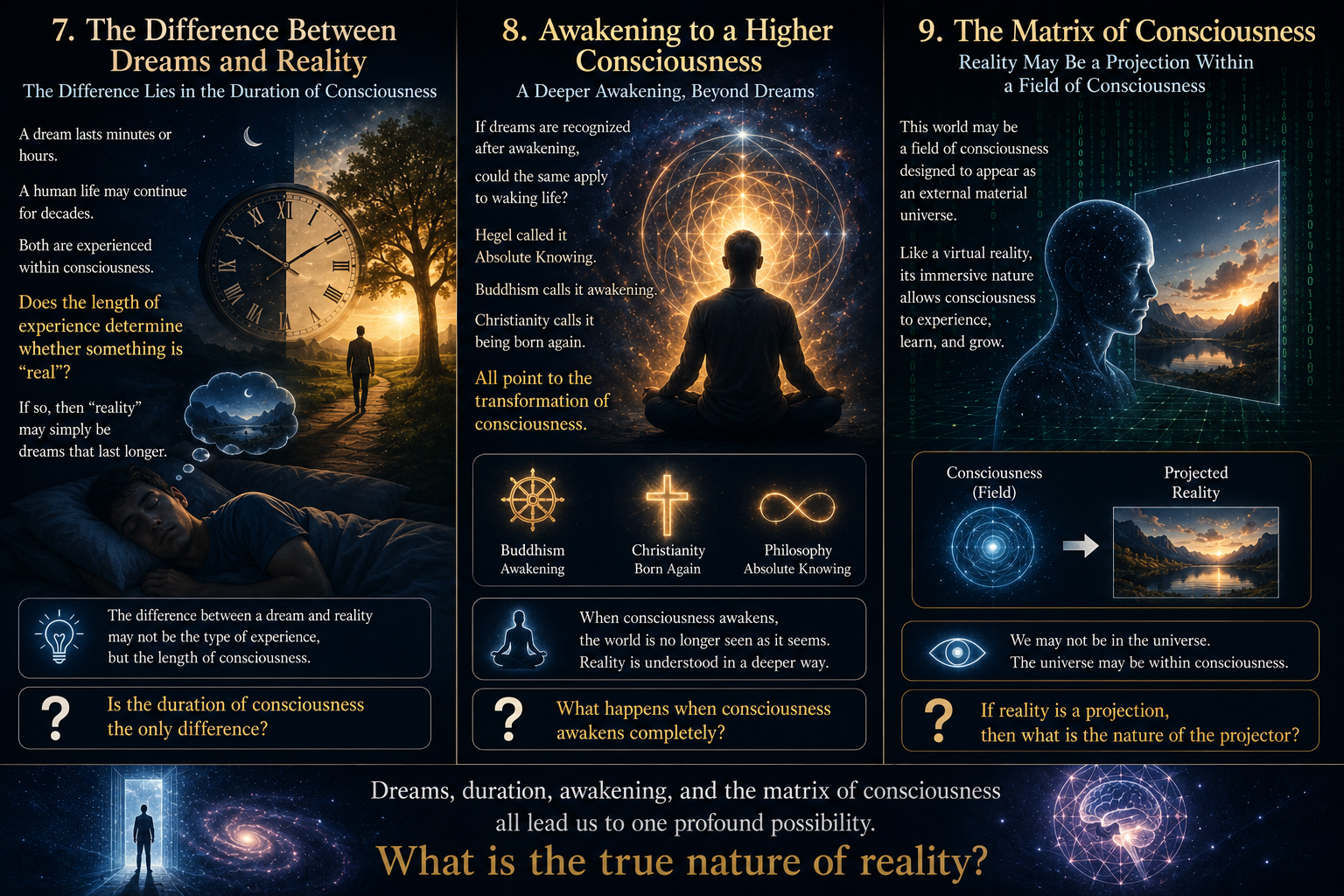
The difference lies in the duration of consciousness.
A dream may last only a few minutes or hours.
A human life, by contrast, may continue for nearly a century.
Both are worlds experienced within consciousness.
The only distinction is how long that conscious experience endures.
We recognize a dream as a dream because we awaken into a longer and more stable state of consciousness.
But while living within this reality, we have no higher waking state from which to view it.
For that reason, reality appears absolute.
8. Awakening to a Higher Consciousness
If dreams are recognized only after awakening, could the same principle apply to waking life?
Is it possible that what we call reality is itself a temporary stage of consciousness?
According to Hegel, the highest stage of human understanding is Absolute Knowing.
It is the moment when the apparent division between the subject and the object disappears, and reality is understood as a unified whole.
Many religious traditions describe a remarkably similar transformation.
Buddhism speaks of awakening.
Christianity speaks of being born again through the Spirit.
Although their language differs, both point toward the awakening of consciousness rather than a change in the external world.
When consciousness itself is transformed, reality is seen from an entirely new perspective.
Perhaps awakening is not escaping this world.
Perhaps it is seeing this world as it truly is.
9. The Matrix of Consciousness
Why, then, does this world feel so solid and convincing?
Why does matter appear completely separate from ourselves?
Perhaps reality has been designed in precisely this way.
Imagine entering a virtual world so immersive that you forget you are inside it.
Only then can every choice, every challenge, and every relationship be experienced as completely real.
The film The Matrix illustrates this idea through the choice between the blue pill and the red pill.
The purpose of the red pill is not to reject the world.
It is to awaken to a deeper level of reality.
Likewise, this world may be understood as a field of consciousness structured to appear as an external material universe.
Its apparent solidity is not necessarily proof that consciousness is secondary.
It may instead be the very condition that allows consciousness to experience, learn, and grow.
If so, reality is not the opposite of consciousness.
It is one of the ways consciousness reveals itself.
10. Consciousness Grows Through Experience
If reality exists as a field in which consciousness unfolds, then one question naturally follows.
Why does consciousness create such a world?
Why would it generate a reality filled with joy and sorrow, success and failure, love and loss?
The answer may be surprisingly simple.
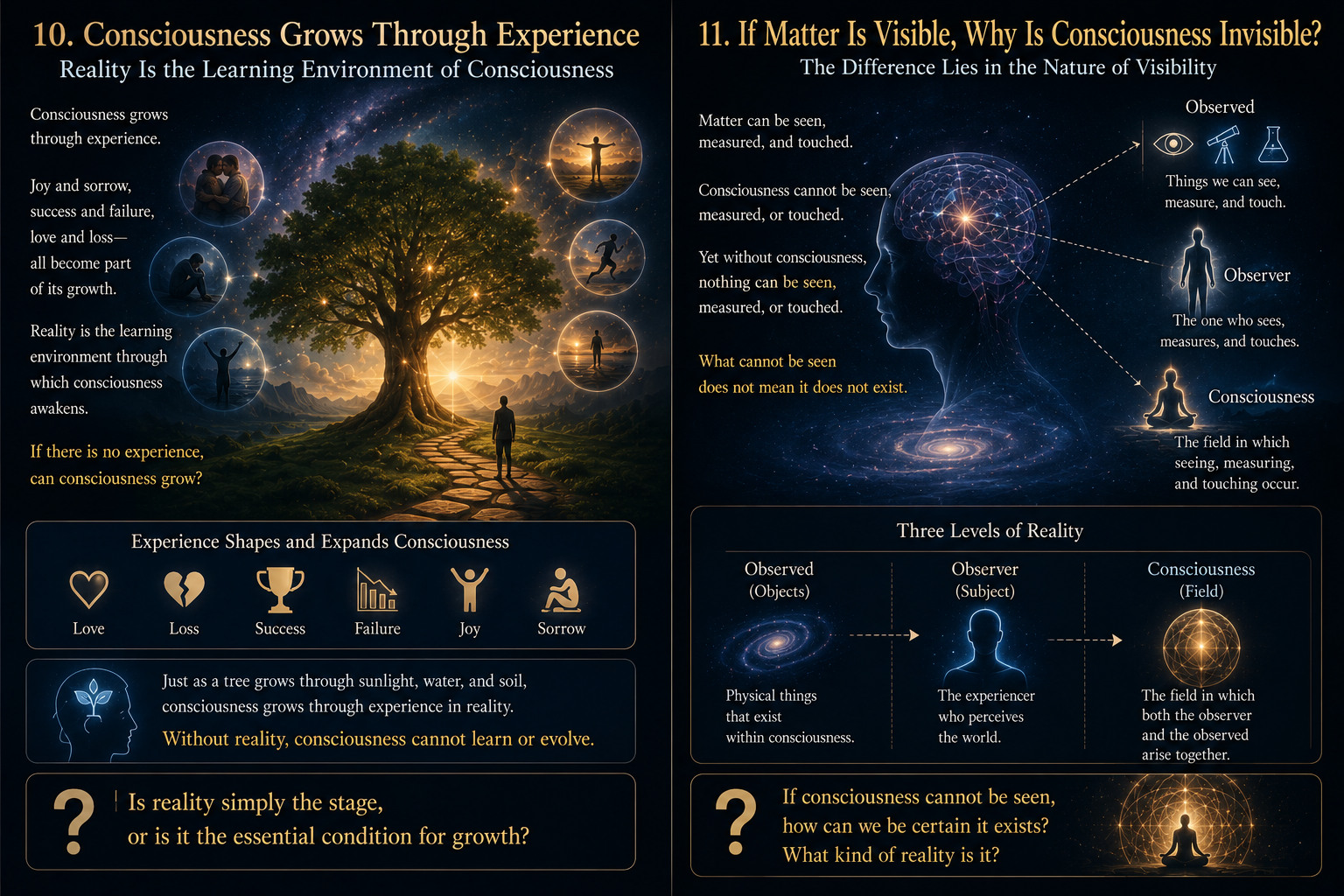
Consciousness grows.
A newborn computer possesses only its basic operating system.
Its true potential unfolds only after connecting to a vast network, processing information, and learning through countless interactions.
Human consciousness appears to develop in a similar way.
Each encounter, every challenge, every disappointment, and every act of love becomes part of its growth.
Without resistance, there can be no learning.
Without experience, there can be no transformation.
Reality may therefore be understood as more than a physical universe.
It may be the learning environment through which consciousness gradually awakens to its own nature.
11. The Highest Stage of Consciousness
If consciousness continues to grow, then it must also have a destination.
Philosophy has called this destination Absolute Knowing.
Buddhism describes it as the awakening of the Buddha.
Christianity speaks of being born again through the Holy Spirit.
Although these traditions use different languages, they point toward the same transformation.
They describe a state in which consciousness no longer experiences itself as separate from reality.
From this perspective, the world is no longer perceived as something external.
It is recognized as an expression of consciousness itself.
Perhaps this is why the great spiritual traditions have never placed their ultimate hope in changing the world.
Instead, they have sought the awakening of the one who experiences it.
Conclusion | The Third Copernican Revolution
For centuries, humanity has searched for the origin of the universe in distant galaxies, particles, and physical matter.
Yet every night, we quietly witness another act of creation.
A complete universe appears within a dream.
No external light.
No physical objects.
No material universe.
And still, an entire world comes into existence.
Dreams suggest that creation may begin not with matter, but with consciousness.
If this is true, then the greatest revolution still lies before us.
The first Copernican Revolution transformed our understanding of the cosmos.
The second, proposed by Kant, transformed our understanding of human knowledge.
The third asks an even deeper question.
Does reality arise from matter, or does it arise from consciousness?
This book proposes that consciousness is not a product of the universe.
Rather, the universe is one expression of consciousness.
When consciousness fully awakens, reality itself is understood in an entirely new way.
Perhaps that awakening is the destination toward which philosophy, science, and religion have all been pointing.
And perhaps tonight, as you close your eyes and begin to dream, you will once again witness the closest act of creation in the universe.
The greatest mystery of the universe may not lie among the stars.
It may awaken tonight, behind your closed eyes.
🎬 Watch the Video Series
📖 Read the Full Article
https://cheonbong.kr/does-creation-begin-with-consciousness/
🎥 2-Minute Introduction
Tonight, You Will Create a Universe | Are Dreams Evidence of Creation?
A brief introduction to the Third Copernican Revolution.
▶ https://youtube.com/shorts/XXXXXXXXXXX
🎥 10-Minute Exploration
Is the Dream a Blueprint for Creation? | The Secret of Consciousness Revealed
A deeper exploration of dreams, consciousness, and the origin of reality.
▶ https://youtu.be/XXXXXXXXXXX
📚 Series
The Third Copernican Revolution
A new perspective on consciousness, reality, science, philosophy, and the future of humanity.