
Prologue
For centuries, humanity has searched for the origin of reality in matter.
We looked to atoms, stars, space, and the Big Bang, believing that the visible universe was the beginning of everything.
But what if we have been asking the wrong question?
What if creation does not begin with matter, but with consciousness?
The previous chapter explored this possibility through dreams and proposed a new perspective on the origin of reality.
If consciousness is the true beginning of creation, then another question naturally follows.
What does consciousness actually do?
This chapter explores that question.
Rather than treating consciousness as a passive observer, we will examine it as the invisible source from which reality itself unfolds.
Everything we know, from seeing and thinking to time, space, matter, language, relationships, life, and even death, may be expressions of consciousness.
If this is true, then consciousness is not merely one function of the human mind.
It is the hidden foundation upon which the entire world appears.
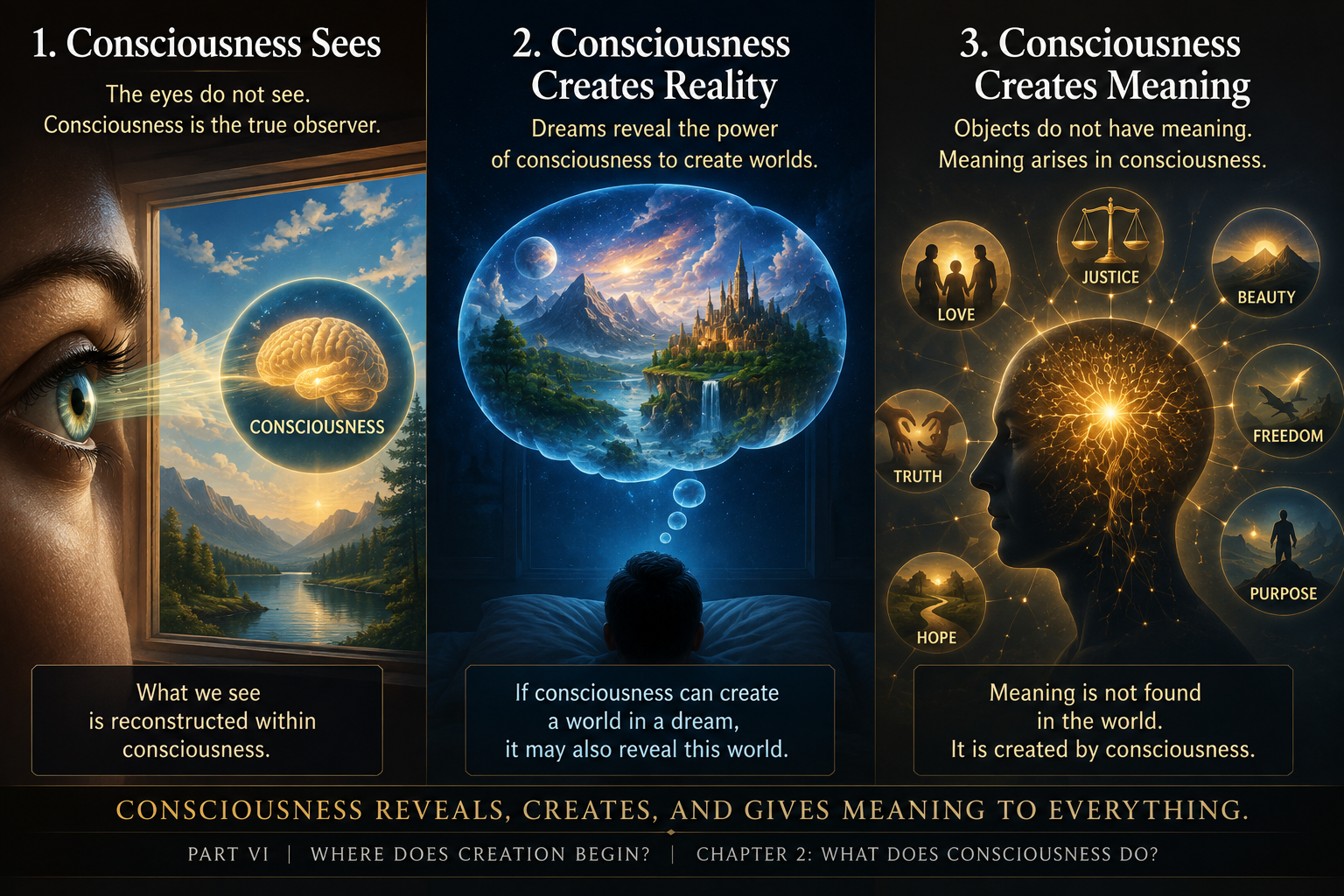
1. Consciousness Sees
When we open our eyes, we naturally believe that our eyes are seeing the world.
Yet the eyes themselves never truly see.
They only receive light.
The colors, shapes, depth, and movement we experience are reconstructed within consciousness.
The visible world does not simply enter the mind.
It appears as an experience created through consciousness.
Without consciousness, there would be no seeing, regardless of how perfectly the eyes function.
Consciousness is therefore the true observer of reality.
2. Consciousness Creates Reality
Dreams reveal one of the deepest mysteries of consciousness.
While dreaming, we experience mountains, oceans, people, cities, and entire worlds.
We see them, touch them, and believe them to be completely real.
Yet none of these experiences depend on external matter.
They arise entirely within consciousness.
This raises a profound possibility.
If consciousness can create a complete world during sleep, then the reality we experience while awake may also emerge through the activity of consciousness.
Reality is not merely encountered.
It is revealed through consciousness.
3. Consciousness Creates Meaning
The physical world contains objects, but objects alone possess no meaning.
A stone is simply a stone.
A tree is simply a tree.
Love, justice, beauty, freedom, success, and purpose do not exist as physical substances.
They arise when consciousness interprets experience.
Meaning is not hidden inside the world waiting to be discovered.
Meaning is created through consciousness.
Every value that shapes human civilization begins as an act of conscious interpretation.
Without consciousness, the universe would contain events, but no meaning.
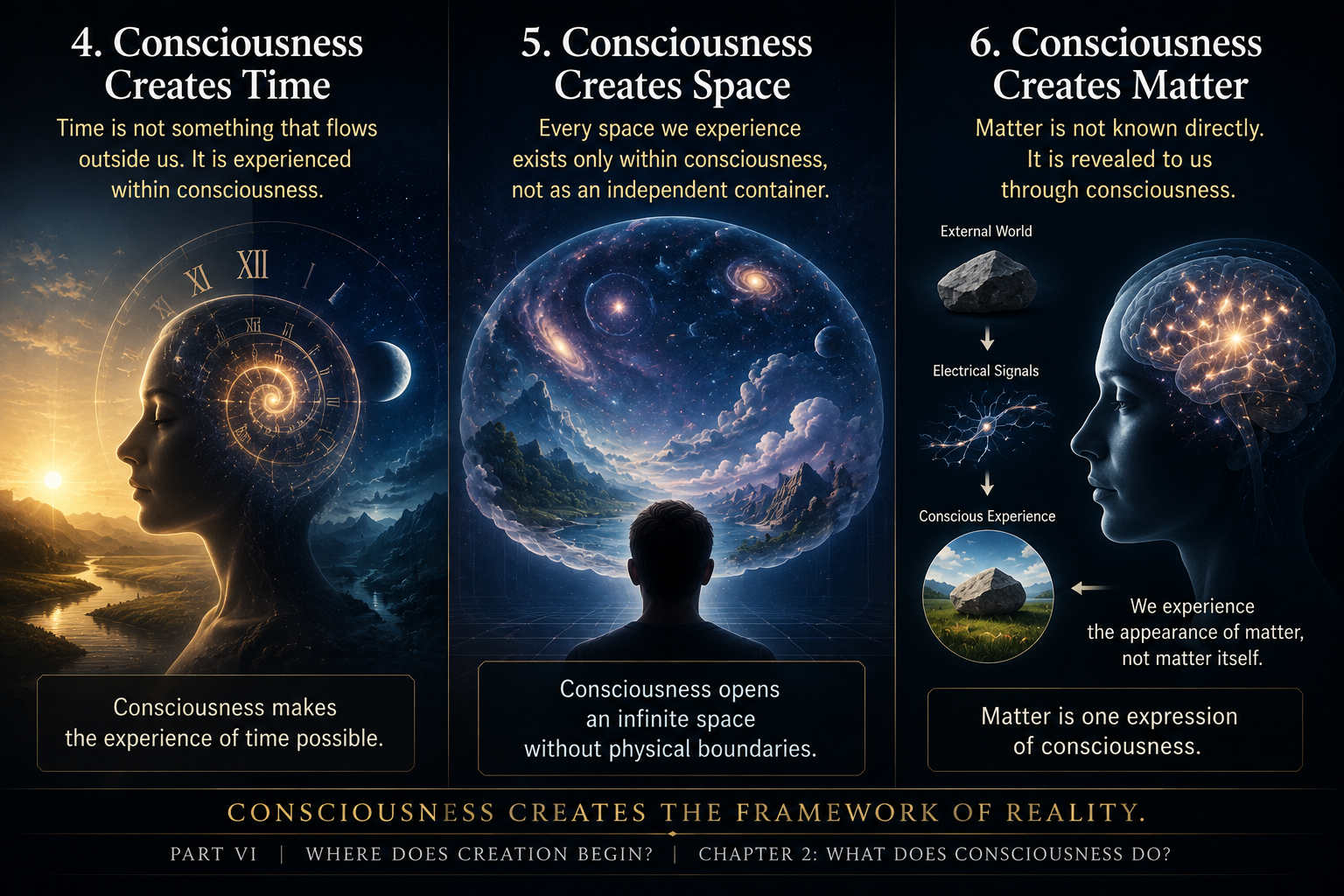
4. Consciousness Creates Time
Time does not flow because clocks exist.
A clock merely measures change.
The experience of time arises within consciousness.
Moments of joy seem to pass in an instant, while moments of suffering appear endless.
If time were an independent object existing outside us, it would always be experienced in exactly the same way.
Immanuel Kant argued that time is not a property of the external world, but one of the fundamental forms through which consciousness organizes experience.
Consciousness does not simply move through time.
It makes the experience of time possible.
5. Consciousness Creates Space
Space appears to be the vast stage upon which the universe exists.
Yet every space we experience is known only through consciousness.
Close your eyes and imagine an endless ocean, distant galaxies, or an infinite sky.
No physical space exists inside the brain.
Nevertheless, consciousness effortlessly opens a limitless world.
Dreams demonstrate the same principle.
Entire cities, mountains, and universes appear without occupying any physical location.
Space is not merely the container of experience.
It is one of the ways consciousness reveals reality.
6. Consciousness Creates Matter
Matter seems to be the most undeniable aspect of reality.
We touch it, measure it, and believe it exists independently of ourselves.
Yet what we truly experience is never matter itself.
We experience only the appearance of matter within consciousness.
Modern neuroscience shows that the brain receives electrical signals rather than physical objects.
Consciousness transforms these signals into the solid world we perceive.
Dreams reveal the same mystery.
Stones, rivers, buildings, and even our own bodies appear completely real, although no external matter exists.
Matter, therefore, is not simply discovered.
It is revealed as one expression of consciousness.
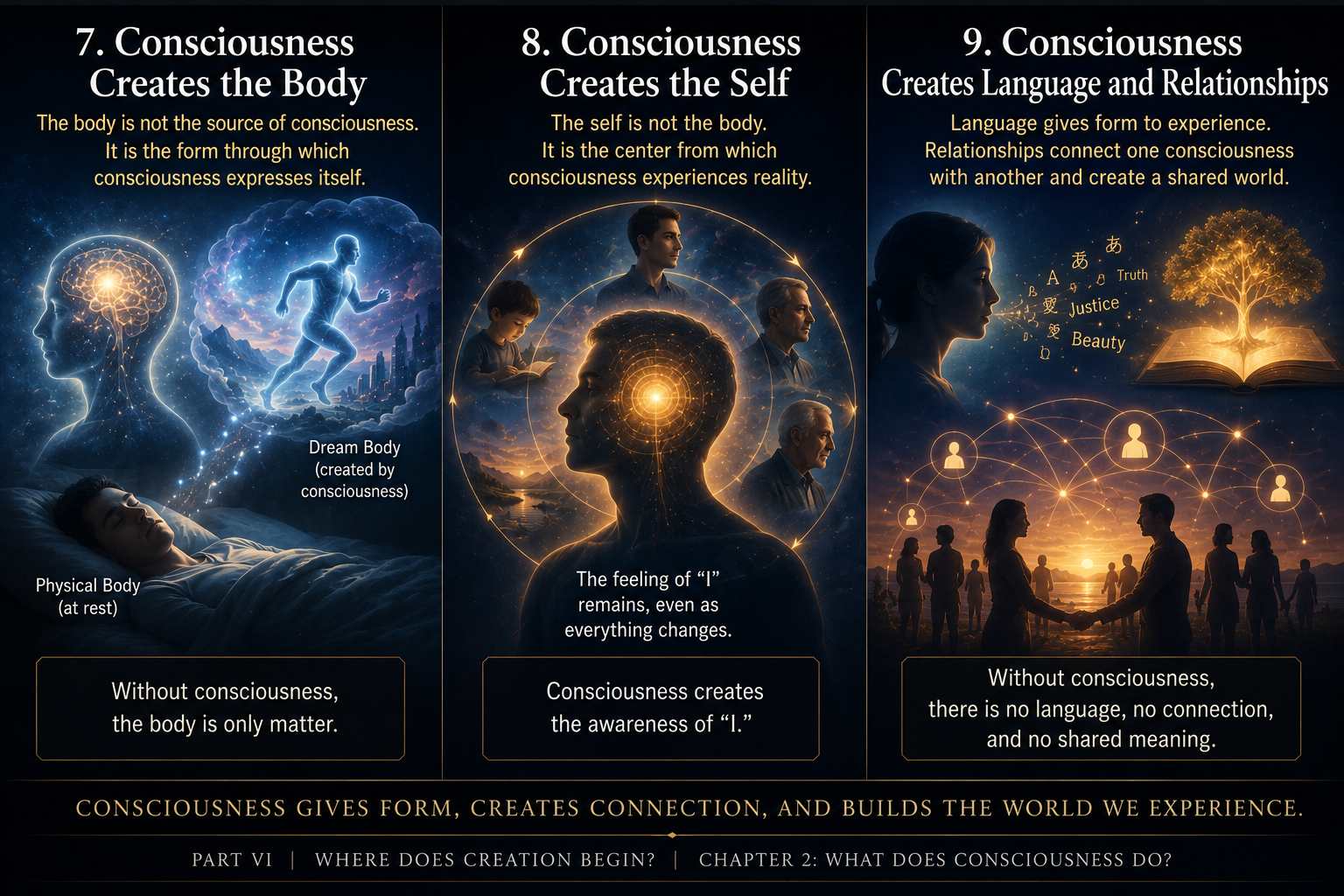
7. Consciousness Creates the Body
We usually believe that the body exists first, and that consciousness arises from it.
Dreams suggest the opposite.
While sleeping, the physical body remains motionless.
Yet within the dream, another body walks, runs, feels pain, and experiences joy.
That dream body is not made of physical matter.
It is created entirely by consciousness.
The body we experience is not simply a biological object.
It is the form through which consciousness expresses itself.
Without consciousness, the body could never become a living experience.
Consciousness does not merely inhabit the body.
It continually reveals the body as part of reality.
8. Consciousness Creates the Self
Who is the “I” that experiences the world?
Our physical body changes throughout life.
Cells die and are replaced.
Memories fade.
Thoughts constantly change.
Yet the feeling of being “I” remains.
This enduring sense of self cannot be explained by the body alone.
The self is not a material object.
It is the center from which consciousness experiences reality.
Consciousness continuously creates the awareness of “I.”
Without consciousness, there would be no observer, no identity, and no experience of existence.
9. Consciousness Creates Language and Relationships
Language is more than a collection of sounds.
It is the way consciousness gives form to experience.
Words such as truth, justice, beauty, freedom, and even God do not exist as physical objects.
They arise because consciousness names and shares what it experiences.
Relationships emerge in the same way.
A parent, a friend, or a stranger is not defined by matter alone.
Meaningful relationships are formed through conscious recognition.
Consciousness connects one person with another and transforms isolated lives into a shared world.
Without consciousness, there would be neither language nor relationships.
There would only be silent existence without meaning.
10. Consciousness Creates Choice
Every moment presents countless possibilities.
Yet only one becomes our lived experience.
The world does not decide for us.
Consciousness does.
Hope or despair, forgiveness or hatred, courage or fear all begin as choices within consciousness.
Matter cannot choose.
Only consciousness possesses the freedom to determine the meaning and direction of experience.
Choice is therefore one of the highest expressions of consciousness.
11. Consciousness Creates Growth
Consciousness is never static.
It continually expands through experience.
Joy teaches gratitude.
Suffering deepens understanding.
Failure gives birth to wisdom.
Love broadens the boundaries of the self.
Every experience becomes material for the growth of consciousness.
Life is not simply a process of biological survival.
It is the continual evolution of consciousness toward a deeper understanding of itself and reality.
12. Consciousness Creates Life and Death
Life and death appear to be opposites.
Yet both are experienced only through consciousness.
Every night we fall into deep sleep.
The world disappears.
Then another world emerges in dreams.
When we awaken, one reality dissolves and another begins.
Life and death may follow the same principle.
They are not absolute endings or beginnings.
They are different expressions of the continuous activity of consciousness.
Without consciousness, neither life nor death could ever be experienced.

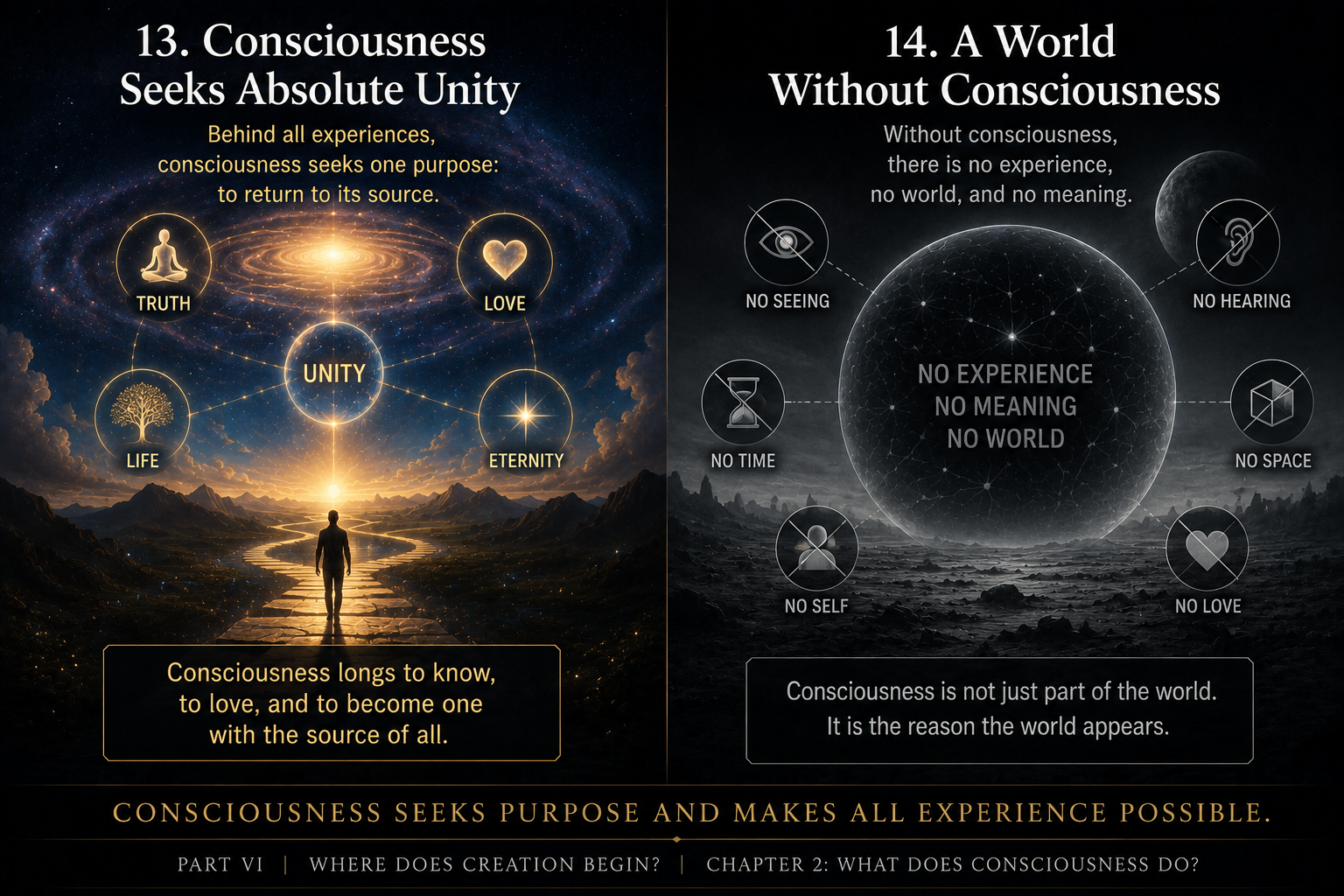
13. The Purpose of Consciousness
If consciousness creates seeing, reality, meaning, time, space, matter, the body, the self, language, relationships, choice, growth, life, and death, one final question remains.
Why does consciousness create them?
Throughout history, philosophers have proposed that consciousness naturally seeks a higher unity.
Eastern traditions describe this as the movement from Yin toward Yang.
Western philosophy often describes it as the journey from evil toward goodness.
Hegel called it Absolute Knowing.
Although expressed in different languages, they all point toward the same direction.
The purpose of consciousness is not merely to experience the world.
It is to transform itself through experience until it reaches a more complete understanding of reality.
14. If Consciousness Did Not Exist
Imagine a world without consciousness.
There would be no colors to see.
No sounds to hear.
No flowing time.
No surrounding space.
No matter.
No body.
No self.
No language.
No relationships.
No choices.
No growth.
No life.
No death.
The universe might still exist as an unknown possibility, but no reality could ever be experienced.
Everything that humanity has ever known depends upon consciousness.
Without consciousness, there is no world.
There is no observer.
There is only absolute silence beyond experience.
Conclusion
For centuries, humanity searched for the origin of reality in the external world.
We explored matter, energy, space, and time, believing that they formed the foundation of existence.
Yet every discovery returned us to the same question.
Who is experiencing all of this?
Everything we know appears only within consciousness.
Reality, time, space, matter, the body, the self, language, relationships, life, and death all become meaningful only because consciousness reveals them.
Perhaps consciousness is not merely one phenomenon within the universe.
Perhaps it is the very condition that allows the universe to appear.
For thousands of years, humanity has given many names to this invisible source.
Mind.
Spirit.
Soul.
The Absolute.
God.
Different traditions speak different languages, yet they all point toward the same mystery.
The deepest reality we seek may not exist somewhere beyond us.
It may already be present within the consciousness through which we experience every moment.
And perhaps the greatest journey is not to search for reality outside ourselves,
but to awaken to the infinite depth of the consciousness that has always been looking through our own eyes.
📖 Read the Complete Series
Part VI | Where Does Creation Begin?
Chapter 1
Where Does Creation Begin?
▶ https://…
Chapter 2
What Does Consciousness Do? (Current Episode)
▶ https://…
Chapter 3
Why Have Humans Called Consciousness God?
(Coming Soon)
🌍 Explore the Previous Parts
Part I
The Beginning of Consciousness
Part II
…
Part III
…
Part IV
Where Does Consciousness Come From?
Part V
How Does Consciousness Create Reality?
▶ More Videos
⚡ 2-Minute Version
▶ URL
🎬 10-Minute Version
▶ URL
🎙 20-Minute Deep Exploration
▶ URL
📖 Full WordPress Article
▶ URL
🔔 Subscribe
K-Philosophy: World Re-interpretation
Exploring Philosophy, Science, Consciousness, and Spirituality through the Third Copernican Revolution.