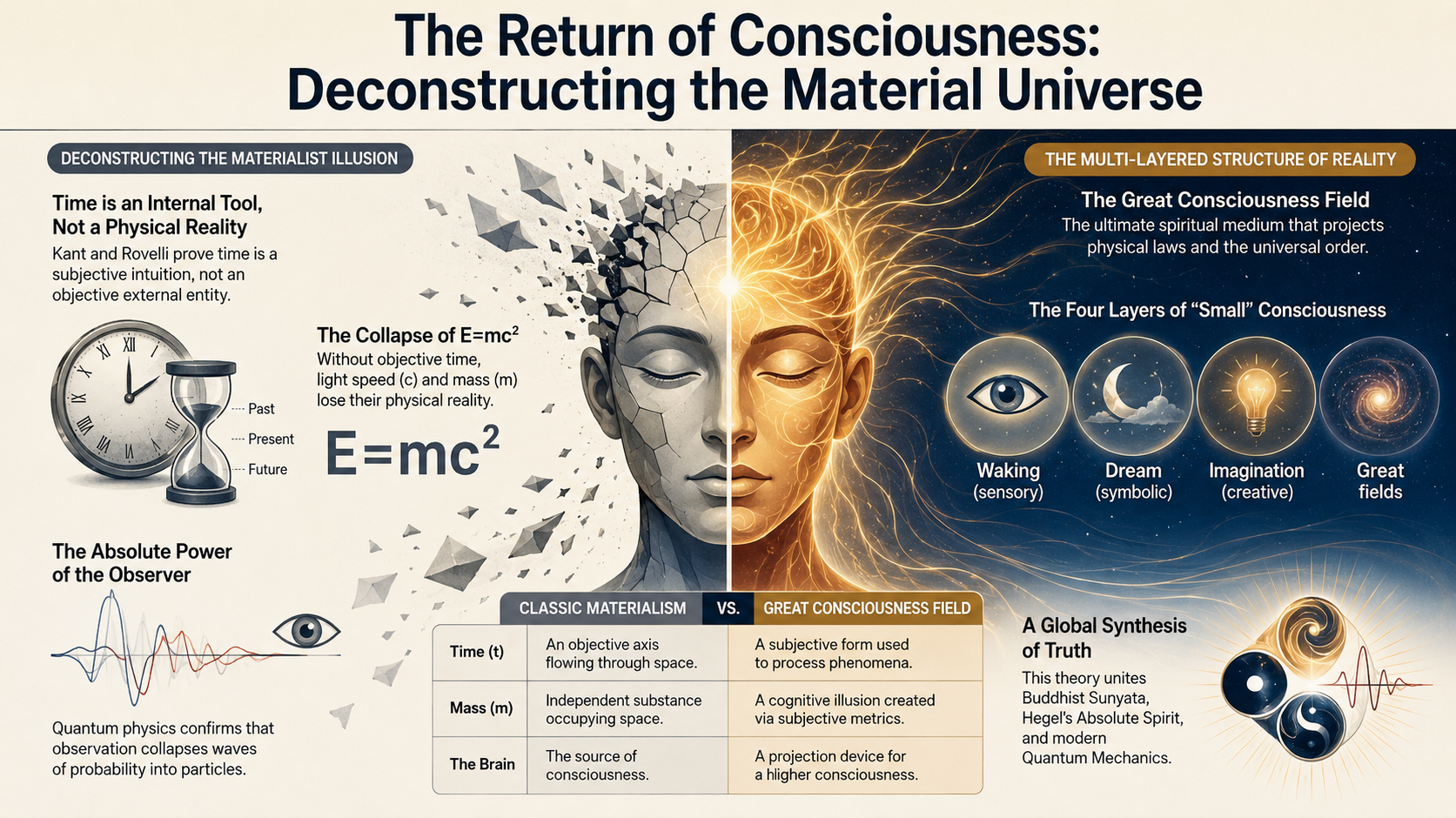
Carlo Rovelli, Immanuel Kant, and the Great Consciousness Field Theory Reconsider the Nature of Time

Does time really exist?
This is not merely a philosophical curiosity.
It is one of the deepest questions confronting modern physics, and perhaps one of the most important questions we can ask about reality itself.
From the moment we are born, we accept time as something obvious.
Morning becomes afternoon.
Afternoon becomes evening.
The hands of a clock never stop moving.
Because of this, most people naturally assume that time is an objective feature of the universe, something that exists independently of us.
For centuries, science has largely shared this assumption.
Isaac Newton regarded time as an absolute framework flowing uniformly throughout the universe.
Motion was measured through time.
Physical laws were expressed through time.
The history of the cosmos itself was written upon the axis of time.
Even today, modern science depends on this foundation.
Velocity is defined through time.
Acceleration is measured through time.
Energy changes through time.
The evolution of life, the motion of galaxies, and the history of the universe are all described using time as their fundamental reference.
We often say that science studies matter.
Yet a closer look reveals something surprising.
Before science can describe matter, it must first assume the existence of time.
Every equation in physics quietly depends upon it.
Without time, there is no velocity.
Without velocity, there is no motion.
Without motion, much of modern physics would lose its mathematical foundation.
And yet, an extraordinary question remains unanswered.
Science has used time to explain the universe.
But what exactly is time?
We can observe clocks.
We can watch the movement of a second hand.
We can see the Sun rise and set.
We experience changing seasons.
But no one has ever directly observed time itself.
What we actually observe is change.
Time is the name we give to that change.
This is precisely where modern physics begins to challenge one of its oldest assumptions.
Theoretical physicist Carlo Rovelli, in The Order of Time, argues that the universe does not contain a single, universal flow of time.
Time is not a great river carrying everything forward.
Rather, it emerges from relationships among physical events.
At first, this idea seems difficult to accept.
But consider your own experience.
Do you ever perceive time itself?
Or do you only perceive change?
A growing tree.
A beating heart.
A moving clock.
An aging face.
Perhaps what we call “time” is simply the concept we use to organize countless changes.
Remarkably, this idea is not entirely new.
More than two centuries earlier, Immanuel Kant approached the same question from a completely different direction.
For Kant, time was never an object existing outside the human mind.
It was an a priori form of intuition.
In other words, time is not something we discover in the world.
It is one of the conditions that makes experiencing the world possible.
Here, modern physics and philosophy begin to converge.
Rovelli questions the objective reality of time.
Kant places time within the structure of human cognition.
They begin from different disciplines, yet arrive at a surprisingly similar possibility.
Perhaps time is not an independent physical entity after all.
And if that is true, another question immediately follows.
If time does not exist independently of consciousness, what have we really been measuring all along?
Did Science Borrow Time?
Imagine a successful architect standing before a magnificent building.
People admire the elegant design.
They praise the engineering.
They celebrate the finished structure.
Then someone quietly asks a simple question.
“Who supplied the foundation?”
Suddenly, attention shifts.
The building itself has not changed.
Only our perspective has.
I believe something similar has happened in modern science.
This is not an accusation against science.
It is a philosophical invitation.
Science has achieved extraordinary success by describing the universe with remarkable precision.
But perhaps it has become so successful that one of its deepest assumptions has rarely been questioned.
That assumption is time.
Since Newton, time has served as the invisible framework behind nearly every scientific theory.
Physics measures motion through time.
Velocity exists only because time provides a reference.
Energy is calculated through temporal relationships.
Astronomy reconstructs the history of the universe through time.
Biology traces evolution through time.
Every major branch of science quietly depends upon it.
Yet we rarely stop to ask a more fundamental question.
Where did this concept of time come from?
Is time truly a property of the external universe?
Or is it part of the structure through which conscious beings interpret reality?
If Kant was correct, time is not discovered in nature.
It is one of the conditions that makes nature experienceable in the first place.
If Rovelli is correct, the universe itself contains no single universal flow of time.
Time is relational rather than absolute.
If both perspectives deserve serious consideration, then modern science may have been describing the universe through a framework that originates, at least in part, within conscious experience.
This is why I deliberately ask whether science has “borrowed” time.
Not because science has made a mistake.
Far from it.
Science has revealed extraordinary truths about the physical universe.
Rather, the question concerns the origin of one of its most fundamental tools.
A ruler measures length.
A scale measures weight.
A thermometer measures temperature.
But what measures time?
A clock does not create time.
It measures recurring physical processes.
The movement of a clock hand is itself another change within the world.
The clock does not prove that time exists as an independent entity.
It simply provides a stable way of comparing change.
This distinction may appear subtle.
Yet it has profound philosophical consequences.
If time is not an independent substance flowing outside consciousness,
then every scientific description built upon temporal measurement deserves to be reconsidered from a new perspective.
At this point, another question naturally emerges.
If time provides the foundation for velocity,
and velocity lies at the heart of Einstein’s most famous equation,
what exactly does E = mc² assume about reality?
That question leads us to one of the most celebrated equations in modern science, and perhaps to one of its least examined philosophical assumptions.
Einstein’s E = mc²
The Hidden Assumption Behind the World’s Most Famous Equation
Few scientific equations have changed human history as profoundly as
E = mc².
It appears in textbooks,
documentaries,
university classrooms,
and popular culture around the world.
For many people,
it represents the ultimate triumph of modern physics.
The equation tells us that mass and energy are fundamentally equivalent.
Matter can become energy.
Energy can become matter.
Its predictive power has been confirmed countless times.
Nothing in this chapter is intended to challenge those scientific achievements.
Instead,
I would like to ask a different question.
What assumptions make this equation possible?
Most readers immediately focus on E, energy.
Others think about m, mass.
But surprisingly little attention is given to c.
The speed of light is often treated as though it were simply another physical constant.
Yet what exactly is speed?
Speed is not an independent object.
It is a relationship.
More precisely,
it is the distance traveled during a given interval of time.
Without distance,
speed cannot be defined.
Without time,
speed cannot be defined either.
Every statement about velocity already assumes the existence of time.
Now return once again to Einstein’s equation.
The symbol c is not merely a number.
It represents a velocity.
And every velocity presupposes time.
This observation does not weaken Einstein’s theory.
Instead,
it directs our attention toward something deeper.
The equation depends upon a concept whose own nature remains philosophically unresolved.
If time is an objective feature of the universe,
then the equation stands within that framework.
But if Kant was correct,
and time belongs to the structure of human cognition,
then the equation also depends upon one of the fundamental conditions of conscious experience.
The mathematics remains valid.
The predictions remain astonishingly accurate.
What changes is not the calculation,
but the interpretation.
Perhaps physics has not only been describing matter.
Perhaps it has also been describing reality through a framework supplied by consciousness itself.
This possibility becomes even more intriguing when we remember Carlo Rovelli’s work.
Rovelli argues that no universal cosmic clock governs the universe.
Time emerges from relationships rather than existing as an independent background.
Once again,
physics and philosophy begin approaching the same horizon from different directions.
Neither discipline proves the other.
Yet both invite us to reconsider one of our oldest assumptions.
If time is not an independently existing substance,
what becomes of the physical concepts built upon it?
This question reaches beyond relativity.
It reaches the foundations of reality itself.
And it is precisely at this point that twentieth-century physics encountered another profound surprise.
The deeper physicists explored the quantum world,
the more difficult it became to ignore one extraordinary presence.
The observer.
Why Quantum Mechanics Could Not Eliminate the Observer
At the beginning of the twentieth century,
physics entered a world no one had expected.
The deeper scientists explored the microscopic universe,
the stranger reality appeared to become.
Phenomena that seemed perfectly ordinary in everyday life no longer behaved according to familiar intuition.
Among the most famous examples is the double-slit experiment.
When particles such as electrons, or even light itself, pass through two narrow openings without being measured, they produce an interference pattern characteristic of waves.
Yet when an attempt is made to determine which slit they pass through,
the interference disappears,
and the particles behave as though they had always been localized objects.
For more than a century,
this experiment has challenged our most basic assumptions about reality.
Why should observation matter?
What changes when a measurement is made?
Does the particle change?
Does the physical system change?
Or does the very appearance of reality depend, in some way, upon the conditions under which it is observed?
Modern physics has proposed many interpretations.
The Copenhagen interpretation.
The Many-Worlds interpretation.
Decoherence.
Relational quantum mechanics.
Each offers a different explanation.
Yet they all share one remarkable feature.
None has been able to remove the observer from the discussion entirely.
This fact deserves careful attention.
In Newtonian physics,
the observer was essentially irrelevant.
The universe existed exactly as it was,
whether anyone looked at it or not.
Quantum mechanics transformed that picture.
It did not necessarily prove that consciousness creates reality.
Such a conclusion remains highly debated.
However,
it did reveal something profound.
The observer could no longer be treated as an entirely insignificant bystander.
At this point,
the conversation begins to move surprisingly close to philosophy.
More than two hundred years before quantum theory,
Immanuel Kant argued that we never experience the world exactly as it is “in itself.”
We experience the world as it appears through the structures of human cognition.
He called this the world of phenomena.
Whether one ultimately agrees with Kant or not,
his question has become unexpectedly relevant once again.
Are we observing reality itself?
Or are we always encountering reality as it appears through the conditions of observation?
Quantum mechanics does not answer this philosophical question.
But it undeniably places the observer back into the conversation.
Perhaps this is its greatest philosophical legacy.
Most people imagine observation as something simple.
Someone looks.
Something is seen.
Yet observation involves much more than vision.
Information is received.
Differences are distinguished.
Patterns are recognized.
Meaning is assigned.
A coherent world emerges through this process.
Observation is therefore not merely an optical event.
It is an act of cognition.
It is an activity of consciousness.
If this is true,
then perhaps the deepest question is no longer,
“What is matter?”
Instead,
it becomes,
“What is consciousness?”
And once that question is asked,
another follows almost immediately.
Does the brain produce consciousness?
Or does consciousness make use of the brain in order to experience the physical world?
That question leads us beyond quantum physics and into one of the most fascinating debates in contemporary neuroscience.
Does the Brain Create Consciousness?
Or Does Consciousness Use the Brain?
After reflecting on time,
and after following the role of the observer through quantum mechanics,
we arrive at another question that has challenged philosophers and neuroscientists alike.
Where does consciousness come from?
Today, the dominant view in neuroscience is that consciousness emerges from the activity of the brain.
Billions of neurons communicate through vast electrical and chemical networks.
From these enormously complex interactions,
subjective awareness is thought to arise.
This framework has led to extraordinary scientific discoveries.
Among the most influential contributors to this field was the Nobel Prize winning neuroscientist Gerald Edelman.
Edelman proposed that consciousness is not generated by a single location within the brain.
Instead,
it emerges through the continuous dynamic interaction of widely distributed neural networks.
Central to his theory is the concept of reentry,
an ongoing process in which different regions of the brain constantly exchange information,
integrating perception,
memory,
emotion,
and decision making into a unified conscious experience.
His work remains one of the most sophisticated biological accounts of consciousness ever proposed.
There is little reason to dismiss these achievements.
Brain injuries can alter memory.
Damage to specific neural circuits can change personality,
emotion,
or even one’s sense of identity.
The relationship between brain activity and conscious experience is undeniable.
Yet one important question still remains.
Does correlation necessarily establish origin?
When a piano produces beautiful music,
we naturally observe vibrations within the instrument.
But we do not conclude that the piano composed the music.
When a television displays a documentary,
we observe intricate electronic processes.
Yet we do not assume that the television created the program itself.
The device faithfully expresses information,
but expression alone does not establish authorship.
Could the brain present a similar philosophical puzzle?
We unquestionably observe an intimate relationship between neural activity and conscious experience.
But this leaves open two fundamentally different possibilities.
The first is familiar.
The brain generates consciousness.
The second is rarely explored.
Consciousness employs the brain as its biological interface with the physical world.
These two possibilities may appear similar,
yet they describe entirely different pictures of reality.
At this point,
I would like to propose a broader interpretive framework.
I call it the Great Consciousness Field Theory.
This theory is not intended to reject neuroscience.
Nor does it deny the remarkable explanatory power of Edelman’s work.
Instead,
it asks whether neuroscience may be describing how consciousness operates through the brain, rather than how consciousness comes into existence.
From this perspective,
the brain is not necessarily the factory that manufactures consciousness.
It may instead function as an exquisitely organized biological instrument,
through which consciousness encounters the physical world.
The neural dynamics described by Edelman would remain fully meaningful.
Reentry,
memory,
emotion,
and cognition would still occur.
What changes is not the neuroscience,
but the philosophical interpretation of what those processes ultimately represent.
If this possibility deserves consideration,
then consciousness may be larger than the brain itself.
The brain would become one expression of consciousness,
rather than its ultimate source.
This perspective opens the door to a deeper question.
When we dream,
remember,
imagine,
or experience the waking world,
are all of these experiences occurring within a single undifferentiated consciousness?
Or could consciousness itself possess multiple layers,
each revealing reality in a different way?
The Great Consciousness Field Theory begins precisely with this question.
Dreams, Reality, and the Layers of Consciousness
A New Perspective from the Great Consciousness Field Theory
Most of us assume that consciousness is a single, continuous phenomenon.
The awareness with which you are reading these words now,
the dreams you experienced last night,
the memories of your childhood,
and the images you create through imagination
are all usually regarded as different activities of the same mind.
But are they truly the same?
Or do they reveal different layers within consciousness itself?
Consider the experience of dreaming.
While we are dreaming,
the dream rarely feels unreal.
We meet people.
We speak with them.
We experience fear,
joy,
loss,
or hope.
Time appears to pass.
Space seems to exist.
Events unfold with their own internal logic.
Within the dream,
everything feels completely real.
Only after awakening do we recognize that the world we had accepted moments before was a dream.
Immediately,
our confidence shifts.
Now we call the waking world “reality.”
Yet this raises an intriguing question.
Why did the dream feel so convincing while we were inside it?
If waking reality alone is truly real,
why does dreaming possess such extraordinary immediacy?
Perhaps this question is not ultimately about dreams.
Perhaps it is about reality itself.
At this point,
I would like to introduce the central idea of the Great Consciousness Field Theory.
The theory does not describe consciousness as a single, uniform entity.
Instead,
it proposes a layered structure.
At the broadest level exists what I call the Great Consciousness Field.
Rather than being a separate mind or an external force,
it serves as the comprehensive field within which every mode of conscious experience becomes possible.
Within this greater field,
different experiential domains emerge.
I refer to these as Small Consciousness Fields.
The waking world is one such field.
Dreaming is another.
Memory forms another.
Imagination yet another.
Each possesses its own internal coherence.
Each presents a world that feels authentic while we are immersed within it.
These fields are not isolated compartments.
They interact continuously.
Memories influence perception.
Imagination reshapes memory.
Dreams reorganize emotion.
The waking world constantly exchanges information with all of them.
Think for a moment about recalling a childhood memory.
A landscape from decades ago suddenly appears with remarkable clarity.
For a brief moment,
your conscious experience has shifted into a different experiential domain.
The same occurs when an artist imagines a painting that has never existed,
or when a physicist visualizes a theory long before any experiment confirms it.
In each case,
consciousness is operating within a different mode of experience.
Dreaming.
Remembering.
Imagining.
Perceiving.
Although these experiences differ profoundly,
they share one undeniable characteristic.
Every one of them appears within consciousness.
From this perspective,
what we call “reality” may not be the only coherent experiential world available to consciousness.
It may simply be the most stable one.
The Great Consciousness Field Theory therefore proposes a different way of interpreting human experience.
Reality is not denied.
Dreams are not elevated above waking life.
Instead,
both are understood as different expressions of a larger architecture of consciousness.
This proposal is not presented as an established scientific theory.
Rather,
it is offered as a philosophical framework that seeks dialogue among contemporary physics,
neuroscience,
philosophy,
and the contemplative traditions of humanity.
If nothing else,
it encourages us to ask a question that has remained surprisingly neglected.
Perhaps the deepest mystery is not how consciousness arises within reality.
Perhaps the deeper mystery is how reality appears within consciousness.
A Final Thought Experiment
Which Is More Fundamental: The Observer or the Observed?
Before reaching a conclusion,
I would like to invite you into one final thought experiment.
It is remarkably simple.
Yet its implications may reach further than they first appear.
Consider the following question.
What is more fundamental?
The observer?
Or the thing being observed?
For centuries,
most of us have assumed that both simply coexist.
There is a world.
And there are observers within that world.
It seems perfectly obvious.
But let us examine the assumption more carefully.
Imagine, for a moment,
that every conscious observer disappears.
No human beings.
No animals.
No awareness of any kind.
Mountains remain.
Stars remain.
Galaxies continue their silent motion.
Or do they?
Who now confirms their existence?
Who experiences them?
Who can truthfully say,
“The universe exists”?
Now consider the opposite situation.
Suppose every physical object disappears.
No planets.
No stars.
No galaxies.
No space.
No measurable universe.
Yet consciousness remains.
It can still think.
It can still imagine.
It can still remember.
Most importantly,
it can still be aware of itself.
This simple thought experiment reveals an intriguing asymmetry.
A universe without observers may still be imagined.
But no statement about that universe can ever be experienced or verified from within it.
By contrast,
consciousness, even in the absence of physical objects, still possesses the possibility of experience.
Of course,
an immediate objection naturally arises.
“The universe exists whether anyone observes it or not.”
Perhaps.
Many philosophers and scientists have defended precisely this position.
Yet another question quietly follows.
Where does that statement originate?
The claim itself appears within someone’s consciousness.
The assertion,
“An objective universe exists independently of observers,”
is itself a conscious judgment.
Even the attempt to defend objective reality presupposes the activity of consciousness.
This observation does not disprove the existence of an external world.
Nor does it prove idealism.
What it does reveal is something more subtle.
Every argument about objective reality is necessarily articulated from within conscious experience.
Consciousness cannot be stepped outside in order to evaluate reality from nowhere.
At this point,
Kant’s famous concept of the thing in itself takes on a fascinating new dimension.
Kant argued that behind every phenomenon lies a reality that can never be known directly.
But the very concept of the “thing in itself” also emerged through philosophical reflection.
It, too, entered human thought through consciousness.
This raises a profound possibility.
Perhaps the unknowable is not located outside consciousness.
Perhaps it belongs to a deeper level within consciousness that has not yet become experience.
The Great Consciousness Field Theory does not claim to settle this question once and for all.
Instead,
it offers a different perspective.
The objective world may not stand opposite consciousness as an entirely separate realm.
It may instead emerge as one mode through which consciousness encounters itself.
If so,
the traditional opposition between subject and object begins to dissolve.
The object is no longer simply outside the subject.
Rather,
what we call the objective world may itself appear within the horizon of conscious experience.
If this possibility deserves serious consideration,
then perhaps the deepest philosophical revolution is not the discovery of a new world.
It is the realization that the world we have always known may already have been appearing within consciousness from the very beginning.
Conclusion

It Is Time to Return Time to Philosophy
This journey began with a simple question.
Does time really exist?
At first glance,
the question appears almost unnecessary.
Time seems obvious.
We build clocks.
We calculate motion.
We estimate the age of stars.
We describe the history of the universe.
Modern science has achieved extraordinary success by using time as one of its most fundamental tools.
There is no reason to deny those achievements.
Yet success does not remove the need for deeper questions.
Instead,
it often makes them more important.
The question is no longer whether science has described the universe with remarkable precision.
It clearly has.
The deeper question is this:
What is the origin of the very framework through which the universe has been described?
Carlo Rovelli invites us to reconsider whether time is truly a universal feature of reality.
Immanuel Kant argues that time belongs to the structure of human cognition.
Quantum mechanics reminds us that the observer cannot simply be ignored.
Neuroscience continues to reveal an intimate relationship between the brain and conscious experience,
while leaving the ultimate origin of consciousness unresolved.
Taken together,
these disciplines do not provide a single answer.
But they appear to move toward a common horizon.
They all lead us back to the same fundamental mystery.
What is the relationship between consciousness and reality?
It is here that I have proposed the Great Consciousness Field Theory.
Not as a replacement for science.
Not as an alternative religion.
Not as a final philosophical system.
Rather,
as an invitation to reopen a conversation that has gradually become divided across different disciplines.
Science asks how the universe works.
Philosophy asks how reality becomes knowable.
Religion asks what ultimately gives existence its meaning.
These questions need not compete with one another.
They may instead illuminate different dimensions of the same mystery.
If time cannot be fully separated from conscious experience,
if observation is inseparable from cognition,
if dreaming,
remembering,
imagining,
and waking all emerge within consciousness,
then reality itself may deserve to be understood in a broader way than materialism alone allows.
Perhaps the universe is not merely a collection of physical objects.
Perhaps it is also the unfolding of experience within consciousness.
This book does not ask its readers to accept that conclusion.
It asks something far simpler.
To pause.
To reconsider.
To question what has long appeared unquestionable.
Is time something flowing outside us?
Or is it one of the conditions that makes experience possible?
Is matter the ultimate foundation of reality?
Or does matter appear only within the horizon of conscious awareness?
These questions remain open.
Perhaps humanity is only beginning to ask them with sufficient seriousness.
And perhaps,
at the far edge of those questions,
philosophy,
science,
and religion will discover that they have never been walking in opposite directions.
They have been approaching the same horizon from different paths.
If that day comes,
we may realize something both simple and profound.
We do not merely observe the universe.
The universe appears within the field of consciousness through which observation itself becomes possible.
That possibility is what I call
The Great Consciousness Field Theory.