1. The Body on the Bed and the Body in the Dream
In the previous chapter, we followed a simple apple into the mysterious world of dreams.
The moment we woke up,
the apple disappeared without leaving a trace.
But the apple was not the only thing that vanished.
The hand holding it disappeared.
The mouth tasting it disappeared.
The eyes looking at it disappeared.
Even the body that had been walking freely through the dream simply ceased to exist.
Yet something strange remains.
Most people easily accept that the dream apple was not real.
Very few stop to ask a much deeper question.
Where did the dream body come from?
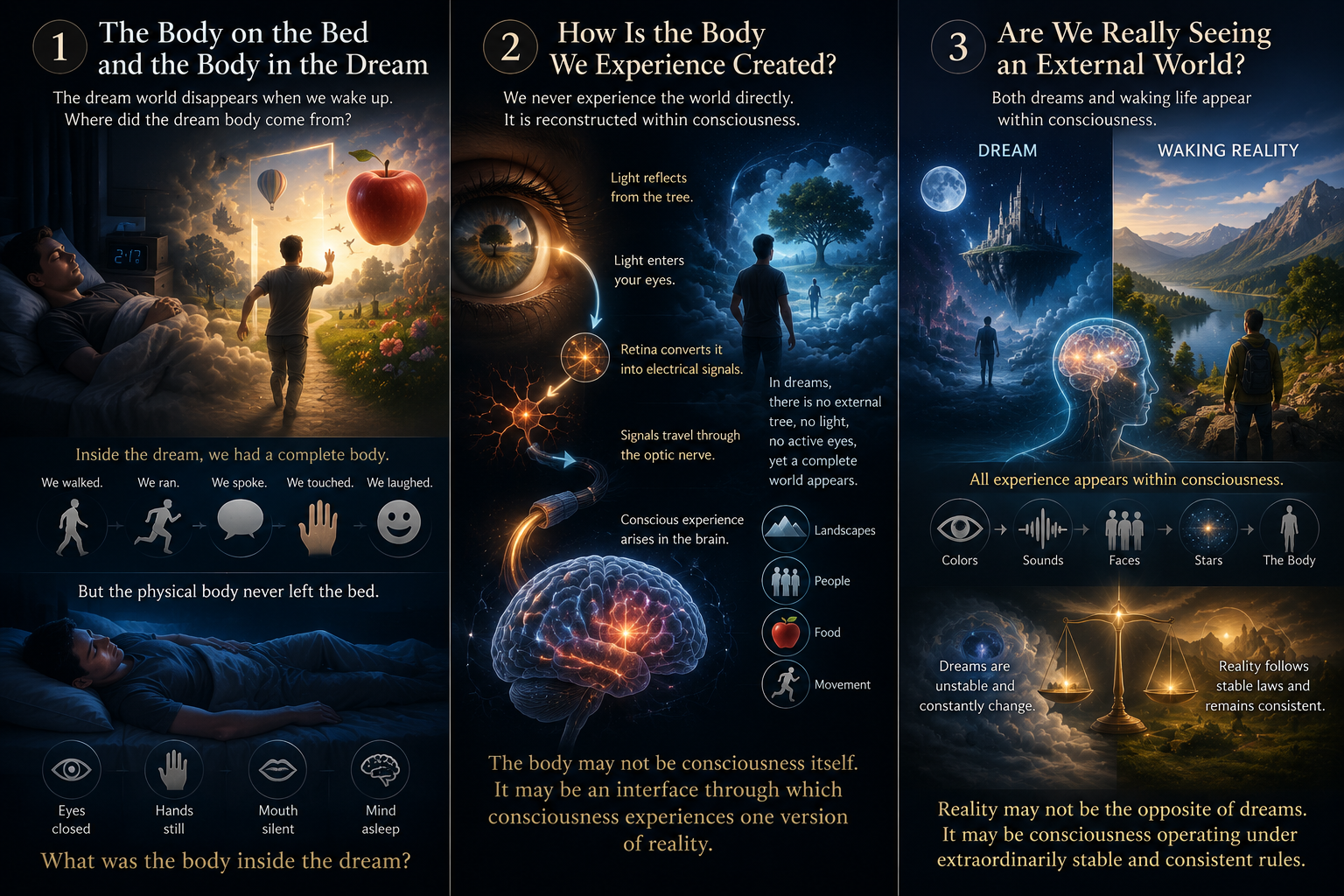
Inside the dream, we possessed a complete body.
We walked.
We ran.
We spoke.
We touched.
We laughed.
Everything felt perfectly natural.
There was never a moment when we doubted that body was our own.
Meanwhile, our physical body had never left the bed.
Its eyes remained closed.
Its hands never moved.
Its mouth never spoke.
If the physical body stayed asleep,
what was the body inside the dream?
This question quietly challenges one of our oldest assumptions.
Perhaps what we call “the body” is not always a physical object.
Perhaps consciousness can generate an entire body whenever it creates a world.
2. How Is the Body We Experience Created?
Now let us examine the waking world.
When you look at a tree,
it feels obvious that you are seeing something outside yourself.
Yet modern neuroscience describes a very different process.
Light reflects from the tree.
The light enters your eyes.
Your retina converts it into electrical signals.
Those signals travel through the optic nerve to the brain.
Only then does conscious experience arise.
Strictly speaking,
you never experience the tree directly.
You experience the world reconstructed within consciousness from sensory information.
Dreams reveal something remarkable.
There is no external tree.
No light.
No active eyes.
No physical sensory input.
Yet the dream still presents a complete world.
You can see landscapes.
You can meet people.
You can taste food.
You can even feel your own body moving naturally through that world.
This raises a profound question.
If consciousness can generate a complete body without physical input during dreams,
what role does the physical body actually play in waking life?
Perhaps the body is not consciousness itself.
Perhaps it functions as an interface through which consciousness experiences one particular version of reality.
3. Are We Really Seeing an External World?
So far, we have discovered two important facts.
First,
dreams demonstrate that consciousness can produce an entire world without external matter.
Second,
that world includes objects,
people,
space,
and even a body.
Now consider waking reality.
We naturally believe that mountains exist “out there.”
The sky seems to stretch above us.
Other people appear to stand outside ourselves.
But is that where our actual experience occurs?
Every color,
every sound,
every face,
every star,
and even the body you call “yourself”
appears only after conscious experience is formed.
From the perspective of experience,
both dreams and waking life unfold within consciousness.
The difference is not where they appear,
but how stable they remain.
Dreams constantly change.
Reality follows remarkably consistent laws.
Its continuity allows civilizations to grow,
science to develop,
and human beings to share a common world.
Perhaps reality is not the opposite of dreams.
Perhaps it is consciousness operating under an extraordinarily stable and consistent set of rules.
If that is true,
then the body may not be who we are.
It may be the biological interface through which consciousness participates in this ordered reality.
And that possibility leads us toward an even deeper question.
If the body is only the interface, then who is the one using it?‘
4. Then Where Is the Real “Me”?
So far, we have explored the body.
We have examined the body that appears in dreams.
We have examined the body that exists in waking life.
We have also considered the possibility that every world we experience appears within consciousness.
Now an even deeper question emerges.
Where is the real “me”?
Most of us instinctively point to our bodies and say,
“This is me.”
But was the body in your dream truly you?
Your childhood body is gone.
Your body today is different.
Your body will continue to change throughout your life.
Yet something has remained constant.
The one who remembers childhood.
The one who experiences the present.
The one who imagines the future.
Science tells us that the cells of the human body are continuously replaced.
The physical body changes.
Yet our sense of identity remains remarkably stable.
What preserves that continuity?
Is it the body?
Or is it the consciousness that experiences the body?
When a dream ends,
the dream body disappears.
But the one who awakens remains.
When imagination fades,
the imagined body disappears.
Yet the one who recognizes that imagination has ended still remains.
Perhaps the body is not the observer.
Perhaps consciousness is.
If so,
the body may not be who we are.
It may simply be the instrument through which consciousness experiences the physical world.
5. Why Have We Overlooked Consciousness?
From childhood,
we are taught to identify ourselves with our bodies.
We look into a mirror and hear,
“That is you.”
Schools teach us biology.
Medicine studies the body.
Neuroscience investigates the brain.
These fields have produced extraordinary knowledge.
Yet surprisingly little attention has been given to the very thing that experiences them all.
Consciousness.
We observe the world every day,
but rarely ask,
What is it that is actually observing?
We think,
yet seldom ask,
Who is doing the thinking?
We dream,
yet almost never ask,
Who is experiencing the dream?
The reason may be simple.
Consciousness is so close to us that it becomes invisible.
The eye sees everything around it,
yet it cannot directly see itself.
Perhaps consciousness is similar.
It is the starting point of every experience,
and for that very reason,
it has become the last mystery we choose to investigate.
Throughout history,
humanity has uncovered many invisible realities.
Air.
Gravity.
Electricity.
Atoms.
Perhaps consciousness is the next great discovery.
Because at this very moment,
it is consciousness that is reading these words.
6. Can Consciousness Grow?
We naturally recognize that the body grows.
A newborn child becomes an adult.
Muscles develop.
Knowledge increases.
But does only the body grow?
Or can consciousness grow as well?
A baby enters the world without language.
Without concepts.
Without an understanding of self.
Like a newly activated computer,
it possesses enormous potential,
but almost no experience.
As life unfolds,
the child observes,
listens,
learns,
questions,
fails,
discovers,
and gradually expands awareness.
While the body matures,
consciousness matures alongside it.
The same pattern appears throughout human history.
People once believed that Earth stood still.
They believed the Sun revolved around our planet.
Lightning was once interpreted as the anger of gods.
Invisible microorganisms were unknown.
Human understanding expanded because consciousness continued asking new questions.
Perhaps our understanding of consciousness today resembles humanity’s early understanding of the universe.
We have learned how to study matter.
Only recently have we begun learning how to study consciousness itself.
History repeatedly reminds us that what seems obvious today may become tomorrow’s greatest misconception.
If consciousness truly develops,
then humanity’s next great evolution may not be biological.
It may be the evolution of awareness itself.
And when consciousness grows,
our understanding of ourselves,
our world,
life,
and even death,
may be transformed forever.

7. What Changes When Consciousness Evolves?
Human beings spend their entire lives developing the body.
We nourish it.
We strengthen it.
We protect it from disease.
We celebrate its youth and mourn its aging.
Because we believe the body is who we are.
But what if the greatest human development has never been physical?
What if the true evolution of humanity is the evolution of consciousness?
A child does not merely grow taller.
A child learns to see.
To understand.
To ask questions.
To discover meaning.
As consciousness expands,
the world itself begins to change.
The same pattern can be seen throughout human history.
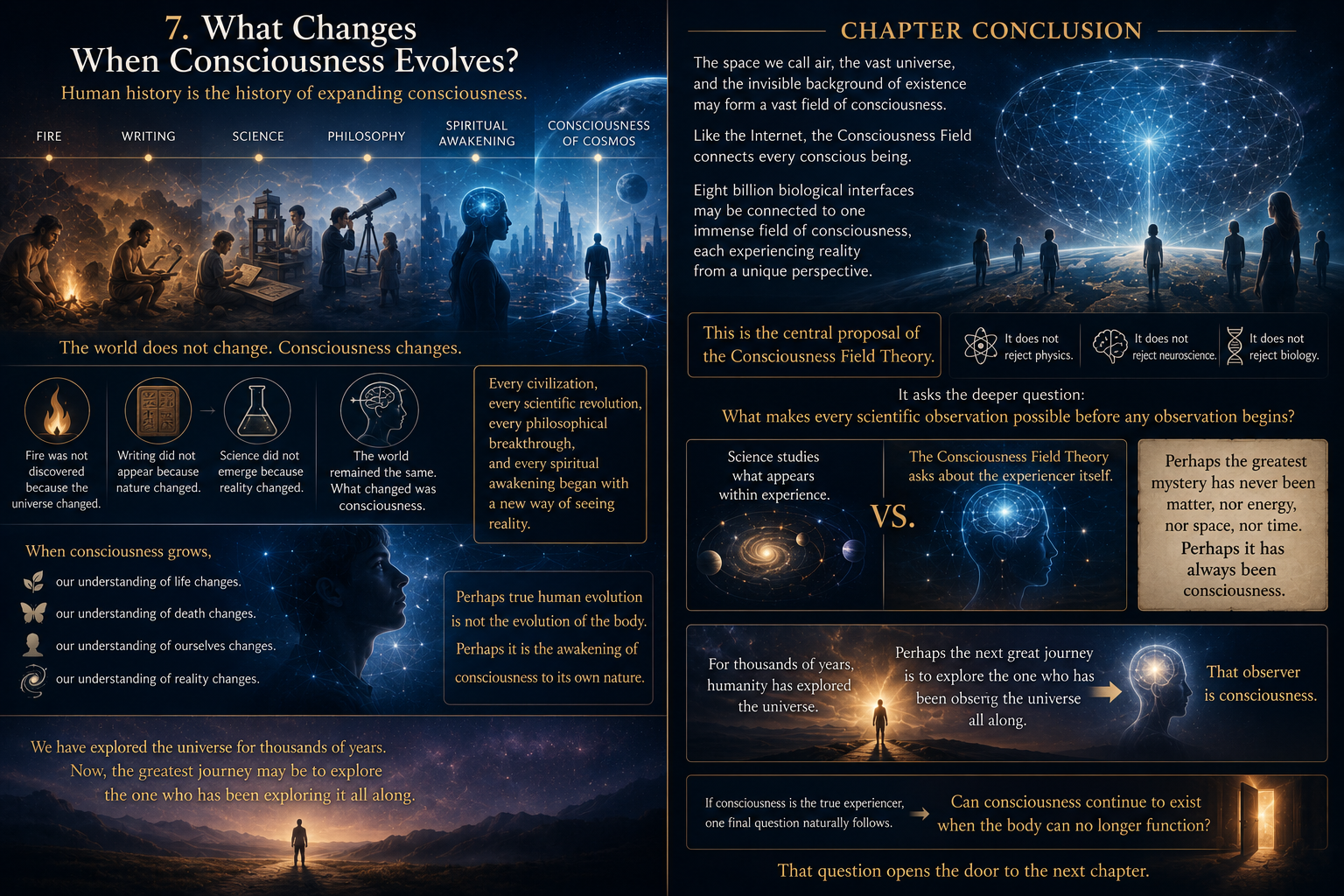
Fire was not discovered because the universe changed.
Writing did not appear because nature changed.
Science did not emerge because reality changed.
The world remained the same.
What changed was consciousness.
Every civilization,
every scientific revolution,
every philosophical breakthrough,
and every spiritual awakening
began with a new way of seeing reality.
Human history is not merely the history of technology.
It is the history of expanding consciousness.
Today we believe we understand the universe.
Yet perhaps we stand where ancient civilizations once stood,
confident,
but still unaware of the greatest mystery before us.
We have learned to explore matter.
We have learned to measure energy.
We have learned to decode life itself.
But we are only beginning to investigate the consciousness that makes every discovery possible.
Perhaps humanity’s next great leap will not come from faster computers,
more powerful machines,
or more advanced artificial intelligence.
Perhaps the next revolution will come from understanding the one reality that has accompanied every human experience from the very beginning.
Consciousness.
When consciousness grows,
our understanding of life changes.
Our understanding of death changes.
Our understanding of ourselves changes.
And ultimately,
our understanding of reality changes.
Perhaps true human evolution is not the evolution of the body.
Perhaps it is the awakening of consciousness to its own nature.
Chapter Conclusion
This book offers a different possibility.
The space we call air,
the vast universe stretching beyond our atmosphere,
and the invisible background of existence itself
may not be empty.
They may form a vast field of consciousness.
Consider the Internet.
A computer connected to a network can communicate,
create,
learn,
and share information.
Disconnected from that network,
it becomes an isolated machine.
Perhaps the human body functions in a similar way.
The body may be the interface.
Consciousness may be the user.
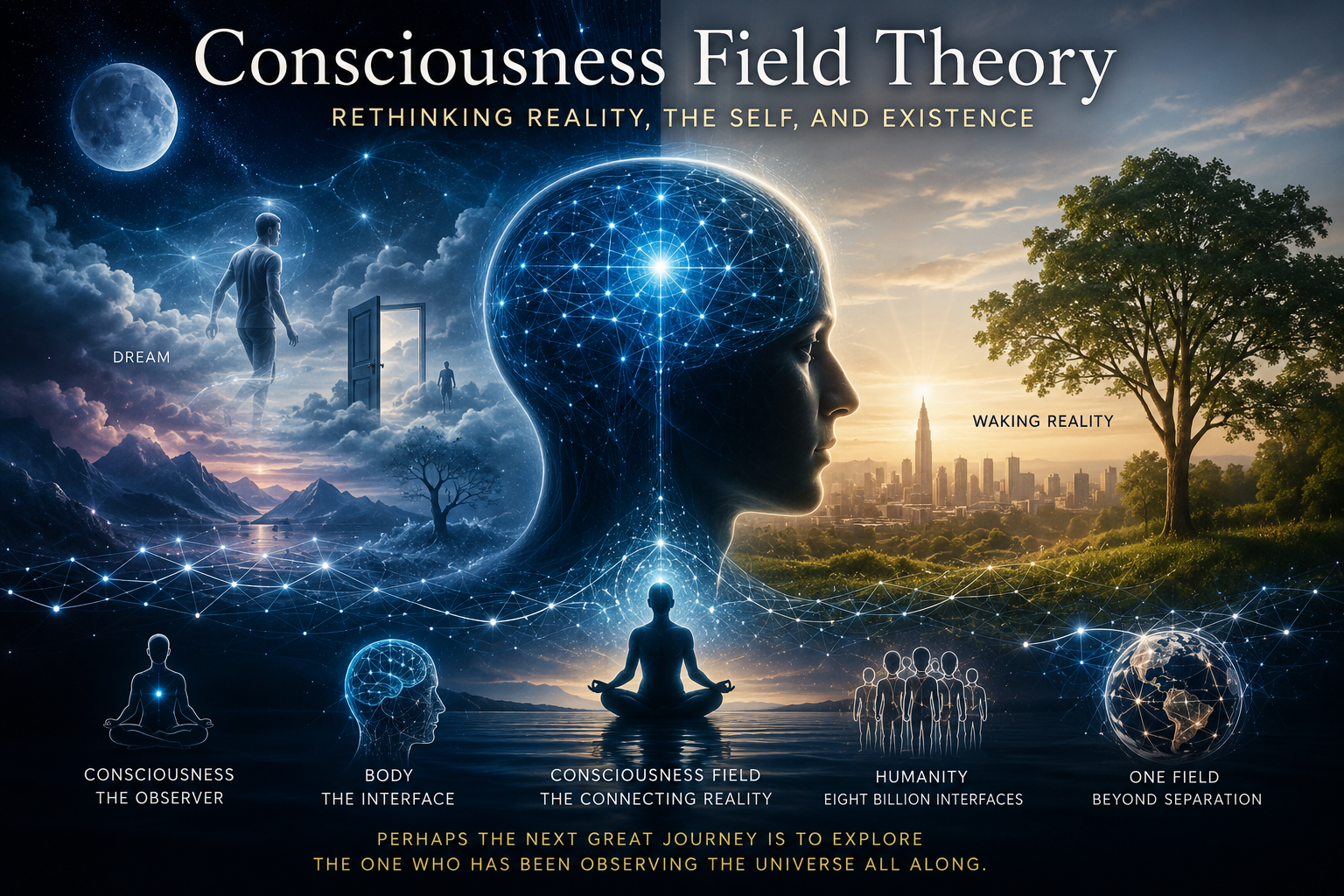
And the greater Consciousness Field may be the invisible reality connecting every conscious being.
At this moment,
more than eight billion people live on Earth.
Perhaps this does not mean that eight billion separate consciousnesses exist.
Perhaps it means that eight billion biological interfaces are connected to one immense field of consciousness,
each experiencing reality from a unique perspective.
This is the central proposal of the Consciousness Field Theory.
It does not reject physics.
It does not reject neuroscience.
It does not reject biology.
Instead,
it asks a question that lies beneath them all.
What makes every scientific observation possible before any observation begins?
Science studies what appears within experience.
The Consciousness Field Theory asks about the experiencer itself.
Perhaps the greatest mystery has never been matter.
Nor energy.
Nor space.
Nor time.
Perhaps it has always been consciousness.
Because before we can observe the universe,
there must first be someone capable of experiencing it.
For thousands of years, humanity has explored the universe.
Perhaps the next great journey is to explore the one who has been observing the universe all along.
That observer is consciousness.
And if consciousness is the true experiencer,
one final question naturally follows.
Can consciousness continue to exist when the body can no longer function?
That question opens the door to the next chapter.
2-Minute Video Description
Is your body really who you are?
Every night, you enter a dream with a different body.
You walk, speak, touch, and experience an entire world.
Yet when you wake up, that body disappears.
So who were you inside the dream?
In just two minutes, this thought experiment challenges one of our deepest assumptions about identity, reality, and consciousness.
Explore More
📖 Full Chapter (WordPress)
https://cheonbong.kr/is-your-body-really-you/
🎬 10-Minute Documentary
(Insert YouTube Link)
🎧 20-Minute Deep Audio Documentary
(Insert YouTube Link)
#Consciousness #Dreams #Reality #Philosophy #Neuroscience #ConsciousnessFieldTheory #Mind #Self #WhoAmI