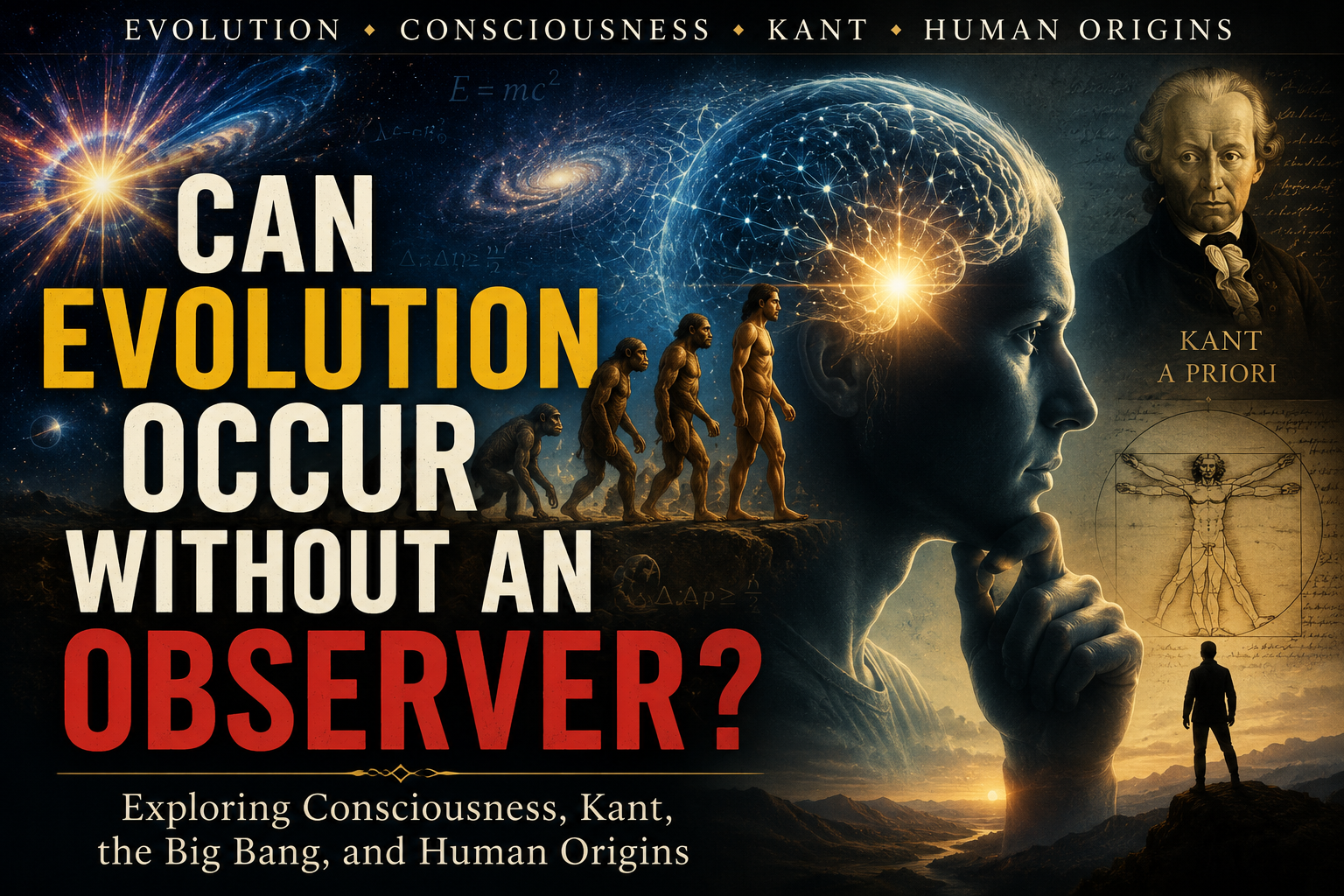
Can Evolution Occur Without an Observer? Rethinking Evolution Through Consciousness

Humanity has searched for its origin for a very long time.
We have dug into the earth.
We have examined ancient bones.
We have studied fossils buried beneath layers of rock.
We have compared DNA and reconstructed evolutionary trees.
And whenever we discovered an older skeleton, we asked the same question.
Could this be one of our earliest ancestors?
This search has produced remarkable scientific achievements.
Yet perhaps there is another question we have rarely asked.
Why have we always searched for the first human in bones?
What if the beginning of humanity cannot be found only in the body?
What if the deeper beginning of the human being lies in consciousness?
1. Evolution and the Theory of Evolution Are Not the Same Thing

Let us begin with an important distinction.
Evolution and the theory of evolution are not identical.
Evolution refers to a process believed to have occurred in nature.
The theory of evolution is a human explanation of that process.
Charles Darwin observed living organisms.
He compared differences among species.
He studied variation, inheritance, and adaptation.
Then he connected those observations into a coherent explanation of life.
This leads to a surprisingly simple question.
Could Darwin’s theory of evolution have existed without Darwin’s consciousness?
The question may sound strange.
But consider it carefully.
A fossil does not explain its own history.
A bone does not say:
“I am your ancestor from millions of years ago.”
DNA does not draw its own evolutionary tree.
Layers of rock do not independently write textbooks about geological time.
Someone observes.
Someone compares.
Someone remembers.
Someone arranges evidence within a sequence of time.
Someone discovers patterns and constructs an explanation.
That someone is a conscious subject.
Darwin did not create biological change.
But Darwin’s theory required observation, comparison, reasoning, memory, and language.
In other words, the theory required consciousness.
Then why has consciousness so often remained outside the center of our discussion about human origins?
2. Who Turned Scattered Evidence Into the History of Evolution?
The history of humanity appears to extend through an immense relay of time.
Across that vast temporal landscape, traces have remained.
Bones.
Fossils.
Genes.
Sedimentary layers.
Changes in biological structure.
Human beings discovered these traces and gave them meaning.
We recognized the concept of time.
We compared evidence scattered across different places.
We arranged those fragments into logical sequences.
Eventually, consciousness constructed the magnificent narrative we call the history of evolution.
This does not mean that natural phenomena did not occur independently of human beings.
The question is more subtle.
Even if objective natural events existed, what does a “history of evolution” mean without a subject capable of recognizing time, arranging evidence, recording history, and assigning meaning?
A fossil may exist.
But “the past” is already a temporal concept.
A genetic difference may exist.
But “development from an earlier form to a later form” requires an ordered sequence.
A bone may exist.
But “ancestor” and “descendant” are relational concepts constructed within a temporal framework.
Who recognizes these relationships?
Consciousness.
Therefore, we must distinguish between nature itself and the history of nature as consciously reconstructed.
Evolution and evolutionary theory are not the same.
The universe and cosmology are not the same.
The world and the world as known by us may not be perfectly identical.
Perhaps, while explaining the entire history of matter, we have overlooked the very subject that recognizes and explains that history.
Consciousness.
3. Can Evolution Exist Without Time?

Here we encounter Immanuel Kant.
Kant proposed one of the most radical ideas in the history of philosophy.
Space and time are not simply objects that we discover outside ourselves in the same way we discover a stone or a tree.
They are fundamental forms through which human beings experience phenomena.
We do not first encounter a world and then later add time and space.
The world we experience already appears to us through spatial and temporal forms.
Now consider evolution again.
Evolution requires time.
Millions of years.
Hundreds of millions of years.
Earlier organisms.
Later organisms.
Ancestors.
Descendants.
Mutation.
Selection.
Change.
All of these are arranged within a temporal sequence.
Then a philosophical question emerges.
If time is inseparable from the structure through which the human mind experiences the world, how should we understand a history extending billions of years before any human observer existed?
This question does not prove that evolution did not occur.
It asks something more fundamental.
Are we describing the world exactly as it exists independently of every possible knower?
Or are we reconstructing the past through the cognitive conditions by which consciousness understands reality?
Perhaps the history of evolution is scientifically powerful and yet still inseparable from the structure of human cognition.
If so, evolution may need to be reconsidered not only as a biological question but also as a philosophical question concerning consciousness.
4. Could the Big Bang Be Described Without Consciousness?
The same question can be directed toward cosmology.
Modern cosmology describes a universe that began approximately 13.8 billion years ago.
Georges Lemaître helped develop the idea of an expanding universe from the equations of general relativity.
Later observations strengthened the modern Big Bang model.
But again, consider the structure of the explanation.
Thirteen point eight billion years.
Expansion.
An earlier universe.
A later universe.
A beginning.
Development.
Cosmic history.
Every one of these concepts is understood within a framework of time and space.
Lemaître thought through consciousness.
Cosmologists calculate through consciousness.
Scientists observe light, compare measurements, construct mathematical models, and reconstruct cosmic history through conscious cognition.
Then we must ask:
Could the Big Bang theory have existed without a consciousness capable of recognizing time, space, sequence, measurement, and causality?
Again, this is not a denial of cosmology.
The universe is not the same thing as cosmological theory.
The Big Bang, as a proposed physical event, and the Big Bang theory, as a human model of cosmic history, must be distinguished.
The deeper question is this:
Are we unconsciously projecting the temporal and spatial structure of human cognition backward into a reality that existed before human consciousness?
And if we are, should modern cosmology and evolutionary theory be reconsidered in light of the philosophy of cognition?
5. The Observer Returned to Science

For centuries, science attempted to describe an objective world independent of the observer.
The ideal was simple.
Remove the human subject.
Measure the object.
Describe reality as it is.
But modern physics complicated this picture.
Quantum mechanics introduced profound questions concerning observation and measurement.
This does not mean that quantum physics has proven that human consciousness creates the universe.
Such a claim would go beyond scientific consensus.
Yet the observer and the conditions of measurement can no longer be treated as philosophically trivial.
The relationship between the observed and the conditions under which observation occurs became a serious problem.
This creates an unexpected connection with Kant.
Kant asked:
What are the conditions that make experience possible?
Modern physics asks:
What role do measurement conditions play in what can be physically described?
These are not identical questions.
But both disturb a simple assumption.
The assumption that the world can always be discussed without examining the conditions through which it becomes known.
Then perhaps another question must be asked.
Why should theories developed before the modern observer problem became central remain completely untouched by this philosophical transformation?
Darwin developed his theory in the nineteenth century.
Modern quantum theory emerged later.
Contemporary neuroscience developed later still.
Our understanding of perception, cognition, and the observer has changed.
Then should our interpretation of evolution remain philosophically frozen in the nineteenth century?
Perhaps evolution itself is not the only thing that evolves.
Perhaps our interpretation of evolution must evolve as well.
6. Edelman and the “Second Nature” We Experience
Neuroscience adds another layer to the problem.
Gerald Edelman’s work emphasized that the brain is not merely a passive machine that copies an external world.
Perception involves selection, categorization, memory, and reentrant neural processes.
The world we consciously experience is not simply a photographic duplicate delivered into the skull.
The brain actively participates in constructing the experienced world.
This suggests a profound distinction.
There may be nature.
And there is nature as experienced, categorized, and reconstructed by consciousness.
We might call this experienced reality a kind of second nature.
Consider a fossil.
The fossil is physically present.
But when consciousness encounters it, an enormous cognitive process begins.
We identify its shape.
We compare it with known organisms.
We estimate its age.
We place it within geological time.
We connect it with other fossils.
We construct a lineage.
Finally, we say:
“This organism lived millions of years ago.”
The physical fossil may belong to nature.
But the evolutionary history appearing in human knowledge is a reconstructed world of meaning.
A second nature.
Then a difficult question appears.
Have we sometimes mistaken our reconstruction of nature for nature in itself?
7. Before Human Consciousness, Who Observed the Age of Dinosaurs?
Imagine the age of dinosaurs.
No human historian was present.
No archaeologist.
No paleontologist.
No laboratory.
No calendar.
No scientific paper.
Yet today we speak confidently of the Jurassic and Cretaceous periods.
We describe extinction events.
We reconstruct ecosystems.
We estimate temperatures.
We draw maps of ancient continents.
How is this possible?
Because present consciousness examines present evidence and reconstructs a past.
The dinosaur age, as scientific history, appears in consciousness now.
This does not mean dinosaurs were imaginary.
It means that the “age of dinosaurs” as an ordered historical narrative is a present reconstruction by conscious subjects.
Then consider the philosophical weight of this fact.
We never travel directly into the past.
We encounter traces in the present.
From present evidence, consciousness constructs a temporal world.
The past is known through consciousness.
The history of evolution is known through consciousness.
The history of the universe is known through consciousness.
Then why do we continue to treat consciousness as a late and secondary accident of matter?
If consciousness is necessary even for the universe to become known as a universe with a history, perhaps the priority of matter is not as self-evident as we once believed.
8. What If Consciousness Comes First?
In the previous chapters, we asked a different question.
Where does consciousness come from?
Does the brain manufacture consciousness?
Or does the brain receive, organize, or manifest consciousness?
We also examined a simple problem.
Parents participate in the formation of a child’s body.
But do parents consciously design the child’s consciousness?
A mother does not choose the structure of her child’s subjective awareness.
A father does not program the child’s sense of “I.”
Yet a new conscious subject appears.
A new “I” opens its eyes.
Where did this “I” come from?
If consciousness belongs only to the individual brain, the question appears to end with biology.
But if consciousness cannot yet be fully reduced to neural activity, another path opens.
My consciousness.
The consciousness of my parents.
The consciousness of their parents.
The consciousness of our ancestors.
The consciousness of the earliest humans.
The First Consciousness.
And beyond the First Consciousness:
Original Consciousness.
The chain is not a biological family tree alone.
It is a genealogy of subjectivity.
We have spent centuries searching for the oldest human bone.
Perhaps we should also ask:
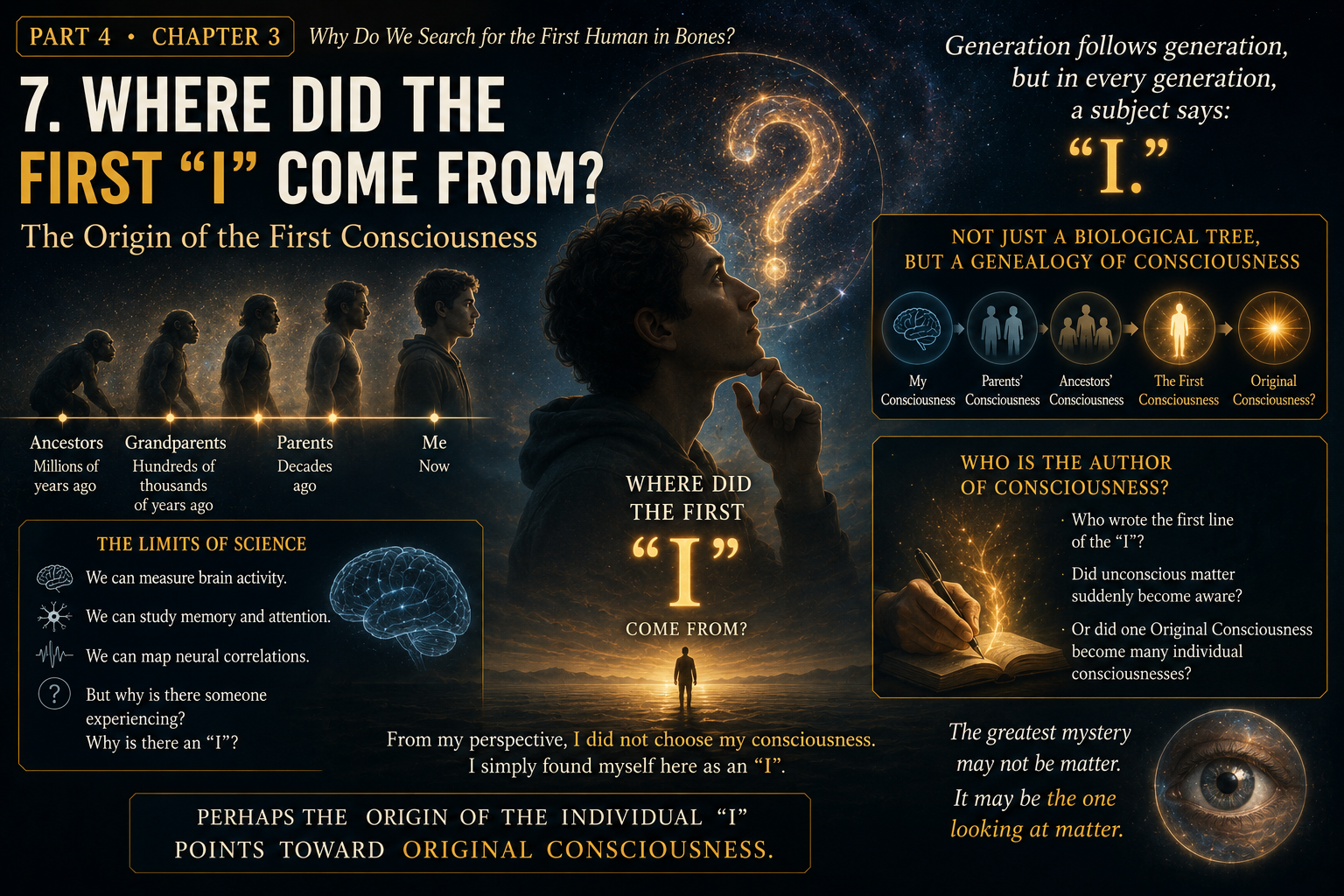
Where did the first “I” come from?
9. The First Human May Not Be the Oldest Skeleton

Suppose archaeologists discover an older hominin skeleton tomorrow.
Would that skeleton automatically be the first human?
What exactly makes a human human?
The shape of the pelvis?
The size of the skull?
The ability to walk upright?
The use of tools?
Or is there something more fundamental?
The awareness:
“I exist.”
The ability to experience a world.
The emergence of a subject for whom something appears.
Perhaps the true beginning of humanity cannot be identified only by bones.
Bones reveal bodies.
Tools reveal behavior.
Genes reveal biological relationships.
But none of these directly show us the first appearance of subjective consciousness.
The first conscious being may have left no fossil of consciousness.
Consciousness does not fossilize.
There is no skull containing a preserved “I.”
There is no archaeological layer in which subjective awareness can be excavated.
Then perhaps the greatest mistake in our search for the first human was methodological.
We searched for the origin of humanity only where matter could leave a trace.
We searched in bones because bones remain.
But consciousness leaves no bone.
10. From Me to My Parents, From My Parents to the First Consciousness
Let us follow consciousness backward.
I am conscious.
My parents were conscious.
Their parents were conscious.
Generation follows generation.
The body changes.
Faces disappear.
Names are forgotten.
Yet in every generation, a new subject says:
“I.”
At some point, if humanity had a beginning, there must have been an earliest human consciousness.
A first subject.
A first “I.”
Where did that consciousness come from?
Did unconscious matter suddenly discover itself?
Did a sufficiently complex arrangement of neurons cross an invisible line and say:
“I exist”?
Perhaps.
But this remains one of the deepest unsolved questions in science and philosophy.
We know increasingly much about neural correlations.
We can observe electrical activity.
We can map brain regions.
We can study perception, memory, and attention.
Yet the existence of subjective experience itself remains difficult to explain.
Why is there an experience at all?
Why is there someone experiencing?
Why is there an “I”?
If the first consciousness cannot be fully explained by the body alone, then the search must move beyond the skeleton.
From individual consciousness to ancestral consciousness.
From ancestral consciousness to the First Consciousness.
From the First Consciousness to Original Consciousness.
This is the genealogy of consciousness we are exploring.
11. Who Is the Author of Consciousness?
There is one fact that is extraordinarily difficult for me to deny.
Consciousness is occurring here, now.
I am questioning.
I am reading.
I am thinking.
I am aware that something is appearing to me.
I may doubt my interpretation of the world.
I may question my memories.
I may misunderstand what I see.
I may even ask whether the world I experience is identical to reality itself.
But the very act of doubting reveals something.
Conscious activity is taking place.
There is an experience.
And there is a subject to whom that experience appears.
In epistemology, perhaps this is one of the most immediate facts available to us.
My present consciousness is here.
This does not prove that consciousness is the only thing that exists.
Nor does it prove that the external world is unreal.
The point is more modest.
But perhaps it is also more important.
Before I construct a theory of the universe, evolution, matter, or the brain, consciousness is already present as the condition through which I ask the question.
The universe I know appears within conscious experience.
The history of evolution I understand is reconstructed within conscious experience.
My body itself is seen, felt, and recognized within conscious experience.
Then another question arises.
Is this consciousness entirely my private possession?
I say:
“My consciousness.”
“My thoughts.”
“My memories.”
“My life.”
Yet did I create the consciousness I call mine?
I did not choose to be born.
I did not design my own awareness before birth.
I did not write the first line of my own consciousness.
One day, from my present point of view, I simply found myself here.
A subject.
An “I.”
A world was already appearing.
Then let us follow the genealogy of consciousness once again.
Me.
My parents.
My ancestors.
The earliest human subject.
The First Consciousness.
And, by inference, Original Consciousness.
This genealogy itself is, of course, constructed within present consciousness.
We must admit this.
We cannot step outside consciousness, look at consciousness from nowhere, and verify Original Consciousness as we verify a stone placed on a laboratory table.
Original Consciousness is not directly available to us in that way.
But inference remains possible.
Much of human knowledge begins with present traces and moves toward causes that cannot be directly revisited.
We do not travel directly into the beginning of the universe.
We examine light and other present evidence and infer a cosmic history.
We do not personally witness millions of years of biological change.
We examine fossils, genes, and geological traces and reconstruct evolutionary history.
Likewise, if consciousness exists now, we may ask whether its existence points beyond the individual subject.
This brings us to a strange metaphor.
A drama has characters.
The characters speak.
They suffer.
They love.
They lose.
Within the drama, an entire world unfolds.
But behind the drama stands an author.
The author constructs the world in which the characters appear.
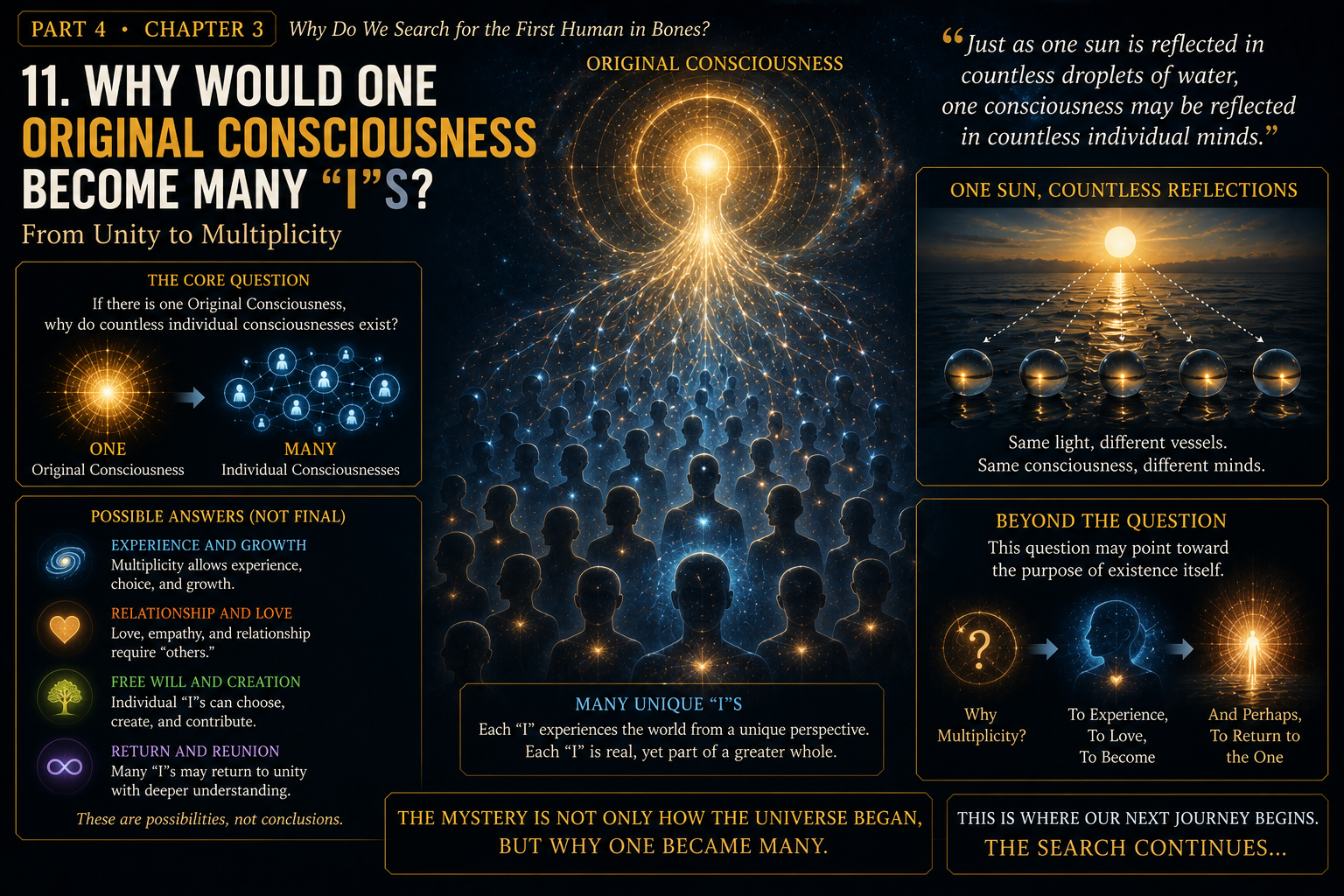
Then who is the author of consciousness?
Who wrote the first line of the “I”?
Who established the field in which individual consciousness appears, experiences a world, and lives a life?
I propose a possibility.
My life occurs within my consciousness and within a field of consciousness.
If so, the origin of the individual “I” may not be found only in the brain or in biological ancestry.
Perhaps the author of individual consciousness must be sought in Original Consciousness.
We cannot directly place Original Consciousness under a microscope.
We cannot photograph it.
We cannot excavate its fossil.
But we possess one immediate clue.
Consciousness exists here, now.
My consciousness is active.
I am aware.
And I am human.
This may lead to a provocative conclusion.
Humanity is not merely one more object contained within the world.
The human being is also the conscious subject through whom the world becomes observed, questioned, reconstructed, and known.
In this sense, the human being stands at the center of the known world.
Not necessarily at the physical center of the universe.
But at the epistemological center of the world that appears to us.
The question, then, is no longer only:
How did the human body evolve?
A deeper question has appeared.
Who is the author of the consciousness that says “I”?
Perhaps the genealogy of consciousness is pointing us toward an answer.
From me.
To my parents.
To my ancestors.
To the First Consciousness.
And beyond the First Consciousness:
Original Consciousness.
12. Matter Explains the Body. But Can Matter Explain the Observer?
Evolutionary theory provides a powerful explanation of biological change.
Cosmology provides a powerful explanation of cosmic development.
Neuroscience provides increasingly detailed explanations of brain function.
But one question remains standing at the center of all three.
Who knows these explanations?
The universe is measured by consciousness.
Evolution is reconstructed by consciousness.
The brain is studied by consciousness.
Even the claim that consciousness is produced by the brain is itself a proposition formed within consciousness.
This creates a strange circle.
Consciousness examines matter.
Then consciousness declares that matter produced consciousness.
But can the observer fully remove itself from the explanation and still claim to have explained the observer?
Perhaps the greatest mystery is not matter.
Perhaps the greatest mystery is the one looking at matter.
If every theory of matter appears through consciousness, then the priority of matter cannot simply be assumed without examining the nature of consciousness itself.
This does not prove that consciousness created matter.
It does, however, reveal a philosophical imbalance.
For centuries, we have asked how matter produced consciousness.
Perhaps it is time to ask the reverse question as well.
What if consciousness is more fundamental than we have assumed?
13. We May Have Been Searching in the Wrong Place

For a long time, humanity searched downward.
Into the earth.
Into fossils.
Into bones.
Into cells.
Into genes.
Into neurons.
This search has given us extraordinary knowledge.
But perhaps another direction is now necessary.
Not only downward into matter.
But inward toward the observer.
Who sees the fossil?
Who understands the gene?
Who reconstructs the past?
Who imagines the beginning of the universe?
Who asks where humanity came from?
The answer is always present before the question is completed.
Consciousness.
Therefore, perhaps the question is not simply:
Where is the oldest human skeleton?
The deeper question may be:
Where did the First Consciousness come from?
And if every individual consciousness can be traced conceptually backward through parents, ancestors, and the earliest conscious subject, then another question waits beyond the first human.
What was before the First Consciousness?
Was there an Original Consciousness?
A source from which individual consciousness emerged?
Perhaps the history of humanity did not begin when the first bone took a human shape.
Perhaps it began when the first “I” opened its eyes and a world appeared.
And perhaps even that first “I” was not the beginning.
The next question is unavoidable.
Why would one Original Consciousness become many individual consciousnesses?
That is where our next journey begins.