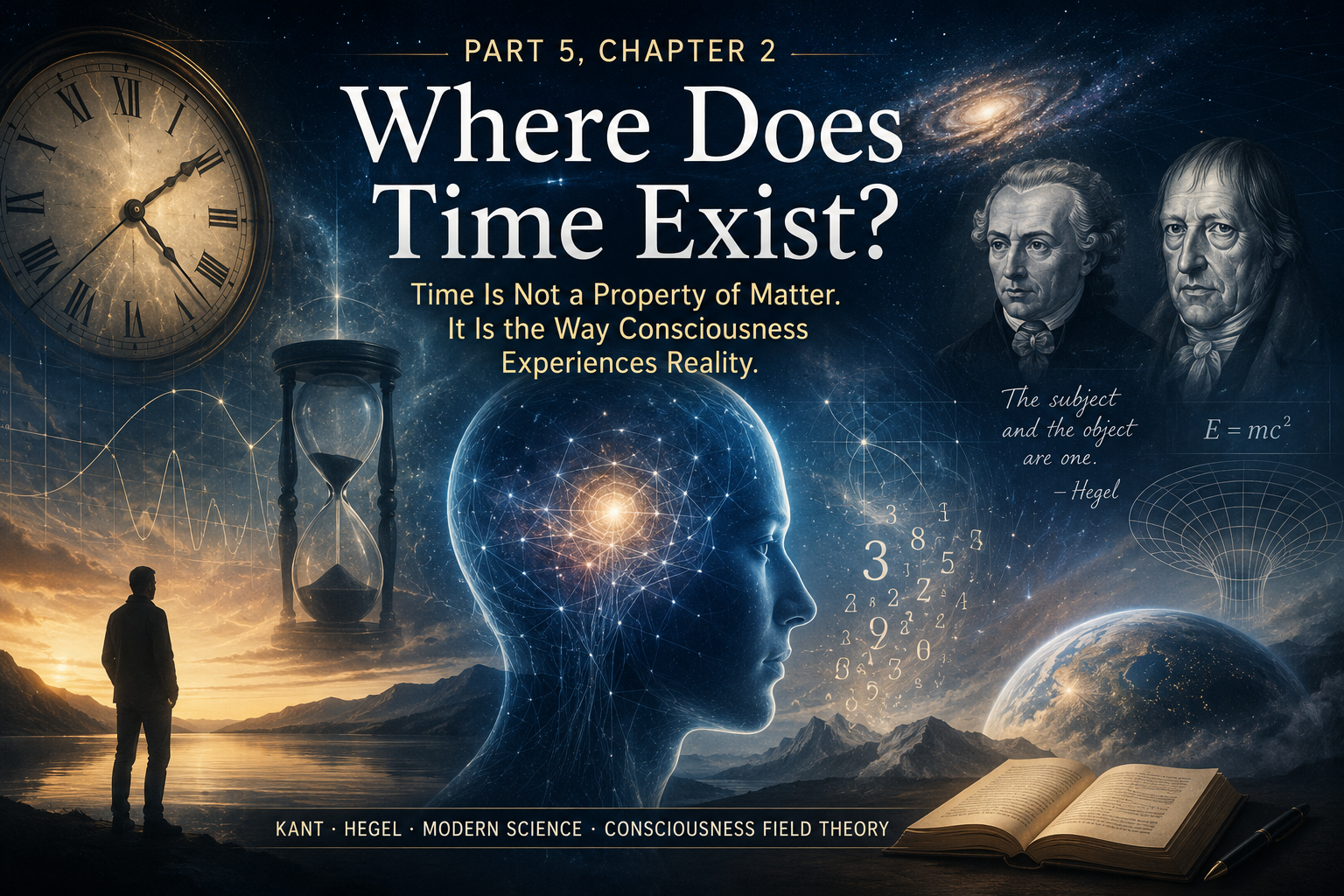
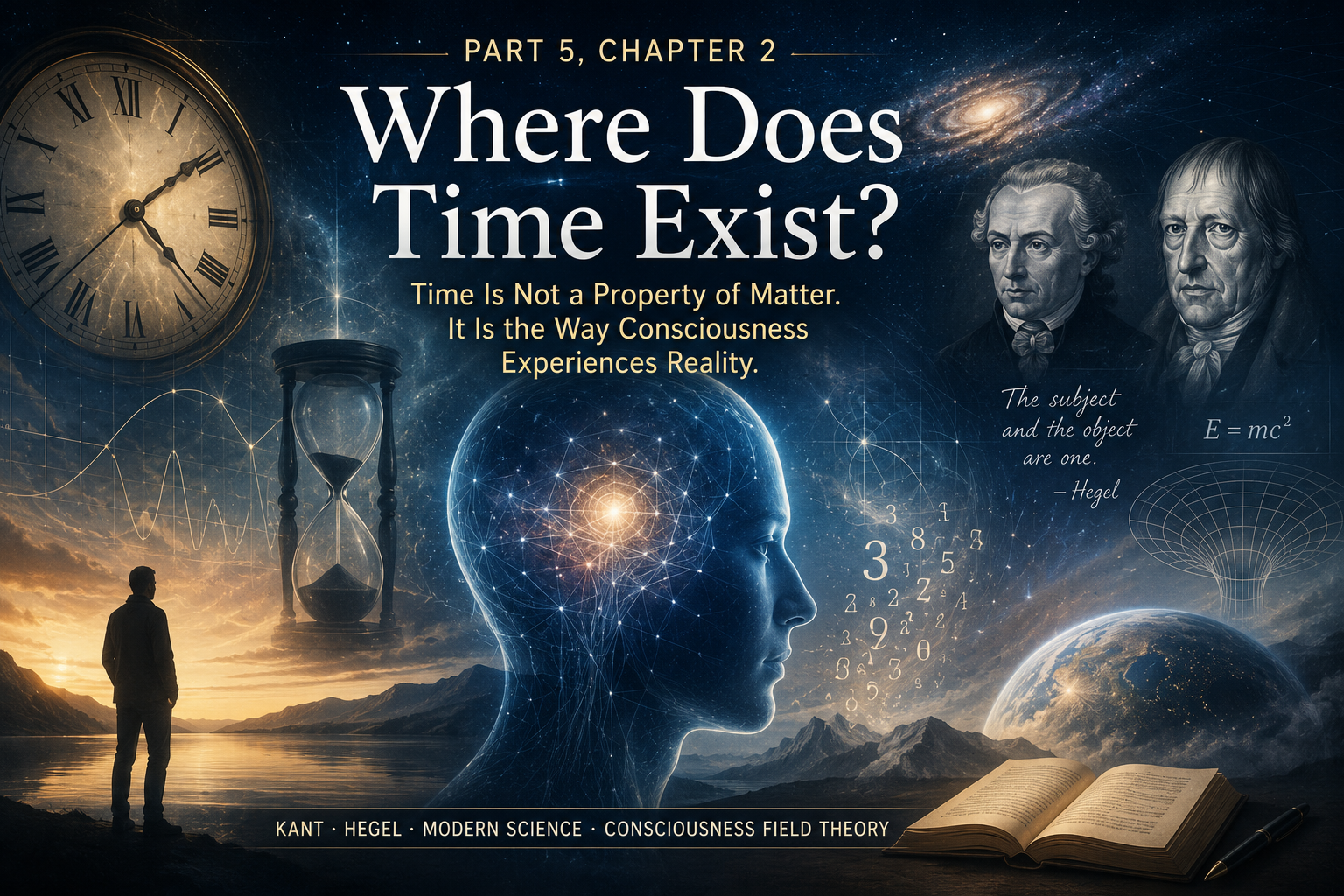
Time Is Not a Property of Matter. It Is the Way Consciousness Experiences Reality.
Section 1
Have We Ever Seen Time?
Where Does Time Exist
Time is one of the most familiar concepts in human life.
We constantly speak of yesterday, today, and tomorrow.
We measure our lives in years.
We schedule our days by hours and minutes.
Yet there is a surprising question that almost no one asks.
Have we ever actually seen time?
We have seen clocks.
We have watched the hands move.
We have measured change.
But no one has ever pointed to time itself.
No microscope has discovered it.
No telescope has photographed it.
No scientific instrument has isolated it.
We experience change,
but we never directly observe time.
This simple observation opens a profound philosophical question.
If time itself cannot be observed,
where does it actually exist?
Section 2
Does a Clock Measure Time or Change?
Most people believe that a clock measures time.
But does it?
A clock does not detect time itself.
It records movement.
The second hand rotates.
The pendulum swings.
A quartz crystal vibrates.
An atomic clock counts oscillations.
Every clock measures repeated physical change.
The concept of “time”
is something we assign to those changes.
Without a conscious observer,
there would still be motion.
There would still be change.
But would there be “time”
as we understand it?
This distinction is rarely discussed,
yet it may be one of the deepest questions in philosophy and science.
Section 3
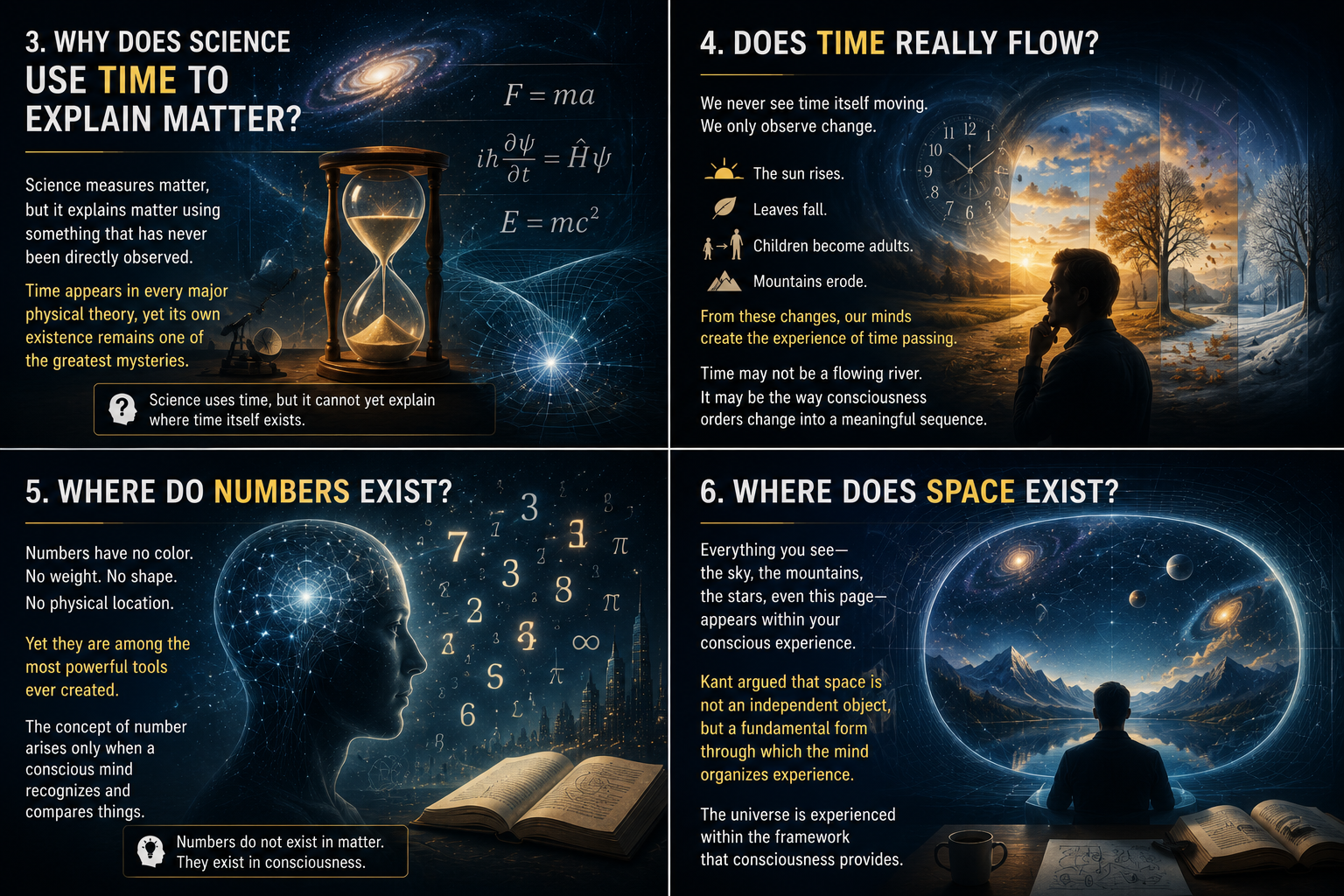
Why Does Science Use Time to Explain Matter?
Modern science describes the universe through equations.
Motion,
gravity,
electricity,
and even the evolution of stars
are expressed using time.
Yet an interesting paradox remains.
Science measures matter,
but it explains matter using something that has never been directly observed.
Time appears in every major physical theory.
However,
its own existence remains one of the greatest mysteries.
Perhaps this is why philosophers such as Immanuel Kant argued that time is not an object existing outside us,
but a fundamental form through which the human mind experiences reality.
If this is true,
then science is not merely describing the external universe.
It is also using one of the deepest structures of consciousness itself.
And that possibility changes everything.
Section 4
Does Time Really Flow?
People often say that time flows.
But have we ever seen time itself moving?
What we actually observe
is the continuous change of events.
The sun rises.
Leaves fall.
Children become adults.
Mountains slowly erode.
Everything around us changes.
From these changes,
our minds construct the experience of time passing.
Imagine a universe in which absolutely nothing changed.
No motion.
No growth.
No decay.
No thoughts.
Would anyone be able to say
that time was flowing?
Perhaps time is not an invisible river carrying the universe forward.
Perhaps it is the way consciousness orders change into a meaningful sequence.
If so,
time is not a substance.
It is a mode of experience.
Section 5
Where Do Numbers Exist?
Modern civilization depends upon numbers.
Science,
engineering,
economics,
and computers
all rely on mathematics.
Yet a simple question is rarely asked.
Where do numbers actually exist?
Can anyone find the number three
inside an atom?
Can a telescope discover the number one
floating somewhere in the universe?
Numbers have no color.
No weight.
No shape.
No physical location.
Yet they are among the most powerful tools ever created.
Their existence appears to belong
not to matter,
but to consciousness.
The universe may contain countless objects,
but the concept of number
arises only when a conscious mind recognizes and compares them.
Section 6
Where Does Space Exist?
We naturally believe
that space exists outside us.
We imagine an enormous universe
stretching in every direction.
But there is another question.
Where is the space
that you are experiencing right now?
Everything you see,
the sky,
the mountains,
the stars,
and even this page,
appears within your conscious experience.
Immanuel Kant argued
that space is not an independent object.
Rather,
it is one of the fundamental forms
through which the human mind organizes experience.
If this is true,
then what we call “external space”
is inseparable
from the structure of consciousness itself.
The universe is not simply observed through consciousness.
It is experienced
within the framework that consciousness provides.
This possibility invites us
to rethink the relationship
between reality,
space,
and the observer.
Section 7
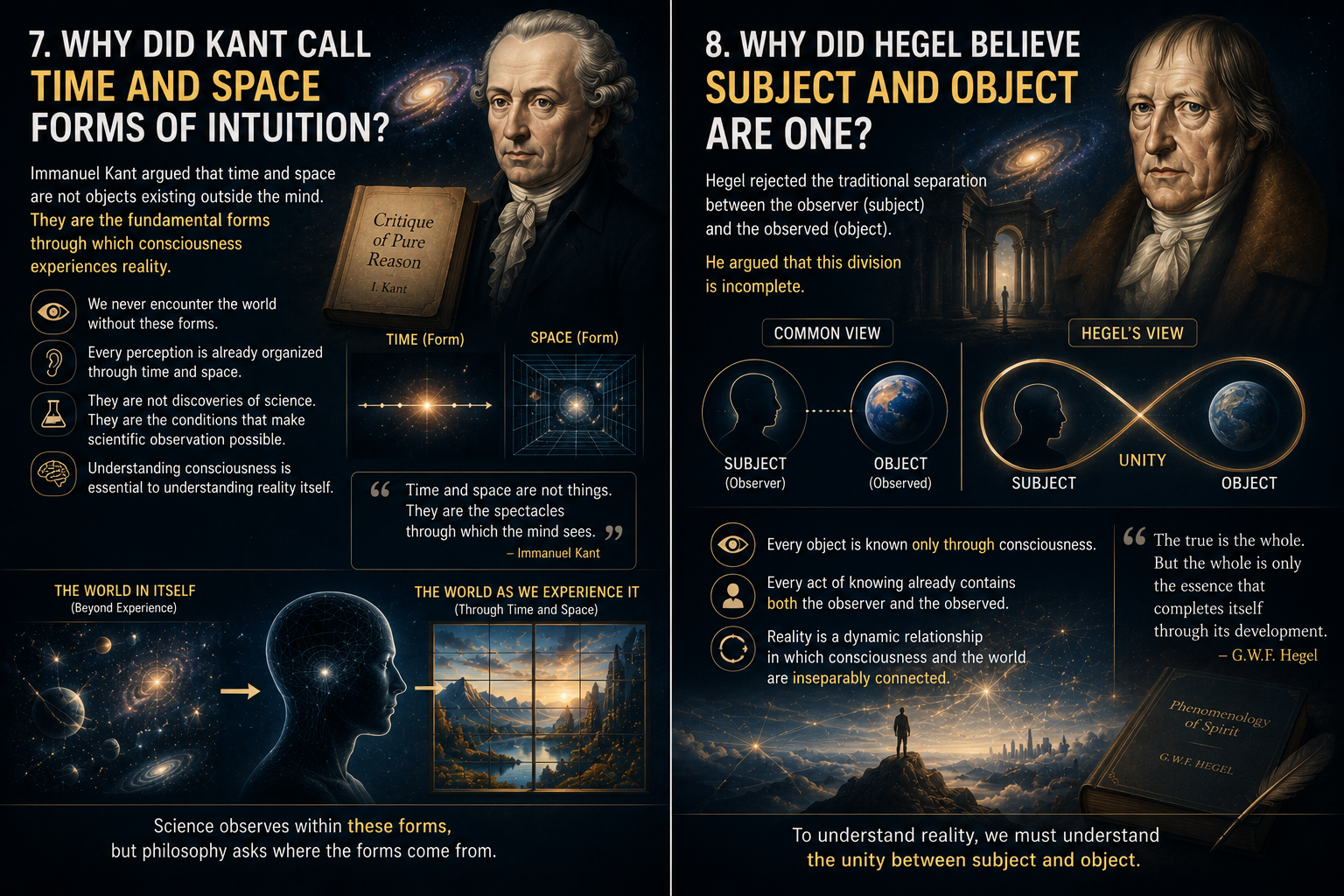
Why Did Kant Call Time and Space Forms of Intuition?
For centuries,
people believed
that time and space existed independently of human beings.
Immanuel Kant challenged that assumption.
He argued
that time and space are not objects existing outside the mind.
Instead,
they are the fundamental forms
through which consciousness experiences reality.
According to Kant,
we never encounter the world
without these forms.
Every sound,
every color,
every movement,
and every event
is already organized
through time and space
before we become aware of it.
This means
that time and space
are not discoveries of science.
They are the conditions
that make scientific observation possible.
Kant’s insight transformed philosophy.
It suggested
that understanding consciousness
is essential
to understanding reality itself.
Section 8
Why Did Hegel Believe Subject and Object Are One?
Georg Wilhelm Friedrich Hegel
took this idea even further.
He questioned
the traditional separation
between the observer
and the observed.
We often imagine
that there is a subject here
and an independent object over there.
But Hegel argued
that this division
is incomplete.
Every object
is known only
through consciousness.
Every act of knowing
already contains
both the observer
and the observed.
Reality is not simply
a collection of isolated objects.
It is a dynamic relationship
in which consciousness
and the world
are inseparably connected.
Understanding reality,
therefore,
requires understanding
the unity
between subject
and object.
Section 9
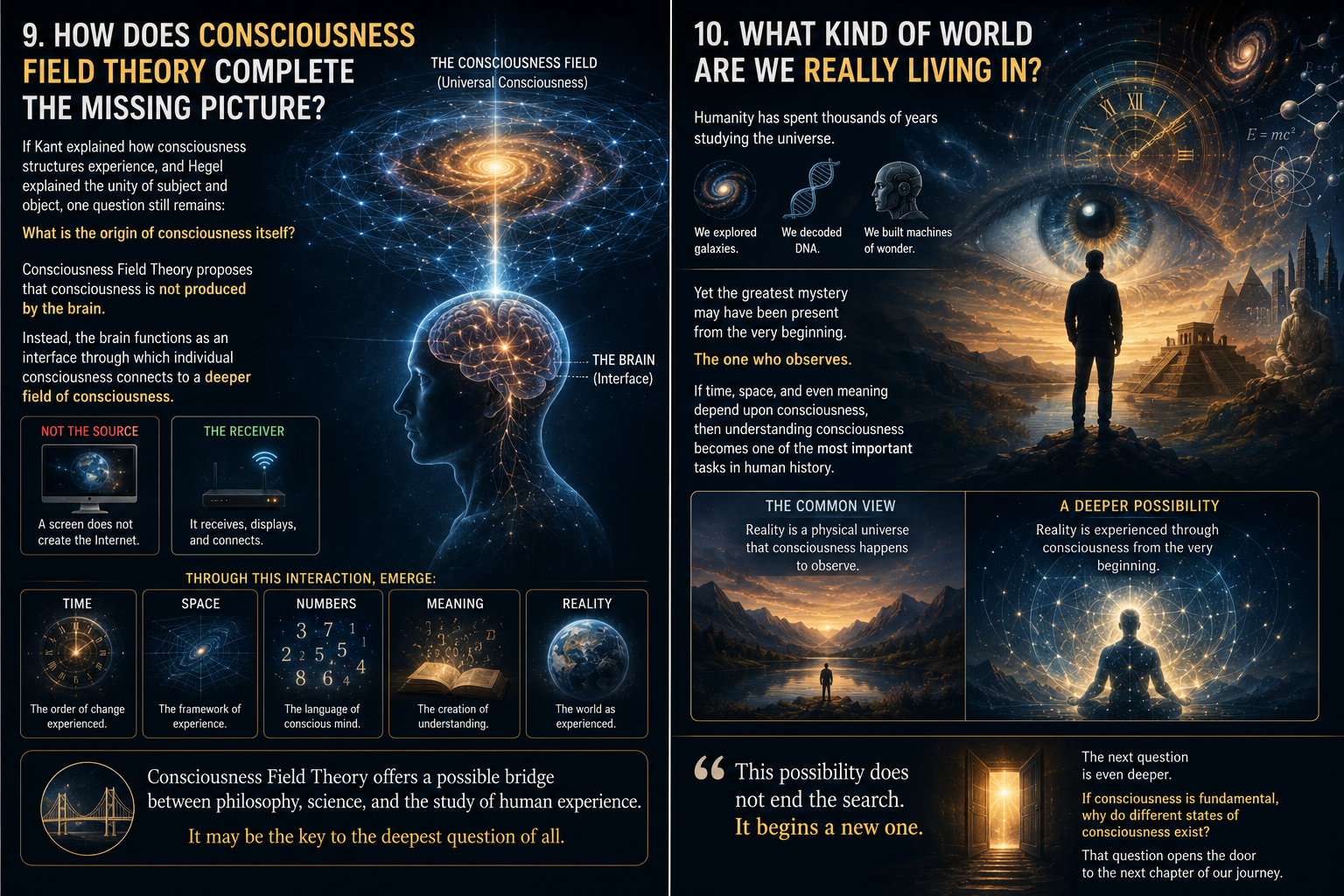
How Does Consciousness Field Theory Complete the Missing Picture?
If Kant explained
how consciousness structures experience,
and Hegel explained
the unity
between subject and object,
one question still remains.
What is the origin
of consciousness itself?
Consciousness Field Theory
proposes
that consciousness
is not produced
by the brain.
Instead,
the brain functions
as an interface
through which
individual consciousness
connects
to a deeper field
of consciousness.
Just as a computer screen
does not create
the internet,
the human brain
may not create consciousness.
It may simply
receive,
organize,
and express it.
From this perspective,
time,
space,
numbers,
and meaning
all emerge
through the interaction
between consciousness
and reality.
This view
offers a possible bridge
between philosophy,
science,
and the study
of human experience.
Section 10
What Kind of World Are We Really Living In?
Humanity has spent thousands of years
studying the universe.
We have explored galaxies,
decoded DNA,
and built machines
capable of extraordinary achievements.
Yet the greatest mystery
may have been present
from the very beginning.
The one who observes.
If time,
space,
and even meaning
depend upon consciousness,
then understanding consciousness
becomes
one of the most important tasks
in human history.
Perhaps reality
is not simply
a physical universe
that consciousness happens to observe.
Perhaps reality
is experienced
through consciousness
from the very beginning.
This possibility
does not end the search.
It begins a new one.
The next question
is even deeper.
If consciousness is fundamental,
why do different states of consciousness exist?
That question
opens the door
to the next chapter
of our journey.
🎬 Continue Exploring This Topic
🎥 2-Minute Introduction
Can you actually see time?
This 2-minute thought experiment challenges one of our deepest assumptions. If you’ve never questioned where time truly exists, this short video is the perfect place to begin.
👉 Watch the 2-Minute Video:
https://youtube.com/shorts/e5ZRw1yvqJo?feature=share
📺 10-Minute Documentary
Where does time really exist?
Discover how philosophy, modern science, Kant, Hegel, and Consciousness Field Theory come together to explore one of humanity’s greatest unanswered questions.
👉 Watch the 10-Minute Documentary:
(Insert your 10-minute video link here.)
안녕하세요 cheonbong84님

🎧 20+ Minute Deep Audio Documentary
Go beyond the summary and explore the complete journey.
This extended documentary offers a deeper investigation into time, consciousness, reality, and the relationship between philosophy, science, and human experience.
👉 Watch the 20+ Minute Deep Audio:
https://youtu.be/grvu_0OXEss