Did Consciousness Exist Before Atoms and the Universe?
Atoms never named themselves. Consciousness gave them a name.
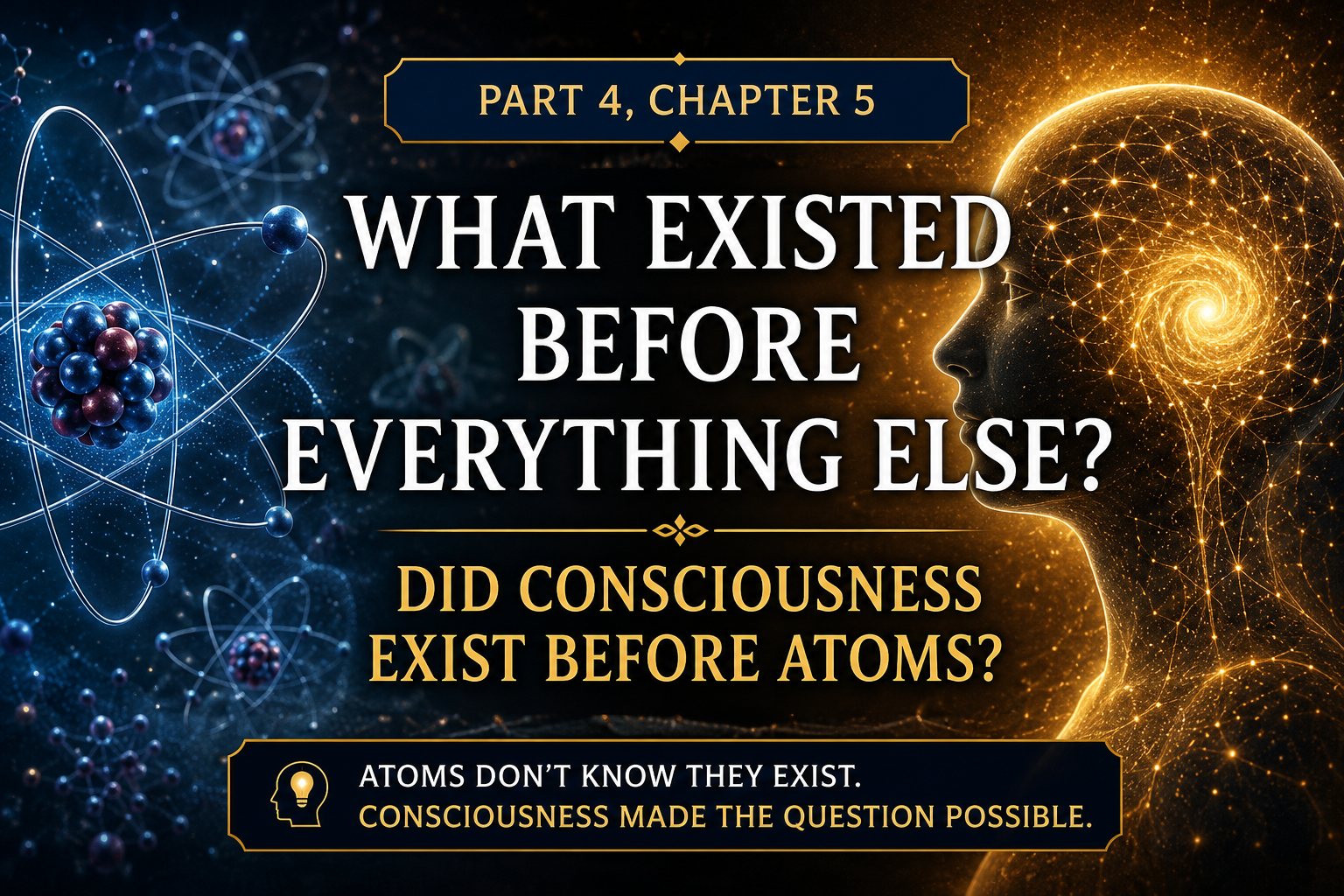
What Existed from the Very Beginning?
This chapter explores what existed from the very beginning and asks whether matter or consciousness is the true foundation of reality.
For centuries, humanity has searched for the first thing that existed.
Some said it was matter.
Others said energy.
Modern science points to atoms, quantum fields, or the Big Bang.
But there is a question that almost no one asks.
Who recognized any of these as existing in the first place?
What Existed from the Very Beginning?
Before we speak about atoms,
before we speak about galaxies,
before we speak about the beginning of the universe,
we must ask a more fundamental question.
Could anything be known without consciousness?
If atoms cannot know themselves,
and the universe cannot describe itself,
what was truly first?
Can Matter Exist Without a Knower?
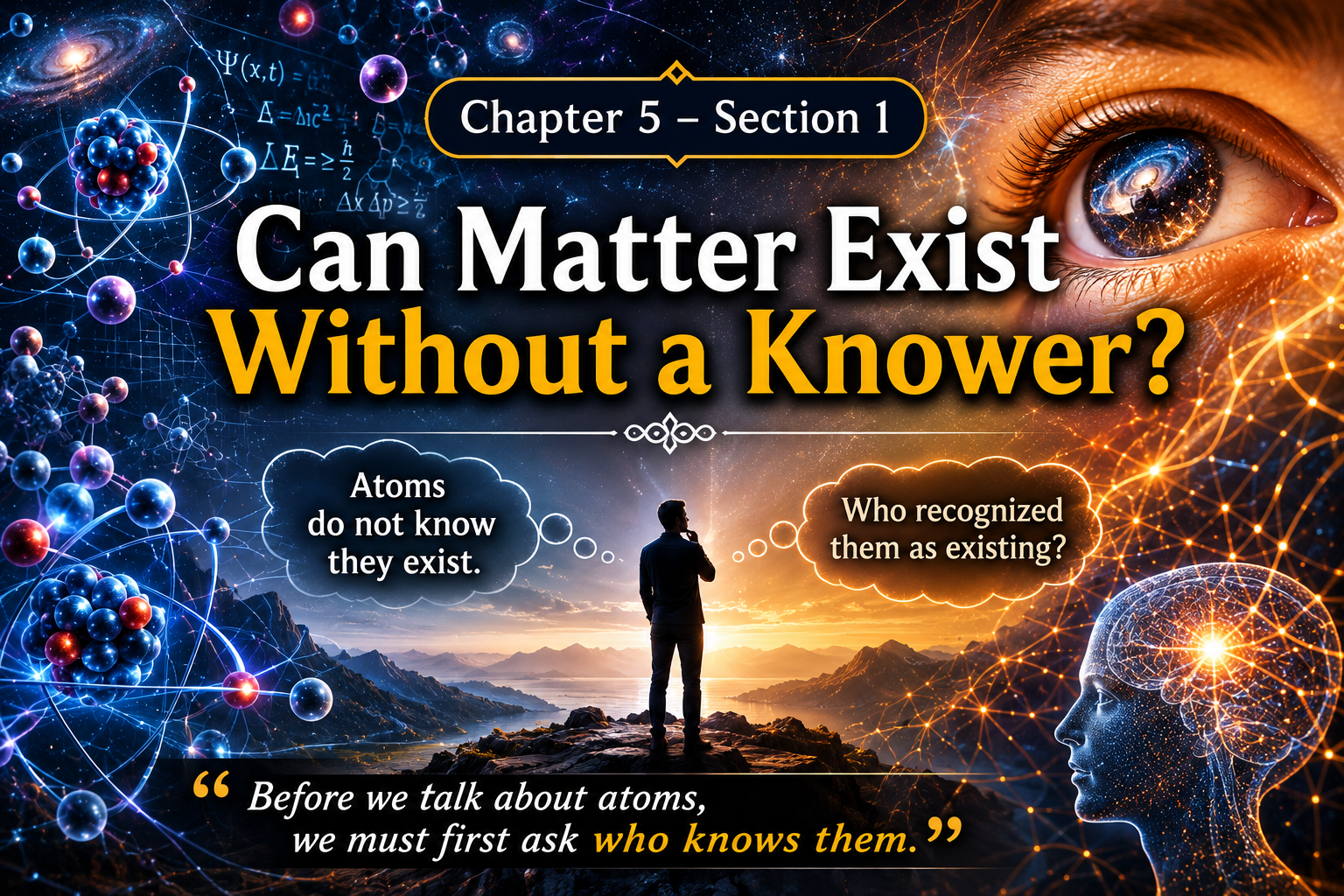
1. Can Matter Exist Without a Knower?
Can anything truly exist if nothing is there to recognize it?
Matter has never claimed that it exists.
An atom has never said,
“I am an atom.”
A galaxy has never announced,
“I am a galaxy.”
The universe has never explained itself.
Everything we call matter
became meaningful only after
consciousness recognized it.
That raises a profound question.
If matter cannot recognize itself,
who was the first to recognize matter?
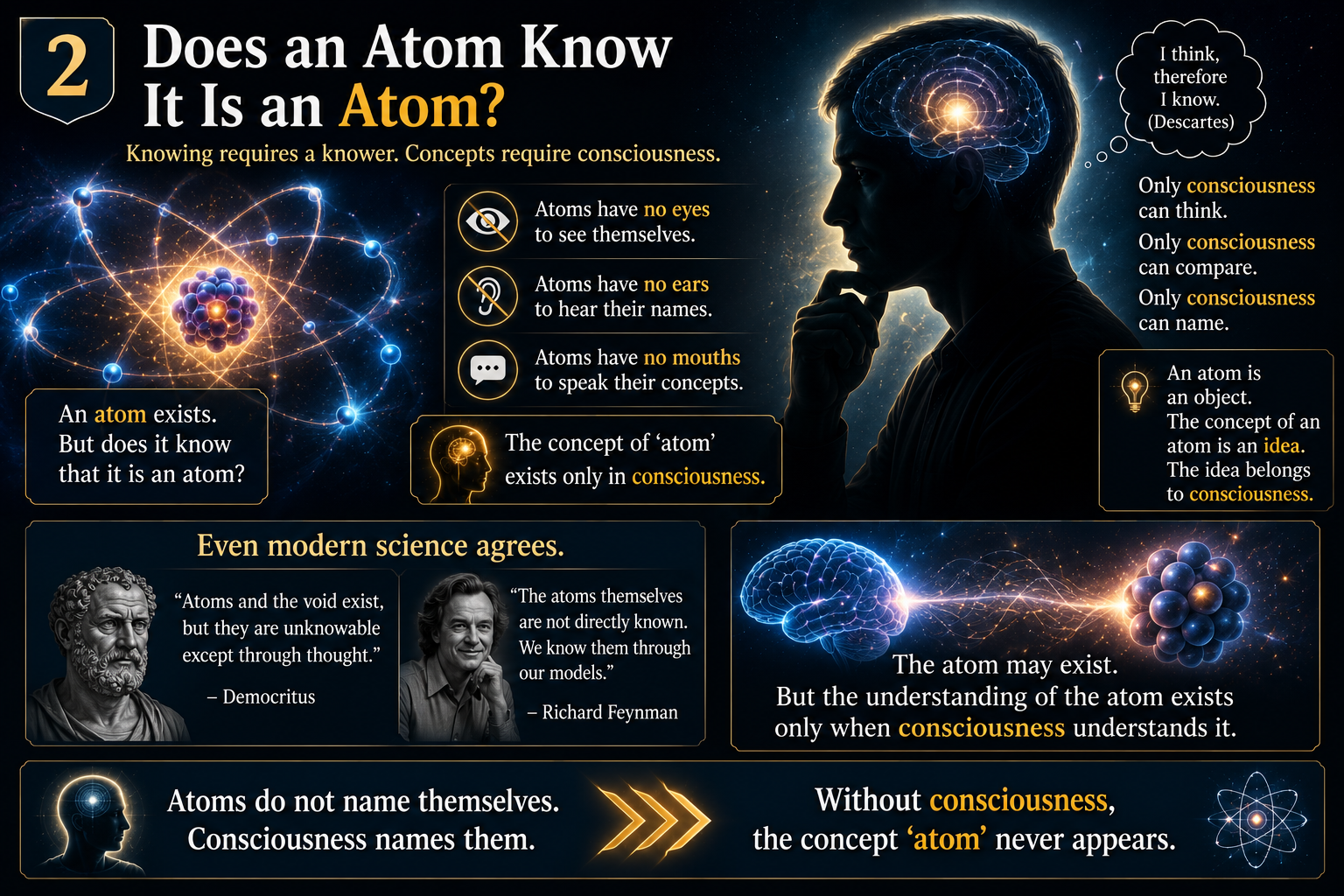
2. Does an Atom Know It Is an Atom?
If an atom cannot know itself, who gave it a name?
Every science textbook speaks about atoms.
Physicists describe their structure.
Chemists explain their reactions.
Biologists build life upon them.
But one simple question is almost never asked.
Has an atom ever called itself an atom?
The answer is obvious.
No atom has ever spoken.
No atom has ever thought.
No atom has ever recognized its own existence.
The word “atom” was created by consciousness.
The concept of an atom was discovered,
defined,
and understood
only because a conscious observer existed.
This changes the direction of the entire discussion.
Matter did not explain itself.
Consciousness explained matter.
The universe did not write the laws of physics.
Human consciousness discovered and described them.
Therefore, the deepest mystery is not the atom.
The deepest mystery is the one who knows the atom.
If consciousness is required
before anything can be understood,
shouldn’t consciousness itself become
the first subject of our investigation?
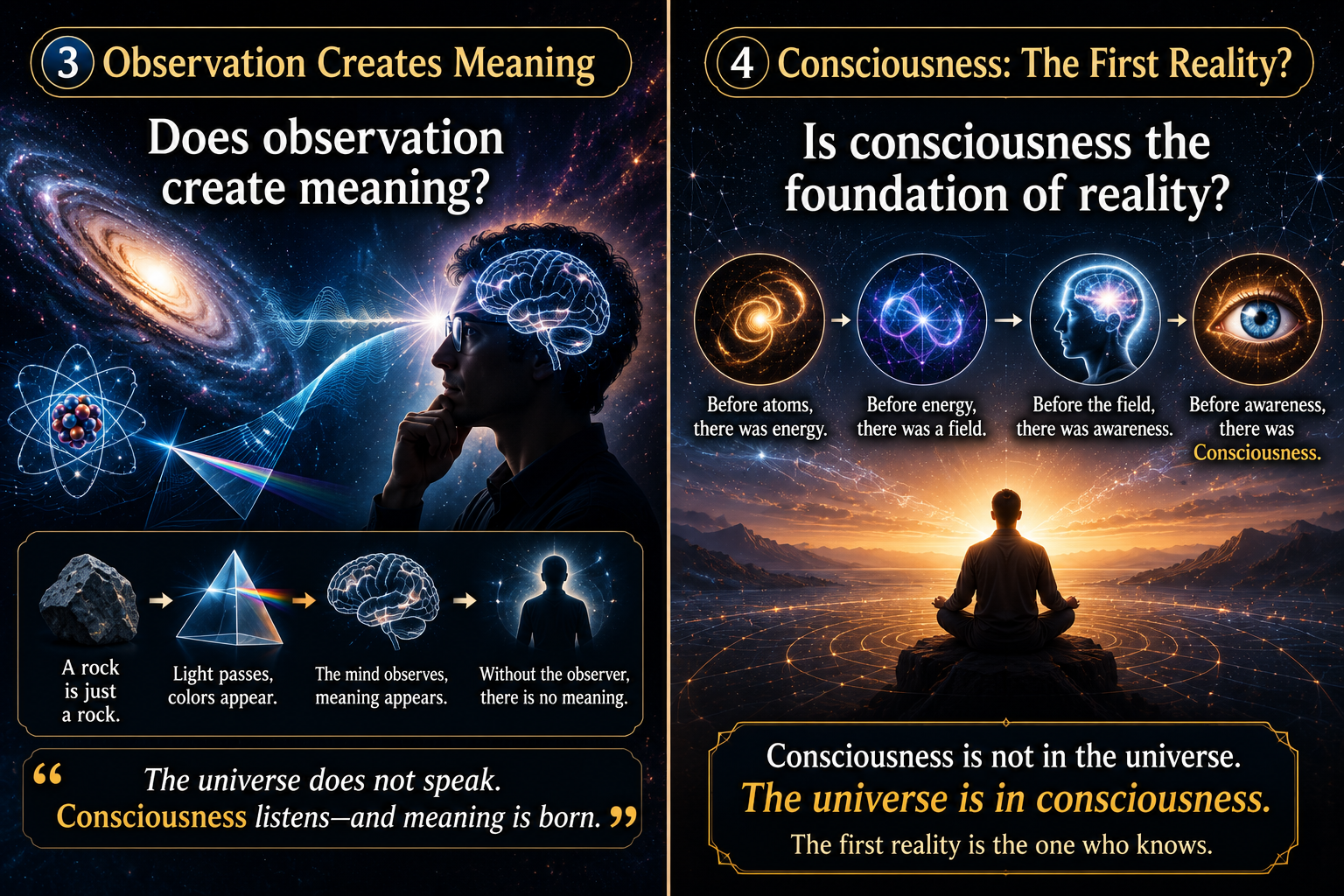
3. Does Observation Create Meaning?
Can anything have meaning before it is recognized?
A mountain does not call itself a mountain.
An ocean never says,
“I am the sea.”
A star does not know
that it is shining.
Without a conscious observer,
there are no names,
no concepts,
and no meaning.
The physical world may exist,
but meaning appears
only when consciousness recognizes it.
Think about a book
written in a language
no one can understand.
The words are there,
yet the meaning does not exist
for anyone.
Meaning is not stored in matter.
Meaning arises in consciousness.
The same is true of the universe.
Matter may exist,
but the universe becomes
a universe
only when consciousness understands it.
4. Is Consciousness the First Reality?
What if consciousness is not a product of the universe, but its foundation?
Modern science explains
how matter changes.
It explains
how stars are born,
how galaxies evolve,
and how atoms combine.
These discoveries
have transformed
our understanding
of the physical world.
Yet one mystery
still remains.
Science can describe
the processes
of the universe,
but it still cannot explain
why conscious experience exists.
Why is there
someone
who can understand
the universe?
Why does matter
become experience?
Perhaps
we have been asking
the wrong question.
Instead of asking,
“How did consciousness emerge from matter?”
perhaps we should ask,
“Could matter ever become meaningful without consciousness?”
Every scientific discovery,
every mathematical equation,
and every law of nature
must first be recognized
by consciousness.
Without consciousness,
there is no observation,
no understanding,
and no knowledge.
Consciousness is not merely
another object
inside the universe.
It is the condition
that makes
every object
knowable.
If this is true,
then another question
naturally follows.
Could consciousness
be the first reality,
rather than matter?
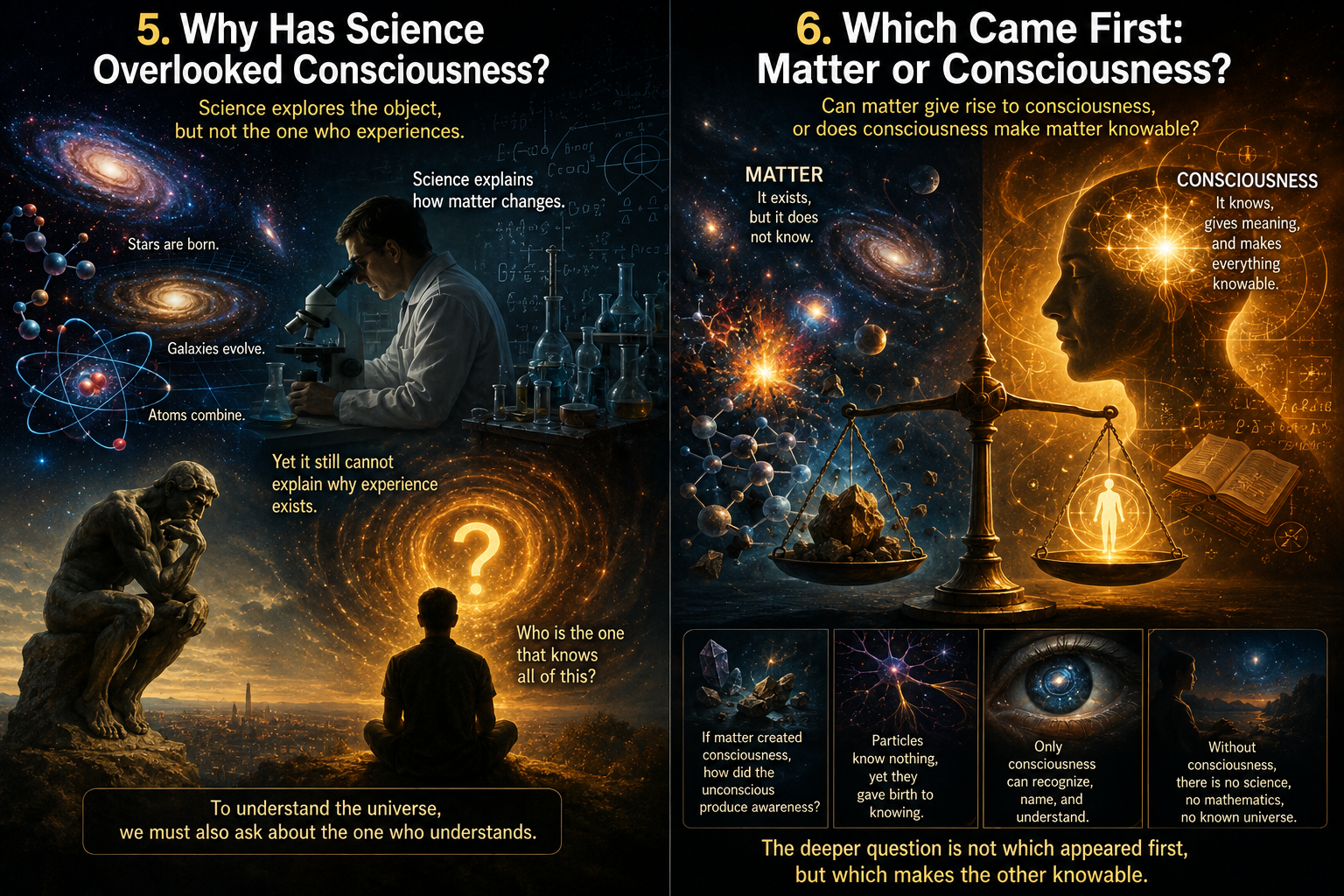
5.Why Has Science Overlooked Consciousness?
Why has science explained the universe so successfully, yet still struggles to explain consciousness?
Modern science
has transformed
our understanding
of reality.
It has revealed
the structure of atoms,
the evolution of stars,
the origin of galaxies,
and even the history
of the universe itself.
Its achievements
are extraordinary.
Yet one question
remains unanswered.
Who is the one
that knows all of this?
Science measures
the objects
of experience.
It analyzes
matter,
energy,
space,
and time.
But the one
who experiences
these things
cannot be placed
inside a laboratory.
Consciousness
cannot simply
be weighed,
measured,
or reduced
to numbers.
The brain
can be observed.
Neural activity
can be recorded.
Yet the experience
of being
“I”
still remains
a mystery.
Perhaps
science has not failed.
Perhaps
it has simply been
looking
in only one direction.
To understand
the universe,
we must study
the universe.
But to understand
consciousness,
we must also ask
about
the one
who understands.
Only then
can we begin
to approach
the deepest question
of all.
6.Which Came First: Matter or Consciousness?
Can matter give rise to consciousness, or does consciousness make matter knowable?
For centuries,
humanity has assumed
that matter came first.
From matter,
life emerged.
From life,
the brain evolved.
And from the brain,
consciousness appeared.
This has become
the most common explanation
of human existence.
But does it truly
answer the question?
Matter can be measured.
Energy can be calculated.
The brain
can be observed.
Yet none of these
explains
why there is
someone
who experiences them.
If matter
created consciousness,
how did unconscious matter
produce awareness?
How did particles,
which know nothing,
give birth
to a being
who can know
everything around it?
Perhaps
we have been asking
the question
from the wrong direction.
Matter may exist,
but matter
does not know
that it exists.
Only consciousness
can recognize matter,
give it a name,
and understand
its existence.
Without consciousness,
there is no science,
no mathematics,
no philosophy,
and no universe
that can be known.
The real question,
therefore,
is not simply
which came first.
The deeper question is:
Which makes
the other
knowable?
Until that question
is answered,
the mystery
of consciousness
will remain.
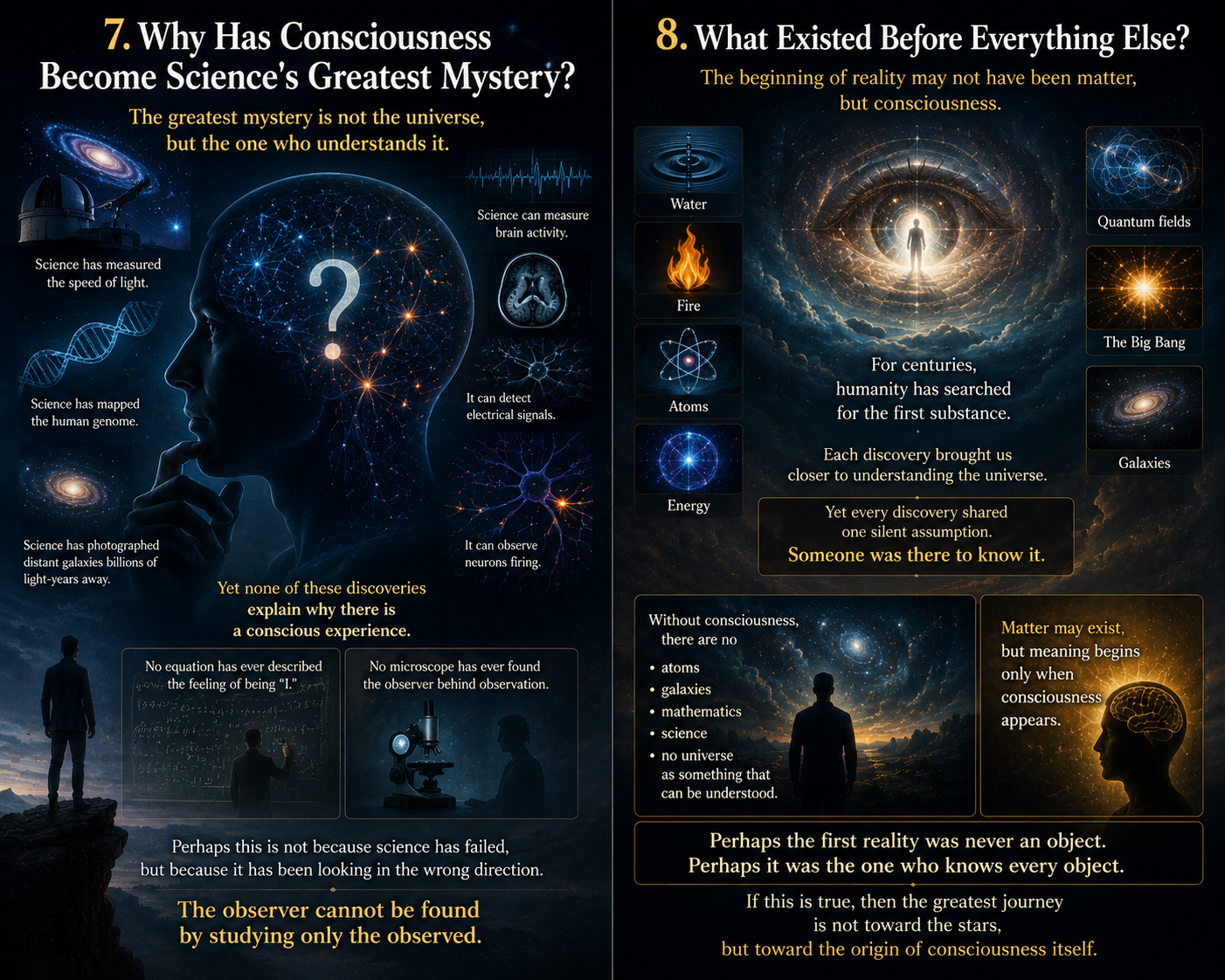
7. Why Has Consciousness Become Science’s Greatest Mystery?
.The greatest mystery is not the universe, but the one who understands it.
Modern science
has uncovered
remarkable truths.
It has measured
the speed of light.
It has mapped
the human genome.
It has photographed
distant galaxies
billions of light-years away.
Yet one question
remains unanswered.
Who is the one
experiencing all of this?
Science can measure
brain activity.
It can detect
electrical signals.
It can observe
neurons firing.
But none of these
discoveries explain
why conscious experience exists.
No equation
has ever described
the feeling
of being
“I.”
No microscope
has ever found
the observer
behind observation.
Perhaps
this is not because
science has failed,
but because
it has been looking
in the wrong direction.
The observer
cannot be found
by studying
only
the observed.
Perhaps
the greatest mystery
has never been
the universe itself.
Perhaps
it has always been
the consciousness
that understands
the universe.
8. What Existed Before Everything Else?
What if the beginning of reality was not matter alone, but something even more fundamental?
For centuries,
humanity has searched
for the first substance.
Water.
Fire.
Atoms.
Energy.
Quantum fields.
The Big Bang.
Each discovery
brought us
closer
to understanding
the universe.
Yet every discovery
shared
one silent assumption.
Someone
was there
to know it.
Without consciousness,
there are
no atoms
as concepts.
No galaxies
as realities
that can be understood.
No mathematics.
No science.
No universe
as something
that can be known.
Matter
may exist.
But meaning
begins
only when
consciousness
appears.
Perhaps
the first reality
was not simply
an object.
Perhaps
the deepest question
is not
what existed first,
but
who made
everything
knowable.
The search
for the beginning
of the universe
may ultimately
lead us
to the beginning
of consciousness.
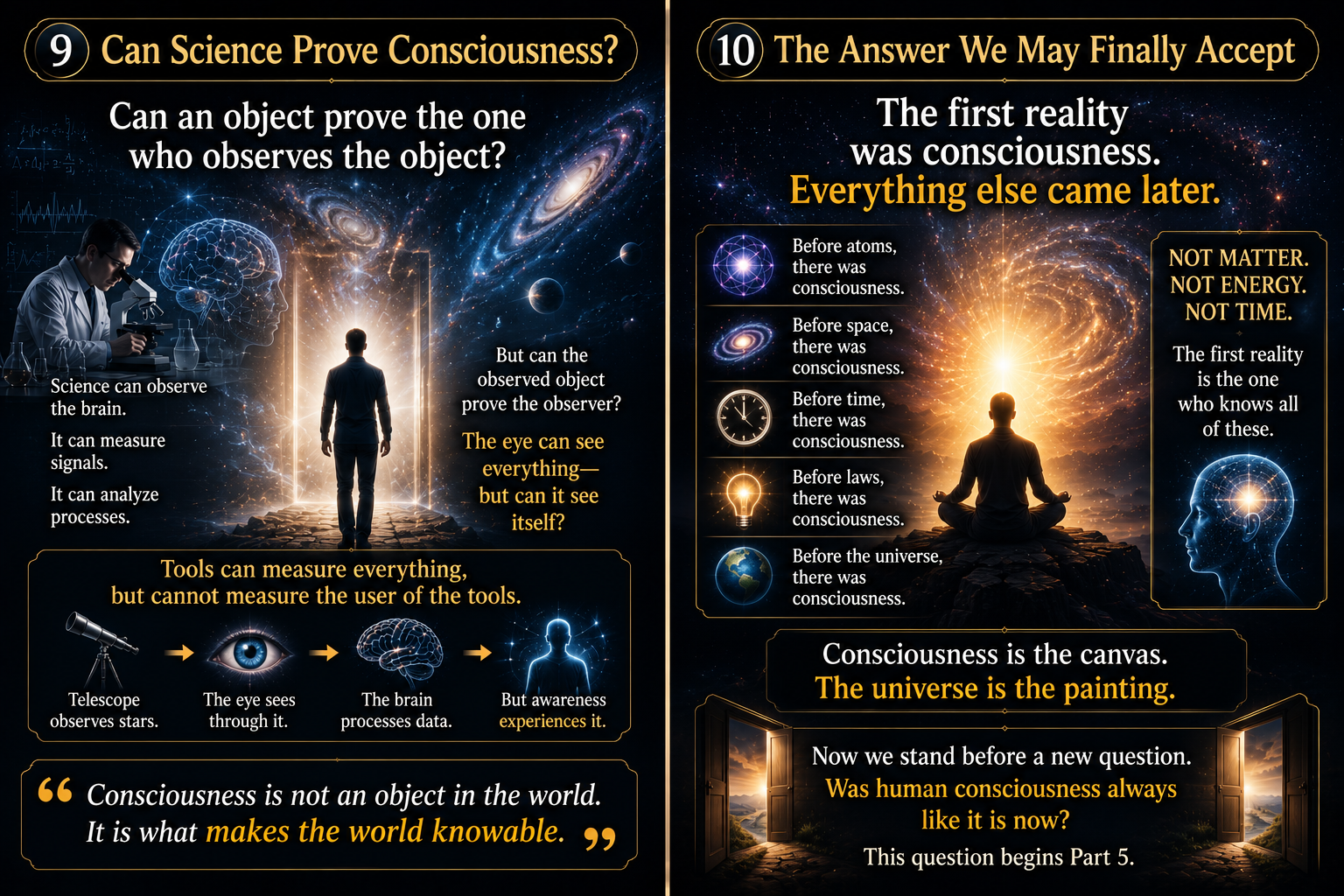
9. What Is the Relationship Between Matter and Consciousness?
Can matter appear without consciousness, or does consciousness give reality its meaning?
For centuries,
matter has been regarded
as the foundation
of reality.
Life,
mind,
and consciousness
were believed
to arise from matter.
This idea
has shaped
science,
philosophy,
and human thought
for generations.
But what if
the relationship
has been understood
in reverse?
Imagine
watching a movie.
Your attention
is drawn
to the characters,
the story,
and the moving images.
Rarely
do you notice
the screen
behind them.
Without the screen,
no image
could ever appear.
The images
change
from moment
to moment.
The screen
remains.
Matter
appears,
changes,
and disappears.
Consciousness
is what makes
every appearance
knowable.
Perhaps
matter
is not
the foundation
of reality.
Perhaps
it is reality
as it appears
within
consciousness.
10. What Question Comes Next?
If consciousness is the foundation of reality, can consciousness itself change?
Our journey
has taken us
from atoms
to galaxies,
from science
to philosophy,
from observation
to awareness.
We asked
what existed
before everything else.
We discovered
that every attempt
to understand reality
depends upon
the existence
of consciousness.
Without consciousness,
there is
no observation,
no knowledge,
and no meaning.
Yet one question
still remains.
What is
consciousness itself?
Is it
a single,
unchanging reality?
Or is it capable
of change,
growth,
and different
ways of
experiencing
the world?
Perhaps
understanding
the universe
begins
with understanding
the one
who experiences it.
And perhaps
that is
the greatest question
of all.
11. Which Came First: Matter or Consciousness?
If every discovery requires consciousness, which truly comes first?
For centuries,
science has searched
for the beginning
of the universe.
It has looked
for the first particle,
the first energy,
and the first moment
of cosmic history.
Yet every search
begins
with the same condition.
Someone
must be there
to recognize
what is found.
Matter
does not know
it exists.
An atom
does not know
it is an atom.
A galaxy
does not know
it is a galaxy.
Only consciousness
can recognize,
describe,
and understand
them.
Without consciousness,
matter
may still exist.
But it cannot become
knowledge,
meaning,
or experience.
Perhaps
the first question
is not
“What came first?”
Perhaps
it is,
“What makes
everything
knowable?”
If that answer
is consciousness,
then the beginning
of our understanding
does not lie
in matter,
but in
the one
who knows it.
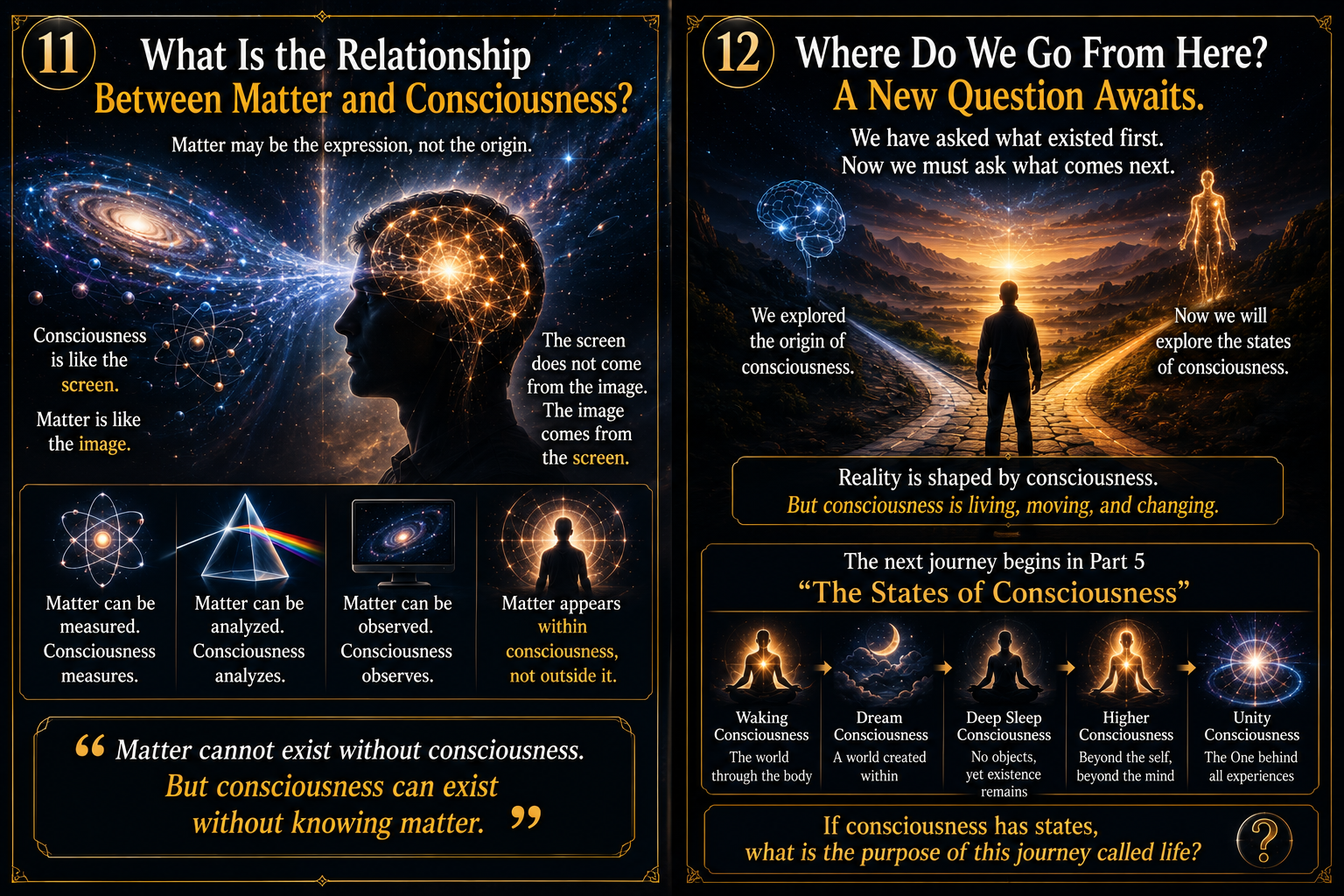
12. Where Do We Go From Here?
A new question now stands before us.
Throughout this chapter,
we asked
what existed
from the very beginning.
Was it
matter?
Energy?
Atoms?
Or consciousness?
The deeper
our search became,
the clearer
one truth emerged.
Every scientific theory,
every philosophical idea,
and every attempt
to understand reality
depends
upon consciousness.
Without consciousness,
there is
no observation,
no knowledge,
no science,
no mathematics,
no philosophy,
and no universe
that can be understood.
Yet one question
still remains.
Is consciousness
always the same?
Can it change?
Can it grow?
Can it awaken
to new ways
of experiencing reality?
If consciousness
is the foundation
of every experience,
then understanding
its nature
is only
the beginning.
The next journey
is no longer
about discovering
the origin
of consciousness.
It is about
discovering
how consciousness
has evolved,
how it changes,
and what
its future
may become.
Before Entering Part V
PROLOGUE
From the History of Matter to the History of Consciousness
Throughout this book, we have explored humanity, the universe, and the nature of consciousness through the lenses of philosophy and science.
For centuries, civilization has assumed that matter is the origin of all existence. Atoms formed the universe, matter gave rise to life, and life eventually produced consciousness. This material-centered worldview has become the foundation of modern philosophy, science, and civilization itself.
Yet our journey has led us to a fundamental question.
Was matter truly the beginning?
If there is no consciousness to perceive matter, can matter be said to exist as reality?
Immanuel Kant argued that the world we experience exists only within the framework of human cognition. Buddhism’s Yogācāra philosophy likewise teaches that consciousness alone is fundamental. Modern quantum physics, through the observer problem, suggests that reality cannot be fully separated from observation.
Different traditions, different languages, yet all point toward the same question.
Can reality exist independently of consciousness?
The Great Consciousness Field Theory offers a different answer.
It proposes that consciousness is not a by-product of matter. Rather, consciousness is the more fundamental field from which matter becomes manifest and knowable.
If this is true, we are not merely revising a scientific theory.
We are redefining the very starting point from which we understand reality.
Imagine discovering that the numbers we believed ran from one to one hundred were actually arranged from one hundred back to one. Correcting a single number would not be enough. The entire sequence would have to be read again from the beginning.
The same is true of our understanding of existence.
Humanity has interpreted the universe, life, and history from the standpoint of matter. But if consciousness is primary, then every conclusion built upon the assumption of material primacy deserves to be reconsidered.
This realization also changes how we understand human suffering.
War, conflict, greed, inequality, environmental destruction, disease, and the fear of death have long been treated as material problems requiring material solutions.
But if consciousness is the source of experience, then the origin of these problems may also lie within consciousness.
A stained photograph cannot be restored simply by editing the picture itself. If the stain comes from the camera, the camera must be repaired first.
Human life is no different.
The crises we observe may be only the visible images. Their true source may lie within the structure of consciousness itself.
Understanding consciousness, therefore, is not merely a philosophical pursuit. It may be the foundation for transforming both humanity and civilization.
At this point, religion must also be viewed in a new light.
History has traditionally separated material history from religious history. Material history has been regarded as factual, while religion has often been dismissed as mythology, belief, or spiritual imagination.
But if matter is the visible expression of consciousness, then religion can no longer be understood as something detached from reality.
Religion becomes the history of humanity’s exploration of consciousness.
Earlier in this book, we traced the path from our present consciousness to our parents, our ancestors, the first humans, and ultimately to Original Consciousness.
This is more than a biological genealogy.
It is the lineage of consciousness itself.
Seen from this perspective, the ideas of God, Buddha-nature, the Holy Spirit, enlightenment, liberation, and the soul may represent humanity’s enduring attempts to describe the same ultimate reality through different cultures, languages, and historical traditions.
Religion appears distant from reality only because reality has been defined too narrowly as matter.
If consciousness is fundamental, then religion is not separate from reality.
It is humanity’s record of seeking the origin of consciousness.
The chapters that follow are therefore not intended to persuade the reader to adopt any particular religion.
Nor are they written to determine which religion is right or wrong.
Instead, they explore how human civilizations, across thousands of years, have sought to understand consciousness, its origin, and its transformation.
Part Five is not simply a study of religion.
It is a journey through the history of human consciousness.
With the Great Consciousness Field Theory as our guide, we will revisit the world’s spiritual traditions from an entirely new perspective.
Having traveled through philosophy and science, we now enter another vast landscape.
The history of consciousness begins here.
📖 Watch the Video Series
🎬 2-Minute Introduction
🎬 10-Minute Exploration
🎬 20-Minute Deep Exploration
[20-minute link]