Chapter 1. What Is Consciousness?
The True Essence of Human Beings Is Consciousness, Not the Body
🎬 Before You Read
Before reading this chapter, you may wish to watch the YouTube documentary below. It introduces the central ideas explored in this chapter through narration, dialogue, and visual storytelling.
1. Consciousness Is the Essence of Human Beings
Among all the questions humanity has asked throughout history, few are more fundamental than this:
What is a human being?
At first glance, the answer seems obvious.
We have a body, a brain, thoughts, emotions, and memories. We are born, we grow older, and eventually we die. Because these experiences are shared by everyone, they appear to define what it means to be human.
Yet beneath this familiar understanding lies a deeper question.
What is it that experiences all of these things?
The body changes continuously throughout life. Cells are replaced, the brain develops and ages, and our appearance gradually transforms over time. Thoughts, emotions, beliefs, and memories also change. Even our personalities often evolve through experience.
Despite all these changes, we continue to experience ourselves as the same person.
What is it that remains?
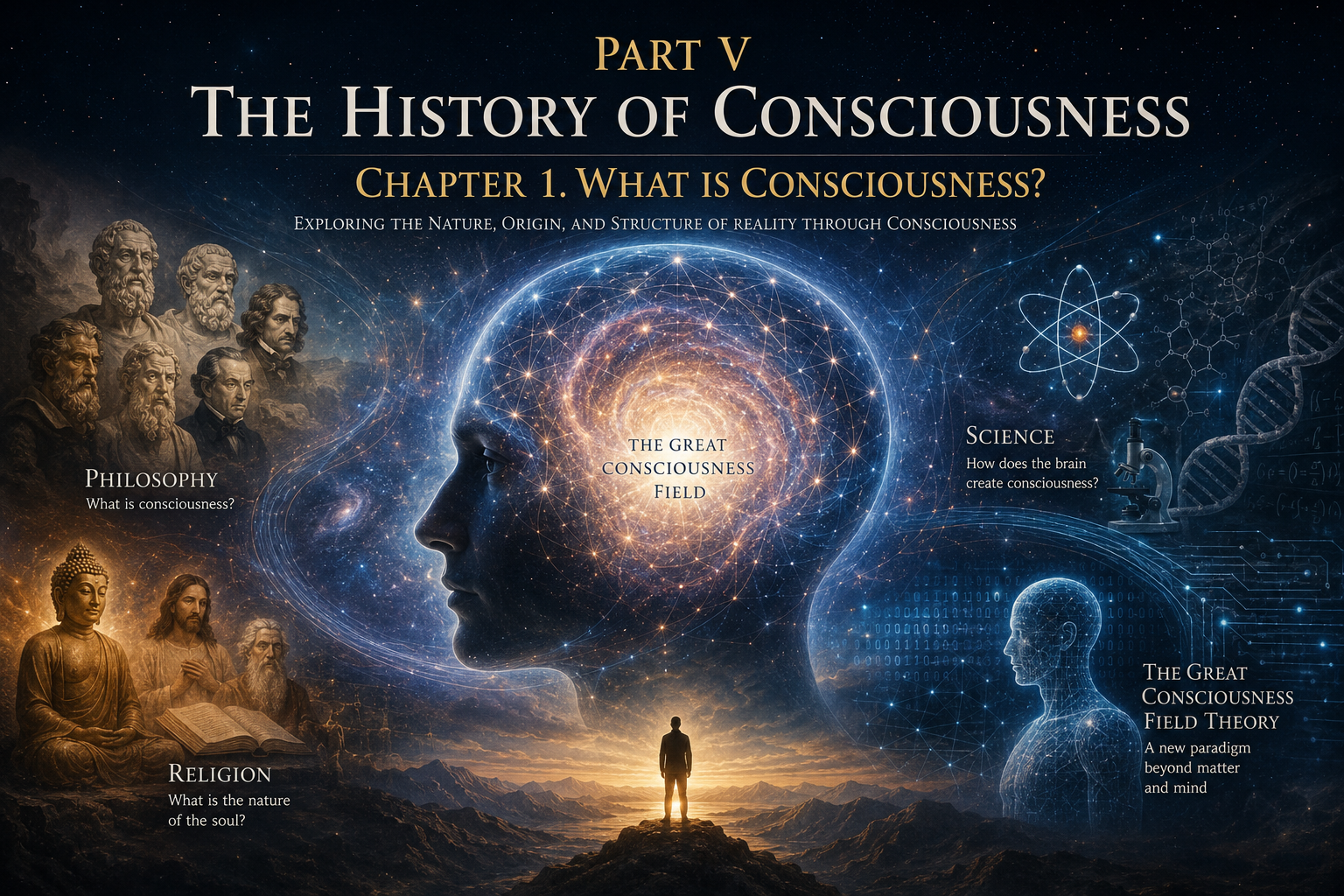
The Great Consciousness Field Theory proposes that the enduring essence of human existence is not the body but consciousness.
Consciousness is the reality that perceives, remembers, thinks, chooses, loves, questions, and searches for meaning. Without consciousness, the body is merely a living biological organism. It is consciousness that transforms biological life into human experience.
Throughout history, many people have identified themselves primarily with the body.
This is understandable.
The body is visible, tangible, and constantly present in our daily lives. We care for it, protect it, and often judge ourselves and others by its appearance, strength, or health.
Yet our deepest sense of identity does not arise from the body itself.
When someone says, “My hand hurts,” the speaker naturally distinguishes between the self and the hand. We say, “my body,” just as we say, “my thoughts” or “my emotions.” In everyday language, the one who possesses these things is subtly distinguished from the things possessed.
That quiet distinction invites a profound question.
Who is the “I” that says, “my body”?
The Great Consciousness Field Theory answers that the “I” is consciousness.
This perspective does not deny the importance of the body.
Rather, it places the body in its proper relationship to the deeper reality that experiences life through it.
If consciousness is indeed the true essence of human beings, then many of our assumptions about life, identity, and even death may need to be reconsidered.
Understanding consciousness is therefore not simply another philosophical exercise.
It is the beginning of understanding ourselves.
2. The Body Is the Instrument of Consciousness
If consciousness is the true essence of a human being, what role does the body play?
Some may conclude that if consciousness is primary, then the body must be of little importance. The Great Consciousness Field Theory reaches a very different conclusion.
The body is not the essence of our existence, but it is the indispensable instrument through which consciousness is expressed in the physical world.
Every word we speak, every act of kindness we perform, and every idea we create becomes possible because consciousness is able to act through the body.
The eyes allow consciousness to perceive the visible world.
The ears receive sound.
The hands transform intention into action.
The feet carry us wherever consciousness chooses to go.
The face reveals emotions that words cannot fully express.
Each part of the body serves as an instrument through which consciousness encounters reality.
A simple analogy may help.
Imagine a musician and a violin.
Without the musician, the violin remains silent.
Without the violin, the musician cannot perform that particular music.
The instrument is essential, but no one mistakes the violin for the musician.
The relationship between consciousness and the body is much the same.
The body allows consciousness to express itself, yet it is not identical with consciousness itself.
This distinction becomes clearer when we consider human identity.
A person who loses an arm, a leg, or even the ability to see or hear does not lose his or her humanity.
Physical abilities may change, but the person remains the same individual.
Why?
Because human identity is rooted more deeply than the body.
It is grounded in consciousness.
This does not make the body unimportant.
On the contrary, the condition of the body greatly influences how fully consciousness can express itself.
A healthy body expands the possibilities for learning, creating, loving, and serving others.
Illness or injury may limit those expressions, but it does not diminish the value of the consciousness that lives through the body.
Among all the organs of the body, the brain occupies a uniquely important position.
Through the brain, consciousness perceives, remembers, reasons, and communicates with the world.
Yet acknowledging the importance of the brain does not necessarily mean that the brain creates consciousness itself.
A musical instrument makes a performance possible, but it is not the source of the music.
Likewise, the brain may be understood as the extraordinary instrument through which consciousness is expressed within physical reality.
Rather than placing the body and consciousness in opposition, the Great Consciousness Field Theory understands them as partners.
Consciousness gives meaning to the body.
The body gives consciousness a way to participate in the world.
Together they form the living reality we call a human being.
This naturally leads to an even deeper question.
Where does consciousness itself come from?
3. Where Does Consciousness Come From?
If consciousness is the true essence of a human being, we are naturally led to one of the oldest and most profound questions in human history.
Where does consciousness come from?
For centuries, philosophers, scientists, and religious thinkers have offered different answers.
Despite remarkable advances in neuroscience, psychology, and philosophy, no explanation has gained universal acceptance.
The origin of consciousness remains one of humanity’s greatest mysteries.
Modern science generally explains consciousness as being closely connected to the activity of the brain.
The human brain contains approximately eighty-six billion neurons that constantly exchange electrochemical signals.
Through these extraordinarily complex interactions, thoughts, emotions, memories, and decisions emerge.
Research has shown that damage to specific areas of the brain can alter memory, personality, language, and behavior.
These discoveries clearly demonstrate that the brain plays a crucial role in the expression of consciousness.
Yet an important question remains.
Does the close relationship between the brain and consciousness necessarily prove that the brain creates consciousness?
These are not the same claim.
Consider a radio.
When music comes from a radio, we do not conclude that the radio has created the music.
The radio receives invisible signals and converts them into sound.
If the radio is damaged, the music can no longer be heard, but the broadcast itself continues to exist.
The Great Consciousness Field Theory suggests that the human brain may function in a similar way.
Rather than producing consciousness, the brain may serve as an extraordinarily sophisticated interface that receives, organizes, and expresses consciousness within the physical world.
If this perspective is correct, changes in consciousness caused by brain injury would not necessarily prove that consciousness originates in the brain.
Instead, they would demonstrate that a damaged interface can no longer express consciousness completely.
At present, science has not conclusively answered this question.
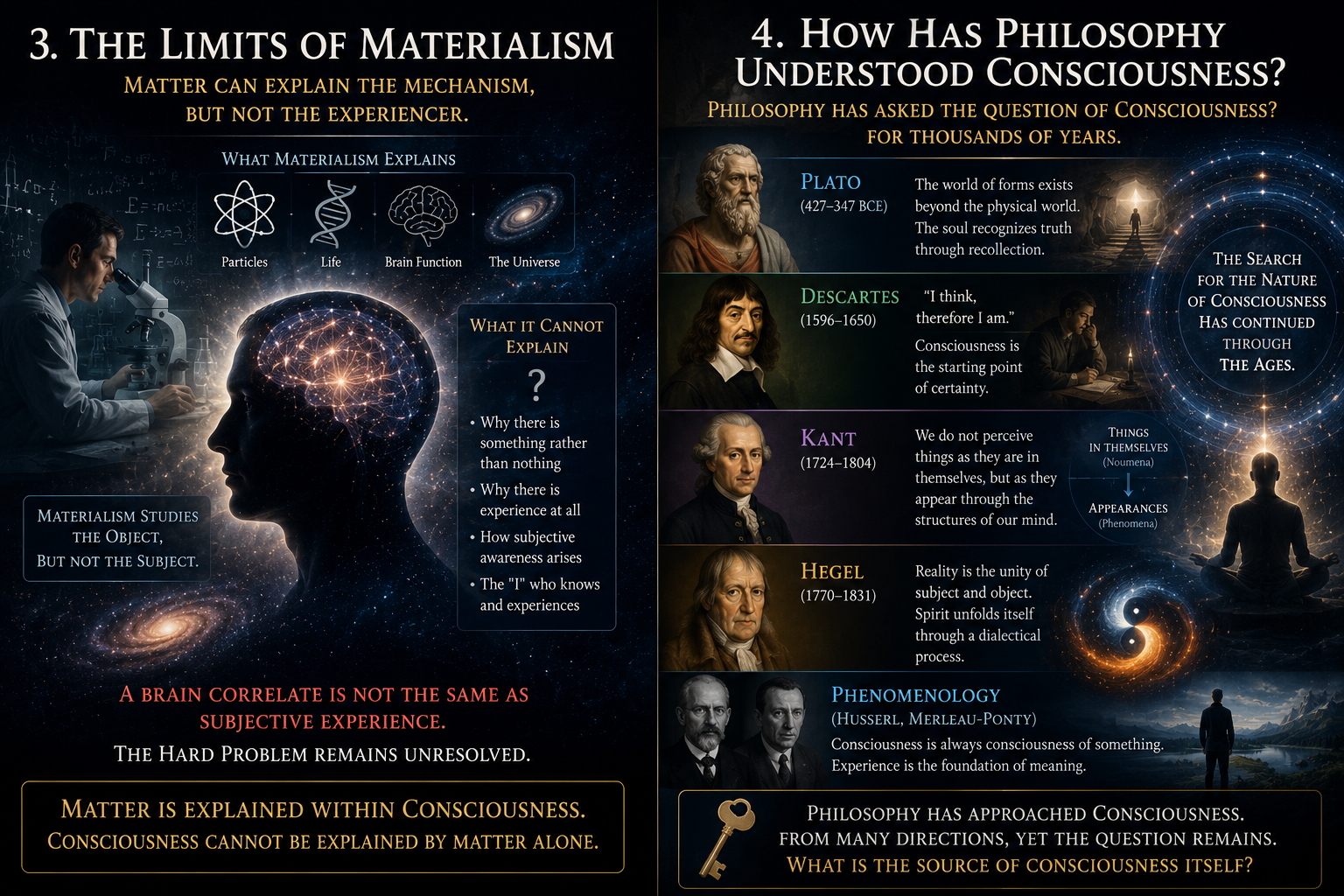
Neuroscience has uncovered countless correlations between brain activity and conscious experience, yet it still cannot explain why physical processes inside the brain give rise to subjective awareness.
This unresolved challenge is widely known as the Hard Problem of Consciousness, one of the central questions in contemporary philosophy of mind.
At this point, philosophy and religion begin to explore a different direction.
Rather than asking how the brain functions, they ask what consciousness fundamentally is.
To understand that search, we must first examine how philosophy has approached consciousness throughout history.
4. How Has Philosophy Understood Consciousness?
Long before neuroscience began examining the brain, philosophy had already begun exploring the mystery of consciousness. For more than two thousand years, philosophers have pursued one of humanity’s most enduring questions:
What is a human being?
Behind this question lies another that is even more fundamental.
What is it that thinks, knows, chooses, and experiences?
Although philosophical traditions have produced different answers, they share a remarkable assumption. Human beings cannot be fully understood by examining the physical body alone. Beneath biological existence lies an inner reality that makes self-awareness, reason, freedom, and the search for truth possible.
This conviction first emerged in ancient Greece.
Socrates turned philosophy inward. Instead of asking how the universe was made, he urged people to examine themselves. His famous exhortation, “Know yourself,” was not merely an ethical instruction. It reflected the belief that the deepest truths about human existence are discovered through conscious self-examination. For Socrates, genuine wisdom begins when consciousness becomes aware of itself.
Plato carried this insight further by distinguishing the changing world of the senses from the eternal world of truth. The human soul, he argued, possesses the unique ability to recognize realities that transcend material existence. Human beings seek justice, beauty, and truth because consciousness is oriented toward something greater than the physical world.
Aristotle offered a different perspective. Rather than separating body and soul into completely independent realities, he understood them as inseparable aspects of one living being. Nevertheless, he also rejected the idea that matter alone could explain human existence. Every living being possesses an inner principle that gives purpose, organization, and meaning to life itself.
Centuries later, philosophy entered a new era.
René Descartes shifted the foundation of knowledge from the external world to conscious awareness itself. His famous declaration, “I think, therefore I am,” established consciousness as the one reality that could not be doubted. Even if every perception proved uncertain, the existence of the conscious self remained undeniable. From that moment, consciousness became one of the central problems of modern philosophy.
Subsequent philosophers expanded this inquiry in different directions.
Immanuel Kant argued that consciousness is not a passive observer but an active participant in shaping human experience. Edmund Husserl made conscious experience itself the primary subject of philosophical investigation, seeking to describe consciousness as it is directly lived. Martin Heidegger moved beyond abstract definitions and explored human existence as an unfolding experience of being in the world.
Across these diverse traditions, philosophy never abandoned its central intuition. Human beings are more than biological organisms. Consciousness cannot be fully explained as a mere byproduct of physical processes. Reason, self-awareness, intentionality, moral responsibility, and the persistent search for meaning all point toward a dimension of existence that transcends material description.
Yet philosophy has never reached a final consensus.
Some identified consciousness with reason. Others emphasized the soul, lived experience, existence, or subjective awareness. Each perspective illuminated an important aspect of human existence, yet none fully answered the ultimate question:
Where does consciousness itself originate?
The Great Consciousness Field Theory acknowledges the profound insights of these philosophical traditions while proposing a broader framework. Rather than viewing them as competing explanations, it understands them as different attempts to approach the same fundamental reality. Each philosopher observed part of the landscape, but no single perspective revealed the entire horizon.
If philosophy has shown us anything, it is that consciousness cannot easily be reduced to matter alone.
The next question therefore becomes inevitable.
How have the world’s religions understood consciousness?
5. How Have the World’s Religions Understood Consciousness?
While philosophy sought to understand consciousness through reason and reflection, religion approached the same mystery through spiritual experience. Across civilizations separated by geography, language, and history, the world’s great religious traditions arrived at a remarkably similar conviction: human beings are more than physical bodies.
Although their teachings differ, they all recognize an inner reality that transcends material existence.
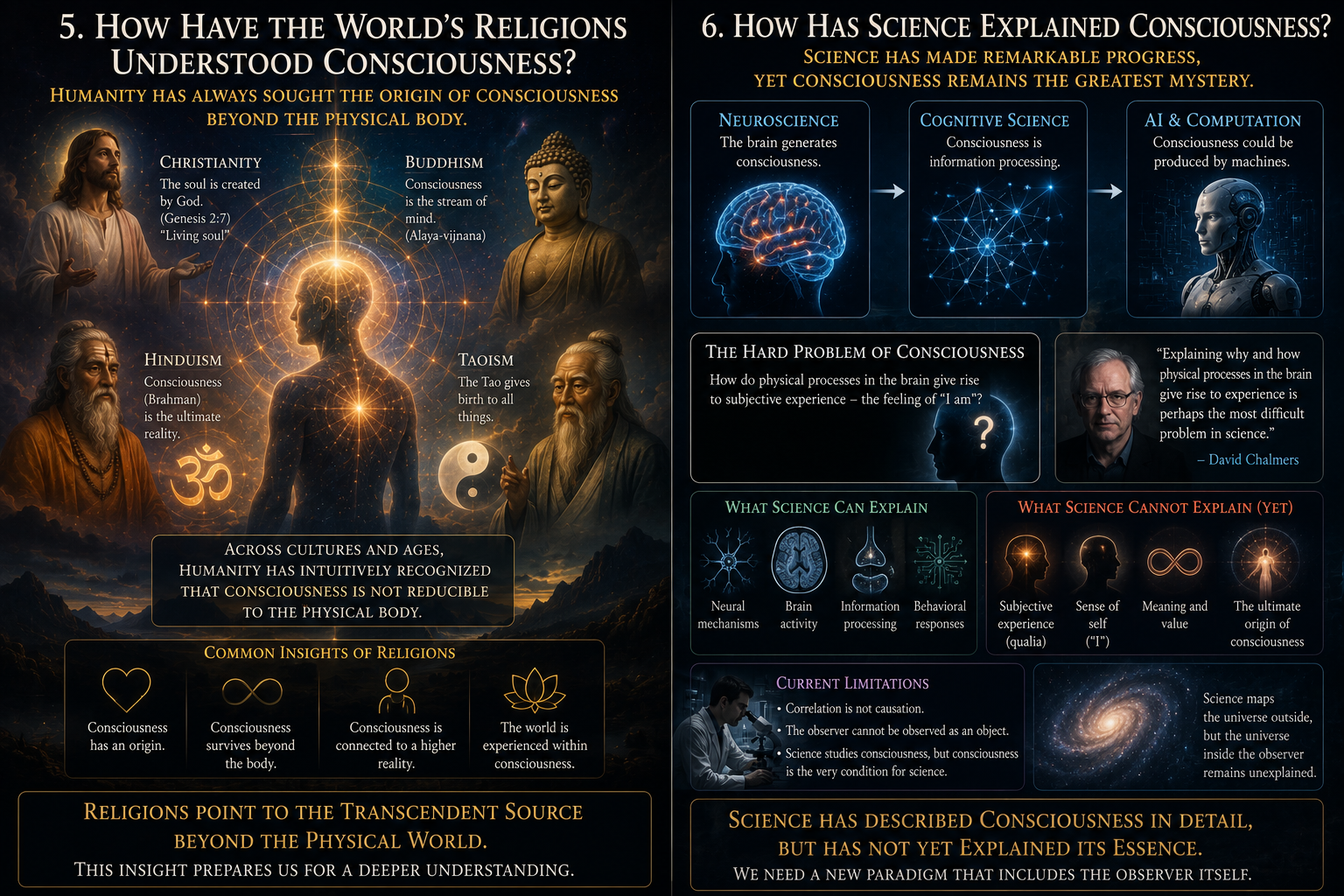
In the Judeo-Christian tradition, human beings are described as being created in the image of God. This teaching does not merely refer to physical appearance, but to the unique capacity for self-awareness, moral judgment, creativity, and the ability to enter into a relationship with the Divine. The human soul is regarded as the spiritual essence of the person, capable of recognizing truth, choosing between good and evil, and seeking eternal life.
Buddhism approaches consciousness from a different perspective. Rather than focusing on an eternal creator, it examines the nature of the mind itself. Human suffering arises from ignorance, attachment, and illusion, while liberation is achieved through awakening. Consciousness is purified as false perceptions disappear, allowing one to experience reality directly. Enlightenment is therefore not the acquisition of something new, but the removal of what obscures true awareness.
Hindu philosophy presents yet another profound vision. It teaches that the deepest self, the Atman, is ultimately united with Brahman, the infinite and universal reality. Individual consciousness is understood as an expression of a greater cosmic consciousness. Spiritual growth is the gradual realization that the apparent separation between the individual and the universal is an illusion.
Islam likewise affirms that human beings possess a spiritual nature bestowed by God. Human life is not merely biological existence but a moral and spiritual journey. Consciousness enables individuals to recognize truth, exercise free will, and accept responsibility before their Creator. Through faith, remembrance, and righteous living, human consciousness becomes aligned with divine guidance.
Many other religious and spiritual traditions express similar ideas in different forms. Whether they speak of spirit, soul, Buddha-nature, divine breath, or sacred life, they consistently affirm that something within the human being transcends the physical body. The vocabulary changes from one culture to another, but the underlying intuition remains remarkably consistent.
Despite their theological differences, these traditions converge on several essential insights. They agree that consciousness is not merely a product of matter, that human life possesses a spiritual dimension, and that genuine transformation begins within. They also recognize that consciousness can develop, mature, and become more fully aligned with truth through moral growth, spiritual practice, or enlightenment.
Yet religion, like philosophy, leaves an important question unanswered.
It describes how consciousness can be transformed, but it does not fully explain where consciousness itself originates. It teaches humanity’s relationship with ultimate reality, but offers different interpretations of the nature of that reality.
These differences have inspired centuries of faith, devotion, and profound spiritual insight. At the same time, they reveal that the fundamental origin of consciousness remains an open question.
If philosophy explored consciousness through reason and religion experienced it through faith, modern science has attempted to investigate it through observation and experimentation.
Can science explain consciousness as a product of the brain, or does consciousness point beyond the physical universe itself?
6. How Has Science Explained Consciousness?
The scientific revolution fundamentally transformed humanity’s understanding of the universe. Through observation, experimentation, and mathematical analysis, science uncovered the laws governing motion, matter, energy, life, and the cosmos. Phenomena once attributed to mystery or divine intervention gradually became understandable through natural laws.
As science achieved extraordinary success in explaining the physical world, it was natural to assume that consciousness would eventually yield to the same methods of investigation.
The human brain therefore became the central object of scientific inquiry.
Over the past century, neuroscience has revealed an astonishing amount about the structure and function of the brain. Billions of interconnected neurons communicate through intricate electrical and chemical signals, forming networks responsible for perception, memory, language, emotion, learning, and decision-making.
Advances in technologies such as electroencephalography (EEG), functional magnetic resonance imaging (fMRI), and positron emission tomography (PET) have enabled researchers to observe brain activity with remarkable precision. Scientists can identify which regions of the brain become active while a person recognizes a face, recalls a memory, solves a mathematical problem, or experiences fear and joy.
These discoveries have transformed our understanding of the relationship between the brain and behavior.
Damage to specific brain regions can alter personality, impair memory, disrupt language, or even change an individual’s sense of self. Such findings demonstrate beyond reasonable doubt that consciousness and the brain are intimately connected.
Yet connection is not the same as explanation.
Neuroscience has become increasingly successful at describing how the brain functions, but explaining how conscious experience itself comes into existence remains an entirely different challenge.
A brain scan can reveal which neurons become active when a person looks at a sunset.
It cannot explain why that person experiences beauty.
Electrical activity can be measured with extraordinary accuracy.
The subjective experience of color, sound, love, sorrow, or hope cannot.
Science can observe the mechanisms that accompany consciousness, but the inner reality of conscious experience itself remains inaccessible to objective measurement.
This distinction has become one of the central questions in contemporary philosophy of mind.
David Chalmers famously called it the Hard Problem of Consciousness. Scientific research has made remarkable progress in explaining cognitive functions such as perception, memory, attention, and decision-making. These are often described as the “easy problems” because they concern processes that can, at least in principle, be analyzed objectively.
The truly difficult question is different.
Why should any physical process produce subjective experience at all?
Why should billions of neurons exchanging electrical signals give rise to the feeling of seeing red, hearing music, falling in love, or contemplating one’s own existence?
No accepted scientific theory has yet provided a definitive answer.
As researchers have attempted to solve this mystery, several influential theories have emerged.
Some propose that consciousness arises as an emergent property of sufficiently complex neural systems. Others argue that consciousness depends upon the degree to which information is integrated within the brain. Still others suggest that the brain continuously constructs predictive models of reality, with consciousness emerging from this ongoing process. More speculative approaches even explore the possible role of quantum phenomena in conscious awareness.
Although these theories differ significantly, they share one fundamental assumption.
They all begin with matter.
Consciousness is regarded as something produced by physical systems once those systems achieve sufficient complexity.
This assumption has guided modern consciousness research for decades and has generated valuable scientific discoveries. Yet it also raises profound philosophical questions that remain unresolved.
If consciousness is nothing more than a product of neural activity, why does subjective experience exist at all rather than mere information processing?
How do countless independent neurons generate the unified awareness experienced by a single individual?
How can physical processes alone account for self-awareness, moral responsibility, creativity, or humanity’s persistent search for meaning and purpose?
These questions suggest that the relationship between the brain and consciousness may be more complex than a simple cause-and-effect relationship.
The brain is unquestionably essential for human consciousness as we experience it in this life.
However, necessity does not necessarily imply origin.
A telescope is necessary for observing distant galaxies, yet it does not create the stars it reveals. Likewise, a radio receives and organizes electromagnetic signals without producing the broadcast itself.
The brain may perform a similar role.
Rather than generating consciousness from matter, it may receive, organize, and express a more fundamental reality that already exists.
This possibility requires a profound shift in perspective.
Instead of asking how matter produces consciousness, we may ask whether consciousness itself is one of the fundamental features of reality from which both mind and matter emerge.
Such a proposal does not reject science. On the contrary, it accepts the achievements of neuroscience while questioning the philosophical assumption that matter must always come first.
Scientific discovery has revealed extraordinary details about the mechanisms through which consciousness operates.
It has not yet explained why consciousness exists in the first place.
If the origin of consciousness cannot be fully understood by examining the brain alone, then the search must move beyond the limits of conventional materialism.
This is where the Great Consciousness Field Theory offers a new perspective.
Rather than treating consciousness as a byproduct of matter, it proposes that consciousness is a universal field underlying reality itself. The brain does not create consciousness from nothing. Instead, it functions as the biological medium through which individual consciousness participates in a greater, universal Consciousness Field.
To understand this perspective, we must first examine the nature of the Great Consciousness Field.
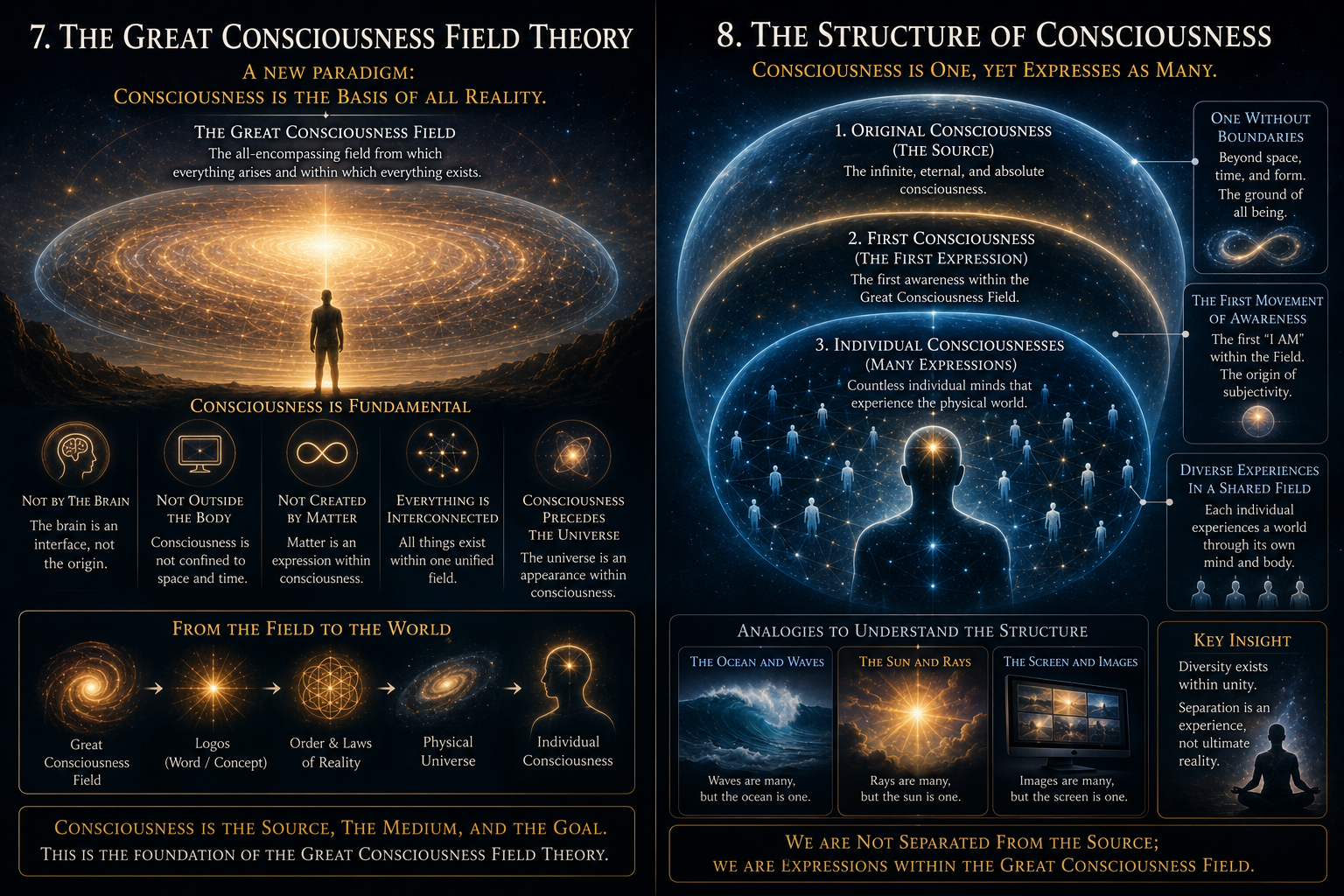
7. The Great Consciousness Field
After centuries of philosophical inquiry, thousands of years of religious reflection, and decades of scientific investigation, one fundamental question still remains unanswered:
Where does consciousness originate?
Philosophy has explored the nature of consciousness through reason. Religion has experienced consciousness through spiritual insight. Science has investigated consciousness through the study of the brain. Each approach has revealed important truths, yet none has fully explained the ultimate source of consciousness itself.
The Great Consciousness Field Theory begins with a different premise.
Instead of asking how consciousness emerges from matter, it asks whether consciousness is more fundamental than matter itself.
This seemingly simple shift transforms the entire framework through which consciousness is understood.
According to the Great Consciousness Field Theory, consciousness is not a product of the brain, nor is it merely an accidental consequence of biological evolution. It is a universal field that exists prior to, and independently of, every individual mind.
Just as all physical objects exist within gravitational and electromagnetic fields, every living being exists within a universal field of consciousness.
This field is called the Great Consciousness Field.
The Great Consciousness Field is not a physical substance that occupies space like ordinary matter. Nor is it a supernatural force that exists outside reality.
Rather, it is the fundamental ground from which conscious existence becomes possible.
Matter provides the structure of life.
The Great Consciousness Field provides the possibility of awareness.
Within this framework, the human brain performs a remarkable function. It does not manufacture consciousness from nothing. Instead, it receives, organizes, expresses, and individualizes consciousness through the biological structure of the human body.
The relationship between the brain and consciousness is therefore similar to that between a musical instrument and music.
A violin does not create the existence of music itself. It allows music to be expressed in a particular form.
Likewise, the brain allows universal consciousness to be expressed as an individual human mind.
Each person experiences consciousness as uniquely personal because each brain interprets and expresses the Great Consciousness Field through its own biological structure, memories, emotions, experiences, and personality.
The field itself is universal.
Its expression is individual.
This distinction explains why human beings possess both individuality and a profound sense of connection with others.
We experience ourselves as separate persons, yet we also recognize truth, beauty, compassion, and love in ways that often transcend individual self-interest.
Such experiences suggest that consciousness is not completely isolated within each individual but participates in a reality greater than itself.
The Great Consciousness Field Theory does not deny the discoveries of neuroscience.
On the contrary, it accepts that every conscious experience is closely associated with brain activity.
However, correlation should not be confused with origin.
A change in the receiver affects the broadcast we hear, but it does not prove that the receiver created the broadcast.
Likewise, changes in the brain influence the expression of consciousness without necessarily explaining its ultimate source.
This perspective also offers a new way of understanding the long-standing dialogue between philosophy, religion, and science.
Philosophy recognized that consciousness could not be reduced to matter.
Religion experienced consciousness as humanity’s connection with a transcendent reality.
Science revealed the extraordinary biological mechanisms through which consciousness is expressed.
Rather than contradicting one another, these perspectives may represent different observations of the same underlying reality viewed from different directions.
If consciousness is indeed a universal field, then many questions that have remained unresolved begin to take on new meaning.
Why does self-awareness exist?
Why do human beings possess an innate moral sense?
Why do people across cultures seek truth, beauty, love, and purpose?
Why has the search for ultimate reality appeared throughout every civilization?
The Great Consciousness Field Theory proposes that these are not accidental products of evolution alone.
They are natural expressions of humanity’s participation in the Great Consciousness Field.
Understanding consciousness in this way changes not only how we understand the mind, but also how we understand life itself.
Human beings are not isolated biological accidents struggling to create meaning within an indifferent universe.
They are conscious participants in a reality whose deepest foundation is consciousness itself.
This new perspective raises an important question.
If every human being participates in the same Great Consciousness Field, why do individuals think, choose, and live so differently?
To answer that question, we must examine how the Great Consciousness Field interacts with human life and gives rise to the diverse expressions of human consciousness.
8. The Great Consciousness Field and Human Life
If the Great Consciousness Field is the universal source of consciousness, then human life cannot be understood as a purely biological phenomenon.
Every individual is born with the capacity to participate in this universal field. Yet no two people express consciousness in exactly the same way. Human beings differ in personality, values, emotions, intelligence, creativity, and moral character. These differences do not arise because each person possesses a different consciousness, but because each individual expresses the same universal consciousness through a unique life.
The Great Consciousness Field Theory distinguishes between the universal source of consciousness and its individual expression.
The source is one.
Its expressions are many.
Just as sunlight passes through stained glass windows of different colors, the same universal consciousness is expressed differently through each human being. Our genetic inheritance, family environment, education, culture, experiences, and personal choices all influence how consciousness is manifested in daily life.
This understanding helps explain one of humanity’s oldest questions.
If all human beings possess consciousness, why do some become compassionate while others become cruel?
Why do some dedicate their lives to truth, while others embrace deception?
The answer does not lie in the origin of consciousness itself.
It lies in the condition through which consciousness is expressed.
The Great Consciousness Field remains constant.
Human consciousness, however, develops through experience and choice.
Every decision strengthens certain patterns of thought, emotion, and behavior. Over time, these patterns shape character, influence judgment, and determine how clearly an individual expresses the deeper qualities of consciousness.
From this perspective, moral growth is not simply obedience to external rules.
It is the gradual alignment of individual consciousness with the universal principles embodied in the Great Consciousness Field.
Qualities such as honesty, compassion, justice, humility, responsibility, and love are not merely social conventions. They represent increasingly harmonious expressions of consciousness itself.
Likewise, hatred, greed, violence, dishonesty, and selfishness are not evidence that consciousness has disappeared. Rather, they reflect forms of consciousness that have become distorted by fear, ignorance, excessive attachment, or the pursuit of self-interest at the expense of others.
Human history can therefore be understood as the history of consciousness expressing itself under different conditions.
Civilizations rise as consciousness expands through knowledge, cooperation, creativity, and ethical responsibility. They decline when fear, division, and the abuse of power obscure humanity’s deeper nature.
This perspective also reshapes our understanding of education.
Education should not merely transmit information or develop technical skills. Its highest purpose is to cultivate consciousness itself. Knowledge becomes truly meaningful only when it contributes to wisdom, moral maturity, and a deeper understanding of human existence.
The same principle applies to science, politics, economics, and culture.
These institutions achieve their greatest value when they support the growth of human consciousness rather than merely increasing material power or economic prosperity.
From the perspective of the Great Consciousness Field Theory, the ultimate measure of human progress is not technological advancement alone.
It is the evolution of consciousness.
A society may become wealthier, more powerful, and more technologically advanced, yet still decline if its consciousness becomes increasingly fragmented by hatred, greed, or the loss of moral responsibility.
True progress occurs when both knowledge and consciousness develop together.
This understanding leads to an even deeper question.
If humanity has always participated in the Great Consciousness Field, why has its true nature remained hidden for so long?
To answer this question, we must examine why human civilization has repeatedly misunderstood the nature of consciousness itself.
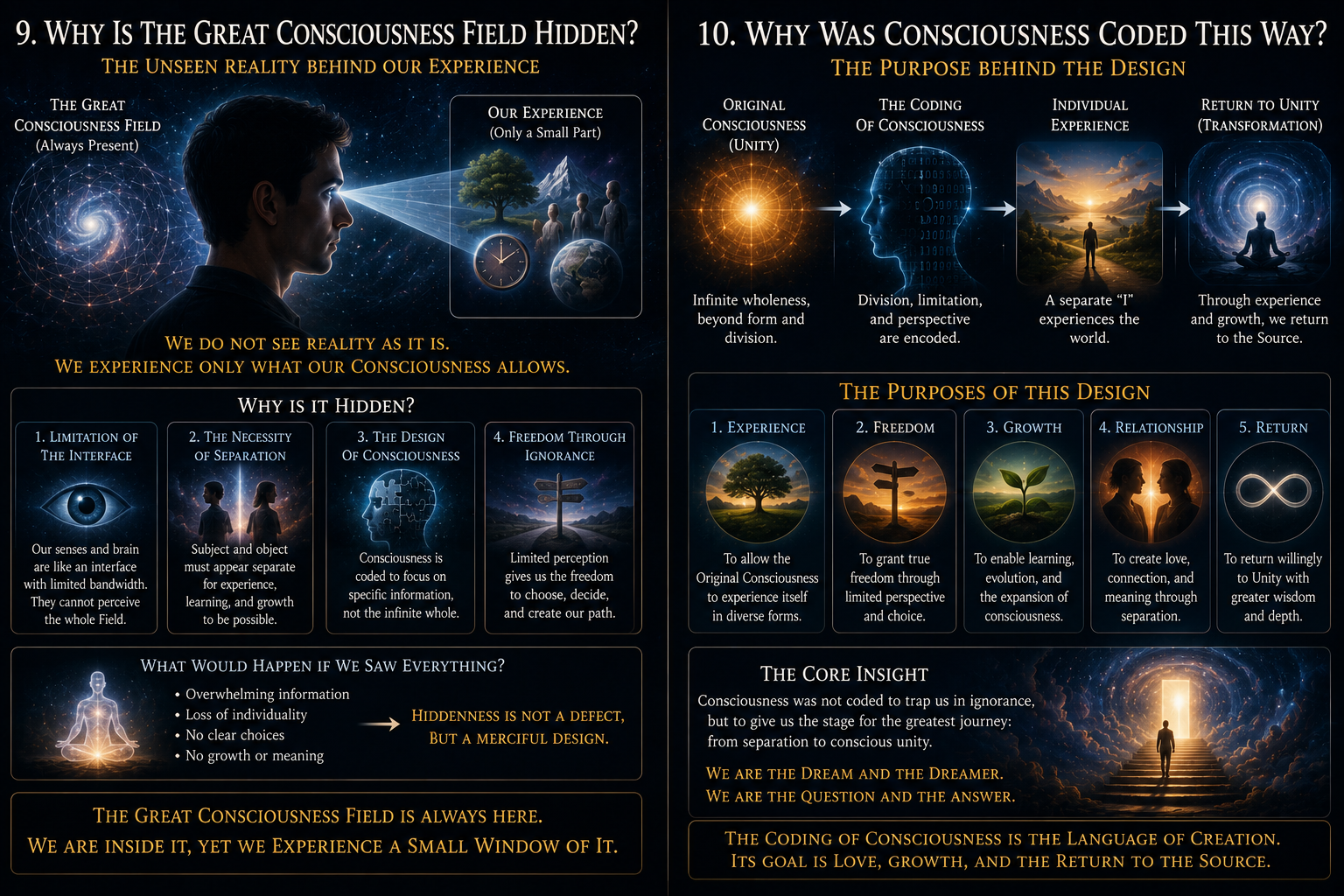
9. Why Is the Great Consciousness Field Hidden?
One of the greatest mysteries of human existence is not that consciousness exists, but that its true nature has remained hidden throughout history.
If the Great Consciousness Field is the foundation of reality, why has humanity never recognized it?
The answer proposed by the Great Consciousness Field Theory is both simple and profound.
Human beings experience reality through a structure of consciousness that has been intentionally organized to perceive the world in a particular way.
This structure may be described as the coding of consciousness.
According to modern science, the physical universe is composed of atoms and the interactions between them. This description is fundamentally correct. Matter, energy, space, and time constitute the physical structure of the universe.
Yet the Great Consciousness Field Theory proposes that this physical universe is not the ultimate layer of reality.
Just as a painting cannot exist without the canvas that supports it, the universe cannot exist without a more fundamental ground upon which the physical world appears.
That ground is the Great Consciousness Field.
The physical universe exists within this Field, not outside it.
The Great Consciousness Field contains both the subject and the object.
The observer and the observed are not two independent realities. They are two modes of existence within the same Field of Consciousness.
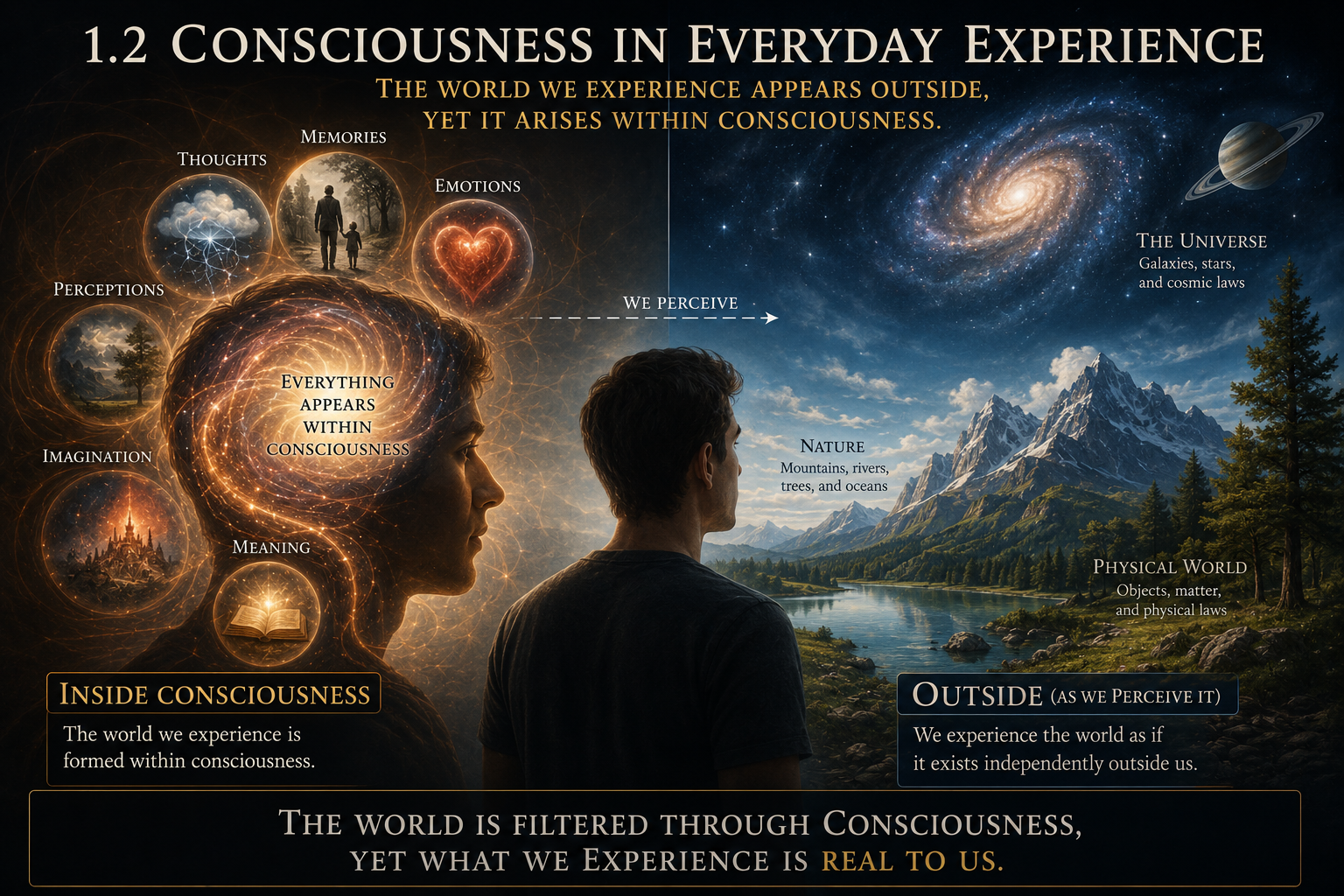
From this perspective, the apparent separation between subject and object is not an ultimate feature of reality. It is the result of the way human consciousness has been structured to experience the world.
Human consciousness is therefore not a container inside the brain observing an external universe.
Rather, individual consciousness participates in a greater Field within which the universe itself already exists.
This explains a question that has puzzled philosophers for centuries.
How can the immense universe appear within the awareness of a single human being?
When we gaze at the night sky, galaxies, mountains, oceans, and entire worlds are present in our experience. If consciousness were merely a product of neural activity confined within the brain, it would be difficult to explain how such vast realities become immediately present within conscious awareness.
The Great Consciousness Field Theory offers a different explanation.
The universe does not enter consciousness from outside.
Both the universe and individual consciousness already exist within the same Great Consciousness Field.
Human awareness is therefore not looking out toward an independent reality.
It is participating in a reality that is already present within the universal Field of Consciousness.
Why, then, do we experience the physical world as existing outside ourselves?
The answer lies in the coding of consciousness.
Human beings are structured to perceive themselves as subjects confronting an external world of objects.
This mode of perception makes ordinary life possible.
We do not feel the Earth rotating at tremendous speed beneath our feet. Nor do we sense the Earth orbiting the Sun or the galaxy moving through space. These motions are real, yet our conscious experience filters them because perceiving them directly would make stable human life impossible.
In a similar way, consciousness does not directly reveal the Great Consciousness Field.
Instead, it presents reality as a world of separate objects existing outside the individual.
This separation is not necessarily the ultimate nature of reality.
It is the mode through which reality becomes livable.
Seen in this light, the long-standing philosophical conflict between subject and object takes on a new meaning.
They are not opposing principles that must somehow be reconciled.
They have never been fundamentally separate.
Both have always existed within the Great Consciousness Field.
The apparent division between the observer and the observed is a condition of human perception rather than the deepest structure of existence.
Perhaps this has been one of the greatest hidden principles of creation.
If so, the Great Consciousness Field is not merely another philosophical concept.
It is the invisible foundation upon which both consciousness and the physical universe arise together.
10. Why Was the Universe Created Through Consciousness?
Human beings naturally assume that the material world is the foundation of reality.
Everything we build appears to require physical materials. Houses require stone and wood. Machines require metal. Cities require concrete, glass, and steel.
From everyday experience, it seems obvious that creation always begins with matter.
Yet this assumption becomes increasingly difficult to maintain when we consider the universe as a whole.
If the universe itself is made of matter, where did the material for the universe come from?
Every physical explanation presupposes the existence of something already physical. Matter may transform into energy, and energy may transform into matter, but neither explains the ultimate origin of existence.
The question therefore remains.
What was the material of creation before matter existed?
The Great Consciousness Field Theory proposes a fundamentally different answer.
The primary material of creation was not matter.
It was Consciousness expressed through Logos.
A concept requires no physical substance.
An idea possesses no weight, no mass, and no spatial dimension. Yet ideas have the power to organize reality.
Every human creation begins this way.
Before a building exists, it exists as a design.
Before a symphony is heard, it exists as a composition.
Before a civilization is built, it exists as an idea.
The physical object is always preceded by a conceptual reality.
The same principle, according to the Great Consciousness Field Theory, applies to the universe itself.
The universe did not begin as assembled matter.
It first existed as Logos within the Original Consciousness.
The Great Consciousness Field became the medium through which that Logos appeared as an ordered physical universe.
Matter was therefore not the source of creation.
Matter was the expression of a deeper order already present within Consciousness.
This also explains why the human mind can perceive the universe.
Human consciousness is not encountering something fundamentally foreign.
Both the universe and individual consciousness arise within the same Great Consciousness Field.
For this reason, the human mind can recognize mathematical order, beauty, truth, and meaning in the cosmos.
Consciousness recognizes the universe because both share the same origin.
If this is true, then creation was never the construction of a material universe from physical substances.
It was the manifestation of Consciousness through Logos into an ordered world that could be experienced as physical reality.
Before You Read
Watch the documentary first.
Watch this 2-minute introduction first.
It presents the core idea of this chapter.
Running Time: 2 min
▶ Watch on YouTube:
Consciousness Through Logos (2 min)
It provides the visual and philosophical foundation
for the chapter that follows.
Running Time: 8 min
Featured Documentary
How can consciousness and the external world ever meet?
For centuries, philosophers have struggled to explain how consciousness and the external world become a single experience.
This documentary presents a new philosophical perspective through the Great Consciousness Field Theory.
Duration: 20 minutes