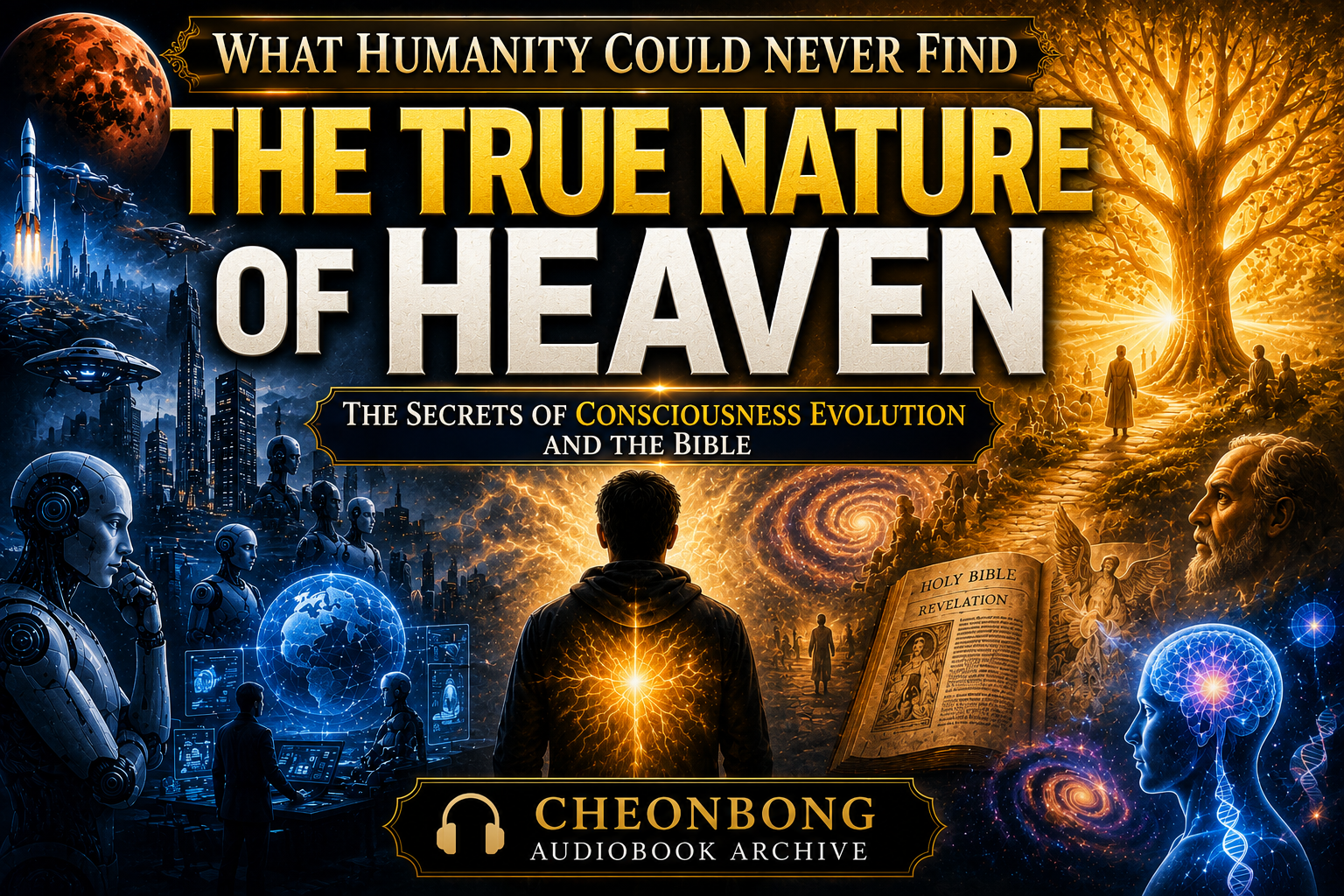

The True Identity of Heaven Series
Part 1
Is Heaven a Place After Death? Or Something That Begins Within You?
Part 1: The Problem Nobody Talks About
If there is one subject that stands at the center of Christianity, it is heaven.
People pray because of heaven.
People worship because of heaven.
People endure hardship because of heaven.
And for many believers, the ultimate goal of faith is to enter heaven after death.
Yet a strange problem appears the moment we ask a simple question:
What exactly is heaven?
Surprisingly, the answers are often completely different.
Ask ten pastors and you may receive ten different explanations.
Some describe heaven as a physical place beyond the clouds.
Others describe it as a magnificent city made of gold and precious stones.
Some say heaven is simply a state of peace.
Others insist that heaven already exists within us.
The contradiction is difficult to ignore.
If heaven is the final destination of Christian faith, why is there so little agreement about what heaven actually is?
Imagine preparing for a journey your entire life while receiving different maps from every guide you meet.
One tells you to travel north.
Another tells you to travel east.
A third says the destination is not a location at all.
At some point, a reasonable person must stop and ask:
Have we misunderstood the destination itself?
Perhaps the confusion surrounding heaven is not caused by a lack of faith.
Perhaps it is caused by a misunderstanding of the language the Bible uses to describe it.
To answer that question, we must return to the words of Jesus Himself.
What Did Jesus Mean by the Kingdom of Heaven?
The phrase “Kingdom of Heaven” appears throughout the Gospels.
At first glance, the meaning seems obvious.
A kingdom is a place.
Heaven is above.
Therefore, heaven must be a place above the earth.
Simple.
Or so it seems.
Then Jesus makes a statement that completely disrupts this assumption.
In Luke 17:21 He declares:
“The Kingdom of God is within you.”
This creates an immediate problem.
How can a physical destination be “within” someone?
How can a location exist inside a human being?
Either Jesus was speaking symbolically, or our understanding of heaven is incomplete.
The deeper we examine the teachings of Jesus, the more evidence we find that the Kingdom of Heaven is not merely a future location waiting beyond death.
Instead, it appears to describe a spiritual reality that begins within human beings themselves.
This interpretation becomes even more interesting when we examine how Jesus actually taught about heaven.
Jesus Rarely Explained Heaven Directly
Modern readers often assume that Jesus clearly defined heaven.
In reality, He did the opposite.
When discussing the Kingdom of Heaven, Jesus repeatedly used parables.
Stories.
Symbols.
Metaphors.
Hidden language.
In Matthew 13:11, Jesus tells His disciples:
“The knowledge of the mysteries of the Kingdom of Heaven has been given to you.”
Notice the word:
Mysteries.
Jesus did not say the Kingdom of Heaven was obvious.
He said it was a mystery.
Something hidden.
Something concealed beneath the surface.
This idea is reinforced by Psalm 78:
“I will open my mouth in parables; I will utter things hidden since the foundation of the world.”
According to the biblical narrative, hidden truths were deliberately embedded within symbolic language from the beginning.
If that is true, then heaven may not be understood simply by reading words literally.
We may need to understand the symbols first.
And one of the most important symbols Jesus ever used is surprisingly small.
A mustard seed.
Why Did Jesus Compare Heaven to a Mustard Seed?
Among all the images Jesus could have chosen, He selected one that seems almost absurd.
A mustard seed.
In Matthew 13:31-32, Jesus says:
“The Kingdom of Heaven is like a mustard seed.”
At first glance, this comparison makes little sense.
How can heaven be a seed?
A seed is not a city.
A seed is not a destination.
A seed is not a place where souls go after death.
Yet Jesus insists that heaven is like a seed.
Then He explains further.
The seed is planted.
It grows.
It becomes a plant.
Eventually it becomes a great tree.
And finally, the birds come and rest in its branches.
Jesus calls this entire process the Kingdom of Heaven.
The obvious question becomes:
What does the seed represent?
Fortunately, the Bible provides its own answer.

The Seed Is the Word of God
In Luke 8:11, Jesus explains another parable:
“The seed is the Word of God.”
Suddenly the picture becomes clearer.
The seed represents divine truth.
The Word of God.
A message.
A spiritual principle.
Something that can be planted within a human being.
Notice where seeds are planted.
Not in the sky.
Not in heaven.
But in soil.
And in biblical symbolism, the soil often represents the human heart.
This means the Kingdom of Heaven begins when the Word of God is planted within a person.
At first, the seed is small.
Almost invisible.
But it grows.
And as it grows, something remarkable happens.
The person begins to change.
The transformation has begun.
The Kingdom is no longer merely something outside the individual.
It has become something developing within.
To Be Continued…
Part 2: Why the Tree Represents a Human Being, the Meaning of the Birds, and How Jesus Himself Became the Living Example of Heaven.